热门文档
- 2025-04-21 11:02:12 2025年中国宠物行业白皮书
- 2024-11-17 13:23:03 Mckinsey:2024中国消费趋势调研
- 2025-06-17 17:31:50 2024中国医疗器械行业发展报告
- 2024-07-31 22:30:59 城市飞行营地总体规划及主题体验区概念设计规划案
- 2025-10-14 11:53:22 中国微短剧精品化发展研究报告(2025)-新京智库
- 2025-03-07 11:57:25 【剧星传媒】《哪吒2》资源推荐0205
- 2024-12-23 13:57:51 哩哔哩《灵笼2》招商方案
- 2025-01-16 15:13:48 2025年全新品牌屋框架模型
- 2024-10-13 08:47:52 联合国:2024世界投资报告
- 2024-05-19 21:59:54 2024小红书餐饮行业方法论
- 2025-05-13 10:34:19 中国茶叶品牌发展报告(2024)会
- 2025-06-10 15:18:07 2025年秋冬淘宝服饰白皮书-篆商业智库

1、本文档共计 22 页,下载后文档不带水印,支持完整阅读内容或进行编辑。
2、当您付费下载文档后,您只拥有了使用权限,并不意味着购买了版权,文档只能用于自身使用,不得用于其他商业用途(如 [转卖]进行直接盈利或[编辑后售卖]进行间接盈利)。
3、本站所有内容均由合作方或网友上传,本站不对文档的完整性、权威性及其观点立场正确性做任何保证或承诺!文档内容仅供研究参考,付费前请自行鉴别。
4、如文档内容存在违规,或者侵犯商业秘密、侵犯著作权等,请点击“违规举报”。
2、当您付费下载文档后,您只拥有了使用权限,并不意味着购买了版权,文档只能用于自身使用,不得用于其他商业用途(如 [转卖]进行直接盈利或[编辑后售卖]进行间接盈利)。
3、本站所有内容均由合作方或网友上传,本站不对文档的完整性、权威性及其观点立场正确性做任何保证或承诺!文档内容仅供研究参考,付费前请自行鉴别。
4、如文档内容存在违规,或者侵犯商业秘密、侵犯著作权等,请点击“违规举报”。
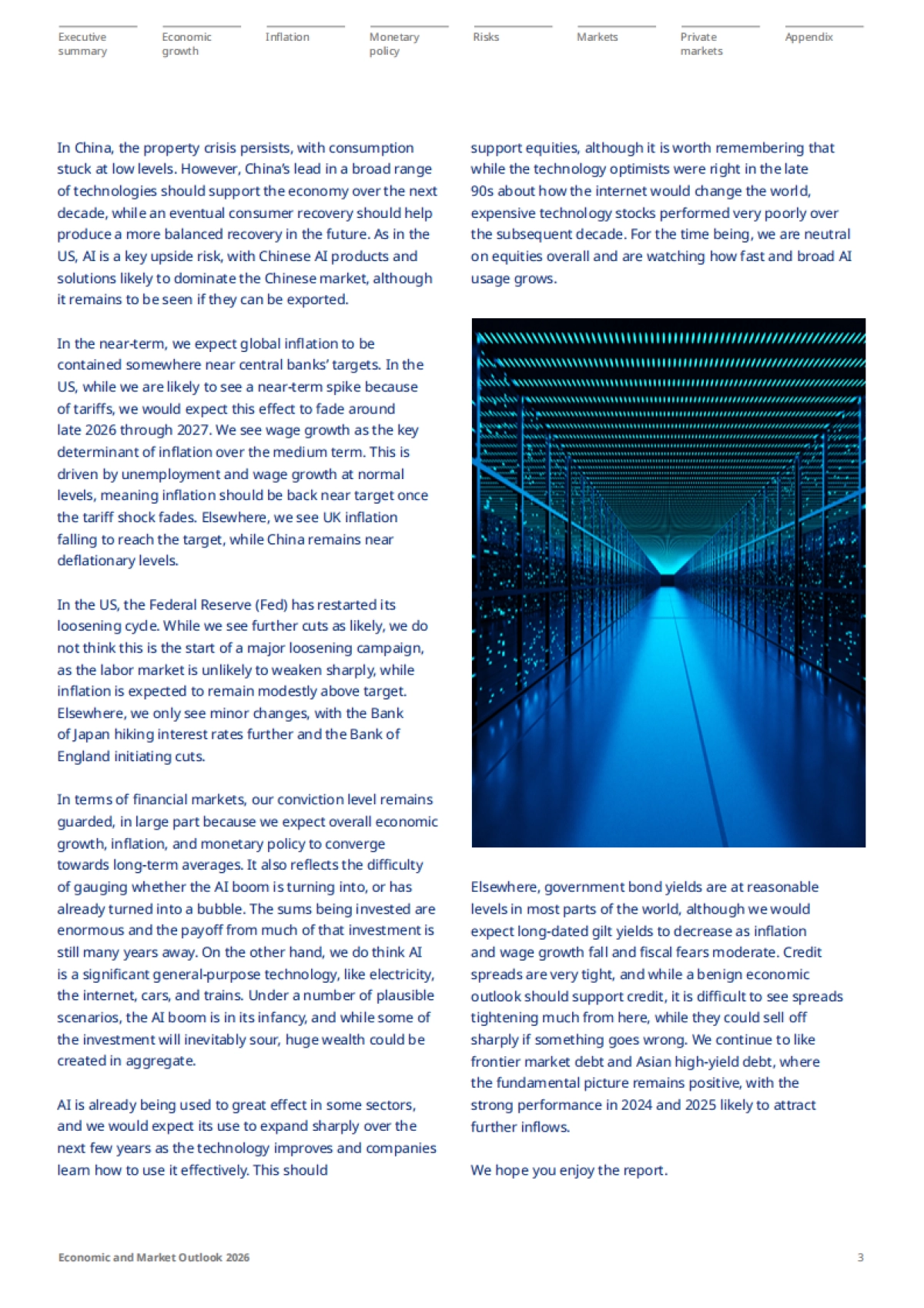
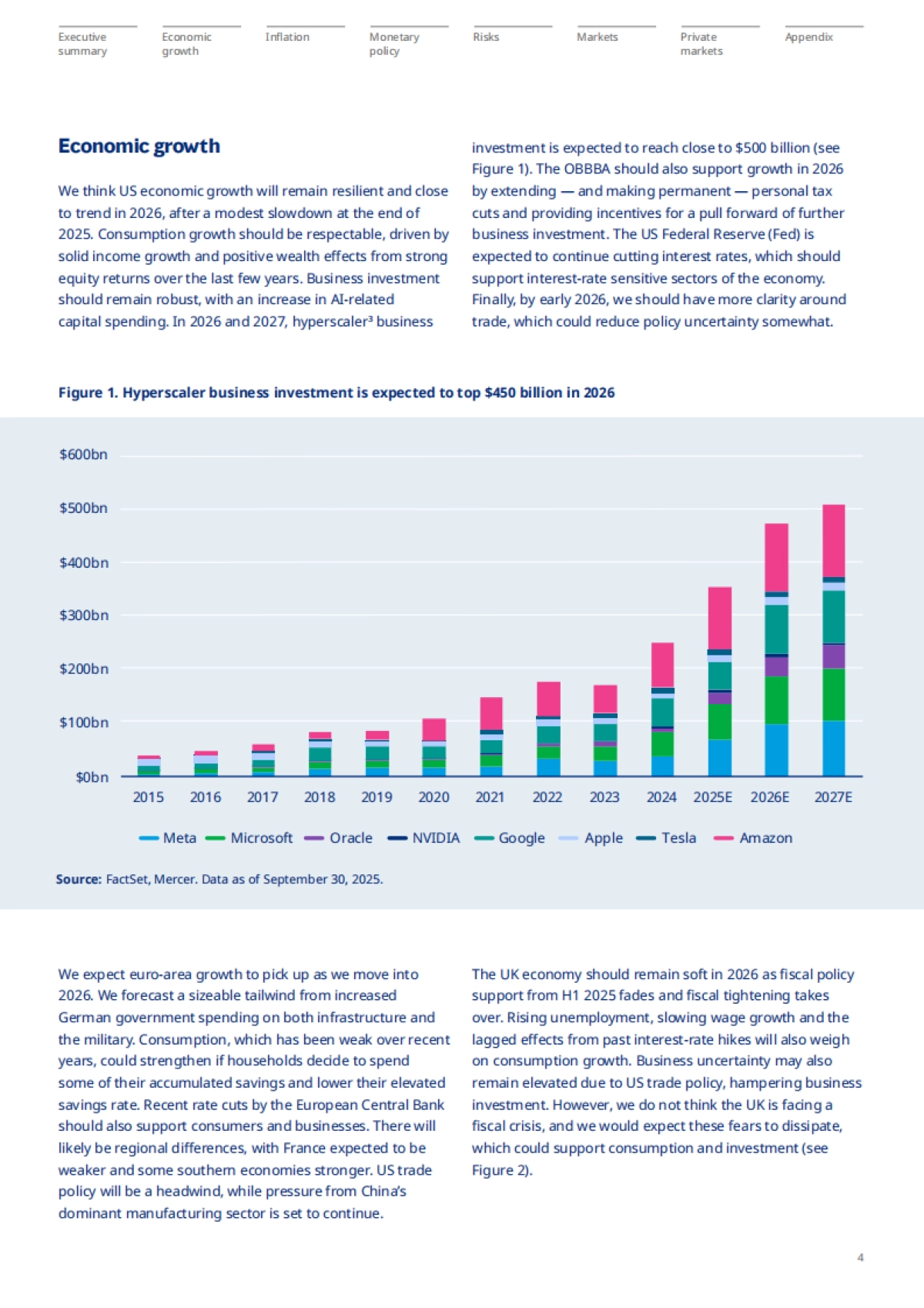
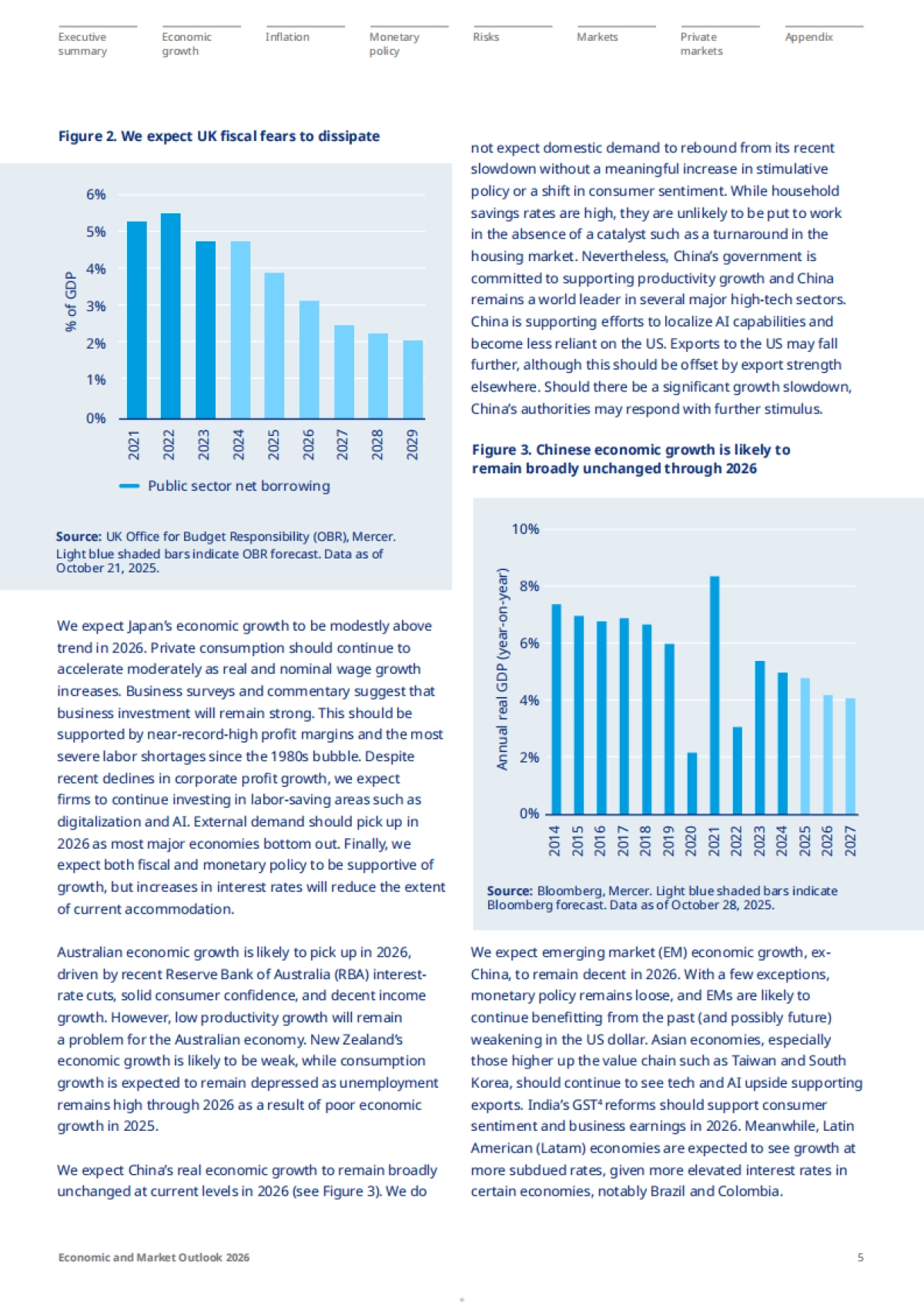
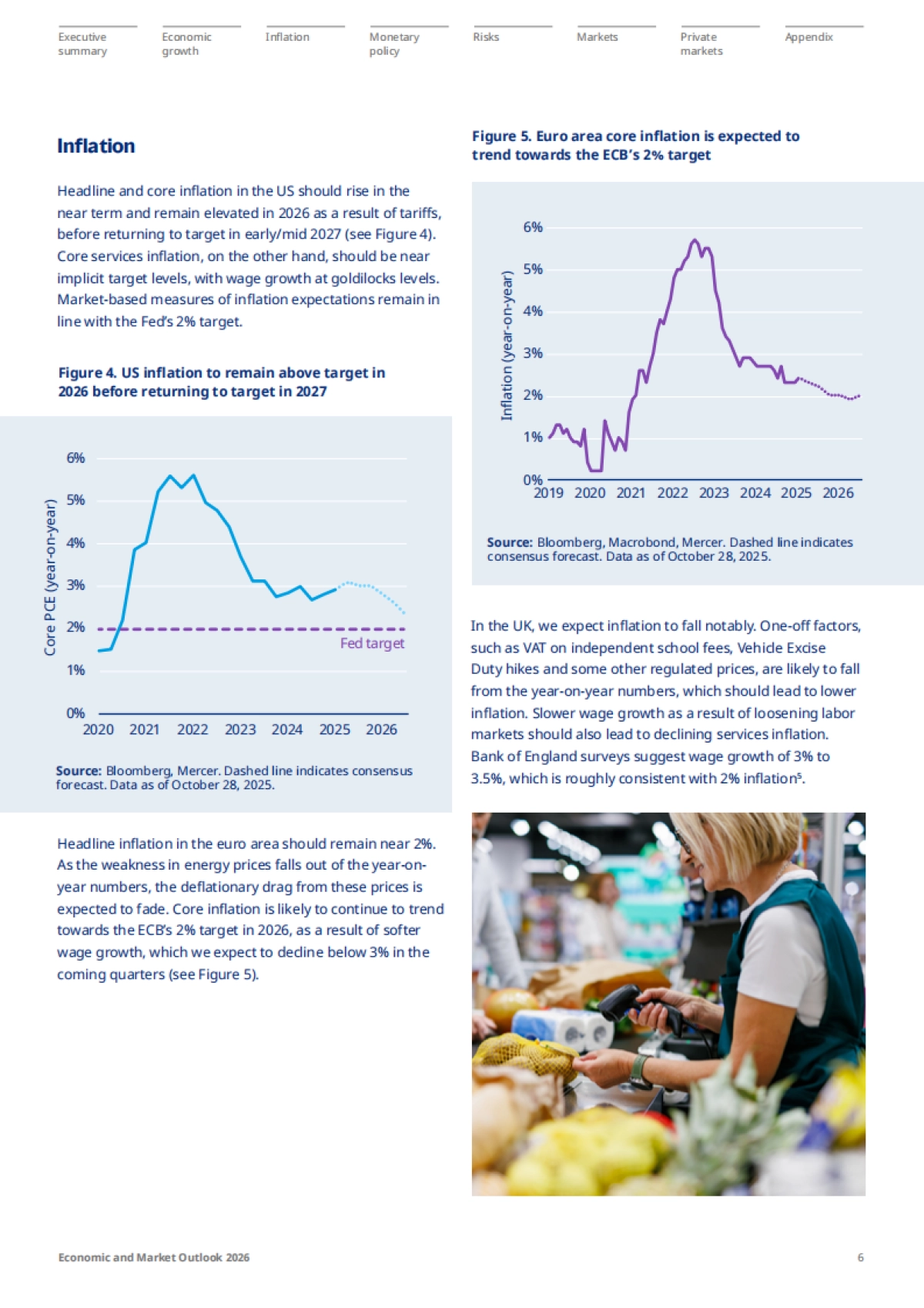
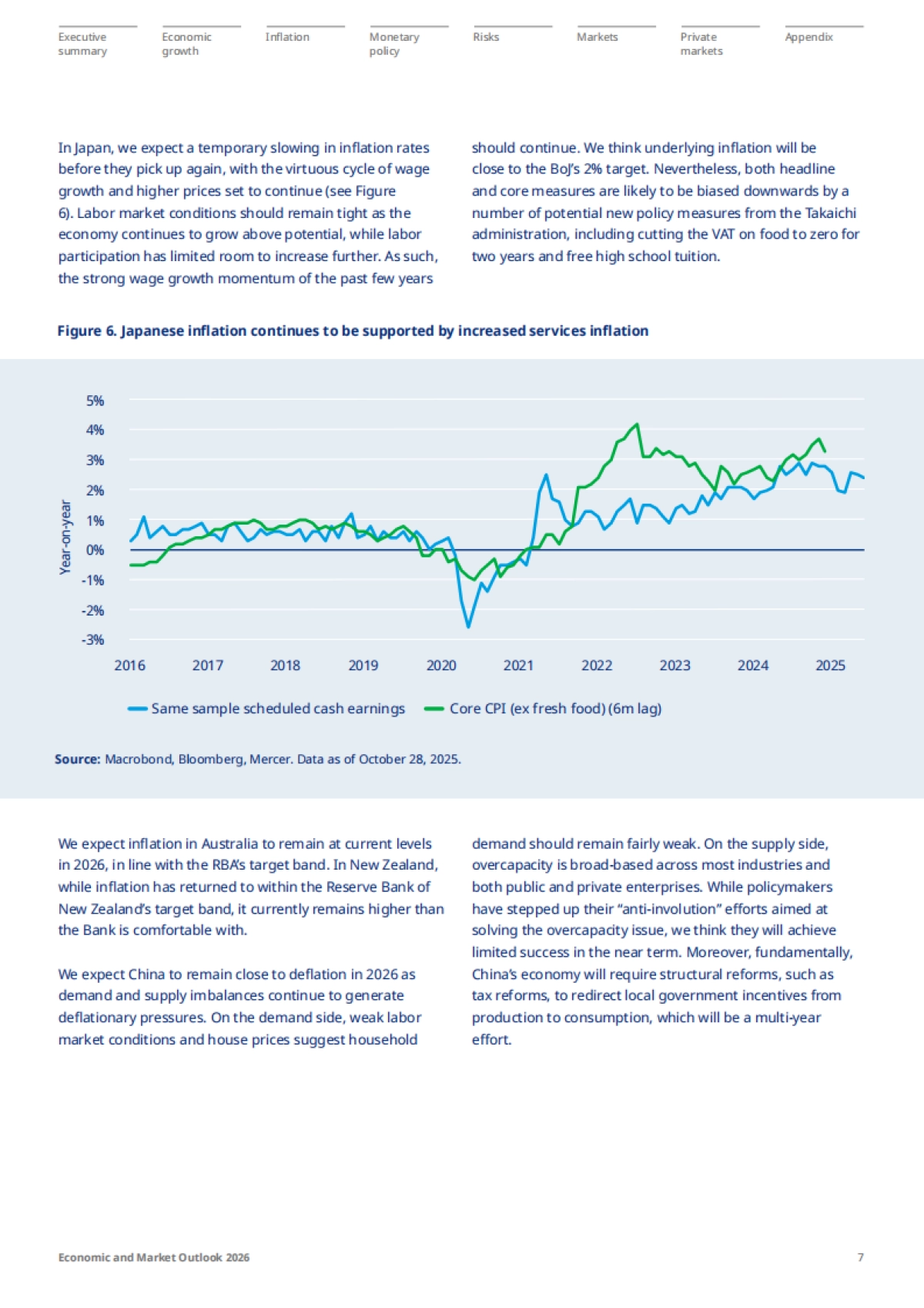
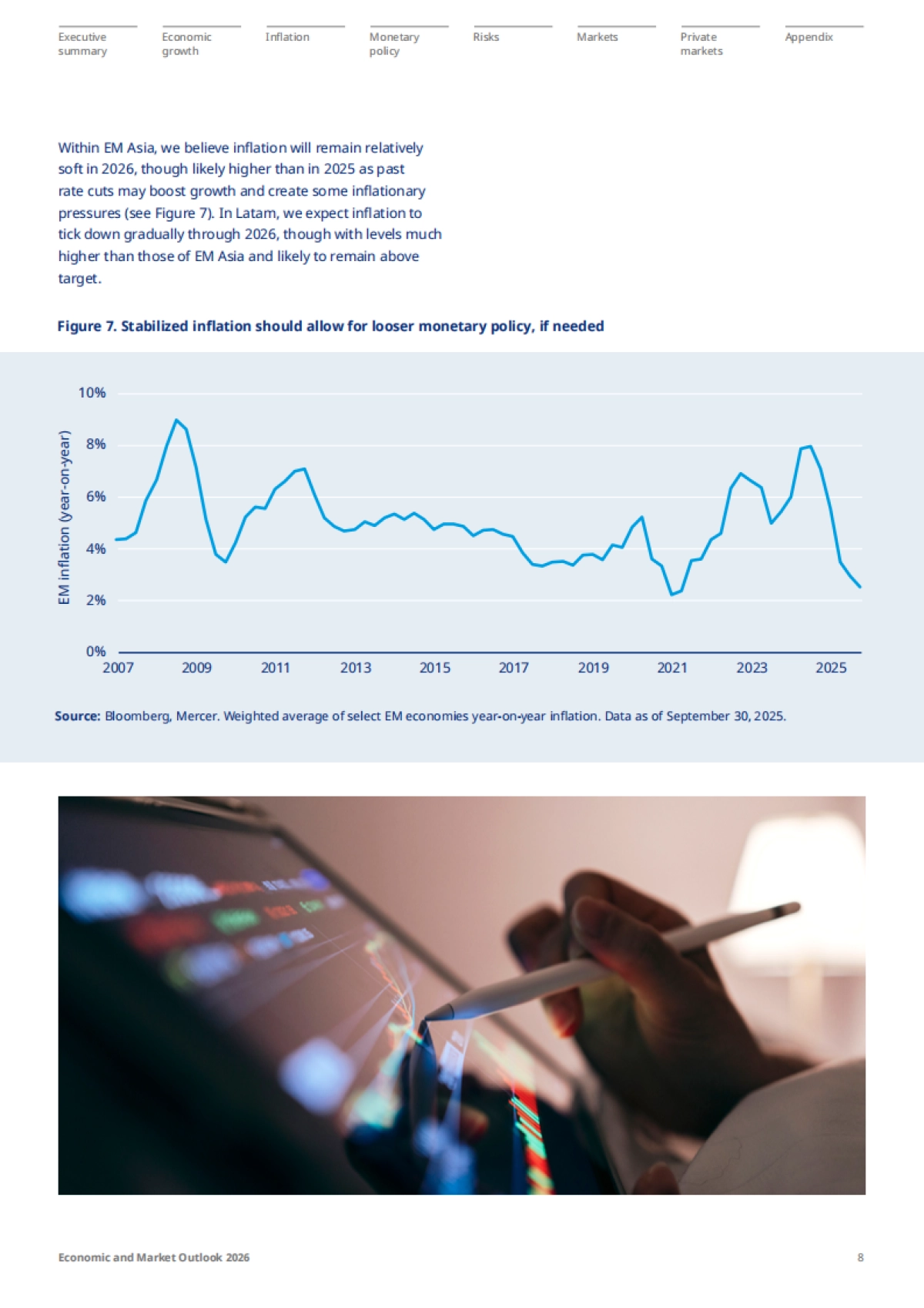
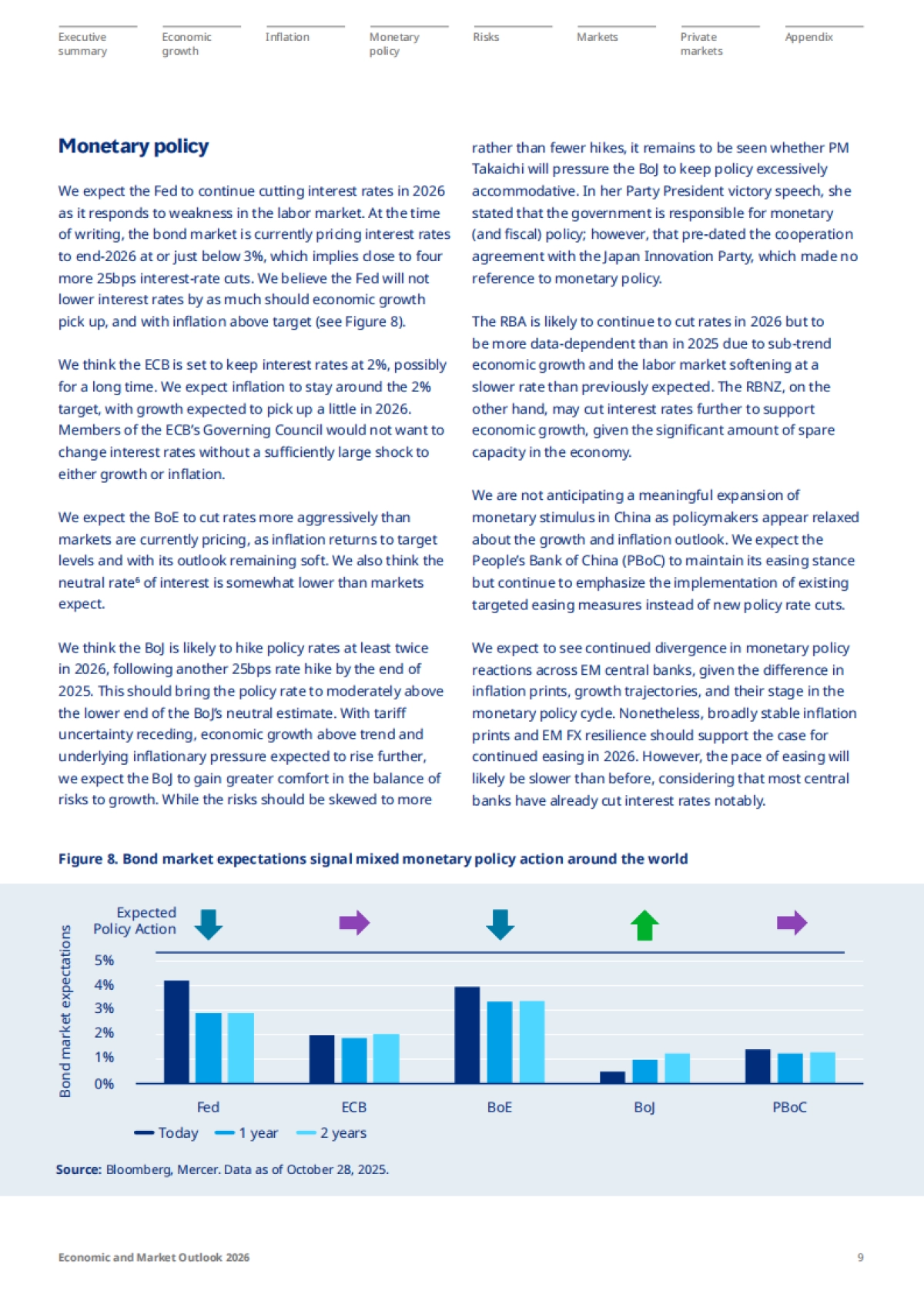
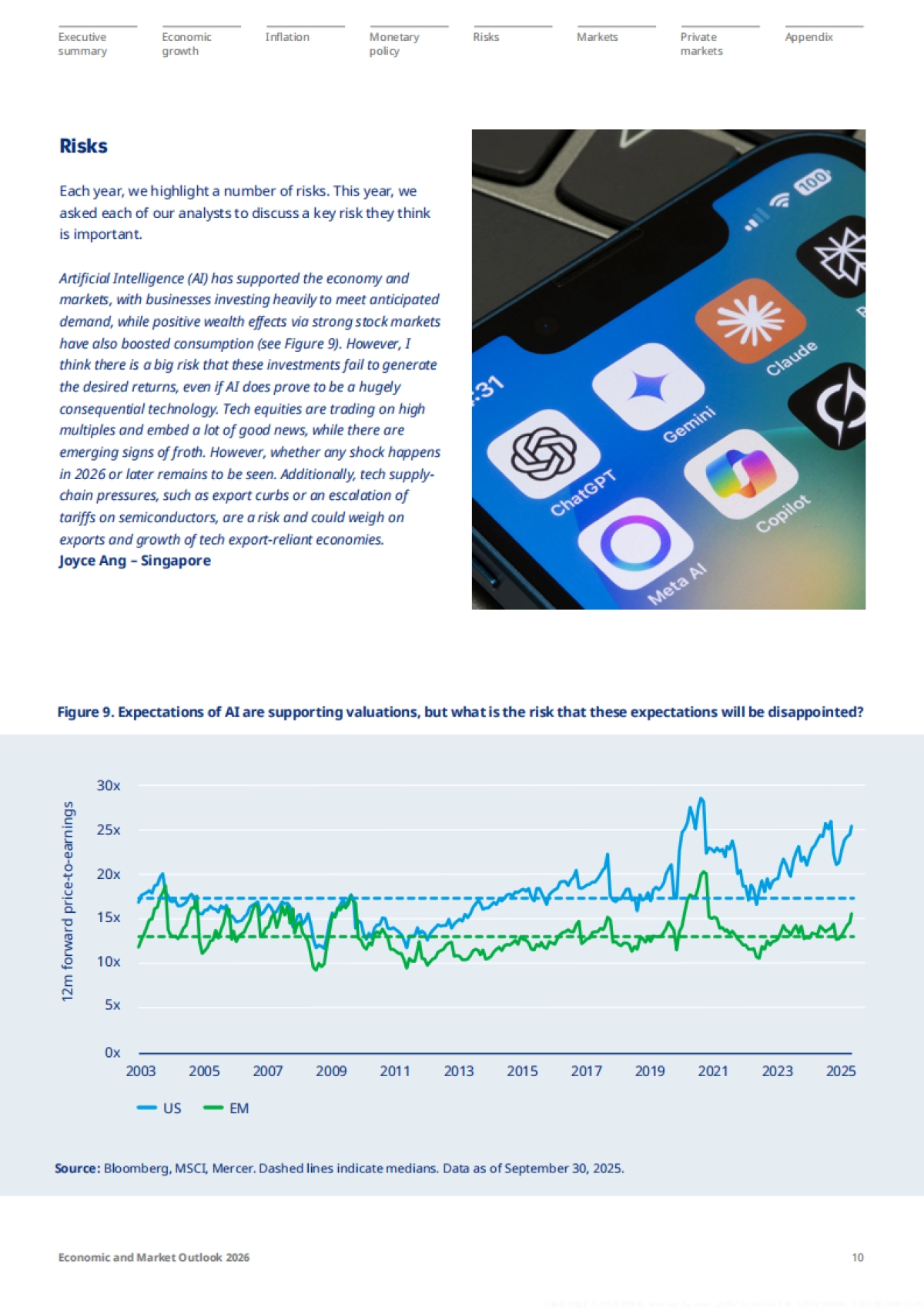
Mercerwelcome to brighterEconomic and marketoutlook 2026ReshapingA business of Marsh McLennanExecutiveEconomicInflationMonetaryRisksMarketsPrivateAppendixsummarygrowthpolicymarketsReshapingExecutive summaryinterest rates will also help.At the time of writing,thelabor market is showing signs of weakness,but we do notBy Rupert Watson,Global Head of Economicsexpect a material rise in unemployment,especially if theand Dynamic Asset Allocation,Mercereconomy strengthens slightly as we expect2025 has felt like a hugely consequential year,andInvestment is likely to remain strong,driven by the2026 is likely to follow suit.President Trump seemsAI boom.The sums involved are huge and are likelyto have put the US on a different path to that trodto benefit the US and other countries where thesince 1945,ripping up the old economic consensus.infrastructure build-out is underway,as well as thoseThe aftermath of this administration will be felt forcountries exporting the underlying hardware.years to come,and its success will only be able tobe fully judged decades from now.The explosiveThe euro-area economy should also strengthen a little,growth of artificial intelligence(AI)may herald thesupported by investment-led growth in Germany on thestart of a new era,although its consequences areback of its infrastructure and defense spending plans.unclear at this stage.All we can say with certaintyWhile economic growth in the eurozone is likely to beis that it is likely to matter from an economic andbetter over the next few years,it remains to be seenfinancial market perspective.whether this growth will be strong.Much will dependon whether the region improves its competitiveness byOf course,as Yogi Berra once said,"it's tough to makeimplementing some of the reforms recommended in thepredictions,especially about the future,"but as investors2024 Draghi report.While the mood music on the need forwe must try,and our annual outlook offers our thoughtschange has certainly improved,whether this will translateon the global economy and markets.In 2025,the twointo action is still an open question.big developments were President Trump's trade agenda,which,after much alarm at the time,seems to have hadThe same can be said about the UK.Its problems areonly a modest impact on growth,and the ongoing AIwell known-poorly targeted government spending.boom.The former may fade further into the backgroundlow investment and productivity growth,an onerousas an influence on the global economy,while AI willregulatory regime (induding planning),and poorcontinue to loom large.government finances.The new Labour government hasrecently begun to grasp the scale of the challenges,butWe expect the global economy to strengthen a little ininsufficient progress has been made.Having said that,2026 as trade headwinds fade and monetary and fiscalpessimism about the UK seems overblown and,as wepolicy loosens at the margin.In the US,we are likely to seeexplained in a recent paper2,we do not see the UK facingthe continued slow pass-through of tariffs to consumera fiscal crisis.prices,hurting real income and thus real consumption.However,the One Big Beautiful Bill Act(OBBBA)shouldWe remain optimistic on the outlook for Japan and thinkprovide fiscal support,while strong equity markets overthe era of deflation is over and that Japan may be enteringthe last few years should further improve householda new phase characterized by stronger nominal growthbalance sheets,providing more spending power.Lowerand improved corporate governance.Economic and Market Outlook 2026ExecutiveEconomicInflationMonetaryRisksMarketsPrivateAppendixsummarygrowthpolicymarketsIn China,the property crisis persists,with consumptionsupport equities,although it is worth remembering thatstuck at low levels.However,China's lead in a broad rangewhile the technology optimists were right in the lateof technologies should support the economy over the next90s about how the internet would change the world,decade,while an eventual consumer recovery should helpexpensive technology stocks performed very poorly overproduce a more balanced recovery in the future.As in thethe subsequent decade.For the time being,we are neutralUS,AI is a key upside risk,with Chinese AI products andon equities overall and are watching how fast and broad AIsolutions likely to dominate the Chinese market,althoughusage grows.it remains to be seen if they can be exported.In the near-term,we expect global inflation to becontained somewhere near central banks'targets.In theUS,while we are likely to see a near-term spike becauseof tariffs,we would expect this effect to fade aroundlate 2026 through 2027.We see wage growth as the keydeterminant of inflation over the medium term.This isdriven by unemployment and wage growth at normallevels,meaning inflation should be back near target oncethe tariff shock fades.Elsewhere,we see UK inflationfalling to reach the target,while China remains neardeflationary levels.In the US,the Federal Reserve(Fed)has restarted itsloosening cyde.While we see further cuts as likely,we donot think this is the start of a major loosening campaign,as the labor market is unlikely to weaken sharply,whileinflation is expected to remain modestly above target.Elsewhere,we only see minor changes,with the Bankof Japan hiking interest rates further and the Bank ofEngland initiating cuts.In temms of financial markets,our conviction level remainsguarded,in large part because we expect overall economicgrowth,inflation,and monetary policy to convergetowards long-term averages.It also reflects the difficultyof gauging whether the AI boom is turning into,or hasElsewhere,government bond yields are at reasonablealready turned into a bubble.The sums being invested arelevels in most parts of the world,although we wouldenormous and the payoff from much of that investment isexpect long-dated gilt yields to decrease as inflationstill many years away.On the other hand,we do think AIand wage growth fall and fiscal fears moderate.Creditis a significant general-purpose technology,like electricity,spreads are very tight,and while a benign economicthe internet,cars,and trains.Under a number of plausibleoutlook should support credit,it is difficult to see spreadsscenarios,the AI boom is in its infancy,and while some oftightening much from here,while they could sell offthe investment will inevitably sour,huge wealth could besharply if something goes wrong.We continue to likecreated in aggregate.frontier market debt and Asian high-yield debt,wherethe fundamental picture remains positive,with theAI is already being used to great effect in some sectors,strong performance in 2024 and 2025 likely to attractand we would expect its use to expand sharply over thefurther inflows.next few years as the technology improves and companiesleam how to use it effectively.This shouldWe hope you enjoy the report.Economic and Market Outlook 2026ExecutiveEconomicInflationMonetaryRisksMarketsPrivateAppendixsummarygrowthpolicymarketsEconomic growthinvestment is expected to reach close to $500 billion(seeFigure 1).The OBBBA should also support growth in 2026We think US economic growth will remain resilient and closeby extending -and making permanent-personal taxto trend in 2026,after a modest slowdown at the end ofcuts and providing incentives for a pull forward of further2025.Consumption growth should be respectable,driven bybusiness investment.The US Federal Reserve(Fed)issolid income growth and positive wealth effects from strongexpected to continue cutting interest rates,which shouldequity returns over the last few years.Business investmentsupport interest-rate sensitive sectors of the economy.should remain robust,with an increase in Al-relatedFinally,by early 2026,we should have more clarity aroundcapital spending.In 2026 and 2027,hyperscaler3 businesstrade,which could reduce policy uncertainty somewhat.Figure 1.Hyperscaler business investment is expected to top $450 billion in 2026$600bn$500bn$400bn$300bn$200bn$100bn$0bn20152016201720182019202020212022202320242025E2026E2027E-Meta Microsoft -OracleNVIDIA-GoogleApple TeslaAmazonSource:FactSet,Mercer.Data as of September 30,2025We expect euro-area growth to pick up as we move intoThe UK economy should remain soft in 2026 as fiscal policy2026.We forecast a sizeable tailwind from increasedsupport from H1 2025 fades and fiscal tightening takesGerman government spending on both infrastructure andover.Rising unemployment,slowing wage growth and thethe military.Consumption,which has been weak over recentlagged effects from past interest-rate hikes will also weighyears,could strengthen if households decide to spendon consumption growth.Business uncertainty may alsosome of their accumulated savings and lower their elevatedremain elevated due to US trade policy,hampering businesssavings rate.Recent rate cuts by the European Central Bankinvestment.However,we do not think the UK is facing ashould also support consumers and businesses.There willfiscal crisis,and we would expect these fears to dissipate,likely be regional differences,with France expected to bewhich could support consumption and investment(seeweaker and some southem economies stronger.US tradeFigure 2).policy will be a headwind,while pressure from China'sdominant manufacturing sector is set to continue.ExecutiveEconomicInflationMonetaryRisksMarketsPrivateAppendixsummarygrowthpolicymarketsFigure 2.We expect UK fiscal fears to dissipatenot expect domestic demand to rebound from its recentslowdown without a meaningful increase in stimulative6%policy or a shift in consumer sentiment.While householdsavings rates are high,they are unlikely to be put to work59%in the absence of a catalyst such as a turnaround in thehousing market.Nevertheless,China's government is49%committed to supporting productivity growth and China3%remains a world leader in several major high-tech sectors.China is supporting efforts to localize AI capabilities and29%become less reliant on the US.Exports to the US may fallfurther,although this should be offset by export strength19%elsewhere.Should there be a significant growth slowdown0%China's authorities may respond with further stimulus.Figure 3.Chinese economic growth is likely toremain broadly unchanged through 2026-Public sector net borrowingSource:UK Office for Budget Responsibility (OBR),Mercer10%Light blue shaded barsindicate OBR forecast.Data as of0 ctober21,2025.8%We expect Japan's economic growth to be modestly abovetrend in 2026.Private consumption should continue to6%accelerate moderately as real and nominal wage growthincreases.Business surveys and commentary suggest that49%business investment will remain strong.This should besupported by near-record-high profit margins and the mostsevere labor shortages since the 1980s bubble.Despite2%recent decines in corporate profit growth,we expectfirms to continue investing in labor-saving areas such asdigitalization and AI.External demand should pick up inn2026 as most major economies bottom out.Finally,weexpect both fiscal and monetary policy to be supportive ofgrowth,but increases in interest rates will reduce the extentSource:Bloomberg,Mercer.Light blueshaded bars indicateof current accommodation.Bloomberg forecast.Data as of October 28,2025.Australian economic growth is likely to pick up in 2026,We expect emerging market(EM)economic growth,ex-driven by recent Reserve Bank of Australia (RBA)interest-China,to remain decent in 2026.With a few exceptions,rate cuts,solid consumer confidence,and decent incomemonetary policy remains loose,and EMs are likely togrowth.However,low productivity growth will remaincontinue benefitting from the past(and possibly future)a problem for the Australian economy.New Zealand'sweakening in the US dollar.Asian economies,especiallyeconomic growth is likely to be weak,while consumptionthose higher up the value chain such as Taiwan and Southgrowth is expected to remain depressed as unemploymentKorea,should continue to see tech and AI upside supportingremains high through 2026 as a result of poor economicexports.India's GST+reforms should support consumergrowth in 2025.sentiment and business earnings in 2026.Meanwhile,LatinAmerican (Latam)economies are expected to see growth atWe expect China's real economic growth to remain broadlymore subdued rates,given more elevated interest rates inunchanged at current levels in 2026(see Figure 3).We docertain economies,notably Brazil and ColombiaEconomic and Market Outlook 2026ExecutiveEconomicInflationMonetaryRisksMarketsPrivateAppendixsummarygrowthpolicymarketsInflationFigure 5.Euro area core inflation is expected totrend towards the ECB's 2%targetHeadline and core inflation in the US should rise in thenear term and remain elevated in 2026 as a result of tariffs,before returning to target in early/mid 2027(see Figure 4).6%Core services inflation,on the other hand,should be nearimplicit target levels,with wage growth at goldilocks levels.5%Market-based measures of inflation expectations remain inline with the Fed's 2%target.(eaK-uo-4%3%Figure 4.US inflation to remain above target in2026 before returning to target in 20272%19%09%-5%2019202020212022202320242025202649%Source:Bloomberg,Macrobond,Mercer.Dashed line indicatesconsensus forecast.Data as of October 28,2025.3%29%In the UK,we expect inflation to fall notably.One-off factors,Fed targetsuch as VAT on independent school fees,Vehide Excise1%Duty hikes and some other regulated prices,are likely to fallfrom the year-on-year numbers,which should lead to lower0%inflation.Slower wage growth as a result of loosening labor2020202120222023202420252026markets should also lead to declining services inflation.Bank of England surveys suggest wage growth of 3%toSource:Bloomberg,Mercer.Dashed line indicates consensusforecast.Data as of October 28,2025.3.5%,which is roughly consistent with 2%inflations.Headline inflation in the euro area should remain near 2%.As the weakness in energy prices falls out of the year-on-year numbers,the deflationary drag from these prices isexpected to fade.Core inflation is likely to continue to trendtowards the ECB's 2%target in 2026,as a result of softerwage growth,which we expect to dedine below 3%in thecoming quarters (see Figure 5).Economic and Market Outlook 2026ExecutiveEconomicInflationMonetaryRisksMarketsPrivateAppendixsummarygrowthpolicymarketsIn Japan,we expect a temporary slowing in inflation ratesshould continue.We think underlying inflation will bebefore they pick up again,with the virtuous cycle of wageclose to the Bol's 2%target.Nevertheless,both headlinegrowth and higher prices set to continue(see Figureand core measures are likely to be biased downwards by a6).Labor market conditions should remain tight as thenumber of potential new policy measures from the Takaichieconomy continues to grow above potential,while laboradministration,including cutting the VAT on food to zero forparticipation has limited room to increase further.As such,two years and free high school tuition.the strong wage growth momentum of the past few yearsFigure 6.Japanese inflation continues to be supported by increased services inflation5%49%3%2%19%09%19%29%3%2016201720182019202020212022202320242025Same sample scheduled cash earnings-Core CPI(ex fresh food)(6m lag)Source:Macrobond,Bloomberg,Mercer.Data as of October 28,2025.We expect inflation in Australia to remain at current levelsdemand should remain fairly weak.On the supply side,in 2026,in line with the RBAs target band.In New Zealand,overcapacity is broad-based across most industries andwhile inflation has returned to within the Reserve Bank ofboth public and private enterprises.While policymakersNew Zealand's target band,it currently remains higher thanhave stepped up their"anti-involution"efforts aimed atthe Bank is comfortable with.solving the overcapacity issue,we think they will achievelimited success in the near term.Moreover,fundamentally,We expect China to remain close to deflation in 2026 asChina's economy will require structural reforms,such asdemand and supply imbalances continue to generatetax reforms,to redirect local government incentives fromdeflationary pressures.On the demand side,weak laborproduction to consumption,which will be a multi-yearmarket conditions and house prices suggest householdeffort.Economic and Market Outlook 2026ExecutiveEconomicInflationMonetaryRisksMarket屯PrivateAppendixsummarygrowthpolicymarketsWithin EM Asia,we believe inflation will remain relativelysoft in 2026,though likely higher than in 2025 as pastrate cuts may boost growth and create some inflationarypressures (see Figure 7).In Latam,we expect inflation totick down gradually through 2026,though with levels muchhigher than those of EM Asia and likely to remain abovetarget.Figure 7.Stabilized inflation should allow for looser monetary policy,if needed10%8%6%49%2%0%2007200920112013201520172019202120232025Source:Bloomberg,Mercer.Weighted average of select EM economies year-on-year inflation.Data as of September 30,2025.Economic and Market Outlook 2026ExecutiveEconomicInflationMonetaryRisksMarketsPrivateAppendixsummarygrowthpolicymarketsMonetary policyrather than fewer hikes,it remains to be seen whether PMTakaichi will pressure the Bo]to keep policy excessivelyWe expect the Fed to continue cutting interest rates in 2026accommodative.In her Party President victory speech,sheas it responds to weakness in the labor market.At the timestated that the government is responsible for monetaryof writing,the bond market is currently pricng interest rates(and fiscal)policy;however,that pre-dated the cooperationto end-2026 at or just below 3%,which implies dose to fouragreement with the Japan Innovation Party,which made nomore 25bps interest-rate cuts.We believe the Fed will notreference to monetary policy.lower interest rates by as much should economic growthpick up,and with inflation above target (see Figure 8).The RBA is likely to continue to cut rates in 2026 but tobe more data-dependent than in 2025 due to sub-trendWe think the ECB is set to keep interest rates at 2%,possiblyeconomic growth and the labor market softening at afor a long time.We expect inflation to stay around the 2%slower rate than previously expected.The RBNZ,on thetarget,with growth expected to pick up a little in 2026.other hand,may cut interest rates further to supportMembers of the ECB's Governing Council would not want toeconomic growth,given the significant amount of sparechange interest rates without a sufficiently large shock tocapacity in the economy.either growth or inflation.We are not anticipating a meaningful expansion ofWe expect the BoE to cut rates more aggressively thanmonetary stimulus in China as policymakers appear relaxedmarkets are currently pricing,as inflation returns to targetabout the growth and inflation outlook.We expect thelevels and with its outlook remaining soft.We also think thePeople's Bank of China (PBoC)to maintain its easing stanceneutral rates of interest is somewhat lower than marketsbut continue to emphasize the implementation of existingexpect.targeted easing measures instead of new policy rate cuts.We think the Boj is likely to hike policy rates at least twiceWe expect to see continued divergence in monetary policyin 2026,following another 25bps rate hike by the end ofreactions across EM central banks,given the difference in2025.This should bring the policy rate to moderately aboveinflation prints,growth trajectories,and their stage in thethe lower end of the Bol's neutral estimate.With tariffmonetary policy cycle.Nonetheless,broadly stable inflationuncertainty receding,economic growth above trend andprints and EM FX resilience should support the case forunderlying inflationary pressure expected to rise further,continued easing in 2026.However,the pace of easing willwe expect the Bo]to gain greater comfort in the balance oflikely be slower than before,considering that most centralrisks to growth.While the risks should be skewed to morebanks have already cut interest rates notably.Figure 8.Bond market expectations signal mixed monetary policy action around the worldExpectedPolicy Action5%4%3%2%0%FedECBBoEBolPBoC-Today -1 year2 yearsSource:Bloomberg,Mercer.Data as of October 28,2025.Economic and Market Outlook 2026ExecutiveEconomicInflationMonetaryRisksMarketsPrivateAppendixsummarygrowthpolicymarketsRisksEach year,we highlight a number of risks.This year,weasked each of our analysts to discuss a key risk they thinkis important.markets,with businesses investing heavily to meet anticipateddemand,while positive wealth effects via strong stock marketshave also boosted consumption (see Figure 9).However,Ithink there is a big risk that these investments fail to generateClaudethe desired returns,even if AI does prove to be a hugelyconsequential technology.Tech equities are trading on highmultiples and embed a lot of good news,while there areGeminiemerging signs of froth.However,whether any shock happensin 2026 or later remains to be seen.Additionally,tech supply-chain pressures,such as export curbs or an escalation ofChatGPTtariffs on semiconductors,are a risk and could weigh onCopilotexports and growth of tech export-reliant economies.Joyce Ang-SingaporeMeta AlFigure 9.Expectations of AI are supporting valuations,but what is the risk that these expectations will be disappointed?155x200320052007200920112013201520172019202120232025Source:Bloomberg,MSCI,Mercer.Dashed lines indicate medians.Data as of September 30,2025Economic and Market Outlook 202610ExecutiveEconomicInflationMonetaryRisksMarketsPrivateAppendixsummarygrowthpolicymarketsI expect policy uncertainty to ease slightly in 2026,but bigthe debt-to-GDP ratio higher.The Congressional Budget Officerisks will remain.While risks surrounding tariffs may decline,(CBO)estimates that the US debt-to-GDP ratio will rise to-120%US midterm elections and the nomination of a new Fed chairby 2035.s Similar dynamics are on display in other parts ofpresent new risks as we head into 2026.If Republicans losethe world.While I do not think we are close to an imminentcontrol of the House following the midterm elections,a dividedfiscal meltdown,some consolidation by the government overCongress could lead to greater oversight of the administrationthe medium term is needed to bring fiscal spending backand complicate the passage of legislation,leading to increasedfrom this wholly unsustainable pathway and reduce debtpolicy uncertainty.Separately,it is widely expected thatPresident Trump will nominate an 'ally to lead the Fed whenLintao Ye-TokyoPowell's term ends in May 2026,which may raise questionsabout monetary policy independence.I think that geopolitics continues to represent a key risk(seeMax Becker-New YorkFigure 10).The Russia-Ukraine conflict continues,while therecould also be rising tensions in the Taiwan Strait or the SouthDebt sustainability risks are increasing globally as governmentChina Sea.Finally,the Middle East will likely remain a flashpointdebt continues to rise in major developed economies.In thefor geopolitical tensions.While the risks stemming from USUS,deficits are expected to remain near 6%of GDP for each oftrade policy have fallen from the peak,they remain elevated.the next several years,outpacing nominal growth and pushingFahad Badar-LondonFigure 10.Geopolitical risk has shifted higher since the Russian invasion of Ukraine600500400300200100019851998199119941997200020032006200920122015201820212024-Geopolitical Risk Index --Average(1985-2021)---Average(2022-present)Source:Matteo Iacoviello,Macrobond,Mercer.Data as of September 30,2025.Economic and Market Outlook 2026ExecutiveEconomicInflationMonetaryRisksMarketsPrivateAppendixsummarygrowthpolicymarketsMarketsalthough it remains to be seen whether earnings resultscan match high expectations.Valuations on a relativeEquitiesbasis (versus DM equities)are still cheap,although theyWe are neutral on developed market (DM)equities.Weare more expensive than historically on an absolute basis.expect earnings growth to be strong,driven by high-techInvestors remain fairly bullish on EM,according to theeamings growth supported by the AI boom(see Figurelatest Bank of America survey,although overall positioning11).Profit growth outside the tech sector has been moreis relatively light compared to DM equities.subdued,and we expect this will also continue,withtariffs and related uncertainty still a headwind.ValuationsWe remain bullish on Japanese equities as they continueare still expensive in both absolute and relative termsto benefit from the end of deflation and corporatecompared to other asset classes.AI remains the keygovernance reforms,which should increase corporateupside for both US and DM equities overall,although aprofits (see Figure 12).Earnings growth should be slightlyfailure to meet lofty expectations is an evident downsidebetter than currently expected,as company guidance doesrisk.We do not have a strong view on whether AI is anot yet indude any impact from the recently announcedbubble,although we do think it will have a significantUS deal.Additionally,ongoing corporate restructuring-positive impact on the global economy.for example,the unwinding of cross-shareholdings andthe selling of non-core assets-could potentially leadFigure 11.DM earnings growth to be supported byto better capital efficiency and return on equity(ROE).AI growth expectationsValuations remain relatively attractive versus broader DMequities.Foreign investor inflows are light compared tohistorical levels,but with corporate reforms potentially229%driving an increase in ROE,we still see plenty of scope for209%foreigners to increase their exposure.18%Figure 12.Japanese valuations on a relative basis16%screen attractive149%90%10%8%80%6%70%60%50%-26e-MSCI World-26e-MSCI USA IT40%30%Source:IBES,Mercer.Data as of October 24,2025uede20%10%We are also neutral on EM equities versus developedmarkets.The outlook for EM equities remains mixed.0%Upside risks from AI in some countries and continued USD1weakness are balanced against downside risks stemmingfrom higher tariff rates and trade uncertainty.Someemerging economies could benefit from a shift away fromSource:IBES,Mercer.Based on current percentiles of trailing 12mChina.Eamings growth should continue to be strong,P/E ratio (0%=most attractive,100%=least attractive).2003-2025.Data as of October 24,2025.Economic and Market Outlook 202612ExecutiveEconomicInflationMonetaryRisksMarketsPrivateAppendixsummarygrowthpolicymarketsWe remain neutral on small caps as we think the currentInflation break-evens,which are pricing inflation at closecomposition and quality of the index will be a headwind.to central bank targets in most countries,are reasonable.While we believe that rate cuts could provide a tailwind toThe only region where we think inflation break-evens aresmall-cap profit growth,this should still lag large-cap profitmispriced is the UK.There,20-year break-evens are at c.3%,growth.Firstly,small caps have lower exposure to higher-and we think the BoE will deliver on its inflation target overgrowth parts of the market(such as AI).Secondly,we thinkthe medium-to-long run,and market-implied inflation ratesearnings guidance quality in small caps is poor,as earningswill fall.forecasts are consistently revised lower.Valuations do,however,continue to look attractive relative to their large-Creditcap counterparts.Investor sentiment continues to supportWe are neutral on investment-grade credit (IG).Corporatethe view that rate cutting will be supportive for small caps,fundamentals are in good shape,with high profitability andbut we do not yet see positioning reflecting this sentiment.falling leverage.However,while this should be supportivefor IG,we are conscious that IG has already priced in a lot ofGovernment bondsgood news,with credit spreads at very tight levels.We are neutral on global nominal government bonds,although we have some regional views.We see upsideWe hold a modest underweight in global high yield (HY).and downside risks to US government bond yields.On theSimilar to our IG credit view,high-yield fundamentals lookupside,better-than-expected US economic growth andgood,and we expect this to remain the case.However,high-firmer inflation readings could cause the Fed to keep ratesyield credit spreads remain at historically tight levels,withon hold,pushing bond yields higher.On the other hand,a spread of just over 2.7%(as measured by the ICE BofAmore pronounced labor market weakness could lead theGlobal High Yield Constrained Index)above governmentFed to cut rates more aggressively.We are overweight UKbonds.This is almost 2%lower than the median creditlong-dated gilts,as we think the BoE will cut interest ratesspread since 2000,trading in the second percentile.We areby more than the amount currently priced into the bondnot particularly bearish on HY per se,but believe it is a goodmarket and that fiscal fears will dissipate,although notfunding source for Asia high-yield and frontier market debt.disappear(see Figure 13).Valuations are attractive,withlong-dated gilt yields at their highest level in nearly 30years.We are underweight Japanese govemment bonds,aswe believe the Bol has not finished hiking interest rates,andthe recalibration of the JGB market from near-zero rates topositive rates still has some room to run.Figure 13.Long-dated gilt yields remainclose to all-time highs6%5%49%1%0%Source:Bloomberg,Mercer.Data as of October 24,2025.Economic and Market Outlook 2026ExecutiveEconomicInflationMonetaryRisksMarketsPrivateAppendixsummarygrowthpolicymarketsWe are overweight Asia high yield (AHY).We expecteddefaults in ex-China property to remain very low.Furtherdefaults are likely in China's property sector,although thisinvolves only around 7%of the asset dass.Even withinChina's property sector,defaults will likely be containedto just a few distressed developers.This has already beenpriced in by markets,thereby limiting the market impact.We hold a high-conviction overweight in frontier marketdebt(FMD)(see Figure 14).Conditions in frontier marketslook set to remain supportive.Resolutions on sovereigndebt restructuring (Ethiopia and Zambia),as well as realimprovements in fundamentals(such as declining debt-to-GDP ratios and improving current account balances),shouldcontinue to drive these markets.The number of ratingupgrades is now higher than the number of downgrades.Valuations continue to be attractive,with strong carry.Investor demand also appears to be increasing.Figure 14.FMD defaults should be contained on improving fundamentals15%13%119%9%5%3%19%0%20112013201520172019202120232025一Frontier market debt一US high yieldSource:Global Evolution,Macrobond,Mercer.Data as of October 24,2025.We are overweight hard-currency EM debt.The outlook forEMD HC should remain resilient given good fundamentals,ease further,supported by likely Fed rate cuts.Spreads stilllook tight,and we expect them to remain tight over thenext quarter in the absence of any significant downsidedevelopments around trade.All-in yields also look strong.Flows to EM bonds have been picking up,and we expect thistrend to continue.Economic and Market Outlook 202614ExecutiveEconomicInflationMonetaryRisksMarketsPrivateAppendixsummarygrowthpolicymarketsFigure 15.Yield differentials are declining as theCommoditiesBoJ hikes and the Fed cutsWe remain neutral on commodities.Precious metals-goldin particular-should be underpinned by robust demandfrom central banks,although we are wary of chasing therally,with gold at an all-time high in real and nominal terms.5%A survey of central banks by the World Gold Council showedSpread widening=>Weigh on JPYthat over 90%expect to increase their gold holdings,which-asn)Spread tightening =Support JPY49%may put upward pressure on gold prices.peaOil prices may range between $50 and $70/barrel.We3%see upside risks stemming from geopolitical flare-ups,deMSinduding Iran supply issues,a blockage of the Red Sea,29%and the ongoing war in Ukraine.However,countering thisis increased supply from OPEC+,which may continue into2026.1%6Currency0%We remain underweight the US dollar (USD)for severalreasons.First,the Fed is expected to continue cutting00interest rates,causing interest-rate differentials betweenthe US and other DM markets to narrow.Second,ongoingSource:Bloomberg,Mercer.Data as of October 24,2025fiscal challenges may be a headwind for the USD.Third,increased hedging of US dollar exposure by non-dollarinvestors may put downward pressure on the greenback.We are bearish on the pound sterling(GBP).We expectthe UK economy to experience a period of slower growth.We remain overweight the euro (EUR)as we believe fiscalInflation should also begin to decline as the labor marketstimulus in Germany should lead to stronger economicslows,bringing down wage growth,which drives a largegrowth over both the short and medium term.Additionally,part of services inflation.This should allow the BoE toother euro-area countries may increase spending onreduce interest rates more than is currently priced in bydefense,leading to better growth in the region.bond markets.We are also bullish on the Japanese yen (PY).The yenWe remain underweight the Swiss franc(CHF)given theremains extremely undervalued,as it still trades close to itssubdued inflation and growth outlook,while the currencycheapest levels on a real basis since the 1970s.We believeremains extremely expensive and offers the lowest yieldsthe yen has further room to appreciate against the USdollar,as Japan's nominal growth continues to perform well,while the interest-rate differential converges(see Figure 15),We continue to favor frontier market currencies implicitly viathe BoJ gradually hikes rates and the Fed continues to ease.the overweight FMD position,as noted earlier.Meanwhile,we do not hold any strong views on mainstream EMcurrencies.Economic and Market Outlook 202615

请如实的对该文档进行评分-
-
-
-
-
0 分