首页研究报告机构研究投资金融2026年私募市场展望报告(英文版)-贝莱德(BlackRock)
十一

文档

7254

关注

2

好评

0
PDF

2026年私募市场展望报告(英文版)-贝莱德(BlackRock)

阅读 612 下载 76 大小 5.68M 总页数 28 页 2025-11-28 分享
价格:¥ 9.90
下载文档
/ 28
全屏查看
2026年私募市场展望报告(英文版)-贝莱德(BlackRock)
还有 28 页未读 ,您可以 继续阅读 或 下载文档
1、本文档共计 28 页,下载后文档不带水印,支持完整阅读内容或进行编辑。
2、当您付费下载文档后,您只拥有了使用权限,并不意味着购买了版权,文档只能用于自身使用,不得用于其他商业用途(如 [转卖]进行直接盈利或[编辑后售卖]进行间接盈利)。
3、本站所有内容均由合作方或网友上传,本站不对文档的完整性、权威性及其观点立场正确性做任何保证或承诺!文档内容仅供研究参考,付费前请自行鉴别。
4、如文档内容存在违规,或者侵犯商业秘密、侵犯著作权等,请点击“违规举报”。
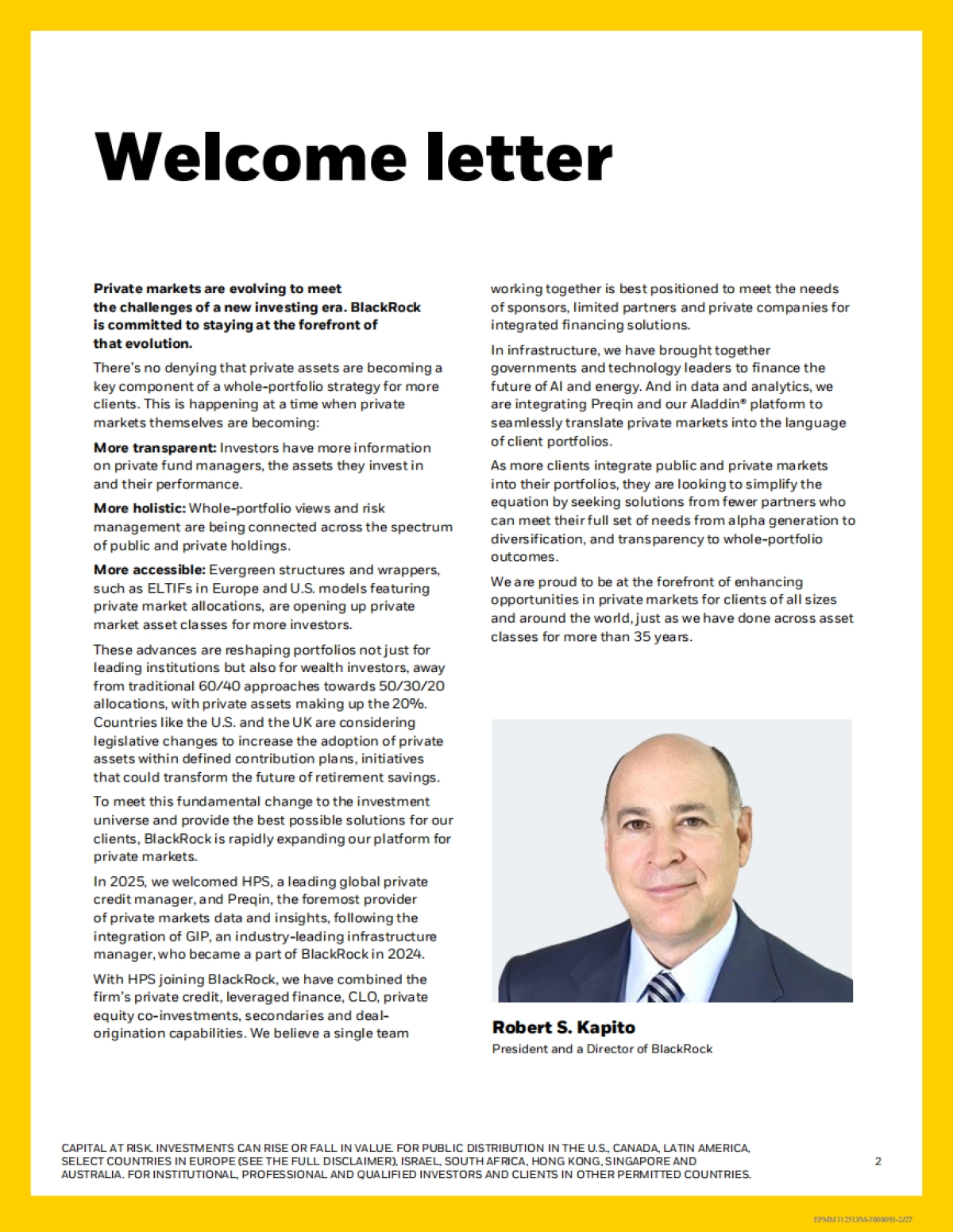
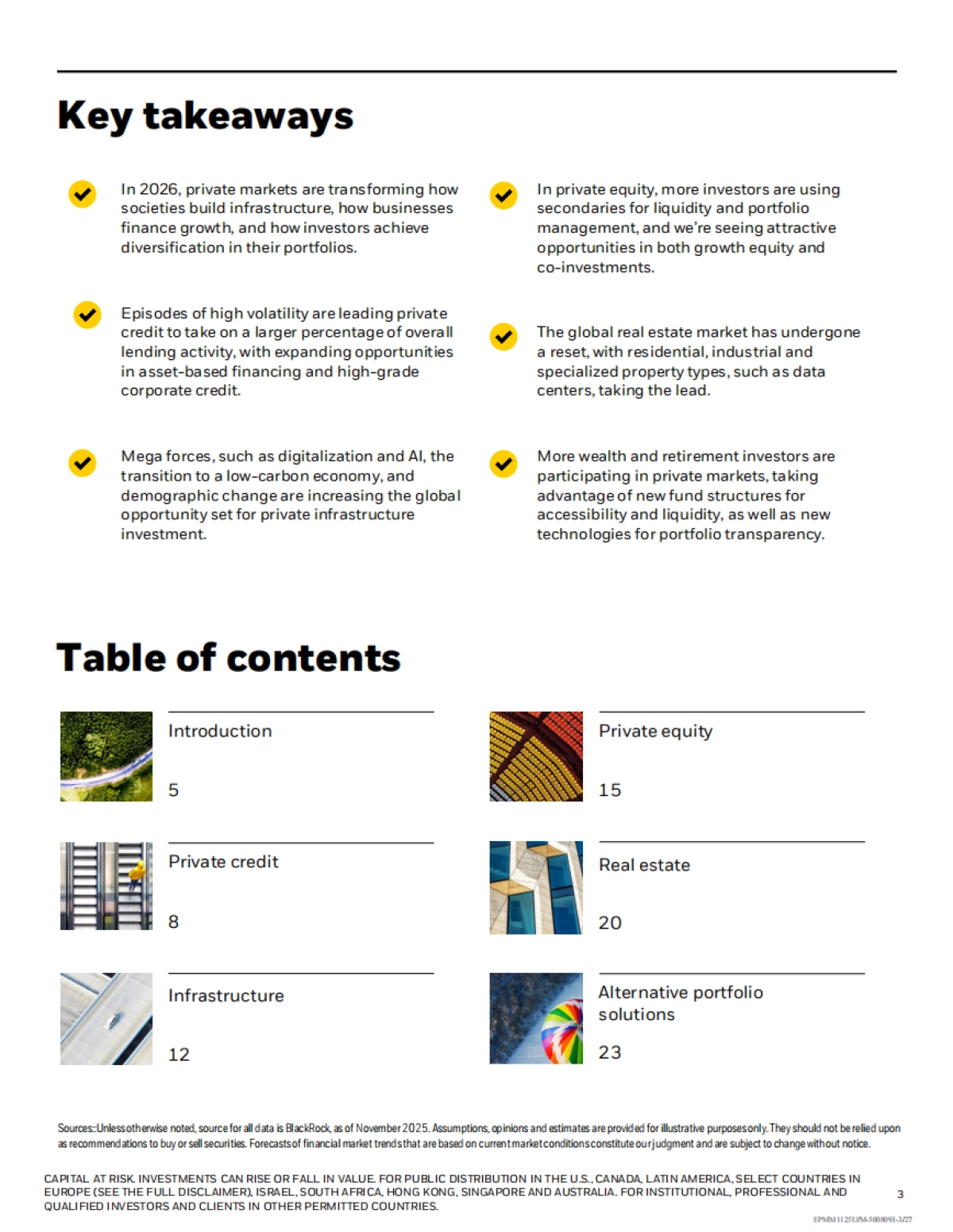
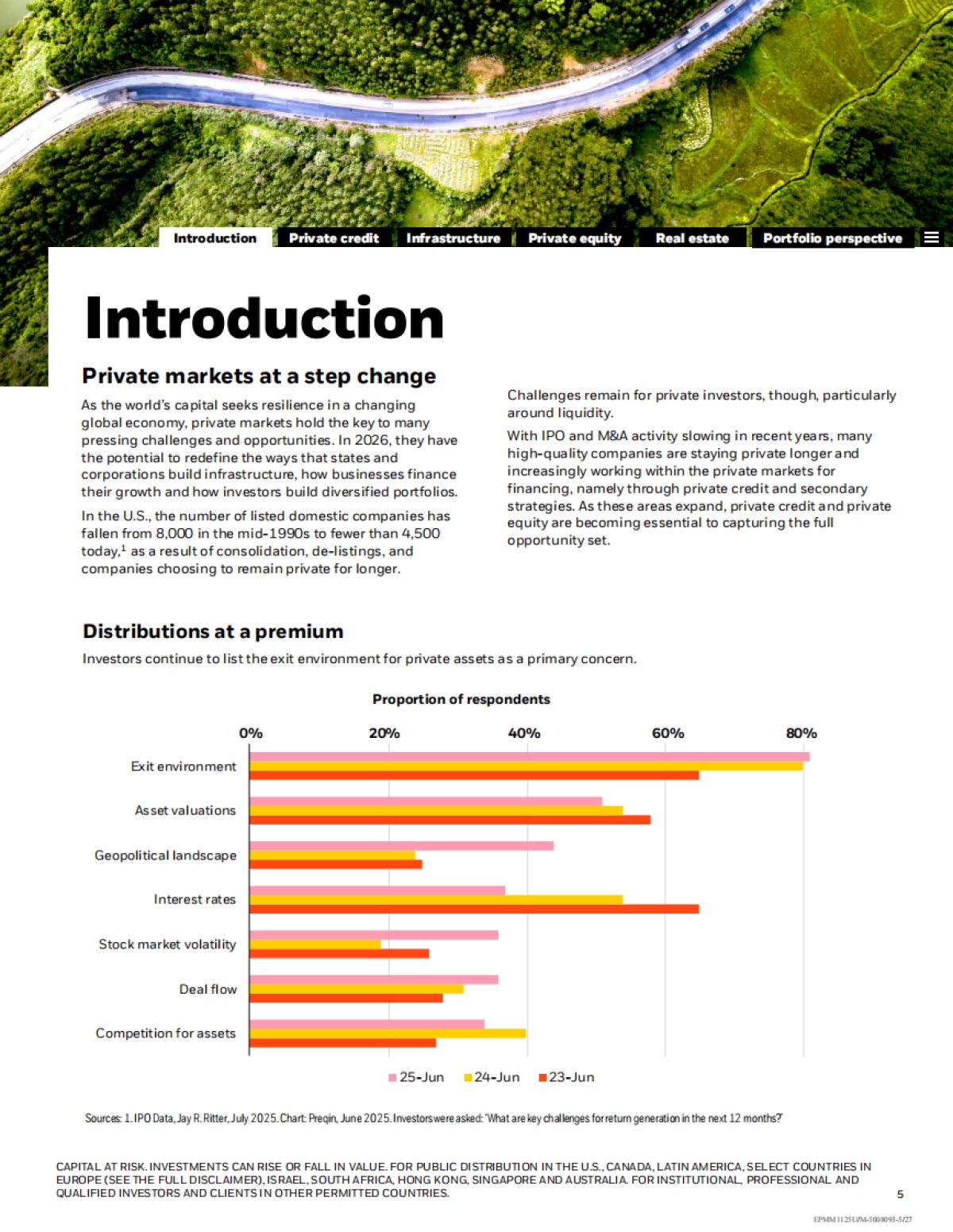
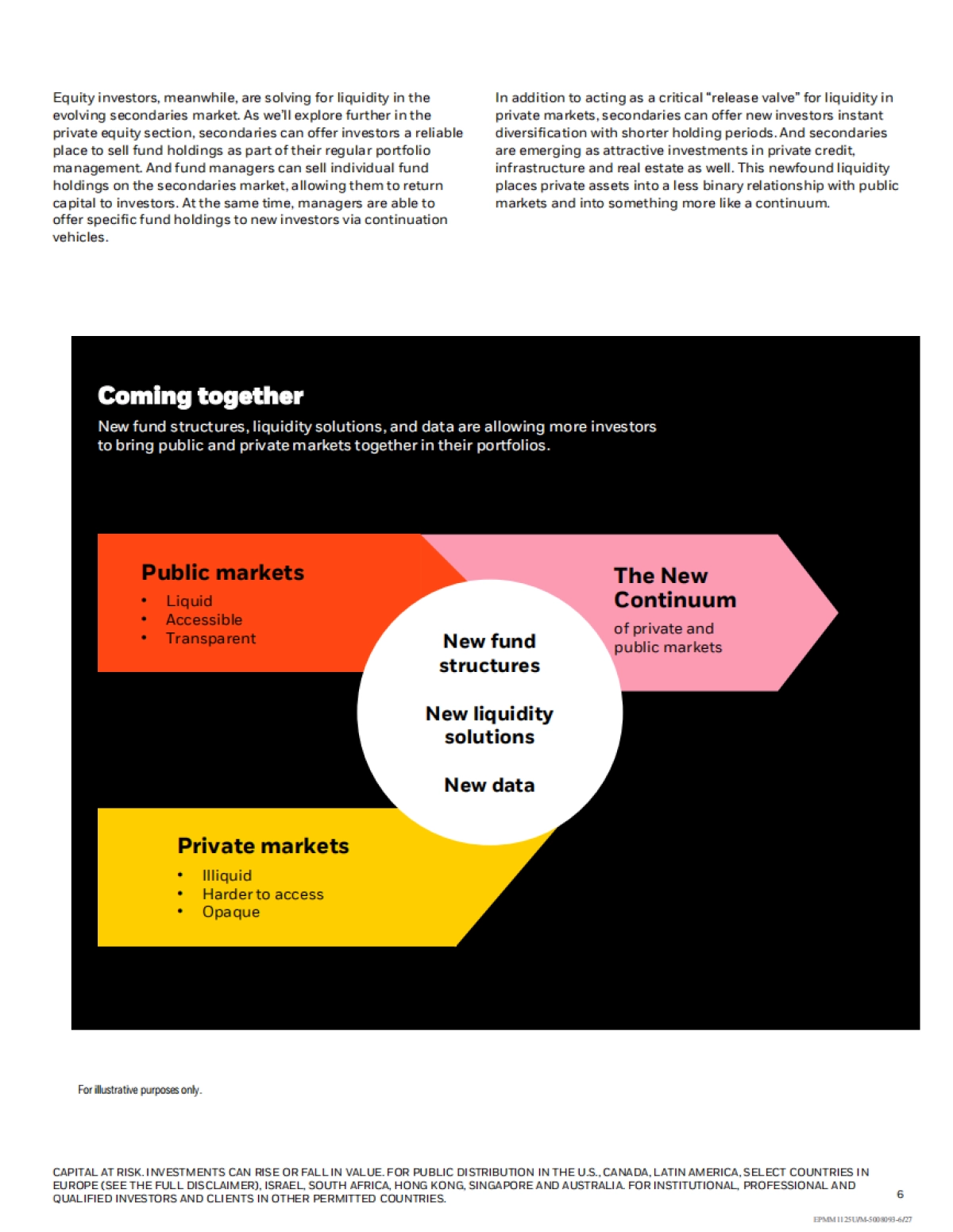
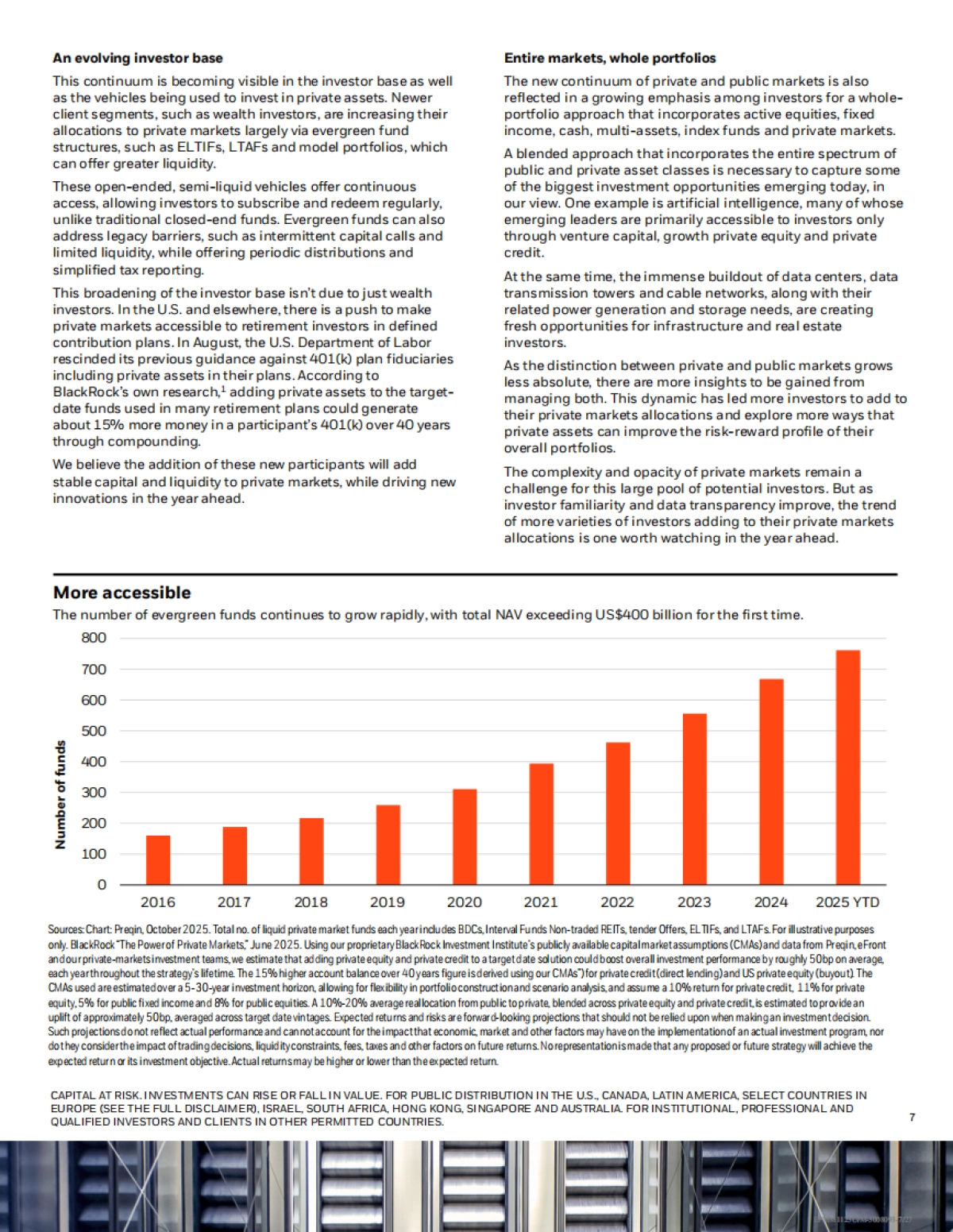
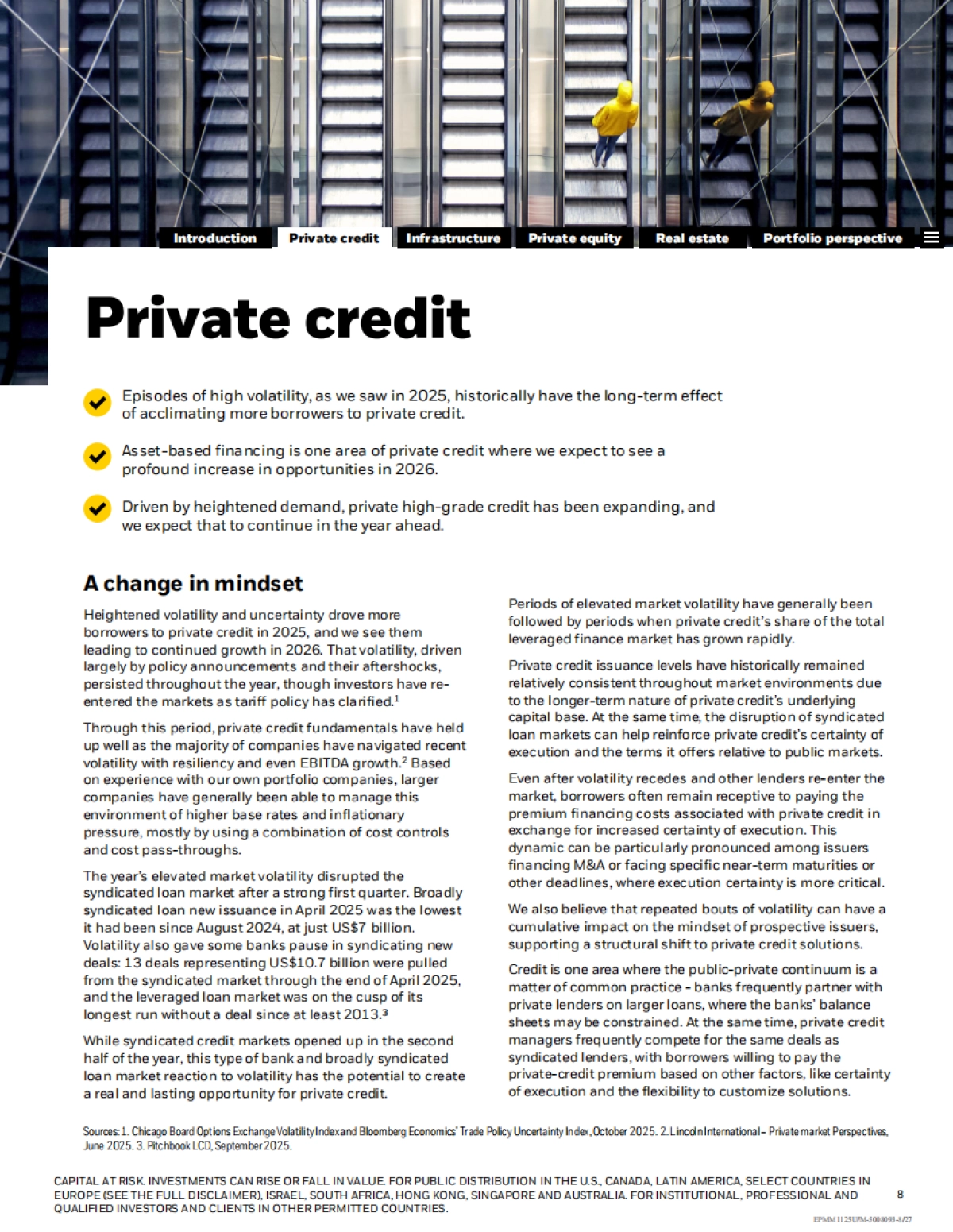
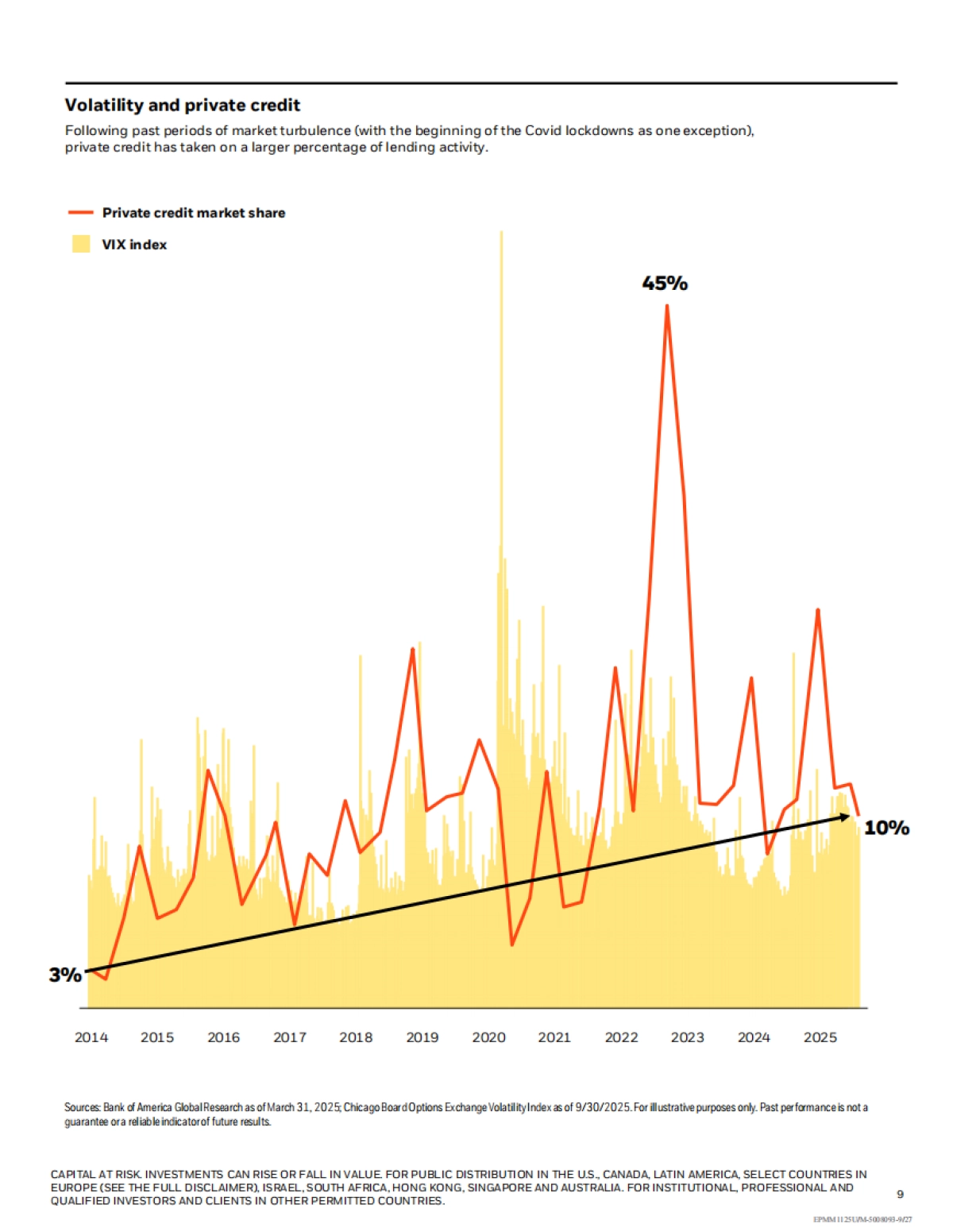
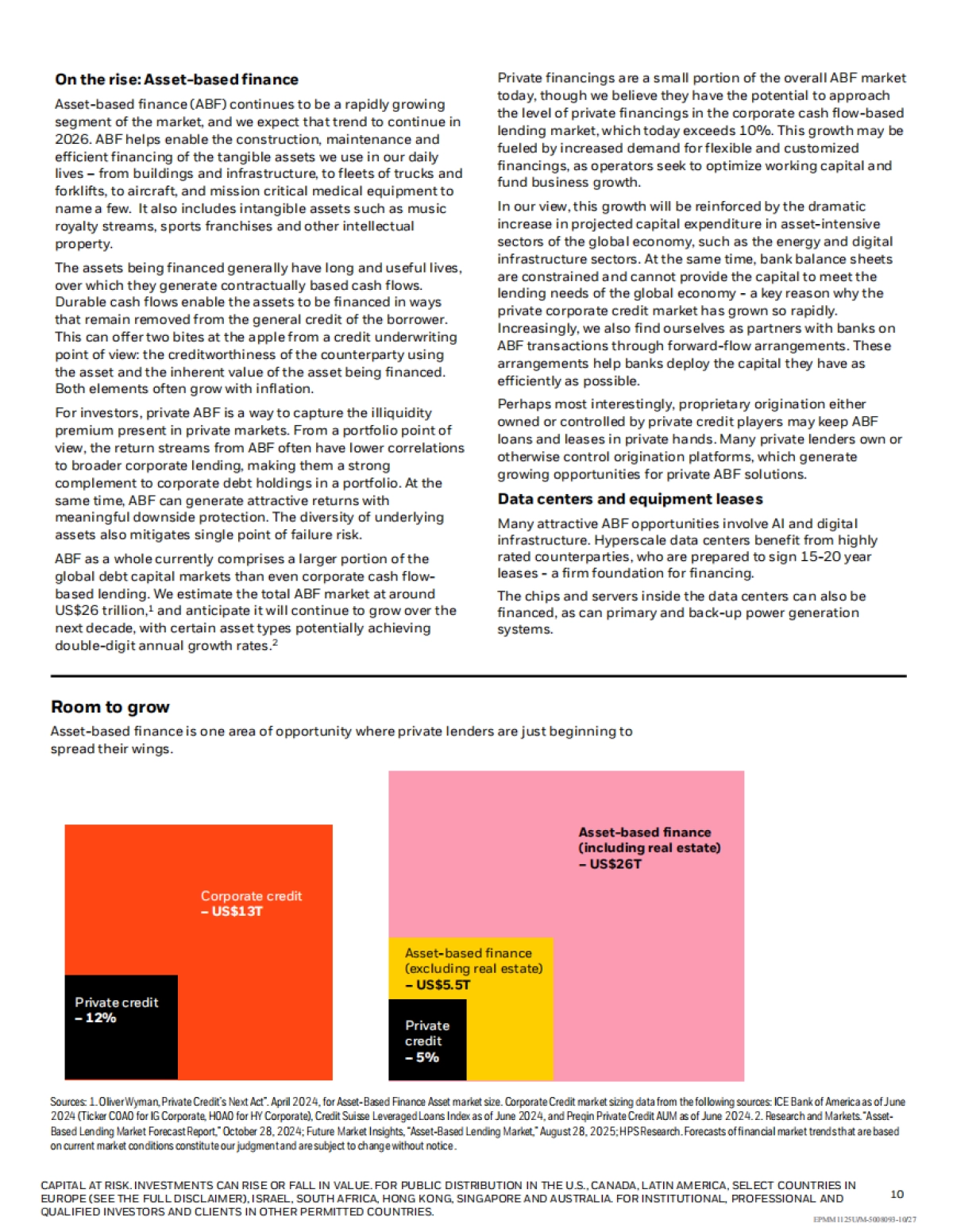
2026PrivateMarketsOutlookA New ContinuumBlackRock.RISK INVESSINGAPORE AND AUSTRALIA.FOR INSTITUTIONAL PROFESSIONAL AND QUALPERMITTED COUNTRIESWelcome letterPrivate markets are evolving to meetworking together is best positioned to meet the needsthe challenges of a new investing era.BlackRockof sponsors,limited partners and private companies foris committed to staying at the forefront ofintegrated financing solutions.that evolution.In infrastructure,we have brought togetherThere's no denying that private assets are becoming agovernments and technology leaders to finance thekey component of a whole-portfolio strategy for morefuture of Al and energy.And in data and analytics,weclients.This is happening at a time when privateare integrating Preqin and our Aladdin platform tomarkets themselves are becoming:seamlessly translate private markets into the languageMore transparent:Investors have more informationof client portfolios.on private fund managers,the assets they invest inAs more clients integrate public and private marketsand their performance.into their portfolios,they are looking to simplify theMore holistic:Whole-portfolio views and riskequation by seeking solutions from fewer partners whomanagement are being connected across the spectrumcan meet their full set of needs from alpha generation toof public and private holdings.diversification,and transparency to whole-portfoliooutcomesMore accessible:Evergreen structures and wrappers,such as ELTIFs in Europe and U.S.models featuringWe are proud to be at the forefront of enhancingprivate market allocations,are opening up privateopportunities in private markets for clients of all sizesmarket asset classes for more investors.and around the world,just as we have done across assetclasses for more than 35 years.These advances are reshaping portfolios notjust forfrom traditional 60/40 approaches towards 50/30/20allocations,with private assets making up the 20%.Countries like the U.S.and the UK are consideringlegislative changes to increase the adoption of privateassets within defined contribution plans,initiativesthat could transform the future of retirement savings.To meet this fundamental change to the investmentuniverse and provide the best possible solutions for ourclients,BlackRock is rapidly expanding our platform forprivate markets.In 2025,we welcomed HPS,a leading global privatecredit manager,and Preqin,the foremost providerof private markets data and insights,following theintegration of GIP,an industry-leading infrastructuremanager,who became a part of BlackRock in 2024.With HPS joining BlackRock,we have combined thefirm's private credit,leveraged finance,CLO,privateequity co-investments,secondaries and deal-origination capabilities.We believe a single teamRobert S.KapitoPresident and a Director of BlackRockCAPITAL AT RISK.INVESTMENTS CAN RISE OR FALL IN VALUE FOR PUBLIC DISTRIBUTION IN THE U.S.,CANADA,LATIN AMERICASELECT COUNTRIES IN EUROPE(SEE THE FULL DISCLAIMER).ISRAEL SOUTH AFRICA.HONG KONG.SINGAPORE ANDAUSTRALIA.FOR INSTITUTIONAL,PROFESSIONAL AND QUALIFIED INVESTORS AND CLIENTS IN OTHER PERMITTED COUNTRIES.Key takeawaysIn 2026,private markets are transforming howIn private equity,more investors are usingsocieties build infrastructure,how businessessecondaries for liquidity and portfoliofinance growth,and how investors achievemanagement,and we're seeing attractivediversification in their portfolios.opportunities in both growth equity andco-investments.Episodes of high volatility are leading privatecredit to take on a larger percentage of overallThe global real estate market has undergonelending activity,with expanding opportunitiesa reset,with residential,industrial andin asset-based financing and high-gradespecialized property types,such as datacorporate credit.centers,taking the lead.Mega forces,such as digitalization and Al,theMore wealth and retirement investors aretransition to a low-carbon economy,andparticipating in private markets,takingdemographic change are increasing the globaladvantage of new fund structures foropportunity set for private infrastructureaccessibility and liquidity,as well as newinvestment.technologies for portfolio transparency.Table of contentsIntroductionPrivate equity515Private creditReal estate820InfrastructureAlternative portfoliosolutions1223Sources-Unlessotherwise noted,source for all data is BlackRock as of November 2025.Assumptions,opinions and estimates are provided for illustrative purposesonly.They should not be relied uponas recommendations to buy or sell securities.Forecastsof financial market trendsthat are based on currentmarketconditionsconstitute ourjudgment and are subject to change without notice.CAPITAL AT RISK.INVESTMENTS CAN RISE OR FALL IN VALUE FOR PUBLIC DISTRIBUTION IN THE U.S.,CANADA,LATIN AMERICA,SELECT COUNTRIES INEUROPE(SEE THE FULL DISCLAIMER),ISRAEL,SOUTH AFRICA,HONG KONG,SINGAPORE AND AUSTRALIA.FOR INSTITUTIONAL,PROFESSIONAL AND3QUALIFIED INVESTORS AND CLIENTS IN OTHER PERMITTED COUNTRIES.AuthorsAdebayo OgunlesiAdam RyanChairman Chief Executive Officer ofChief Investment Officer,Global Infrastructure Partners,a partMulti-Alternativesof BlackRockBrent PatryMichael PattersonGlobal Head,Equity Private Markets,Co-President and Head of DirectCo-Head of GP/LP SolutionsLending,HPS,a part of BlackRockRaffaele SaviGlobal Head,BlackRock SystematicContributorsAmanda LynamHugh LawsonHead of MacroManaging Director,HPS,Credit Researcha part of BlackRockLynn BaranskiMadelaine O'ConnellGlobal Co-Head and ClO,Managing Director,HPS,a part ofPrivate Equity PartnersBlackRockPaul TebbitThomas Mueller-BorjaGlobal Co-Head for Real EstateGlobal Co-Head for Real EstateVidy VairavamurthyChief Investment OfficerAltemative Portfolio SolutionsCAPITAL AT RISK.INVESTMENTS CAN RISE OR FALL IN VALUE FOR PUBLIC DISTRIBUTION IN THE U.S.,CANADA,LATIN AMERICA,SELECT COUNTRIES INEUROPE(SEE THE FULL DISCLAIMER),ISRAEL,SOUTH AFRICA,HONG KONG,SINGAPORE AND AUSTRALIA.FOR INSTITUTIONAL,PROFESSIONAL ANDQUALIFIED INVESTORS AND CLIENTS IN OTHER PERMITTED COUNTRIES.IntroductionPrivate creditInfrastructurePrivate equityReal estatePortfolio perspectivePrivate markets at a step changeAs the world's capital seeks resilience in a changingChallenges remain for private investors,though,particularlyglobal economy,private markets hold the key to manyaround liquidity.pressing challenges and opportunities.In 2026,they haveWith IPO and M&A activity slowing in recentyears,manythe potential to redefine the ways that states andhigh-quality companies are staying private longer andcorporations build infrastructure,how businesses financeincreasingly working within the private markets fortheir growth and how investors build diversified portfolios.financing,namely through private credit and secondarystrategies.As these areas expand,private credit and privateIn the U.S.,the number of listed domestic companies hasequity are becoming essential to capturing the fullfallen from 8,000 in the mid-1990s to fewer than 4,500opportunity set.today,1 as a result of consolidation,de-listings,andcompanies choosing to remain private for longer.Distributions at a premiumInvestors continue to list the exit environment for private assets as a primary concern.Proportion of respondents0%20%40%60%80/%Exit environmentAs set valuationsGeopolitical landscapeInterest ratesStock market volatilityDeal flowCompetition for assets■25-Juna24-Jun■23-JunSources:1.IPO Data.Jay R.Ritter.July 2025.Chart:Pregin June 2025.Imvestorswere asked'What are key challenges for return generation in the next 12 months?CAPITAL AT RISK.INVESTMENTS CAN RISE OR FALL IN VALUE.FOR PUBLIC DISTRIBUTION IN THE U.S..CANADA.LATIN AMERICA.SELECT COUNTRIES INEUROPE(SEE THE FULL DISCLAIMER),ISRAEL,SOUTH AFRICA,HONG KONG,SINGAPORE AND AUSTRALIA.FOR INSTITUTIONAL,PROFESSIONAL ANDQUALIFIED INVESTORS AND CLIENTSIN OTHER PERMITTED COUNTRIES.5Equity investors,meanwhile,are solving for liquidity in theIn addition to acting as a critical "release valve"for liquidity inevolving secondaries market.As we'll explore further in theprivate markets,secondaries can offer new investors instantprivate equity section,secondaries can offer investors a reliablediversification with shorter holding periods.And secondariesplace to sell fund holdings as part of their regular portfolioare emerging as attractive investments in private credit,management.And fund managers can sell individual fundinfrastructure and real estate as well.This newfound liquidityholdings on the secondaries market,allowing them to returnplaces private assets into a less binary relationship with publiccapital to investors.At the same time,managers are able tomarkets and into something more like a continuum.offer specific fund holdings to new investors via continuationvehicles.Coming togetherNew fund structures,liquidity solutions,and data are allowing more investorsto bring public and private markets together in their portfolios.Public marketsThe New·LiquidContinuumAccessibleTransparentof private andNew fundpublic marketsstructuresNew liquiditysolutionsNew dataPrivate marketsHarder to accessOpaqueCAPITAL AT RISK.INVESTMENTS CAN RISE OR FALLIN VALUE.FOR PUBLIC DISTRIBUTION IN THE U.S.,CANADA,LATIN AMERICA,SELECT COUNTRIES INEUROPE(SEE THE FULL DISCLAIMER),ISRAEL,SOUTH AFRICA,HONG KONG,SINGAPORE AND AUSTRALIA.FOR INSTITUTIONAL PROFESSIONAL ANDQUALIFIED INVESTORS AND CLIENTS IN OTHER PERMITTED COUNTRIES.6An evolving investor baseEntire markets,whole portfoliosThis continuum is becoming visible in the investor base as wellThe new continuum of private and public markets is alsoas the vehicles being used to invest in private assets.Newerreflected in a growing emphasis among investors for a whole-client segments,such as wealth investors,are increasing theirportfolio approach that incorporates active equities,fixedallocations to private markets largely via evergreen fundincome,cash,multi-assets,index funds and private markets.structures,such as ELTIFs,LTAFs and model portfolios,whichA blended approach that incorporates the entire spectrum ofcan offer greater liquidity.public and private asset classes is necessary to capture someThese open-ended,semi-liquid vehicles offer continuousof the biggest investment opportunities emerging today,inaccess,allowing investors to subscribe and redeem regularly,our view.One example is artificial intelligence,many of whoseunlike traditional closed-end funds.Evergreen funds can alsoemerging leaders are primarily accessible to investors onlyaddress legacy barriers,such as intermittent capital calls andthrough venture capital,growth private equity and privatelimited liquidity,while offering periodic distributions andcredit.simplified tax reporting.At the same time,the immense buildout of data centers,dataThis broadening of the investor base isn't due to just wealthtransmission towers and cable networks,along with theirinvestors.In the U.S.and elsewhere,there is a push to makerelated power generation and storage needs,are creatingprivate markets accessible to retirement investors in definedfresh opportunities for infrastructure and real estatecontribution plans.In August,the U.S.Department of Laborinvestors.rescinded its previous guidance against 401(k)plan fiduciariesAs the distinction between private and public markets growsincluding private assets in their plans.According toBlackRock's own research,1 adding private assets to the target-less absolute,there are more insights to be gained frommanaging both.This dynamic has led more investors to add todate funds used in mamy retirement plans could generatetheir private markets allocations and explore more ways thatabout 15%more money in a participant's 401(k)over 40 yearsprivate assets can improve the risk-reward profile of theirthrough compounding.overall portfolios.We believe the addition of these new participants will addstable capital and liquidity to private markets,while driving newThe complexity and opacity of private markets remain achallenge for this large pool of potential investors.But asinnovations in the year ahead.investor familiarity and data transparency improve,the trendof more varieties of investors adding to their private marketsallocations is one worth watching in the year ahead.More accessibleThe number of evergreen funds continues to grow rapidly,with total NAV exceeding US$400 billion for the firsttime.80070060050040030020010002016201720182019202020212022202320242025 YTDSources:Chart Pregin,October 2025.Total no.of liquid private market funds each yearincludes BDCs.Interval Funds Non-traded REITs,tender Offers,ELTIFs,and LTAFs.For illustrative purposesandourprivate-marketsinvestment teams,we estimate that adding private equity and private credit to a targetdate solution could boost overall investment performance by roughly 50bp on averageeach yearthroughout the strategy's lifetime The 15%higher account balance over 40years figure isderived using our CMAs")for private credit(direct lending)and US private equity (buyout)Theequity.5%for public fixed income and 8%for public equities.A 10%-20%average reallocation from public toprivate blended across privateequity and privatecreditis estimated toprovide anSuch projectionsdonot reflect actual performance and cannotaccount for the impactthat economic,market and other factors may have on the imp lementationof an actual investment program nordothey considerthe impact oftradingdecisions,liquidityconstraints,fees,taxes and other factors on future returns.Norepresentationismade that any proposed or future strategy will achieve theCAPITAL AT RISK.INVESTMENTS CAN RISE OR FALLIN VALUE.FOR PUBLIC DISTRIBUTION IN THE U.S.,CANADA,LATIN AMERICA,SELECT COUNTRIES INEUROPE (SEE THE FULL DISCLAIMER,ISRAEL,SOUTH AFRICA,HONG KONG,SINGAPORE AND AUSTRALIA.FOR INSTITUTIONAL,PROFESSIONAL ANDQUALIFIED INVESTORS AND CLIENTS IN OTHER PERMITTED COUNTRIES.IntroductionPrivate creditPrivate equityReal estatePortfolio perspectivePrivate creditEpisodes of high volatility,as we saw in 2025,historically have the long-term effectof acclimating more borrowers to private credit.Asset-based financing is one area of private credit where we expect to see aprofound increase in opportunities in 2026.Driven by heightened demand,private high-grade credit has been expanding,andwe expect that to continue in the year ahead.A change in mindsetHeightened volatility and uncertainty drove morePeriods of elevated market volatility have generally beenfollowed by periods when private credit's share of the totalborrowers to private credit in 2025,and we see themleveraged finance market has grown rapidly.leading to continued growth in 2026.That volatility,drivenlargely by policy announcements and their aftershocks,Private credit issuance levels have historically remainedpersisted throughout the year,though investors have re-relatively consistent throughout market environments dueentered the markets as tariff policy has clarified.1to the longer-term nature of private credit's underlyingThrough this period,private credit fundamentals have heldcapital base.At the same time,the disruption of syndicatedloan markets can help reinforce private credit's certainty ofup well as the majority of companies have navigated recentexecution and the terms it offers relative to public markets.volatility with resiliency and even EBITDA growth.2 Basedon experience with our own portfolio companies,largerEven after volatility recedes and other lenders re-enter thecompanies have generally been able to manage thismarket,borrowers often remain receptive to paying theenvironment of higher base rates and inflationarypremium financing costs associated with private credit inpressure,mostly by using a combination of cost controlsexchange for increased certainty of execution.Thisand cost pass-throughs.dynamic can be particularly pronounced among issuersfinancing M&A or facing specific near-term maturities orThe year's elevated market volatility disrupted theother deadlines,where execution certainty is more critical.syndicated loan market after a strong first quarter.Broadlysyndicated loan new issuance in April 2025 was the lowestWe also believe that repeated bouts of volatility can have ait had been since August 2024,at just US$7 billion.cumulative impact on the mindset of prospective issuers,Volatility also gave some banks pause in syndicating newsupporting a structural shift to private credit solutions.deals:13 deals representing US$10.7 billion were pulledfrom the syndicated market through the end of April 2025,Credit is one area where the public-private continuum is amatter of common practice-banks frequently partner withand the leveraged loan market was on the cusp of itslongest run without a deal since at least 2013.3private lenders on larger loans,where the banks'balancesheets may be constrained.At the same time,private creditWhile syndicated credit markets opened up in the secondmanagers frequently compete for the same deals ashalf of the year,this type of bank and broadly syndicatedsyndicated lenders,with borrowers willing to pay theloan market reaction to volatility has the potential to createprivate-credit premium based on other factors,like certaintya real and lasting opportunity for private credit.of execution and the flexibility to customize solutions.June 2025.3.Pitchbook LCD.September 2025.CAPITAL AT RISK.INVESTMENTS CAN RISE OR FALL IN VALUE FOR PUBLIC DISTRIBUTION IN THE U.S.,CANADA,LATIN AMERICA,SELECT COUNTRIES INEUROPE(SEE THE FULL DISCLAIMER),ISRAEL,SOUTH AFRICA,HONG KONG,SINGAPORE AND AUSTRALIA.FOR INSTITUTIONAL,PROFESSIONAL AND8QUALIFIED INVESTORS AND CLIENTS IN OTHER PERMITTED COUNTRIES.Volatility and private creditFollowing past periods of market turbulence(with the beginning of the Covid lockdowns as one exception),private credit has taken on a larger percentage of lending activityPrivate credit market shareVIX index45%3%201420152016201720182019202020212022202320242025guarantee ora reliable indicatorof future results.CAPITAL AT RISK INVESTMENTS CAN RISE OR FALL IN VALUE FOR PUBLIC DISTRIBUTION IN THE U.S.,CANADA,LATIN AMERICA,SELECT COUNTRIES INEUROPE(SEE THE FULL DISCLAIMER),ISRAEL,SOUTH AFRICA,HONG KONG,SINGAPORE AND AUSTRALIA.FOR INSTITUTIONAL,PROFESSIONAL ANDQUALIFIED INVESTORS AND CLIENTS IN OTHER PERMITTED COUNTRIES9On the rise:Asset-based financePrivate financings are a small portion of the overall ABF marketAsset-based finance(ABF)continues to be a rapidly growingtoday,though we believe they have the potential to approachsegment of the market,and we expect thattrend to continue inthe level of private financings in the corporate cash flow-based2026.ABFhelps enable the construction,maintenance andlending market,which today exceeds 10%.This growth may befueled by increased demand for flexible and customizedefficient financing of the tangible assets we use in our dailylives -from buildings and infrastructure,to fleets of trucks andfinancings,as operators seek to optimize working capital andforklifts,to aircraft,and mission critical medical equipmenttofund business growth.name a few.It also includes intangible assets such as musicIn our view,this growth will be reinforced by the dramaticroyalty streams,sports franchises and other intellectualincrease in projected capital expenditure in asset-intensiveproperty.sectors of the global economy,such as the energy and digitalinfrastructure sectors.At the same time,bank balance sheetsThe assets being financed generally have long and useful lives,are constrained and cannot provide the capital to meet theover which they generate contractually based cash flows.Durable cash flows enable the assets to be financed in wayslending needs of the global economy-a key reason why thethat remain removed from the general credit of the borrower.private corporate credit market has grown so rapidly.This can offer two bites at the apple from a credit underwritingIncreasingly,we also find ourselves as partners with banks onpoint of view:the creditworthiness of the counterparty usingABF transactions through forward-flow arrangements.Thesethe asset and the inherent value of the asset being financed.arrangements help banks deploy the capital they have asBoth elements often grow with inflation.efficiently as possible.For investors,private ABF is a way to capture the illiquidityPerhaps most interestingly,proprietary origination eitherowned or controlled by private credit players may keep ABFpremium present in private markets.From a portfolio point ofview,the return streams from ABF often have lower correlationsloans and leases in private hands.Many private lenders own orto broader corporate lending,making them a strongotherwise control origination platforms,which generatecomplement to corporate debt holdings in a portfolio.At thegrowing opportunities for private ABF solutions.same time,ABF can generate attractive returns withData centers and equipment leasesmeaningful downside protection.The diversity of underlyingMany attractive ABF opportunities involve Al and digitalassets also mitigates single point of failure risk.infrastructure.Hyperscale data centers benefit from highlyABF as a whole currently comprises a larger portion of therated counterparties,who are prepared to sign 15-20 yearglobal debt capital markets than even corporate cash flow-leases-a firm foundation for financing.based lending.We estimate the total ABF market at aroundThe chips and servers inside the data centers can also beUS$26 trillion,1 and anticipate it will continue to grow over thefinanced,as can primary and back-up power generationnext decade,with certain asset types potentially achievingsystems.double-digit annual growth rates.2Room to growAsset-based finance is one area of opportunity where private lenders are just beginning tospread their wings.Asset-based finance(including real estate)-US$26TCorporate creditUS$13TAsset-based finance(excluding real estate)-US$5.5TPrivate credit-12%Privatecredit-5%Sources:1.OliverWyman,Private Credit's Next Act.April 2024.for Asset-Based Finance Asset market size.Corporate Credit market sizing data from the following sources:ICE Bank of Americaas ofJune2024 (Ticker COAO for IG Corporate HOAO for HY Corporate).Credit Suisse LeveragedLoans Index as of June 2024.and Preqin Private Credit AUM as of June 2024.2.Research and Markets."Asset-Based Lending Market Forecast Report"October 28.2024:Future Market Insights,"Asset-Based Lending Market"August 28.2025:HPSResearch.Forecasts offinancial market trendsthat are basedon current market conditions constitute our judgmentand are subject to change without notice.CAPITAL AT RISK.INVESTMENTS CAN RISE OR FALL IN VALUE.FOR PUBLIC DISTRIBUTION IN THE U.S.,CANADA,LATIN AMERICA,SELECT COUNTRIES INEUROPE(SEE THE FULL DISCLAIMER),ISRAEL,SOUTH AFRICA,HONG KONG,SINGAPORE AND AUSTRALIA.FOR INSTITUTIONAL,PROFESSIONAL AND10QUALIFIED INVESTORS AND CLIENTS IN OTHER PERMITTED COUNTRIES.Beyond data centers,many users of business-criticalbillion,ahead of 2024's record-setting US$125 billion.1 Weequipment prefer a balance-sheet-light model where theybelieve the stage is set for continued growth in 2026.lease rather than own the assets.Opportunities in this type ofThe increase in deal activity is partially the result of newequipment finance are extensive and range from medicallenders entering the market.Larger insurance companies withequipment to truck fleets to aircraft to photocopiers,to nametheir own in-house capabilities have been the traditionala few.Many of these types of assets come with finance leases,capital providers in this market,and they remain active.Now,where the sum of the lease payments is close to the value ofhowever,asset managers have materially increasedthe asset.The self-amortizing qualities of these leases can bevery attractive.The key to success in this sector is an efficientcompetition for private high-grade debt.We also expect non-U.S.insurers as well as medium-sized and smaller fimms toplatform that can originate assets,underwrite the credit of theend user in a timely manner and service the assets as needed.contribute to greater demand in 2026.With increased demand comes greater competition-resultingReal estate,music and private equityin tighter pricing-though we expect private high-gradeIn other sectors,we think real estate lending is particularlyassets to continue to offer the potential for excess spreadattractive at the moment,notably in the commercial marketabove comparably rated public credit.Private high-gradewhere there has been a massive repricing as rates normalized.offers this excess to investors to compensate them forWe see yields for senior commercial mortgages typically in theilliquidity,complexity and structuring premia,and we seemid-to-high single digits.resilience in the prospect for attractive relative value.On the residential side,the U.S.is facing a shortage of bothA common theme we've observed during the growth of privatesingle-family and multi-family homes.The single-familycredit has been that an influx of capital into a market alsoresidential mortgage market features pockets such as non-draws new borrowers.These borrowers are often looking toqualifying mortgages from high-net-worth borrowers that candiversify their funding sources outside of public markets orbe a better fit for private markets than public securitizationsmay have a specific funding need best tackled through theOther rapidly growing areas of ABFinclude intellectualprivate market.They see the increased demand as a sign thatproperty royalties such as music catalogues and sportsprivate credit can execute at the required scale and offers aviable altemative to public capital.We observe this trend infranchises.We also see an opportunity in extending capital toprivate investment firms and the assets they hold.While theseprivate high-grade as well,contributing to the volume ofare intangible assets rather than hard physical assets,manyopportunities in both the traditional syndicated privategenerate contractually based cash flows and offer the long,placement market and in more bespoke,often directlyuseful lives that hard assets do,making them complementaryoriginated investments.to a portfolio of hard-asset ABF positions.Directly originated investments represent the most attractiveTransformation in private high-gradeopportunity set in the private high-grade market,in our view.By engaging borrowers directly,lenders have the opportunityThe market for private high-grade credit is experiencingto capture not only potentially higher yields but also bespokesignificant change,characterized by growing volumes,newcredit protections in the form of covenants,amortizationparticipants and evolving structures.What had been a markettriggers,parent guarantees and more.As competition in thehistorically focused on unsecured corporate debt to repeattraditional syndicated market continues to grow,we expectborrowers has grown to accommodate a wide range ofindustries and structures and increasingly includes ABFdifferentiation in 2026.opportunities.Issuance in 2025 is on track to exceed US$150A surge in activityVolume in the syndicated private high-grade market has shown notable growth over recent months.$35$33■2024■2025$30$252221$20$17$15$14$15$14$15$12$11$11$10$8$9$10$5$5JanuaryFebruaryMarchAprilMayJuneJulyAugustSeptemberCAPITAL AT RISK.INVESTMENTS CAN RISE OR FALL IN VALUE.FOR PUBLIC DISTRIBUTION IN THE U.S.,CANADA,LATIN AMERICA,SELECT COUNTRIES INEUROPE(SEE THE FULL DISCLAIMER),ISRAEL,SOUTH AFRICA,HONG KONG,SINGAPORE AND AUSTRALIA.FOR INSTITUTIONAL,PROFESSIONAL ANDQUALIFIED INVESTORS AND CLIENTS IN OTHER PERMITTED COUNTRIES.IntroductionPrivate creditPrivate equityReal estatePortfolio perspectivenfrastructureA rapid expansion of digitalization,data migration tothe cloud,and artificial intelligence is driving anunprecedented demand for infrastructure such asdata centers.GlobalThe global energy transition and an added emphasison energy securitywill require substantialInfrastructureinvestments in power generation.Partnersa part of BlackRockGlobal demographic changes-such as rising globalpopulations,es pecially in cities -is increasing theneed for infrastructure investment.A potentially generational investment opportunityOver the past two decades,the infrastructure asset class has become one of the key pillars of the privatemarkets,providing capital for assets that form the backbone of the global economy.Looking forward,even more substantial investments in infrastructure will be a required enabler of thefoundational forces(outlined below)that will shape global economic activity over the next several decadesWith the availability of public capital constrained by rising govemment debts and deficits,we believe theconvergence of these long-term forces is creating a generational investment opportunity and that we standat the threshold of a "golden age"of private infrastructure investingCAPITAL AT RISK.INVESTMENTS CAN RISE OR FALLIN VALUE.FOR PUBLIC DISTRIBUTION IN THE U.S.,CANADA,LATIN AMERICA,SELECT COUNTRIES INEUROPE (SEE THE FULL DISCLAIMER),ISRAEL SOUTH AFRICA,HONG KONG,SINGAPORE AND AUSTRALIA.FORINSTITUTIONAL,PROFESSIONAL ANDQUALIFIED INVESTORS AND CLIENTS IN OTHER PERMITTED COUNTRIES.12Artificial intelligence and digital infrastructureThe global energy transition and energy securityThe rapid expansion of digitalization,data migrationThe global energy transition is another key driver of the needto the cloud,and artificial intelligence (Al)is driving anfor infrastructure investments.Achieving the global net-zerounprecedented demand for cloud computing,data processing.objective will require over US$100 trillion of investments byand enabling infrastructure such as data centers.2050,approximately US$40 trillion of which relate directly toThis growth requires large-scale supply solutions.Throughinfrastructure investments.32030,global data-center demand is projected to grow at aAt the same time,since the beginning of the Russia-Ukrainecompound annual rate of 20%,with an estimated investmentwar,many countries have placed added emphasis on energyrequirement of US$1.5 trillion.1 At the same time,demand forsecurity.electricity to power these data centers is expected to increaseto two to four times current levels.2Achieving these goals will require very substantial investmentsin power generation(renewables,gas-fired,and in the longerWe believe investments in hyperscale data centers present aterm nuclear),and significant upgrades to the electricityparticularly compelling opportunity that is underpinned bydistribution systems,as well as investments that enabledurable demand from long-term supply-demand imbalances.decarbonization of molecules (e.g.clean fuels,carbon capture,high barriers to entry created by high capital intensity andand circular economy).complexity of execution,long-duration contracts with high-quality counterparties,and highly compelling economics.CAPITAL AT RISK.INVESTMENTS CAN RISE OR FALLIN VALUE.FOR PUBLIC DISTRIBUTION IN THE U.S,CANADA,LATIN AMERICA,SELECT COUNTRIES INEUROPE (SEE THE FULL DISCLAIMER),ISRAEL,SOUTH AFRICA,HONG KONG,SINGAPORE AND AUSTRALIA.FOR INSTITUTIONAL,PROFESSIONAL ANDQUALIFIED INVESTORS AND CLIENTS IN OTHER PERMITTED COUNTRIES.13Global demographicsThe fundamental forces that are driving the requirement forinvestments in infrastructure are likely to persist for the long-Global demographic change is another fundamental trendterm.By 2040,the gap between the historical pace offorce that will drive the need for increased infrastructureinfrastructure investments and the projected funding needs isinvestment.While the trend in many developed economies isprojected to be US$15 trillion.3 As previously noted,the needaging populations and declining birth rates,many emergingfor infrastructure investment is occurring at a time in which aeconomies are on the opposite trajectory.The upshot is thattraditional source-public capital,is increasingly constrained.global population is projected to remain on a steady upwardGovemments across the major global economies face risingtrajectory over the next half-century,and will surpass 10 billionin the 2080s.1 This growth will be accompanied by a furtherand potentially unsustainable debts and deficits,makingprivate capital the only plausible solution.Privateacceleration in urbanization,with over 60%of the world'sinfrastructure capital brings with it the added potentialpopulation expected to live in urban areas by 2050.2 Again,benefits of more efficient and higher-quality solutions andtremendous amounts will have to be invested in infrastructure,long-term alignment.As we look ahead,we see private capitalboth in advanced economies to replace aging assets,and inplaying a pivotal role in bridging the infrastructure funding gapemerging economies to meet new demand.and helping to shape the infrastructure investment landscapefor decades to comeSources.1.United Nations,Departmentof Economicand Social Affairs,Population Division(2024)WorldPopulation Prospects 2024:Ten Key Messages.2.United Nations,Department ofEconomic and Social Affairs(2019)World Urbanization Prospects:2018 Revision 3.Infrastructure OutlookA G20 Initiative,Global Infrastructure Outlook,includes data from 56 countriesacross 7 sectors and5 regions.CAPITAL AT RISK.INVESTMENTS CAN RISE OR FALLIN VALUE.FOR PUBLIC DISTRIBUTION IN THE U.S.,CANADA,LATIN AMERICA,SELECT COUNTRIES INEUROPE (SEE THE FULL DISCLAIMER),ISRAEL,SOUTH AFRICA,HONG KONG,SINGAPORE AND AUSTRALIA.FOR INSTITUTIONAL,PROFESSIONAL AND14QUALIFIED INVESTORS AND CLIENTS IN OTHER PERMITTED COUNTRIES.ction:reditfrastructurePrivate equityReal estatePortfolio perspectivePrivate equityThe secondaries market is both expanding and maturing,with more investors usingit as a liquidity source and a tool for regular portfolio management.We see more opportunities in growth equity as companies seek fresh funding onmore attractive terms,while managers benefit from an increase in available data.Co-investments are becoming a cornerstone of portfolios as overall deal sizes rise,while investors seek more control,transparency and cost efficiency.Amid change,a focus on liquidityPrivate equity is in transition.After years of strongThe unifying theme is that private equity is changing.fundraising and performance,private equity investorsIt's still growing,but more slowly.It's more competitiveand managers have turned their focus to liquidity.than ever,with deal volume still weaker than expected,The return of capital to limited partners is essential toand the need for distributions ever-present.Thisallow them deploy into new vintages and emergingcompetition is driving innovation in new fundinvestments.In addition,LPs are increasingly usingstructures as well as more ways to unlock liquidity-liquidity tools such as the secondaries market as partinnovation which we believe is set to continue.of their regular portfolio management.Liquidity is vitalTechnology is another important element in thefor general partners to source new investmentbroader transformation of private equity.In growthopportunities and create value in their portfolioequity,broader data sets help managers potentiallycompanies,as well as growing their own businesses byboost returns by tailoring analytical data science toolsattracting and retaining top talent.traditionally deployed in public markets.This expandedToday,we see value in providing this liquidity.It's ause of data in private equity is just another example ofmajor reason why secondary market volume keepsthe public-private continuum we see continuing in thegrowing,becoming an integral tool for GPs and LPsyears ahead.alike.Market participants are looking for fewer,morestrategic partners to help them with a range of liquidityneeds-across debt and equity and across the riskspectrum.These solutions continue to evolve,even aswe see signs of deal volume picking up,supported bylower interest rates.CAPITAL AT RISK INVESTMENTS CAN RISE OR FALL IN VALUE FOR PUBLIC DISTRIBUTION IN THE U.S..CANADA,LATIN AMERICA.SELECT COUNTRIES INEUROPE(SEE THE FULL DISCLAIMER),ISRAEL,SOUTH AFRICA,HONG KONG,SINGAPORE AND AUSTRALIA.FOR INSTITUTIONAL,PROFESSIONAL ANDQUALIFIED INVESTORS AND CLIENTS IN OTHER PERMITTED COUNTRIES.15
文档评分
    请如实的对该文档进行评分
  • 0
发表评论

特惠

限量优惠活动

正在火热进行

站长

添加站长微信

领取新人礼包

下载

便携运营智库

立即下载APP

工具

运营导航

工具推荐

帮助

帮助中心

常见问题

分销

50%直推收益

30%间推分成

AI

智能对话

办公助手

顶部