
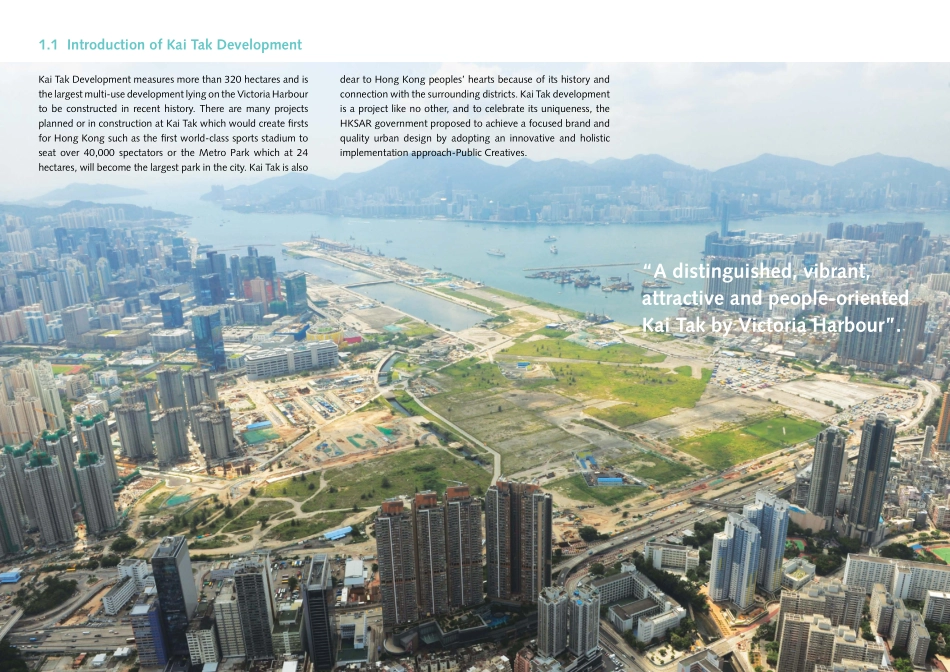
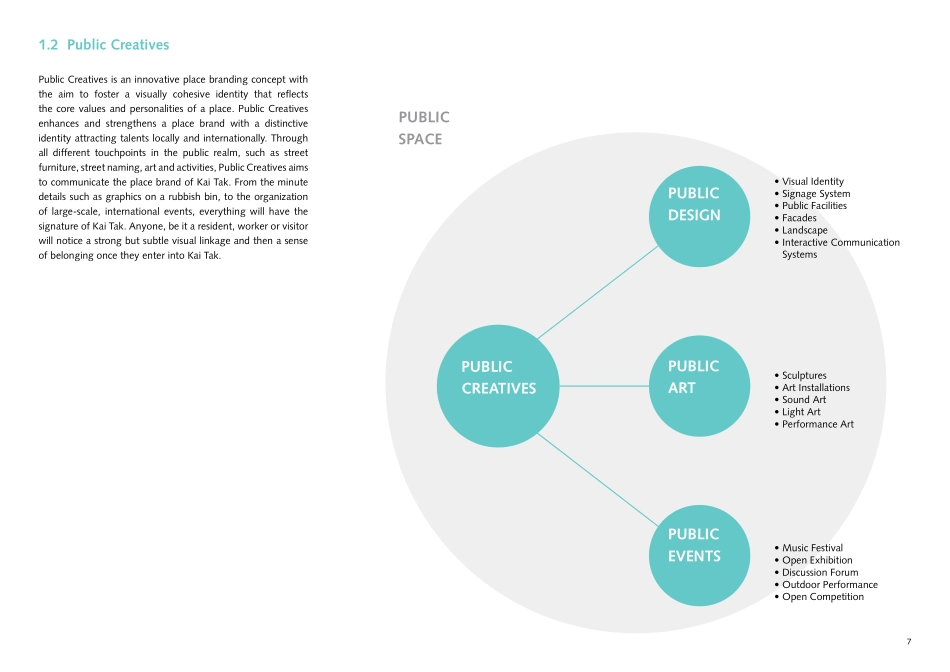
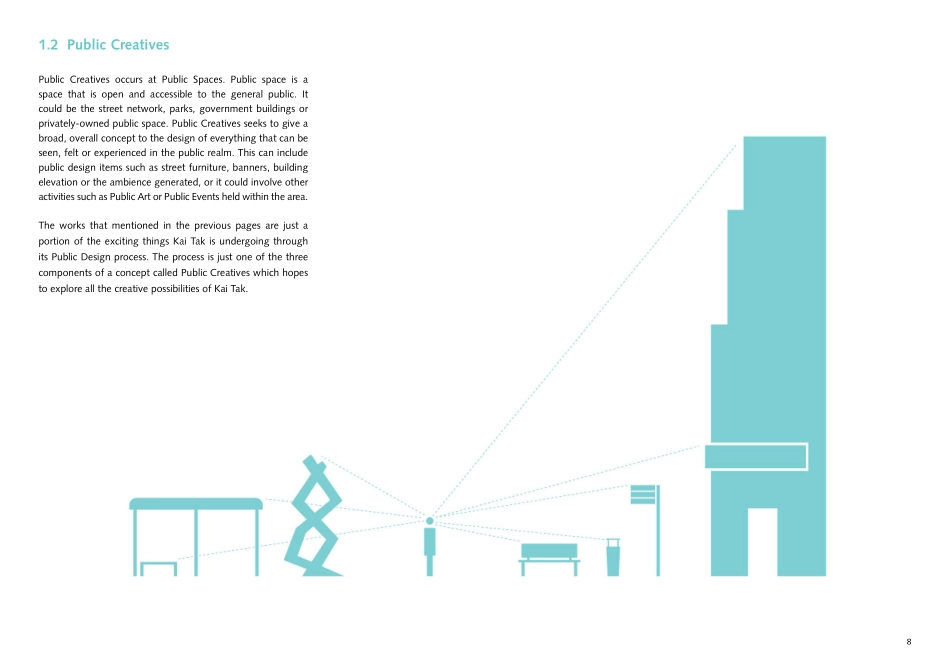
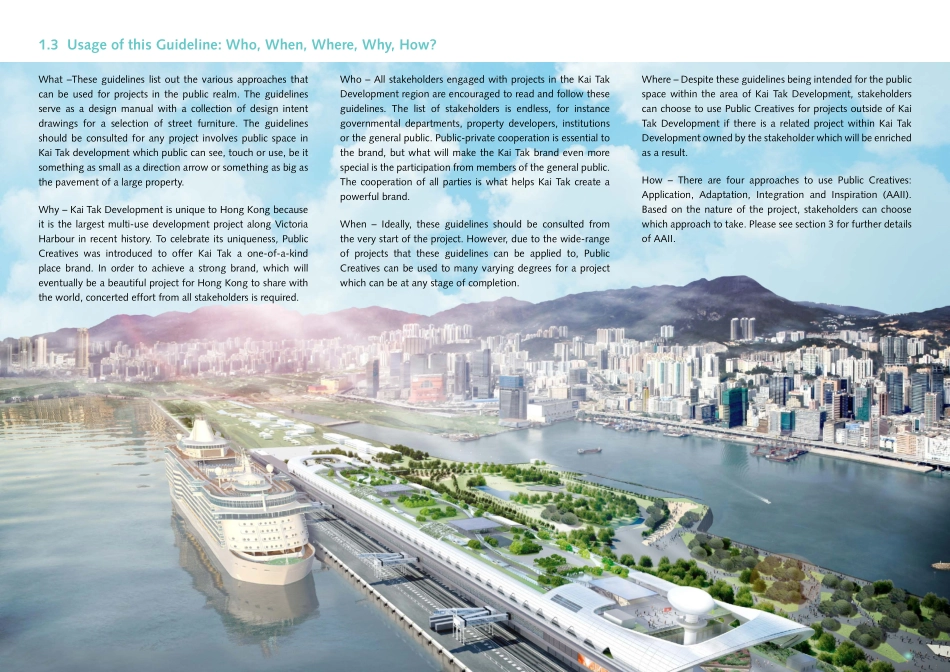
Kai Tak Brand Identity Manual and Public Creatives GuidelineIt is believed that Kai Tak Development has ever been the one and only single project in Hong Kong inheriting the largest public space. Public Creatives is a methodology to integrate the merit of design, art and event of a public space, develop a single yet collective vision, encourage participation of stakeholders, professionals and the publics to collaboratively orchestrate a policy for sustainable development.Kai Tak Development sets a significant reference for Hong Kong of realisation of Public Creatives; breakthroughs the common practices and perception of public space usage, paves a ground for further development for the habitants from old communities (surrounding districts) as well as the immigrants from the new (passengers of Cruise Terminal). It brings the old and the new together, through the 4 approaches of AAII System to evolve along the times, the happenings and the development of the environment.31. Background1.1 Introduction of Kai Tak Development1.2 Public Creatives1.3 Usage of this Guideline: Who, When, Where, Why, How? 1.4 Identity of Kai Tak 1.4.1 The Inheritance 1.4.2 The People 1.4.3 Our home1.5 Creative principles (6 personalities)1.6 Over-arching design theme (Current of Vitality)1.7 Tree as a Metaphor 2. Zoning of Kai Tak2.1 Connection points of Kai Tak2.2 Overview of the planned projects for Kai Tak 3 How to Use the Guidelines3.1 What is AAII?3.2 How to approach the design process 3.2.1 Fix the Project Scope 3.2.2 Consider the Location and Function of the Project 3.2.3 Determining the characteristic of your project 3.2.4 Graphic and 3D Item Considerations 3.2.5 Employment Example of AAII Approaches Content4. Development of Visual Language4.1 DNA Bar4.2 Energy Swirl 5. Brand Identity Guidelines 5.1 The Logo 5.1.1 Fundamental Logo and Signature Elements 5.1.2 Signature Lock-up 5.1.3 Full Colour and Single Colour Versions 5.1.4 Black and White Versions 5.1.5 Signature Spacing Standards 5.1.6 Minimum Size 5.1.7 Clear Space5.2 Colour Scheme 5.2.1 Main Colours 5.2.2 Highlight Colours 5.2.3 Exemptions5.3 Typeface 5.3.1 Chinese Typeface 5.3.2 English Typeface5.4 Examples of Incorrect Use6. Supporting Graphics System6.1 DNA Bar 6.1.1 Variation 6.1.2 Examples of Colour Use in Different Variation6.2 Energy Swirl 6.2.1 Selection 6.2.2 Placement 6.2.3 Minimum Size 6.2.4 Colour - Black and White - Employment of Colour Scheme - Cropping Colours - Cropping Reverse Colours 6.2.5 Examples of Incorrect Use7. Application Examples7.1 Promotional Materials 7.1.1 Banners 7.1.2 Advertisements7.2 Informational Materials 7.2.1 Booklet 7.2.2 Pamphlet47.3 Semi-permanent Applications 7.3.1 Hoarding7.4 Permanent Applications 7.4.1 Façade treatment 8. Signage System8.1 Signage Icon8.2 Alignment9. Ambience Design Considerations9.1 Residential9.2 Commercial9.3 Sports and Entertainment9.4 Parks and Promenades9.5...