pazloupnyeunsopsiaolandPolicy Research Working Paper11105Participation in Pension ProgramsinLow-and Midale-Income CountriesJohnGilesClementJoubertpaz,louIny aunsolpsia o]andTomoakiTanakaWORLDBANKGROUPDevelopment Economics Development Research Group,April2025
Participation in Pension Programs in Low andMiddle Income CountriesTohn Giles'ClementlouberttTomoakiTanakatJELClassification:H55.G51Keywords: pensions, retirement, savings, informality, LMICs"World Bank and IZA.#World Bank and IZA. corresponding authr: joubert@worldbank org+Queen Mary University of London, the Japan International Cooperation Agency (JICA), and the Unisversity ofTokyo.
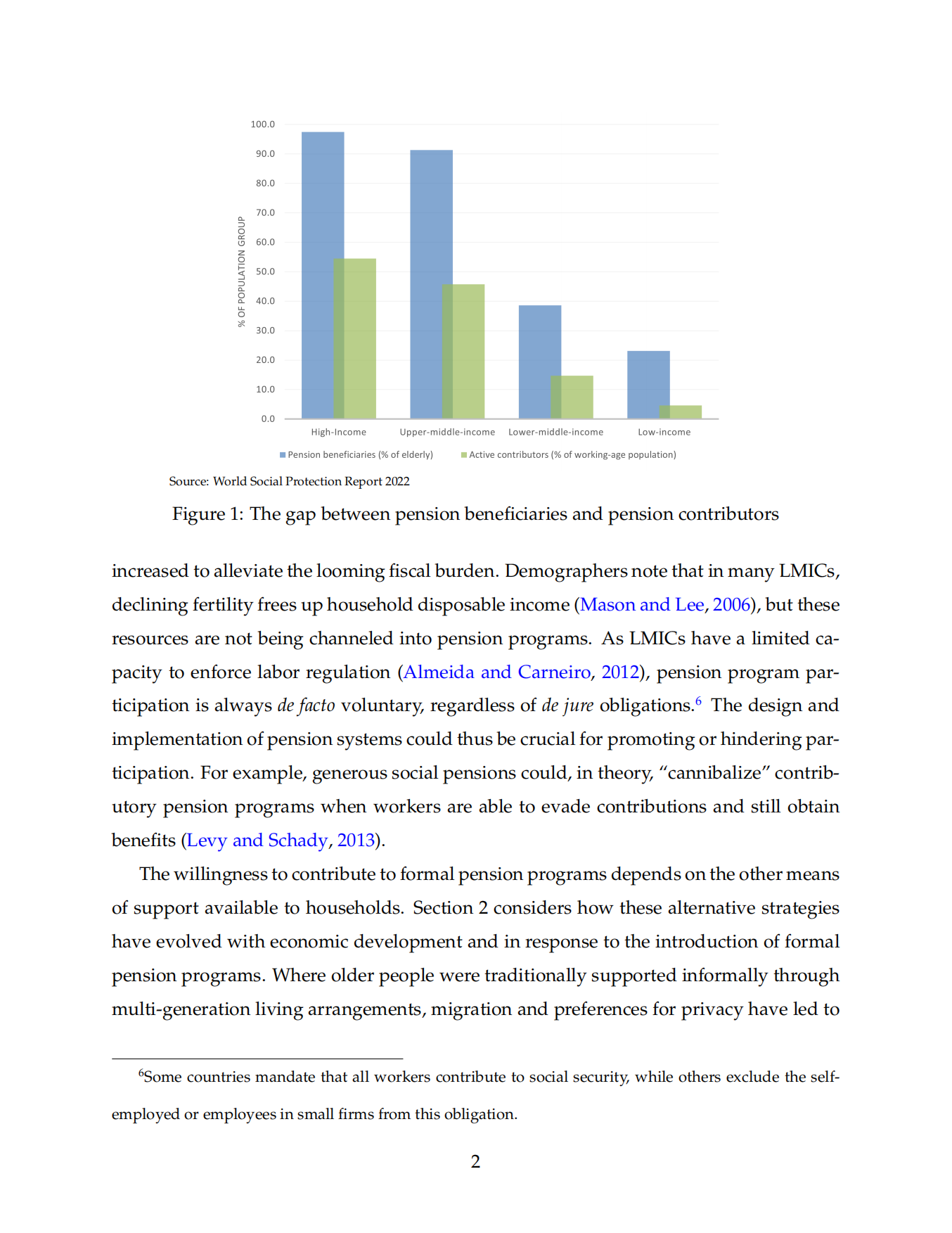
1IntroductionCoemsabound thatlow-and middle- income countries (LMICs) are becoming "*old betfore they arerich." People born in these countries in 2000 will witness a sharp increaseintheold age dependencv ratio? from 8% to 30% by age 70. The decline in multi-generationhouseholds couoled with widesoread financial exclusion (Allen et al, 2016) and low fi-nancial iteracy (Klapper and Lusardi, 2020) highlights the need for pension programs tofacilitate retirement and well-being at older ages. Countries must develop formal mechanisms to cope before the old-age dependency ratios rise sharplySince the turn of the millennium, encouraged by robust grow th rates and rising aspirations for universal social protection,* many LMICs have rapidlvexoanded social (aka"non-contributory") pension programs (Holzmann et al, eds, 2009, Rofman et al, 2015)These schemes, financed through general tax revenue, grant pension benefits to the elderly who have made few contributions to a government-sponsored scheme. They havesharply reduced the number of elderly people without a pension, but benefit levels areoftenlow due to fiscal constraints(Bloom and McKinnon, 2014). At the same time, growthin the proportion of workers contributing to social security schemes has stagnated due towidespread unregistered, or "informal", work. Figure 1 shows the large gap that now ex-ists between pension coverage defined in terms of beneficiaries versus coveragein terms.of contributors. With a growing elderly population, social pension benefits will need toreduce either their coverage or the level of benefits provided, lest they become fiscallymnsustainableA central question arises as to whether participation in contributory schemes can be'For examole:The Economist, December 2023 issue20ld-agedependents (65+)per 100 persons ages15-64PSee projections for less developed regions in the World population prospects.2024revisionFor example in 2016. the World Bank and the International Labour Organization iointlv initiatedthe GlobalPartnership for Universal Social Protection to Achieve the Sustainable DeveloomentGoals(USP2030)*World SocialProtection Report 2020-22,figure4.37.7
100.090.070.0dnO89NOlVIndOd30%60.050.040.030.020.010.0Upper-middle-incomemPensionbeneficiaries(%ofeldery)Source WorldSocial Potection Repor 2022Figure1:The gap between pension be...