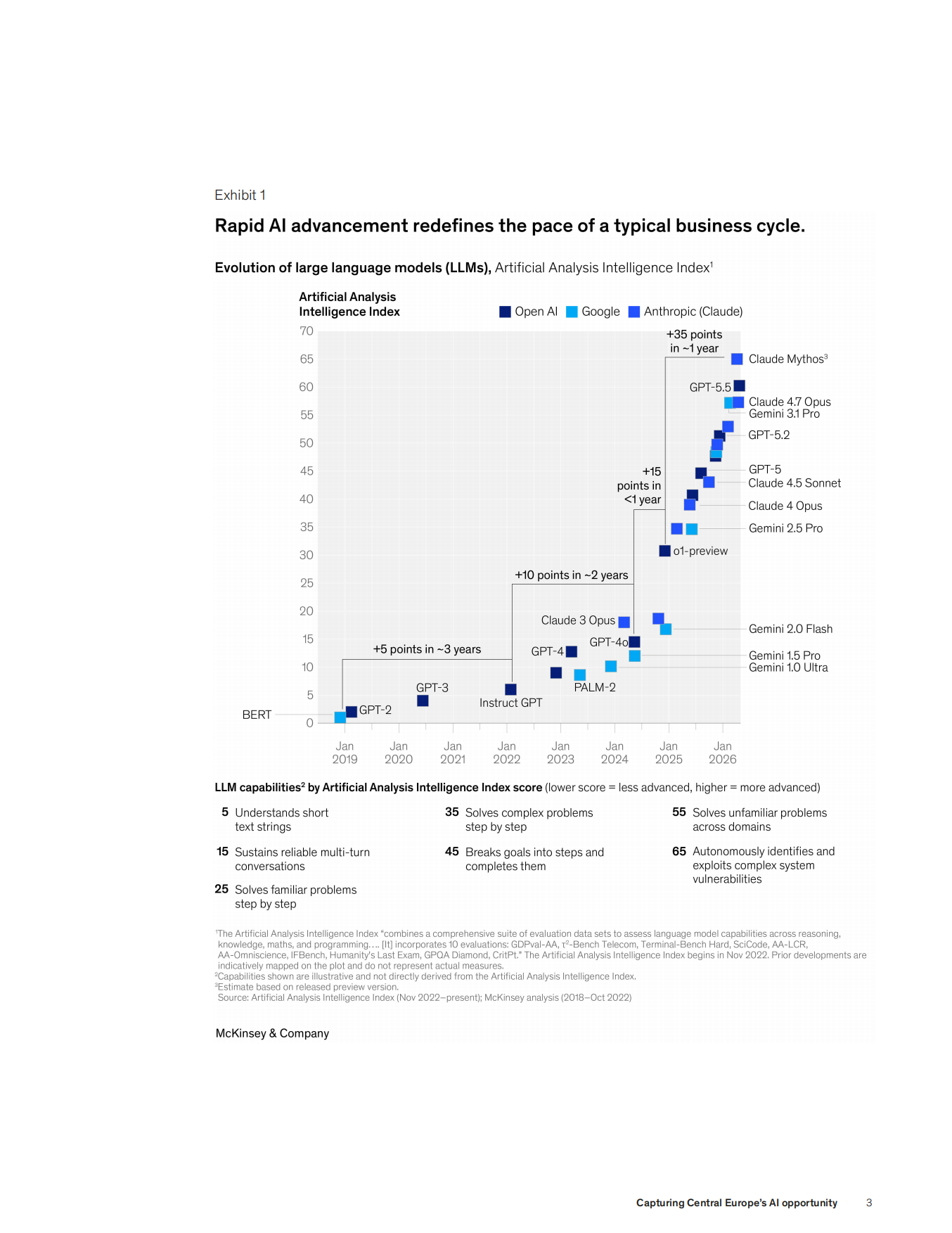
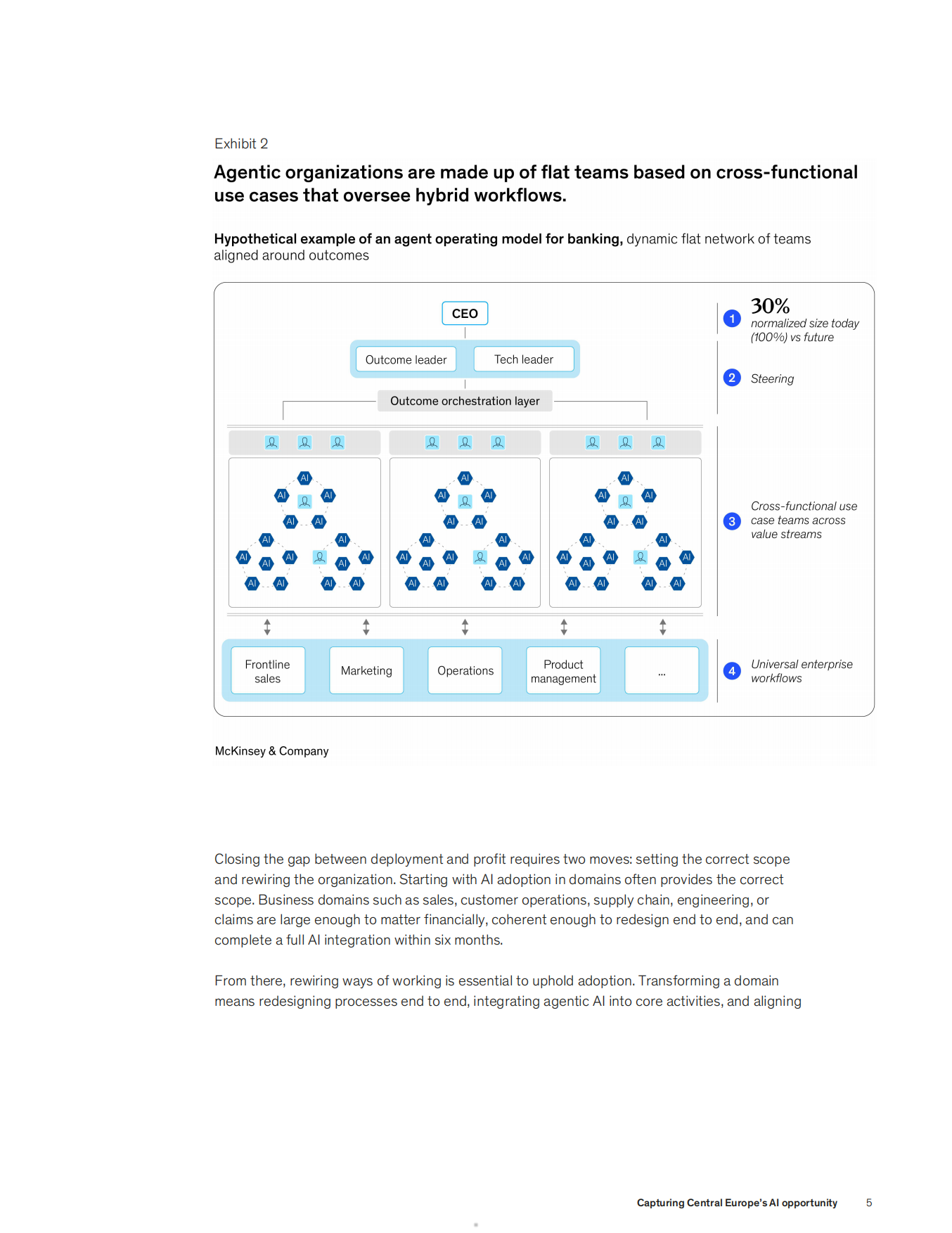
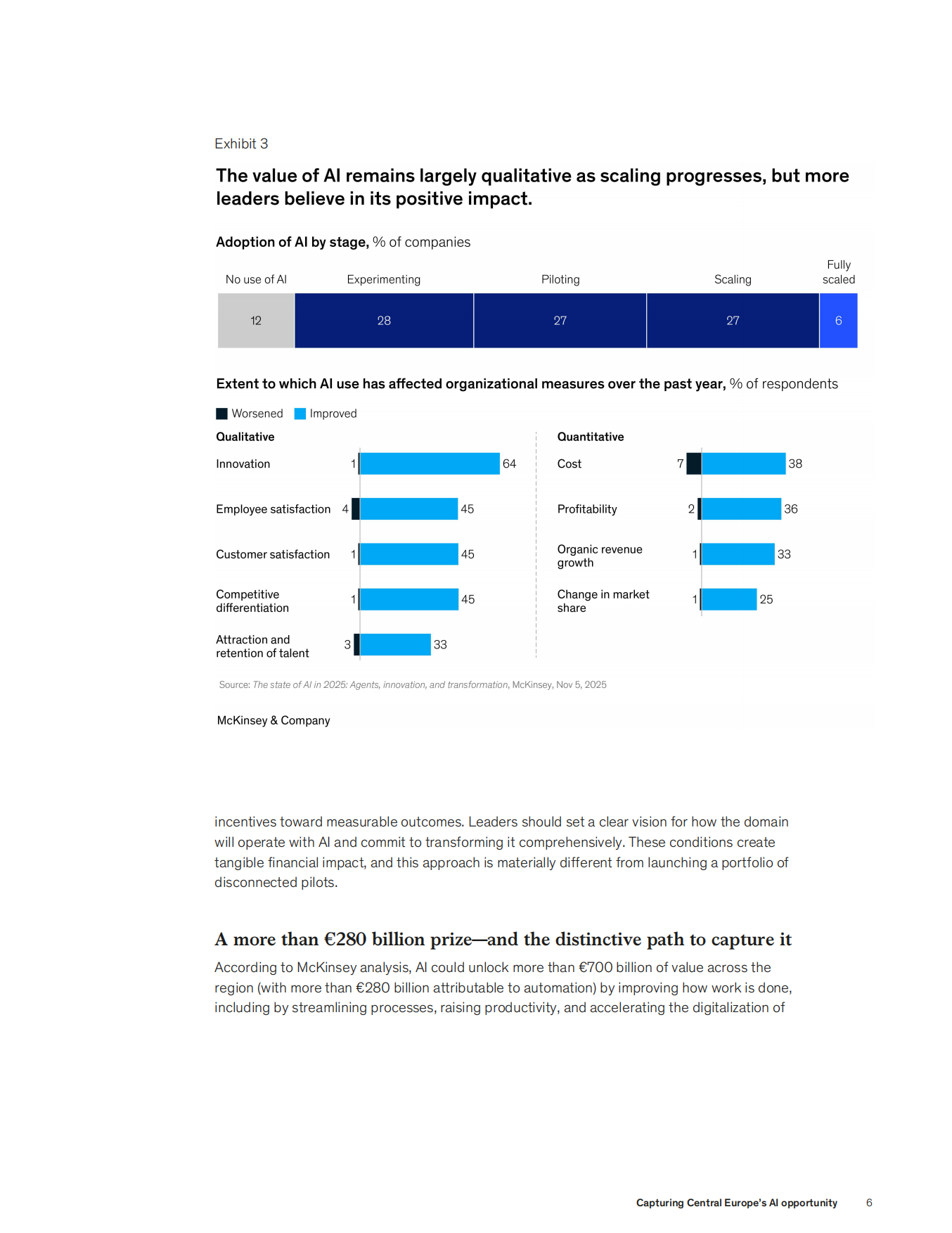
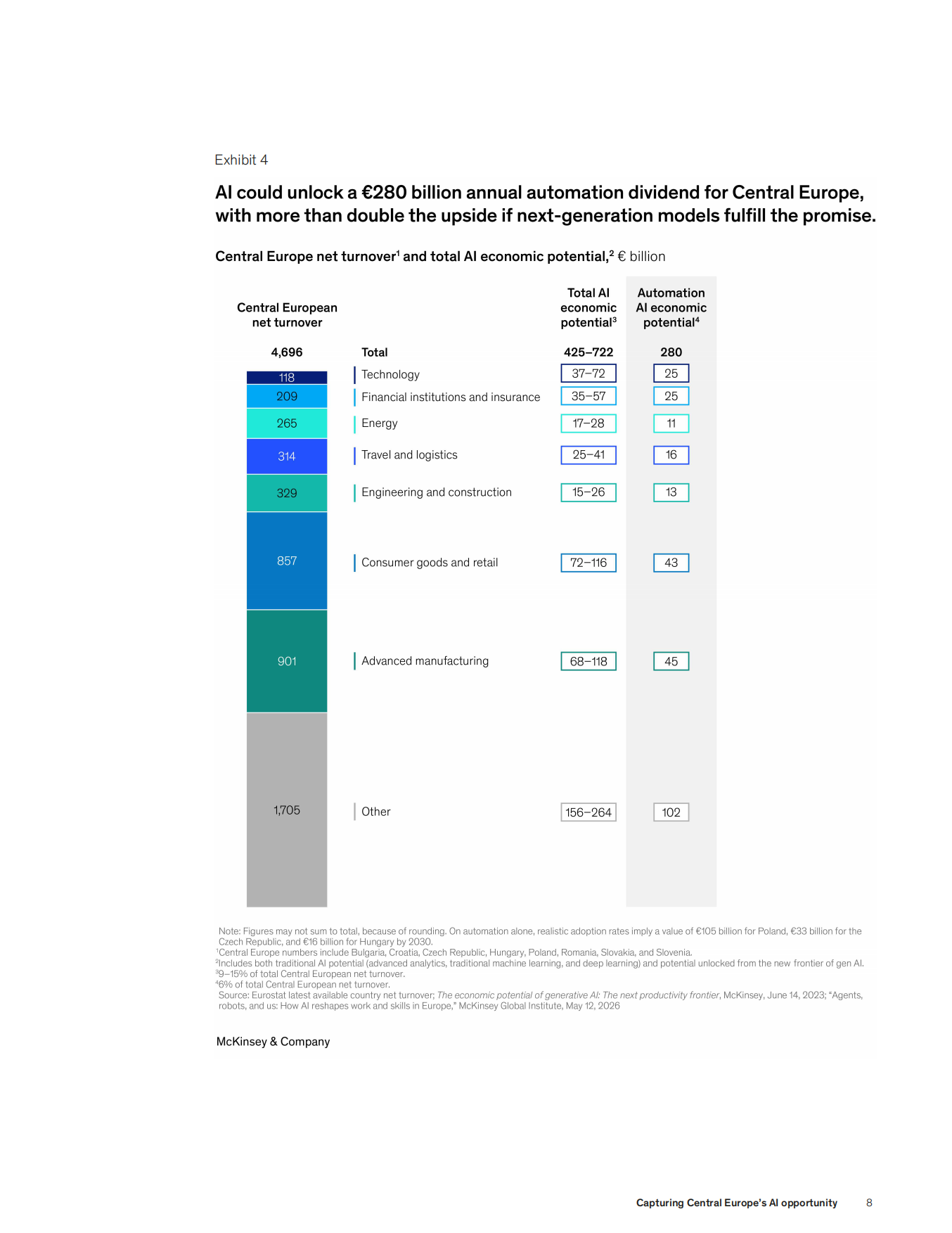
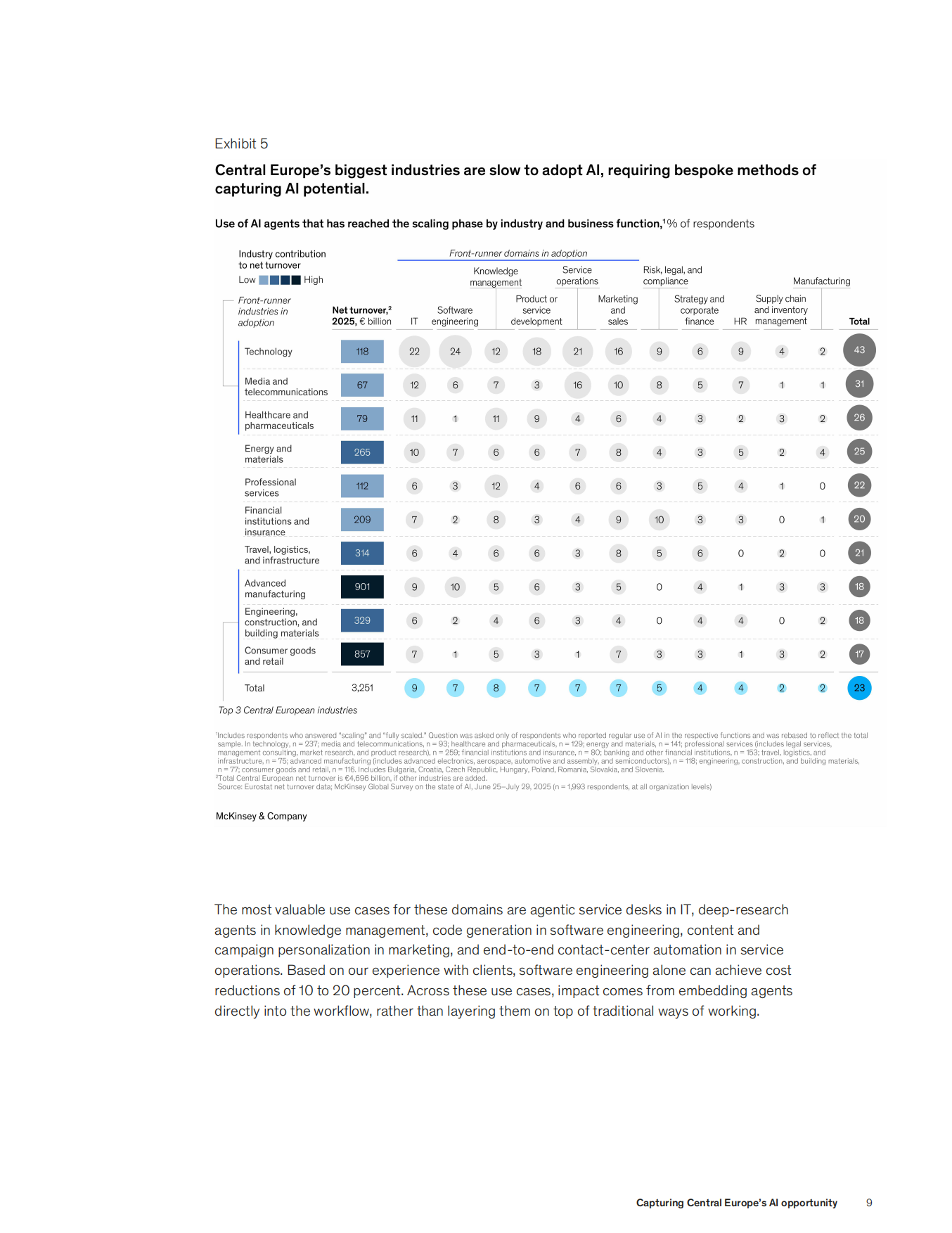
Capturing Central Europe’s AI opportunityAI is advancing too quickly to remain a side initiative for businesses. Central European companies can get ahead by redesigning business domains—and the organization—around AI.by Balázs Czímer and Lieven Van der Veken with Matyáš ZetekJune 2026
Artificial intelligence has become the most pressing topic in boardrooms. Companies are learning how to quickly redesign workflows to include AI and convert technical progress into greater economic value.In Central Europe, the stakes are particularly high. AI could help uncover €280 billion to €700 billion in economic value across the region, equivalent to 6 to 15 percent of the region’s total net turnover. The urgency is sharpened by two realities. First, adoption is widespread, but impact is not: 88 percent of companies globally have deployed AI in at least one function, but 94 percent have not achieved a significant impact on EBIT.1 A long list of pilots may signal that companies are making progress, but these small efforts rarely change end-to-end performance. Second, Central Europe trails Western Europe in enterprise AI adoption by 16 percent, and approximately 60 percent of Central Europe’s economy is tied to sectors where scaling AI is the most difficult.Much of the value of AI will come from embedding AI into physical operations rather than layering it onto digital channels. In industries such as manufacturing, engineering and construction, consumer goods, and retail, AI can optimize production planning to improve factory utilization, refine input materials to reduce yield loss, and increase sales conversion rates through faster, more personalized interactions. Companies can gain advantages by changing how factories, projects, service centers, and commercial functions run, rather than simply using AI as an augmenting tool.Central European leaders must contend with a big question: Will the region’s core industries be reshaped by the companies that operate them today or by competitors that moved faster? By being intentional about AI adoption, Central Europe can catch up to other parts of the world—and integrate these tools in a way that captures maximum value right away.The compounding advantage of AIAI advancements have outpaced traditional planning cycles. Between 2019 and 2022, leading large language models from OpenAI, Google, and Anthropic advanced at roughly two index points per year on the Artificial Analysis Intelligence Index, a composite benchmark spanning reasoning, knowledge, mathematics, and programming.2 From 2024 onward, gains have exceeded 20 points per year and keep accelerating—a tenfold increase since the introduction of ChatGPT in late 2022. Overall capability is now doubling about every 12 months (Exhibit 1).The pace at which AI has been advancing outstrips typical business cycles. Strategy, capital allocation, and operating mod...