热门文档
- 2025-04-21 11:02:12 2025年中国宠物行业白皮书
- 2024-11-17 13:23:03 Mckinsey:2024中国消费趋势调研
- 2025-06-17 17:31:50 2024中国医疗器械行业发展报告
- 2024-07-31 22:30:59 城市飞行营地总体规划及主题体验区概念设计规划案
- 2025-10-14 11:53:22 中国微短剧精品化发展研究报告(2025)-新京智库
- 2025-03-07 11:57:25 【剧星传媒】《哪吒2》资源推荐0205
- 2024-12-23 13:57:51 哩哔哩《灵笼2》招商方案
- 2025-01-16 15:13:48 2025年全新品牌屋框架模型
- 2024-10-13 08:47:52 联合国:2024世界投资报告
- 2024-05-19 21:59:54 2024小红书餐饮行业方法论
- 2025-05-13 10:34:19 中国茶叶品牌发展报告(2024)会
- 2025-06-10 15:18:07 2025年秋冬淘宝服饰白皮书-篆商业智库

1、本文档共计 532 页,下载后文档不带水印,支持完整阅读内容或进行编辑。
2、当您付费下载文档后,您只拥有了使用权限,并不意味着购买了版权,文档只能用于自身使用,不得用于其他商业用途(如 [转卖]进行直接盈利或[编辑后售卖]进行间接盈利)。
3、本站所有内容均由合作方或网友上传,本站不对文档的完整性、权威性及其观点立场正确性做任何保证或承诺!文档内容仅供研究参考,付费前请自行鉴别。
4、如文档内容存在违规,或者侵犯商业秘密、侵犯著作权等,请点击“违规举报”。
2、当您付费下载文档后,您只拥有了使用权限,并不意味着购买了版权,文档只能用于自身使用,不得用于其他商业用途(如 [转卖]进行直接盈利或[编辑后售卖]进行间接盈利)。
3、本站所有内容均由合作方或网友上传,本站不对文档的完整性、权威性及其观点立场正确性做任何保证或承诺!文档内容仅供研究参考,付费前请自行鉴别。
4、如文档内容存在违规,或者侵犯商业秘密、侵犯著作权等,请点击“违规举报”。
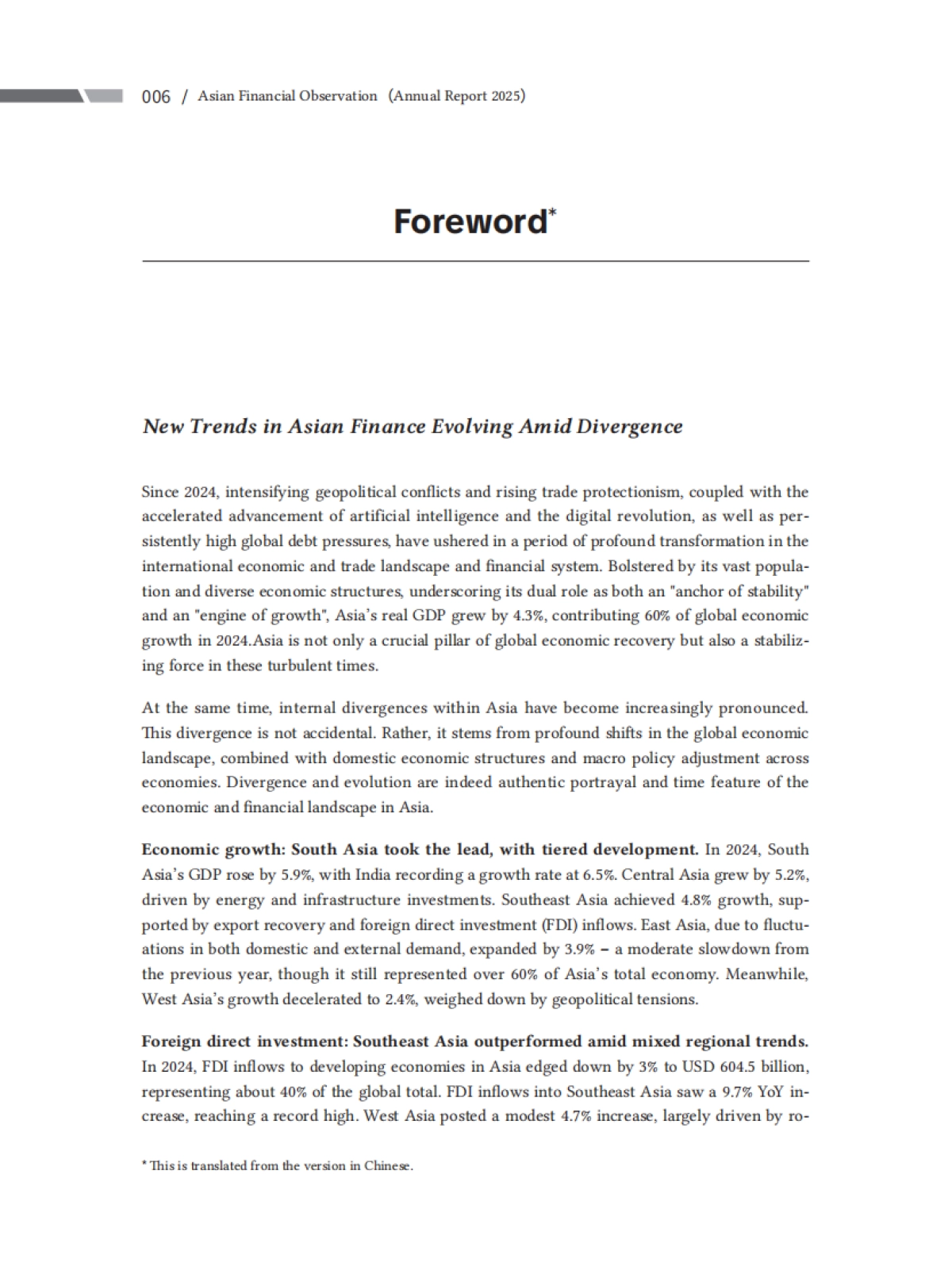
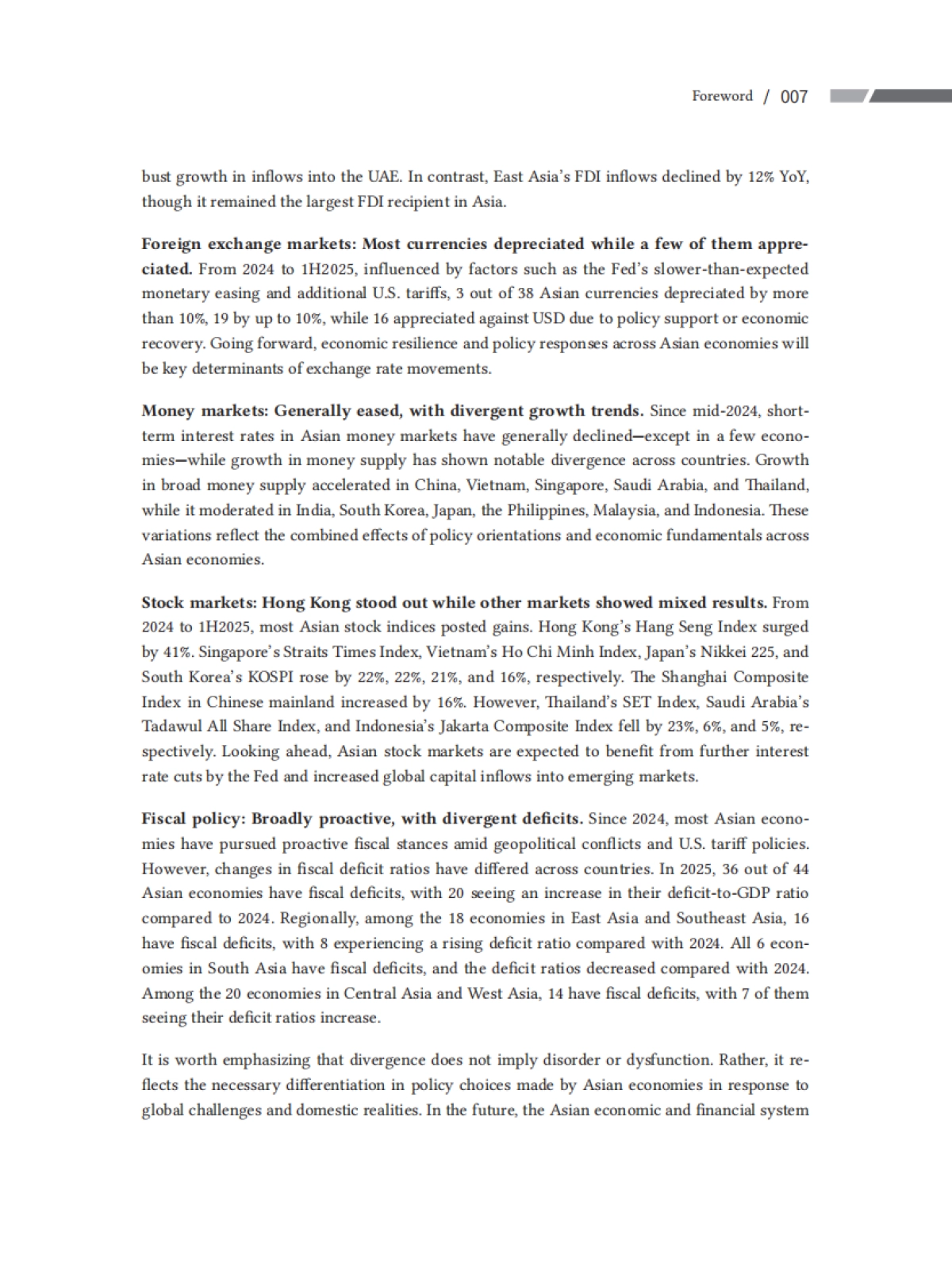
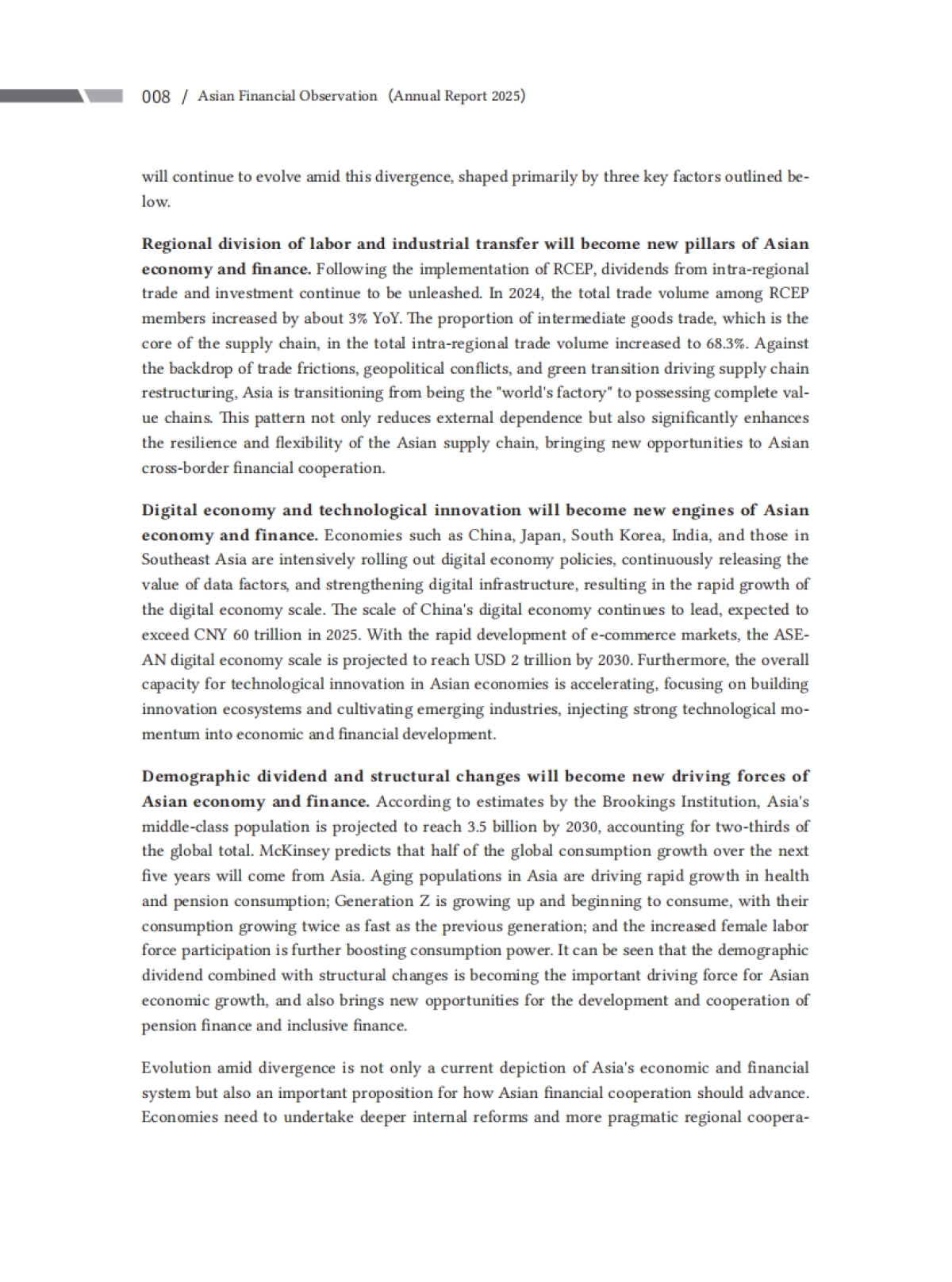
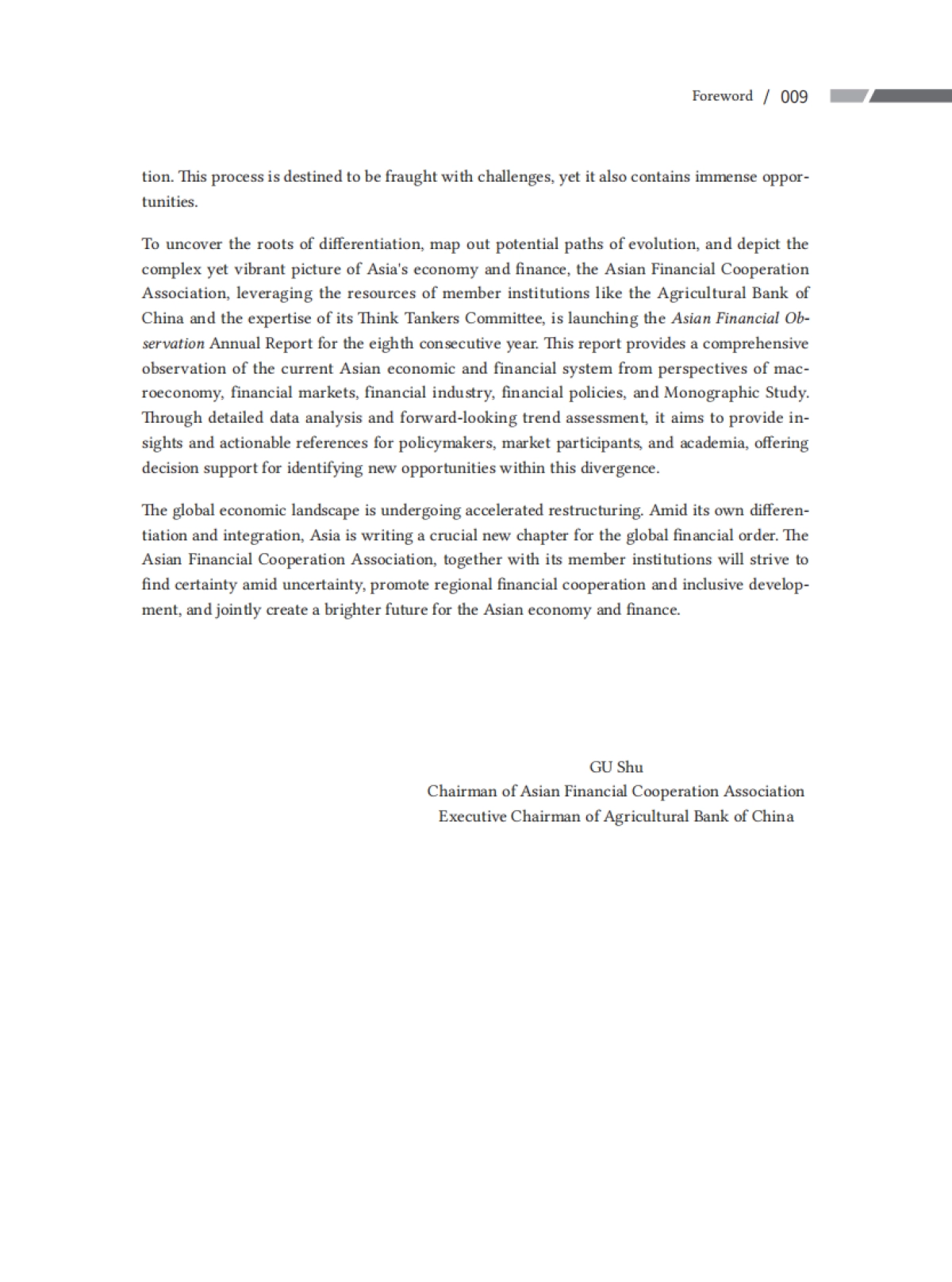
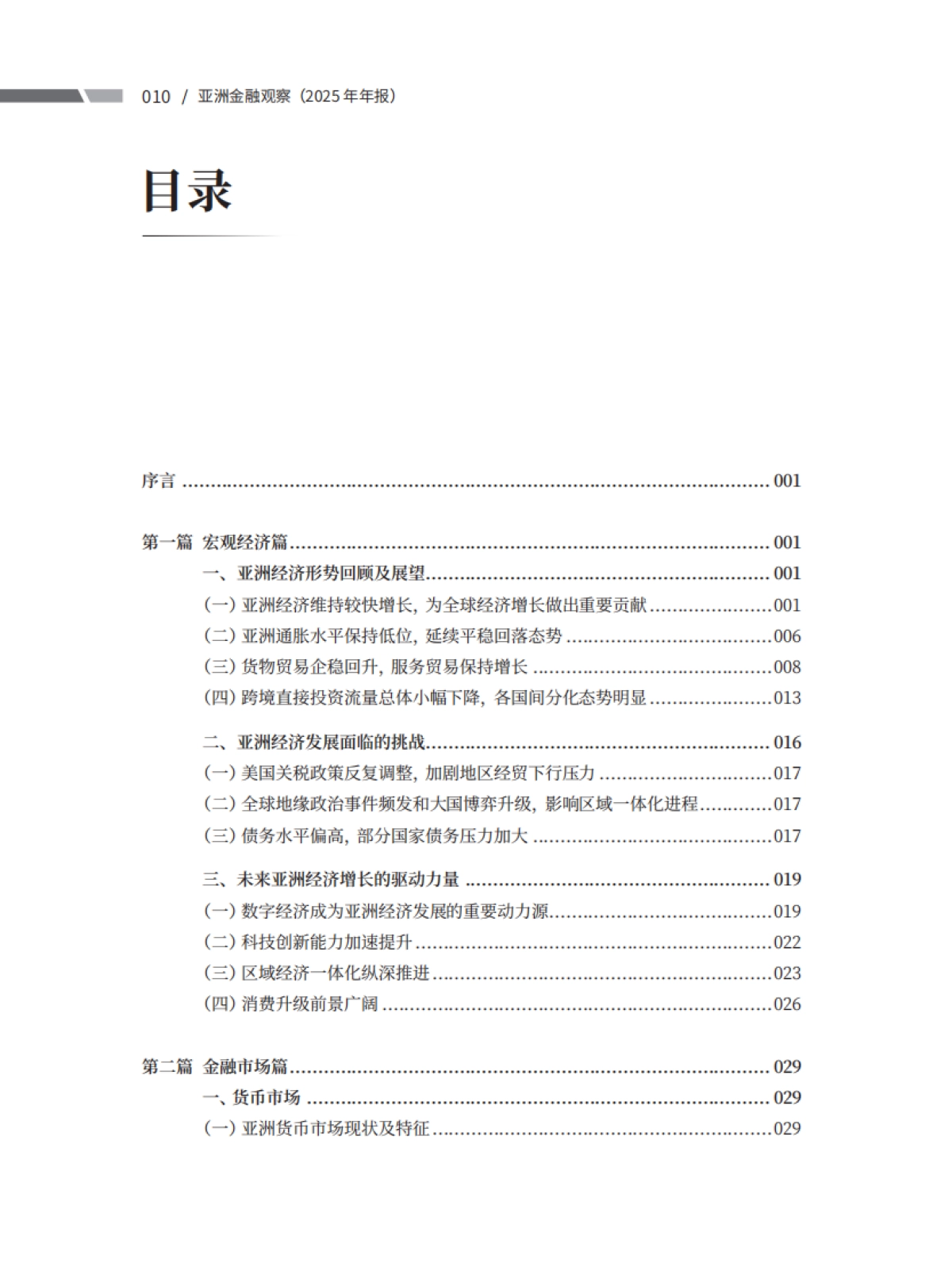
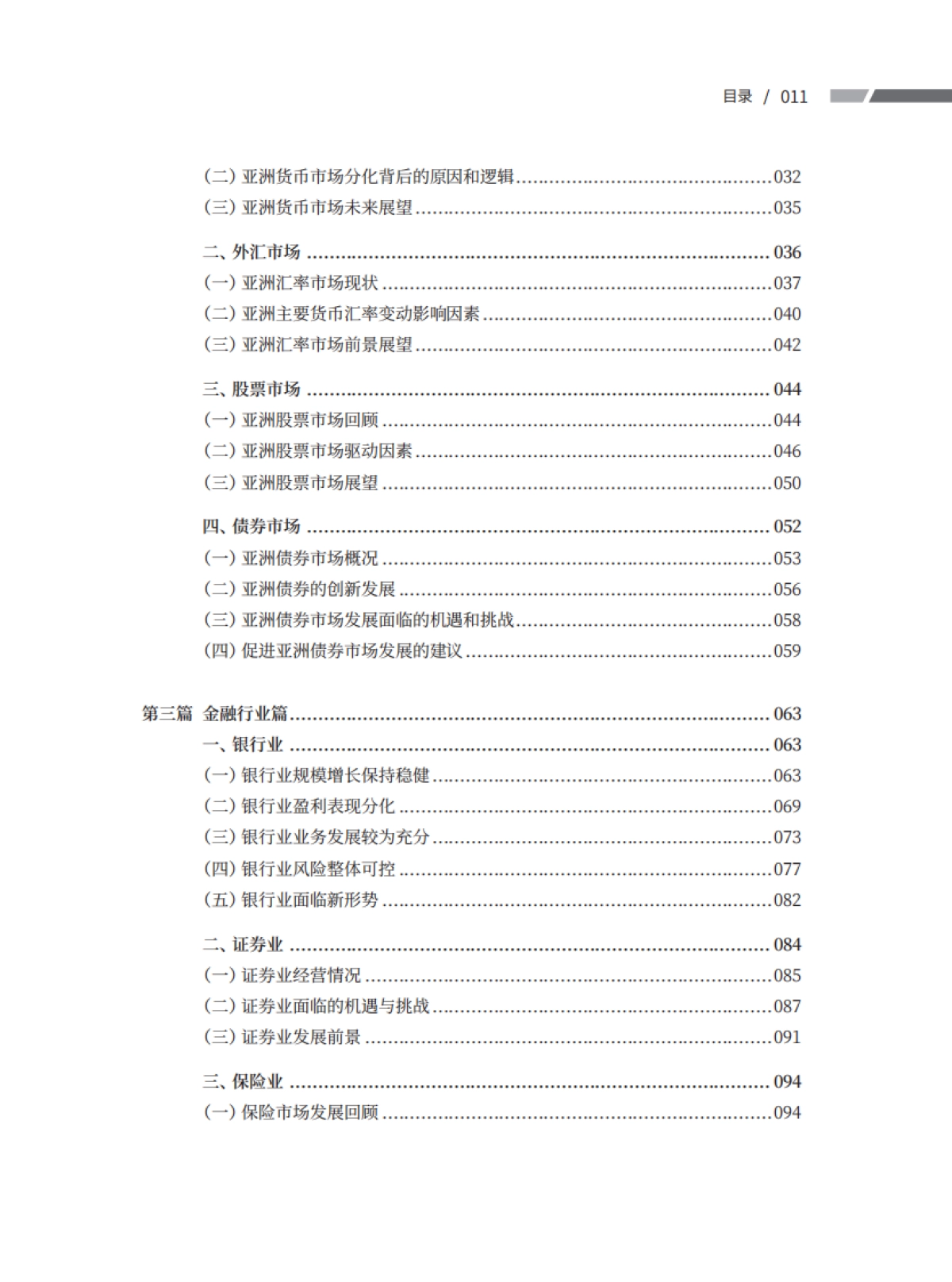
AFCA亚洲金融观察Asian Financial Observation(2025年年报)(Annual Report 2025.i亚洲金融合作协会中国农业银行战略规划部编Asian Financial Cooperation AssociationStrategic Planning Department of Agricultural Bank of China序在分化中演进的亚洲金融新趋势《亚洲金融观察(2025年年报)》序2024年以来,地缘政治冲突和贸易保护主义日益加剧,人工智能与数字化革命加速发展,全球债务压力居高不下,国际经贸格局和金融体系正处在深刻变革时期。亚洲凭借庞大的人口规模和多元的经济结构,彰显出“稳定锚”和“增长极”的双重定位:2024年实际GDP增长4.3%,对全球经济增长贡献率达60%。亚洲既是世界经济复苏的重要支柱,更是动荡时代中的稳定力量。同时,亚洲内部的分化日益凸显。这种分化并非偶然,而是全球经济格局深刻变革、各经济体内部经济结构和宏观政策调整共同作用的结果。分化与演进,正是当下亚洲经济和金融的真实写照和时代特征。经济增长:南亚领跑、梯次发展。2024年,南亚地区GDP增长5.9%,其中,印度GDP增速达到6.5%。中亚地区在能源与基建投资驱动下,GDP增长5.2%。东南亚在出口修复和FDI流入的拉动下,GDP增速达4.8%。东亚地区受内部和外部需求波动影响,GDP增长3.9%,较上年有所放缓,但经济体量占比仍超过60%。此外,受地缘政治冲突拖累,西亚地区GDP增速放缓至2.4%。外商直接投资:东南亚增速领先、其它地区有升有降。2024年,亚洲发展中经济体外商直接投资流入规模小幅下降3%,为6045亿美元,在全球占比约40%。其中,东南亚地区FDI流入规模同比增长9.7%,创历史新高;西亚地区小幅增长4.7%,主要得004/亚洲金融观察(2025年年报)益于阿联酋的FDI流入规模增长较快。东亚地区FDI流入规模同比下降12%,但规模仍居亚洲首位。汇率市场:多数贬值、少数升值。在美联储货币政策宽松不及预期、美国加征关税等因素影响下,2024年至2025年上半年,在统计的38种亚洲货币中,3种货币贬值超过10%,19种货币贬值幅度在10%以内,16种货币因政策支撑或经济复苏对美元升值。未来,亚洲各经济体经济韧性与政策应对将成为影响汇率走势的关键变量。货币市场:整体宽松、增速有别。2024年年中以来,除个别经济体外,亚洲经济体货币市场短期利率整体下行,但不同经济体的货币供应量增长却呈现分化特征。中国、越南、新加坡、沙特和泰国广义货币增速加快,而印度、韩国、日本、菲律宾、马来西亚和印度尼西亚的广义货币增速有所放缓。这背后是亚洲各经济体的政策取向与经济基本面共同作用的结果。股票市场:香港领跑,涨跌互现。2024年至2025年上半年,亚洲多数地区股票指数上涨。其中,中国香港恒生指数累计上涨41%;新加坡海峡指数、越南胡志明指数、日本日经225指数和韩国综合指数分别上涨22%、22%、21%和16%;中国上证综合指数上涨16%;而泰国SET指数、沙特全股指数和印尼雅加达综指分别下跌23%、6%和5%。未来,随着美联储进一步降息,全球资金流入新兴市场,亚洲股市有望继续受益。财政政策:整体积极、赤字不同。2024年以来,在地缘政治冲突、美国关税政策等影响下,亚洲经济体财政政策整体较为积极,但财政赤字率的变化有所不同。2025年,44个亚洲经济体中有36个存在财政赤字,其中20个经济体的财政赤字率较2024年有所上升。东亚和东南亚地区的18个经济体中,有16个存在财政赤字,其中8个财政赤字率较2024年上升;南亚地区的6个经济体全部存在财政赤字,赤字率较2024年有所下降;中亚和西亚地区的20个经济体中,14个存在财政赤字,其中7个赤字率上升。需要强调的是,分化并不意味着混乱或者失灵,而恰好是亚洲经济体在应对全球性挑战时,根据自身国情所做出的不同选择的必然结果。未来,亚洲经济金融体系将在分化中继续演进,影响因素主要体现在以下三个方面:区域分工与产业转移将成为亚洲经济金融的新支柱。RCEP实施后,区域内贸易和投资红利不断释放,2024年RCEP成员间贸易总额同比增长约3%,作为供应链核心的中间品贸易占区域内贸易总额的比重提高到68.3%。在贸易摩擦、地缘冲突和绿色转型推动供应链重构的背景下,亚洲正在由“世界工厂”向完整价值链跃升。这种格局既降低了对外依赖,也显著增强了亚洲供应链的弹性与韧性,为亚洲跨境金融合作带来了新的机遇。序言/005数字经济与科技创新将成为亚洲经济金融的新引擎。中国、日本、韩国、印度以及东南亚各经济体正密集出台数字经济政策,持续释放数据要素价值、夯实数字基础设施,数字经济规模快速增长。中国数字经济规模持续领先,2025年有望突破60万亿元。在电商市场的快速发展下,预计2030年东盟国家数字经济规模可提升至2万亿美元。此外,亚洲经济体整体科技创新能力加速提升,聚焦创新生态构建和新兴产业培育,为经济金融发展注入强劲的科技动能。人口红利与结构变化将成为亚洲经济金融的新动力。布鲁金斯学会测算,到2030年亚洲中产阶级或达35亿人,占全球三分之二;麦肯锡预计未来五年全球消费增长的一半将来自亚洲。亚洲人口老龄化带动健康和养老消费快速增长;Z世代成长并开始消费,其消费增长速度是上一代的两倍;妇女劳动参与率提升意味着消费能力进一步增强。可见,人口红利叠加结构性变化正成为亚洲经济增长的重要动力,也为养老金融、普惠金融的发展与合作带来新的机遇。在分化中演进,不仅是亚洲经济金融体系的当下写照,更是其未来如何开展亚洲金融合作的重要命题。各经济体需要进行更深层次的内部改革与更务实的区域合作,这一过程注定充满挑战,但也蕴含着巨大的机遇。为了剖析分化的主要根源,描绘演进的可能路径,展现亚洲经济金融复杂而充满生机的图景,亚洲金融合作协会依托中国农业银行等会员机构和专家咨询委员会的专家力量,连续第八年推出《亚洲金融观察》年报。从宏观经济、金融市场、金融行业、金融政策及专题研究五个视角,全方位观察当前的亚洲经济金融体系。通过翔实的数据分析和前瞻的趋势判断,为政策制定者、市场参与者与学术界提供洞见与行动参考,为如何在分化中寻找到新的机遇提供决策支持。当前,全球经济格局正在加速重构。而亚洲,正在自身的分化与整合中,为世界金融格局书写至关重要的新篇章。亚洲金融合作协会将携手会员单位,在不确定性中把握确定性,推动区域金融合作与包容发展,共创亚洲经济金融的美好未来。是为序。亚洲金融合作协会理事长中国农业银行党委书记、董事长006 Asian Financial Observation (Annual Report 2025)Foreword'New Trends in Asian Finance Evolving Amid DivergenceSince 2024,intensifying geopolitical conflicts and rising trade protectionism,coupled with theaccelerated advancement of artificial intelligence and the digital revolution,as well as per-sistently high global debt pressures,have ushered in a period of profound transformation in theinternational economic and trade landscape and financial system.Bolstered by its vast popula-tion and diverse economic structures,underscoring its dual role as both an "anchor of stability"and an "engine of growth",Asia's real GDP grew by 4.3%,contributing 60%of global economicgrowth in 2024.Asia is not only a crucial pillar of global economic recovery but also a stabiliz-ing force in these turbulent times.At the same time,internal divergences within Asia have become increasingly pronouncedThis divergence is not accidental.Rather,it stems from profound shifts in the global economiclandscape,combined with domestic economic structures and macro policy adjustment acrosseconomies.Divergence and evolution are indeed authentic portrayal and time feature of theeconomic and financial landscape in Asia.Economic growth:South Asia took the lead,with tiered development.In 2024,SouthAsia's GDP rose by 5.9%,with India recording a growth rate at 6.5%.Central Asia grew by 5.2%.driven by energy and infrastructure investments.Southeast Asia achieved 4.8%growth,sup-ported by export recovery and foreign direct investment(FDI)inflows.East Asia,due to fluctu-ations in both domestic and external demand,expanded by 3.9%-a moderate slowdown fromthe previous year,though it still represented over 60%of Asia's total economy.Meanwhile,West Asia's growth decelerated to 2.4%,weighed down by geopolitical tensions.Foreign direct investment:Southeast Asia outperformed amid mixed regional trends.In 2024,FDI inflows to developing economies in Asia edged down by 3%to USD 604.5 billion,representing about 40%of the global total.FDI inflows into Southeast Asia saw a 9.7%YoY in-crease,reaching a record high.West Asia posted a modest 4.7%increase,largely driven by ro-This is translated from the version in Chinese.Foreword /007bust growth in inflows into the UAE.In contrast,East Asia's FDI inflows declined by 12%YoY,though it remained the largest FDI recipient in Asia.Foreign exchange markets:Most currencies depreciated while a few of them appre-ciated.From 2024 to 1H2025,influenced by factors such as the Fed's slower-than-expectedmonetary easing and additional U.S.tariffs,3 out of 38 Asian currencies depreciated by morethan 10%19 by up to10%.while 16 appreciated against USD due to policy support or economicrecovery.Going forward,economic resilience and policy responses across Asian economies willbe key determinants of exchange rate movements.Money markets:Generally eased,with divergent growth trends.Since mid-2024,short-term interest rates in Asian money markets have generally declined-except in a few econo-mies-while growth in money supply has shown notable divergence across countries.Growthin broad money supply accelerated in China,Vietnam,Singapore,Saudi Arabia,and Thailand,while it moderated in India,South Korea,Japan,the Philippines,Malaysia,and Indonesia.Thesevariations reflect the combined effects of policy orientations and economic fundamentals acrossAsian economies.Stock markets:Hong Kong stood out while other markets showed mixed results.From2024 to 1H2025,most Asian stock indices posted gains.Hong Kong's Hang Seng Index surgedby 41%.Singapore's Straits Times Index,Vietnam's Ho Chi Minh Index,Japan's Nikkei 225,andSouth Korea's KOSPI rose by 22%,22%,21%,and 16%,respectively.The Shanghai CompositeIndex in Chinese mainland increased by 16%.However,Thailand's SET Index,Saudi Arabia'sTadawul All Share Index,and Indonesia's Jakarta Composite Index fell by 23%,6%,and 5%,re-spectively.Looking ahead,Asian stock markets are expected to benefit from further interestrate cuts by the Fed and increased global capital inflows into emerging markets.Fiscal policy:Broadly proactive,with divergent deficits.Since 2024,most Asian econo-mies have pursued proactive fiscal stances amid geopolitical conflicts and U.S.tariff policies.However,changes in fiscal deficit ratios have differed across countries.In 2025,36 out of 44Asian economies have fiscal deficits,with 20 seeing an increase in their deficit-to-GDP ratiocompared to 2024.Regionally,among the 18 economies in East Asia and Southeast Asia,16have fiscal deficits,with 8 experiencing a rising deficit ratio compared with 2024.All 6 econ-omies in South Asia have fiscal deficits,and the deficit ratios decreased compared with 2024.Among the 20 economies in Central Asia and West Asia,14 have fiscal deficits,with 7 of themseeing their deficit ratios increase.It is worth emphasizing that divergence does not imply disorder or dysfunction.Rather,it re-flects the necessary differentiation in policy choices made by Asian economies in response toglobal challenges and domestic realities.In the future,the Asian economic and financial system008 Asian Financial Observation (Annual Report 2025)will continue to evolve amid this divergence,shaped primarily by three key factors outlined be-low.Regional division of labor and industrial transfer will become new pillars of Asianeconomy and finance.Following the implementation of RCEP,dividends from intra-regionaltrade and investment continue to be unleashed.In 2024,the total trade volume among RCEPmembers increased by about 3%YoY.The proportion of intermediate goods trade,which is thecore of the supply chain,in the total intra-regional trade volume increased to 68.3%.Againstthe backdrop of trade frictions,geopolitical conflicts,and green transition driving supply chainrestructuring,Asia is transitioning from being the"world's factory"to possessing complete val-ue chains.This pattern not only reduces external dependence but also significantly enhancesthe resilience and flexibility of the Asian supply chain,bringing new opportunities to Asiancross-border financial cooperation.Digital economy and technological innovation will become new engines of Asianeconomy and finance.Economies such as China,Japan,South Korea,India,and those inSoutheast Asia are intensively rolling out digital economy policies,continuously releasing thevalue of data factors,and strengthening digital infrastructure,resulting in the rapid growth ofthe digital economy scale.The scale of China's digital economy continues to lead,expected toexceed CNY 60 trillion in 2025.With the rapid development of e-commerce markets,the ASE-AN digital economy scale is projected to reach USD 2 trillion by 2030.Furthermore,the overallcapacity for technological innovation in Asian economies is accelerating,focusing on buildinginnovation ecosystems and cultivating emerging industries,injecting strong technological mo-mentum into economic and financial development.Demographic dividend and structural changes will become new driving forces ofAsian economy and finance.According to estimates by the Brookings Institution,Asia'smiddle-class population is projected to reach 3.5 billion by 2030,accounting for two-thirds ofthe global total.McKinsey predicts that half of the global consumption growth over the nextfive years will come from Asia.Aging populations in Asia are driving rapid growth in healthand pension consumption;Generation Z is growing up and beginning to consume,with theirconsumption growing twice as fast as the previous generation;and the increased female laborforce participation is further boosting consumption power.It can be seen that the demographicdividend combined with structural changes is becoming the important driving force for Asianeconomic growth,and also brings new opportunities for the development and cooperation ofpension finance and inclusive finance.Evolution amid divergence is not only a current depiction of Asia's economic and financialsystem but also an important proposition for how Asian financial cooperation should advance.Economies need to undertake deeper internal reforms and more pragmatic regional coopera-Foreword /009tion.This process is destined to be fraught with challenges,yet it also contains immense oppor-tunities.To uncover the roots of differentiation,map out potential paths of evolution,and depict thecomplex yet vibrant picture of Asia's economy and finance,the Asian Financial CooperationAssociation,leveraging the resources of member institutions like the Agricultural Bank ofChina and the expertise of its Think Tankers Committee,is launching the Asian Financial Ob-servation Annual Report for the eighth consecutive year.This report provides a comprehensiveobservation of the current Asian economic and financial system from perspectives of mac-roeconomy,financial markets,financial industry,financial policies,and Monographic Study.Through detailed data analysis and forward-looking trend assessment,it aims to provide in-sights and actionable references for policymakers,market participants,and academia,offeringdecision support for identifying new opportunities within this divergence.The global economic landscape is undergoing accelerated restructuring.Amid its own differen-tiation and integration,Asia is writing a crucial new chapter for the global financial order.TheAsian Financial Cooperation Association,together with its member institutions will strive tofind certainty amid uncertainty,promote regional financial cooperation and inclusive develop-ment,and jointly create a brighter future for the Asian economy and finance.GU ShuChairman of Asian Financial Cooperation AssociationExecutive Chairman of Agricultural Bank of China010/亚洲金融观察(2025年年报)序言001第一篇宏观经济篇...001一、亚洲经济形势回顾及展望..001(一)亚洲经济维持较快增长,为全球经济增长做出重要贡献.001(仁)亚洲通胀水平保持低位,延续平稳回落态势006(三)货物贸易企稳回升,服务贸易保持增长.008(四)跨境直接投资流量总体小幅下降,各国间分化态势明显二、亚洲经济发展面临的挑战016(一)美国关税政策反复调整,加剧地区经贸下行压力(二)全球地缘政治事件频发和大国博弈升级,影响区域一体化进程.017(三)债务水平偏高,部分国家债务压力加大三、未来亚洲经济增长的驱动力量019(一)数字经济成为亚洲经济发展的重要动力源.019(二)科技创新能力加速提升.022(三)区域经济一体化纵深推进023(四)消费升级前景广阔..…第二篇金融市场篇029一、货币市场..029(一)亚洲货币市场现状及特征.029目录/011(二)亚洲货币市场分化背后的原因和逻辑.032(三)亚洲货币市场未来展望035036(一)亚洲汇率市场现状….037(二)亚洲主要货币汇率变动影响因素..040(三)亚洲汇率市场前景展望.042三、股票市场…044(一)亚洲股票市场回顾.044(二)亚洲股票市场驱动因素,(三)亚洲股票市场展望.052(一)亚洲债券市场概况....053(二)亚洲债券的创新发展.056(三)亚洲债券市场发展面临的机遇和挑战.058(四)促进亚洲债券市场发展的建议.059第三篇金融行业篇.一、银行业063(一)银行业规模增长保持稳健(二)银行业盈利表现分化.069(三)银行业业务发展较为充分.073(四)银行业风险整体可控.077(五)银行业面临新形势..二、证券业084(一)证券业经营情况(二)证券业面临的机遇与挑战087(三)证券业发展前景.….091三、保险业094(一)保险市场发展回顾.094012/亚洲金融观察(2025年年报)(二)保险市场展望118120(一)基金业发展概况.…(二)主要经济体基金业发展情况123(三)私募股权创投基金市场表现.130(四)基金业总体特点与差异.131(五)基金业展望.….132第四篇金融政策篇.……135一、货币政策…(一)全球货币政策整体保持宽松,不同经济体出现分化….135二、财政政策.139(一)东亚:中国、日本财政赤字率上升,韩国财政赤字率下降140(二)东南亚:印尼等财政赤字率上升,菲律宾等财政赤字率下降..141(三)南亚:主要经济体财政赤字率下降.142(四)中亚:哈萨克斯坦、乌兹别克斯坦财政扩张力度缩减.143(五)西亚:主要经济体财政赤字率差别较大.143三、监管政策…(一)亚洲主要经济体审慎监管取得较大进展,.144(二)行业监管质效明显提升.147(三)持续完善新兴金融服务监管..151(四)加强金融科技监管...…..153四、金融合作政策.…154(一)打造更有质效的政策对话机制(二)推动区域金融资源互联互通(三)推进亚洲货币支付清算合作157(四)强化金融人才的交流与培养.158第五篇专题研究篇159目录/013一、深入审视美国关税的全球影响159(一)关税的影响.160(二)2025年还发生了什么?..161(三)关税对其他亚洲国家有何影响?(四)美国关税有哪些影响?165(五)总结与结论性思考174二、全球债务:问题、风险与挑战..174(一)全球债务危机概览.175(二)21世纪全球债务剖析…(三)债务治理与多边主义危机.188(四)穿越债务深渊:可持续债务治理策略.191(五)结论:多重危机时代下全球债务治理反思.196三、中亚:区域合作与绿色金融的焦点198(二)从十字路口到边缘化一重返十字路口(三)地缘政治相关性与资源重要性.199(四)中亚的贸易动态.202(五)经济动态204(六)绿色金融从压力到机遇.205(七)区域合作210四、中亚“一带一路”倡议项目:哈萨克斯坦和乌兹别克斯坦的角色(三)为何哈萨克斯坦对“一带一路”的互联互通和投资至关重要.212(四)乌兹别克斯坦在“一带一路”倡议下一阶段发展中的定位213(五)哈萨克斯坦和乌兹别克斯坦的“一带一路”项目.213(六)改进领域(七)“一带一路”在中亚的实施与模式转变.214(八)未来发展前景216014/亚洲金融观察(2025年年报)五、稳定币一它们将如何影响金融中心?218219(二)2035年的数字货币格局—基于主要金融中心的期望(三)各国央行对稳定币的看法…223(四)全球监管框架:拼凑的“百衲被”.225(五)打击洗钱、恐怖主义融资及金融犯罪.227(六)非美元稳定币的发展趋势及挑战,(七)数字货币的多极化未来(八)对金融中心生态系统的影响:重塑竞争格局.232后记235Contents /015ContentsForeword006Chapter I Macroeconomic Perspective237I.Review of the Economic Development237(I)Asia Maintained Relatively Rapid Growth,Contributing Significantlyto Global Expansion237(II)Inflation Remained Low,Continuing a Stable Downward Trend242(III)Trade in Goods Stabilized and Rebounded,While Trade in ServicesContinued to Grow245(IV)Cross-Border Direct Investment Declined Slightly,with Increasing Di-vergence Across Economies250Il.Challenges Ahead254(I)Frequent Adjustments to U.S.Tariff Policies Exacerbate Regional TradePressures254(II)Rising Geopolitical Tensions and Major-Power Rivalries Impede Region-al Integration254(III)Elevated Debt Levels Highten Fiscal Pressures in Some Economies255Ill.Drivers of the Economic Growth in Asia256(I)The Digital Economy as a Key Growth Engine257(II)Accelerated Improvement in Technological Innovation Capabilities260016 Asian Financial Observation (Annual Report 2025)(III)Deepening Regional Economic Integration262(IV)Expanding Prospects for Consumption Upgrading265Chapter ll Financial Markets269I.Money Markets269(I)Current Situation and Key Features269(⑩)Drivers Behind Market Differentiation272(四)Outlook276Il.Foreign Exchange Markets278())Current Situation278(II)Factors Affecting Major Asian Currencies282(四)Outlook284Ill.Asian Stock Markets287())Review287(I)Drivers289(四)Outlook294IV.Asian Bond Markets296(I)Overview297(⑩)nnovations301(III)Opportunities and Challenges303(IV)Suggestions for Promoting the Development305Chapter Ill Financial Industry309I.Banking Industry309(I)Steady Growth in Scale309(四)Divergent Profitability Trends317(III)Sufficient Development of Banking Services321(IV)Overall Risks Remain Controllable324(V)Emerging Trends330Il.Securities industry333(D)Operational Situation334

请如实的对该文档进行评分-
-
-
-
-
0 分