热门文档
- 2025-04-21 11:02:12 2025年中国宠物行业白皮书
- 2024-11-17 13:23:03 Mckinsey:2024中国消费趋势调研
- 2025-06-17 17:31:50 2024中国医疗器械行业发展报告
- 2024-07-31 22:30:59 城市飞行营地总体规划及主题体验区概念设计规划案
- 2025-10-14 11:53:22 中国微短剧精品化发展研究报告(2025)-新京智库
- 2025-03-07 11:57:25 【剧星传媒】《哪吒2》资源推荐0205
- 2024-12-23 13:57:51 哩哔哩《灵笼2》招商方案
- 2025-01-16 15:13:48 2025年全新品牌屋框架模型
- 2024-10-13 08:47:52 联合国:2024世界投资报告
- 2024-05-19 21:59:54 2024小红书餐饮行业方法论
- 2025-05-13 10:34:19 中国茶叶品牌发展报告(2024)会
- 2025-06-10 15:18:07 2025年秋冬淘宝服饰白皮书-篆商业智库

1、本文档共计 0 页,下载后文档不带水印,支持完整阅读内容或进行编辑。
2、当您付费下载文档后,您只拥有了使用权限,并不意味着购买了版权,文档只能用于自身使用,不得用于其他商业用途(如 [转卖]进行直接盈利或[编辑后售卖]进行间接盈利)。
3、本站所有内容均由合作方或网友上传,本站不对文档的完整性、权威性及其观点立场正确性做任何保证或承诺!文档内容仅供研究参考,付费前请自行鉴别。
4、如文档内容存在违规,或者侵犯商业秘密、侵犯著作权等,请点击“违规举报”。
2、当您付费下载文档后,您只拥有了使用权限,并不意味着购买了版权,文档只能用于自身使用,不得用于其他商业用途(如 [转卖]进行直接盈利或[编辑后售卖]进行间接盈利)。
3、本站所有内容均由合作方或网友上传,本站不对文档的完整性、权威性及其观点立场正确性做任何保证或承诺!文档内容仅供研究参考,付费前请自行鉴别。
4、如文档内容存在违规,或者侵犯商业秘密、侵犯著作权等,请点击“违规举报”。
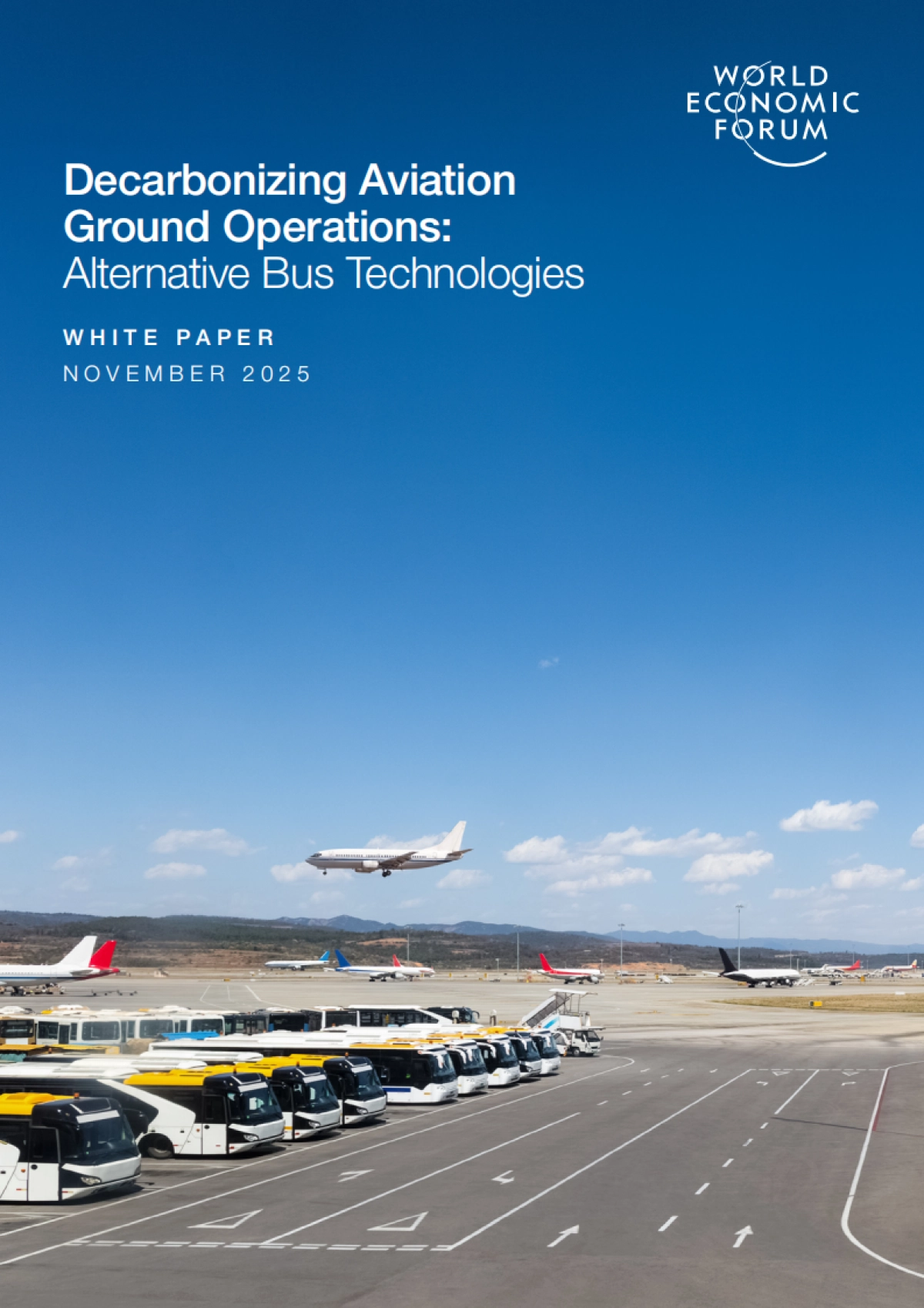
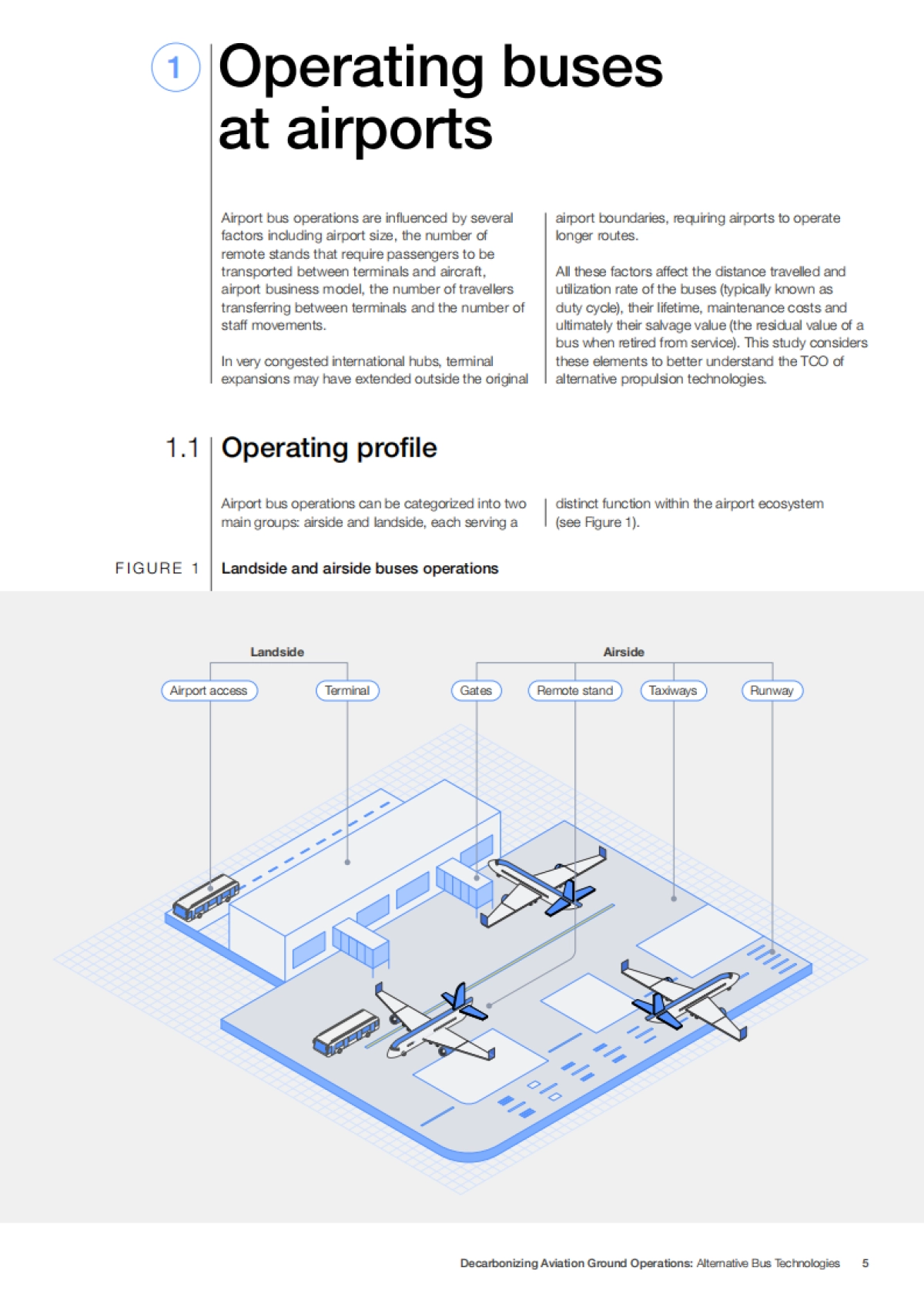
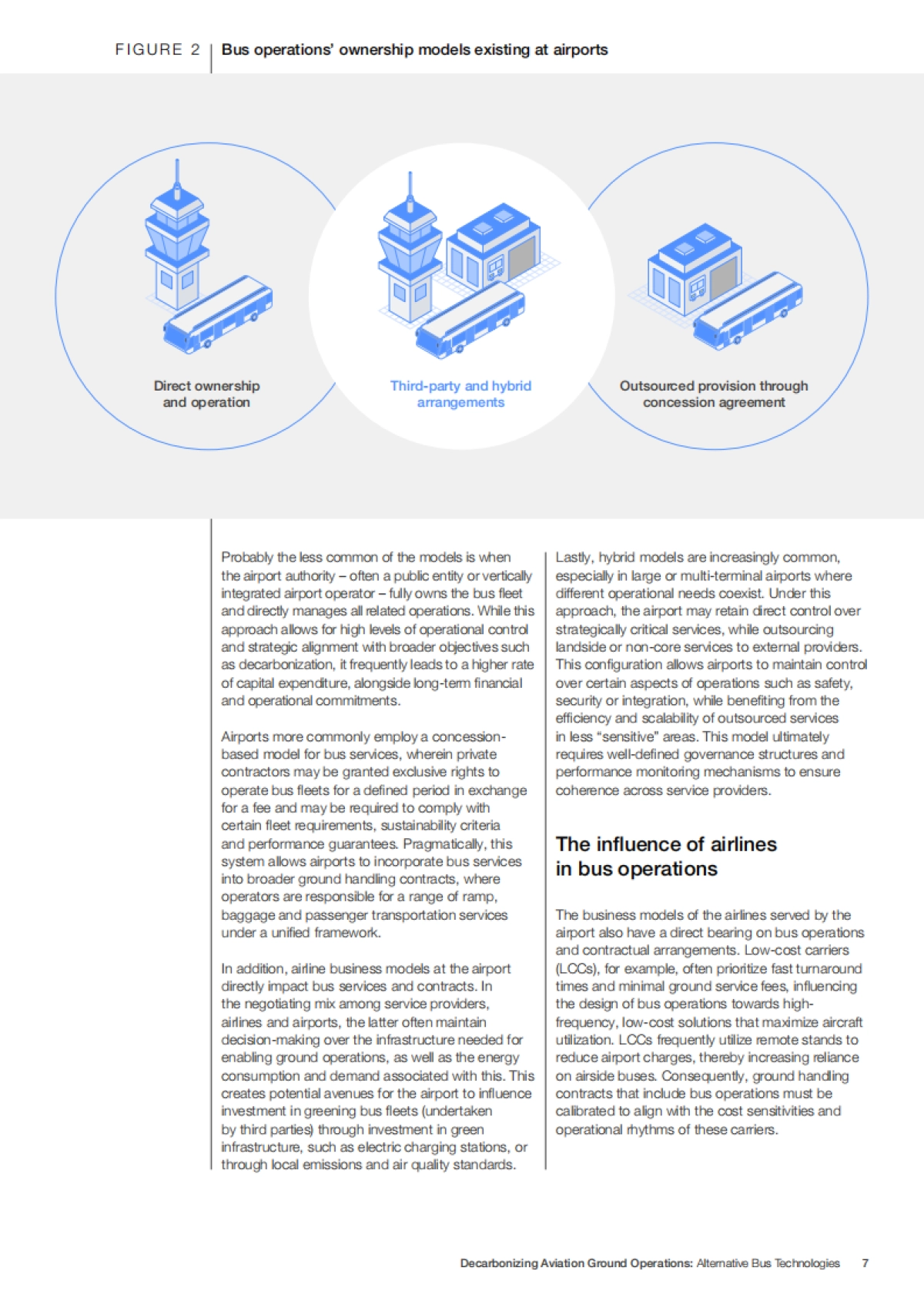
WORLDECONOMICDecarbonizing AviationGround Operations:Alternative Bus TechnologiesWHITE PAPERNOVEMBER 2025Images:Adobe Stock,Unsplash+ContentsExecutive summaryIntroduction1 Operating buses at airports51.1 Operating profile51.2 Bus fleet ownership models2 Airport bus solutions:Technology overview and developments92.1 Technology options92.2 Key features comparison113 Total cost of ownership (TCO)analysis143.1 Reference case study and scenarios considered143.2 Scenario-based TCO results and insights163.3 Sensitivity analysis21Conclusion25Appendix 1:Methodology26Appendix 2:Assumptions details per scenario27Appendix 3:Subsidies29Contributors32EndnotesDisclaimerto a project,insight area or interaction.The findings,interpretations andrepresent the views of the World EconomicForum,nor the entirety of its Members,be reproduced or transmitted in any formand recording,or by any informationDecarbonizing Aviation Ground Operations:Altemative Bus TechnologiesNovember 2025Decarbonizing Aviation Ground Operations:Executive summaryTotal cost of ownership analysis is apragmatic tool to empower airports toadvance strategic decisions on net-zeroground operations.This paper explores the techno-economic feasibilityOperational and strategic considerations:of replacing fossil-fuelled airport buses withThe choice of technology depends on eachalternative low-emission technologies such asairport's operational profile,financial capacityretrofitted diesel-to-electric,battery-electric andhydrogen buses.The aim is to provide actionableanalysis highlights that driver salaries,utilizationinsights for airports seeking to decarbonize groundrates and the availability of subsidies are theoperations and improve local air quality.Usingparameters that affect TCO the most.a robust total cost of ownership (TCO)model-validated through industry research and stakeholderWhile further research is recommended to assessinterviews-the analysis explores how capital,more detailed airport load profiling.batteryoperating,maintenance and infrastructure costsdegradation modelling and real-world retrofitaffect airport bus operations and their costs.Keyperformance data,pragmatic recommendationsfindings include:for airports include:Technology assessment:Retrofitted dieselAdopting common electric vehicle(EV)chargingvehicles with electric powertrains present aand hydrogen refuelling standards to streamlinecost-effective transitional solution that enablesinfrastructure deployment and interoperability,rapid emissions reduction without the needincluding between ground equipment and futureto procure an entire fleet of battery-electricaircraft.buses.Battery-electric buses offer zerotailpipe emissions and are increasingly cost-Integrating renewable energy sources to powercompetitive over their life cycle,especially whereelectric fleets and reduce life-cycle emissions,airport routes are predictable and chargingand renewable transport fuels where reliance oninfrastructure can be efficiently deployed andnon-electric powertrains is envisaged.operated alongside flight schedules.Hydrogenbuses (using fuel cell batteries or internalExploring second-life battery applicationscombustion engines (CE)provide greater rangeto maximize asset value,circularity andand faster refuelling.making them suitablefor larger airports with intensive duty cyclesthough they currently face higher upfront andLeveraging public-private partnerships andinfrastructure costs.green bonds to finance large-scale fleettransitions.TCO:The analysis,based on a referenceEuropean hub airport,reveals that retrofittedEnhancing collaboration among airportsoperators and energy providers to share bestkilometre(km),making them attractive forpractices and accelerate innovation.operators with budget constraints compared tonewer diesel fleets.New battery-electric busesThe paper concludes that decarbonizing busrequire higher upfront investment but can deliveroperations is both technically feasible andlower operating costs over time,particularlyeconomically advantageous,positioning airportswhen supported by government incentives.as enablers in the broader energy transition of theaviation industry.By adopting a tailored,evidence-probably the most expensive option at presentbased approach,airports can also enhancedue to technology and infrastructure costsoperational efficiency while contributing meaningfullyto the aviation industry's net-zero journey.Decarbonizing Aviation Ground Operations:Altemative Bus Technologies3IntroductionThe aviation industry is committed to achievingrequired for decarbonization may benefit a widernet-zero emissions by 2050,with every actor-set of stakeholders,making airport masterairlines,airports,ground handing companies andplanning increasingly important for both aviationpassengers-playing a critical role in this transitionand potential future offtakers who could leverageAs global air passenger numbers are projected tothe airport's energy transition.This broadergrow at a compounded annual growth rate(CAGR)approach can strengthen the business case forof 3.6%,by 2050,1 airports worldwide will expandrapidly,especially in emerging markets.Majorprojects such as the Al Maktoum InternationalThis paper provides a practical tool for airports atAirport in Dubai,King Salman International Airportthis transition point,focusing on a key use case:in Saudi Arabia and Istanbul airport in Turkiye areairport bus operations.Converting bus fleets isset to accommodate hundreds of millions of newa tangible and impactful way to reduce Scope 1emissions,with mamy airports already piloting orexpansions in Asia and Europe further underscoretransitioning to new power trains.The airport busthis growth.market itself is undergoing rapid transfomation;valued at $15.12 billion in 2024,it is projectedThis surge in passenger demand is drivingto grow at a CAGR of 11.6%to reach $44.35billion by 2033.Europe is expected to accountincluding the transformation of ground operations.for over 37.8%of this market,driven by stringentPromising technologies for flight operations-environmental regulations and strong governmentsuch as sustainable aviation fuels (SAF)andsupport for electric and hybrid buses.novel propulsion aircraft(hydrogen and battery-electric)-are advancing quickly,requiring parallelThe analysis in this paper covers the mainupgrades in airport infrastructure.While thesetechnology options for airport buses that couldtechnologies primarily address Scope 3 emissionsreduce or eliminate tailpipe emissions:retrofitteddiesel buses,battery-electric buses and hydrogenemissions profile),there is also a growing focus onfuel cell buses.It compares the TCO and technicalreducing Scope 1 and Scope 2 emissions fromfeasibility of each option,while recognizingbuildings,vehicles and ground operations.Triallingthat different airport archetypes,geographies,on-the-ground decarbonization initiatives can alsooperations and ownership models will ultimatelypave the way for battery-electric and hydrogenaffect the feasibility and costs of new technologyaviation,offering a practical means to test,adaptdeployment.Other technologies,such as hydrogenand build familiarity with the technologies that maybiofuel blends and natural gas or biomethanebuses,are not included in the quantitative analysisAirports serve as strategic nexuses not onlybut are considered qualitatively in the technologyfor aviation but also for the industries andalternatives discussion.communities around them.Infrastructure changesDecarbonizing Aviation Ground Operations:Altemative Bus Technologies①Operating busesat airportsAirport bus operations are influenced by severalairport boundaries,requiring airports to operatefactors including airport size,the number oflonger routes.remote stands that require passengers to betransported between terminals and aircraft,All these factors affect the distance travelled andairport business model,the number of travellersutilization rate of the buses (typically known astransferring between terminals and the number ofduty cycle),their lifetime,maintenance costs andstaff movements.ultimately their salvage value (the residual value of abus when retired from service).This study considersthese elements to better understand the TCO ofalternative propulsion technologies.1.1 Operating profileAirport bus operations can be categorized into twodistinct function within the airport ecosystemmain groups:airside and landside,each serving a(see Figure 1).FIGURE 1Landside and airside buses operationsLandsideAirsideAirport accessTerminalGatesRemote standRunwayDecarbonizing Aviation Ground Operations:Altemative Bus TechnologiesLandside buses operate outside the securityefficient passenger flow.An example is Dubaiperimeter and are primarily responsible forInternational Airport(DXB),which served moretransporting passengers,staff and occasionallythan 92 million passengers in 2024:2 its 200-strongcrew between airport terminals,car parks,publicairside bus fleet transferred over 16,000 passengerstransport hubs and other non-restricted areas.per month on average.3These services are integral to ensuring smoothaccess and connectivity across airport infrastructureIn contrast,intermediate and regional airportsfor arriving and departing passengersmay rely on more modest bus fleets,typicallyranging between 10 and 20 units.However,theseConversely,airside buses function within theregional airports are usually constrained by gatesecure area of the airport,facilitating the transferinfrastructure and may host high volumes of low-of passengers,crew and ground staff betweencost carrier traffic that often prefers bus-to-standterminal buildings and aircraft stands.Given theoperations,to maximize rapid aircraft turnaroundnecessity to synchronize precisely with aircraftand cost-efficiency over the use of gates,which canturnaround times and boarding procedures,airsidebe more limited and expensive to operate.bus operations are subject to stringent safety andoperational requirements.Operating hours at airports,often dictated bylegislative restrictions,also impact bus operationsThe configuration and complexity of both airsideAirports with 24-hour schedules require continuousand landside operations vary significantly with thebus availability and maintenance.On the otherairport's operational profile.This affects the numberhand,airports under night-operating restrictionsof buses operating at airports.For instance,in largemay plan their activities in a different manner.Thesehub airports with multiple terminals,high passengerestrictions affect maintenance costs,bus lifespans,volumes can require extensive landside busstaffing needs and refuel scheduling.networks to manage inter-terminal traffic and ensure1.2 Bus fleet ownership modelsAirport ownership is a factor to consider forAirports'path to emissions-free bus operationspreparing a decarbonization strategy and accessingcould be significantly influenced by the underlyingfunding sources.Ownership models(private orbusiness strategies that emerge from differentstate)may vary depending on region.+Approachesairport ownership models,but also from the busto decarbonization can differ depending on theownership models directly.At a fundamental levelownership model:government-funded airportsthree dominant categories prevail (see Figure 2):often operate within the framework of national ordirect ownership of bus fleet and operation by theregional policies,whereas privately owned airportsairport authority;outsourced provision throughconcession agreements;and third-party contractsaccording to their operational or market context.and hybrid approaches combining both.Decarbonizing Aviation Ground Operations:Altemative Bus Technologies6FIGURE 2Bus operations'ownership models existing at airportsDirect ownershipThird-party and hybridOutsourced provision throughand operationarrangementsconcession agreementProbably the less common of the models is whenLastly,hybrid models are increasingly common,the airport authority-often a public entity or verticallyespecially in large or multi-terminal airports whereintegrated airport operator-fully owns the bus fleetdifferent operational needs coexist.Under thisand directly manages all related operations.While thisapproach,the airport may retain direct control overapproach allows for high levels of operational controlstrategically critical services,while outsourcingas decarbonization,it frequently leads to a higher rateThis configuration allows airports to maintain controlof capital expenditure,alongside long-temm financialover certain aspects of operations such as safety,and operational commitments.security or integration,while benefiting from theefficiency and scalability of outsourced servicesAirports more commonly employ a concession-in less "sensitive"areas.This model ultimatelybased model for bus services,wherein privaterequires well-defined governance structures andoontractors may be granted exclusive rights toperformance monitoring mechanisms to ensureoperate bus fleets for a defined period in exchangecoherence across service providers.for a fee and may be required to comply withcertain fleet requirements,sustainability criteriaand performance guarantees.Pragmatically,thisThe influence of airlinessystem allows airports to incorporate bus servicesinto broader ground handling contracts,wherein bus operationsoperators are responsible for a range of ramp,baggage and passenger transportation servicesThe business models of the airlines served by theunder a unified framework.airport also have a direct bearing on bus operationsand contractual arrangements.Low-cost carriersIn addition,airline business models at the airportdirectly impact bus services and contracts.Intimes and minimal ground service fees,influencingthe negotiating mix among service providers,the design of bus operations towards high-airlines and airports,the latter often maintainrequency,low-cost solutions that maximize aircraftdecision-making over the infrastructure needed forutilization.LCCs frequently utilize remote stands toenabling ground operations,as well as the energyreduce airport charges,thereby increasing relianceconsumption and demand associated with this.Thison airside buses.Consequently,ground handingcreates potential avenues for the airport to influencecontracts that include bus operations must beinvestment in greening bus fleets(undertakencalibrated to align with the cost sensitivities andby third parties)through investment in greenoperational rhythms of these camiers.infrastructure,such as electric charging stations,through local emissions and air quality standards.Decarbonizing Aviation Ground Operations:Altemative Bus TechnologiesIn contrast,legacy airlines may demand tighterand a need for airports to establish robustintegration with lounge and gate infrastructure.oversight mechanisms to ensure safety,quality andAll these factors affect bus service coordinationinteroperability across competing providers.As abetween airlines,airport and ground serviceresult,procurement processes have become moreproviders.Therefore,airports serving a diversestructured,often requiring competitive tenders,airline mix may adopt hybrid ownership andmulti-year service-level agreements and detailedoperating models that can accommodate varyingperformance metrics.Ultimately,all these factorsservice expectations and turnaround profiles.may become barriers if an airport is willing tochange the infrastructure needed for changing thebus fleet.Regional regulations impactingthe ownership modeln sum,the business and ownership models ofairport bus fleets are neither static nor one-size-fits-all.They reflect a complex interplay of operationalIn some cases,regulatory frameworks largelyconfigurations,commercial imperatives anddetermine the model adopted.In Europe,forregulatory constraints.As airports intensify efforts tomust be carefully assessed and leveraged to pursueservice provision models.The directive mandatesthe path of least resistance to meaningful progressthe liberalization of ground handling services,in sustainability.When fleet decarbonization isallowing multiple service providers to compete inelevated to a strategic priority,public-privateeligible commercial airports-in this case,thosepartnerships and the shift from asset-basedwith annual traffic exceeding 2 million passengersownership to service-oriented mobility contractsor 50,000 tonnes of freight.This has led toincreasingly come to the fore-a developmentincreased outsourcing,greater price competitionfurther examined in Chapter 4.zing Aviation Ground Operations:Altemative Bus Technologies2)Airport bus solutions:Technology overviewand developmentsGround transport-particularly bus fleets-hasfuel cell and retrofitted diesel vehicles with battery-become a key focus for airports seeking to reduceelectric powertrain.Renewable biofuel (hydrotreatedoperational emissions and advance sustainabilityvegetable oil,or HVO)and biomethane buses,goals.Rapid technology developments are driving aalthough not considered in the TCO model,havereassessment of fleet strategies and the adoption ofalso been assessed.By examining the operationalnnovative solutions.characteristics,infrastructure requirements anddecarbonization potential of each option,this chapterThis chapter provides an overview of the mainaims to equip decision-makers with the insightstechnological pathways considered for the TCOneeded to navigate the complex landscape ofanalysis that are shaping the future of airport bustechnology options and align investments with bothoperations,including battery-electric,hydrogenimmediate needs and long-term climate objectives.2.1 Technology optionsThe decarbonization of airport bus fleets isare particularly well-suited to airports with compactincreasingly shaped by three primary technologies:layouts,predictable routes and scheduled breaksbattery-electric,hydrogen fuel cell and retrofittedthat align with charging opportunities.Overnightdiesel.depot charging is often sufficient for landside shuttleservices,while high-power opportunity charging canEach option offers distinct operational characteristicssupport airside operations with higher duty cycles.and infrastructure requirements,making its suitabilitydependent on the specific operational context of theHowever,battery-electric technology is notairport.While their shared objective is the reductionwithout limitations.Range and battery lifetimeof greenhouse gas emissions and local pollutants.can be affected by ambient temperature,heavythe underlying technologies differ significantly inpassenger loads and continuous use of auxiliaryenergy storage,refuelling or recharging methods,and performance profiles.pronounced in extreme cold or heat.Charginginfrastructure requires careful integration with airportUnderstanding the core features of each technologypower systems to avoid grid strain,potentiallyand weighing it with financial considerations cannecessitating upgrades to accommodate the risingenable decision-makers to achieve a full techno-energy demands,or the deployment of energyeconomic picture guiding strategic investment.storage solutions at airports.In addition,strategiesfor end-of-life battery management and disposalremain a critical consideration;some airportsElectric busesare already adopting "second-life"applications,5repurposing retired batteries for stationary storage,which can help mitigate environmental and logisticalBattery-electric buses draw propulsion energy fromchallenges if properly implemented.high-capacity lithium-ion or,in emerging cases,solid-state batteries,offering zero tailpipe emissionsAirports implementing electric buses must considerand high energy efficiency.the operational fit,route length,fleet size and theability to coordinate charging with operational peaksTheir primary advantage is the relative maturityElectric buses have seen rapid adoption,especially inof the technology thanks to the rise of EVs in theEuropean airports such as Aeroporti di Roma,whereautomotive industry,and the rapidly expandingrenewable energy powers 11 fully-electric shuttlesupply chain,which has driven down procurementbuses,or London Gatwick,which will entirelycosts and improved performance.Electric busesreplace its 14-bus fleet with fully electric buses.Decarbonizing Aviation Ground Operations:Altemative Bus TechnologiesHydrogenRetrofitted busesRetrofitted diesel buses offer a transitionalinto electricity through an electrochemical reaction,decarbonization pathway by replacing the internalemitting only water vapour from the tailpipe,whichcombustion engine and associated componentscan be collected for later use.One of their principalwith alternative powertrain solutions-mostadvantages lies in operational autonomy:hydrogencommonly full battery-electric,but potentially alsovehicles typically achieve ranges of 350 to 500hydrogen ICE,or hybrid systems that combinekm on a single refuelling,which is particularlycombustion and electric drivetrains (includingadvantageous in large airports with extended apronplug-in variants).For the purposes of this analysis,networks (where buses are specialized vehicleshowever,only the conversion from diesel to fullused to transport passengers between terminalsbattery-electric is examined in detail.and aircraft)or where buses operate on multi-shiftcycles with minimal downtime.This intermediate solution is particularly interestingfor airports with a relatively new bus fleet (fossil-Moreover,hydrogen systems can deliver consistentfuel or biofuel based).This allows them to extendpower output regardless of ambient temperature,the operational life of their fleets while achievingsubstantial reduction in tailpipe emissions,avoidingor cabin heating to operate without significantlythe capital cost of procuring entirely new vehiclescompromising range-an important considerationin airports located in extreme climates or wherethe price of a brand-new electric one).From apassenger comfort requirements are stringent.technical standpoint,retrofitting can be completedRefuelling is rapid,often under 15 minutes,enablingin a fraction of the time required for full fleethigh vehicle availability and reducing the need forreplacement,and it enables the reuse of bus bodieslarge spare fleets.and chassis and leaves the interiors in serviceablecondition.The main opportunities lie in legacyOperationally,hydrogen buses are particularlyfleet decarbonization where budget constraints,suited to airside use cases where flexibility,longlong procurement cycles or sustainability targetsduty cycles and reduced turnaround times aredemand rapid emissions reduction.critical,and where land availability allows for theinstallation of a dedicated hydrogen refuellingHowever,retrofitting presents challenges:thefacility.For instance,Greater Toronto Airportsdiversity of existing fleet specifications canAuthority's plan for hydrogen bus adoption iscomplicate corversion processes,certificationstrongly linked with the airport's wider ecosystem,requirements may vary by jurisdiction,andbenefiting from the installation of a hydrogenmaintenance teams could require retraining torefuelling station outside of airport boundaries formanage the new systems.light and heavy-duty vehicles.Decarbonizing Aviation Ground Operations:Altemative Bus Technologies 10Additionally,airports considering this as a solutiontechnology.These deployments are enablingmay double-check if,after the retrofit,the busairports to achieve immediate emissions reductionfleet would achieve the same efficiency,rangewhile longer-term electrification and hydrogenand reliability compared to purpose-built zero-infrastructure are developed.emission vehicles,particularly in demanding airsideenvironments.Biomethane-powered busesGeneva Airport1 illustrates the potential of thisapproach:in 2024 it invested in two retrofitted busesat an average cost of CHF 350,000 each,with fourThis alternative uses methane produced frommore to be delivered in 2025.Together with otherfleet measures,this brings the airport to 24 electricsewage sludge or agricultural residues,which isbuses in a total of 27,showing how retrofitting canused as a drop-in replacement for compressedprovide a cost-efficient bridge while infrastructure foror liquefied natural gas in standard gas enginesnext-generation technologies is developed.or hybrid systems.It enables airports and transitoperators to decarbonize their fleets withoutcompletely replacing existing vehicles or refuellingFossil-fuel and biofuel-mix busesinfrastructure.Biomethane buses have quickrefuelling times,long operational ranges andsignificantly lower particulate and nitrogen oxideHVO buses represent a growing trend in airportemissions compared with diesel.When theground transport decarbonization strategies.HVObiomethane is sourced from waste streams,theis a renewable diesel alternative produced fromoverall greenhouse gas balance can approachvegetable oils or waste fats,offering a significantcarbon neutrality.reduction in life-cycle carbon emissions-up toThe Munich Airport's biomethane buses12 haveare in most cases compatible with existing diesela range of up to 800 km and refuel in about fiveengines and fuelling infrastructure,making themminutes.They have reduced particulate emissionsa practical and immediate solution for airportsby roughly 90%and nitrogen oxides by over 60%seeking to lower their operational emissions withoutcompared with Euro VI diesel buses.extensive new infrastructure investments.From an infrastructure perspective,HVO'sHydrogen internalcompatibility with existing diesel fuelling systemsmeans that airports can transition their fleetscombustion enginewith minimal operational disruption or capitalexpenditure.This contrasts with the previouslyHydrogen ICE is another retrofit option underanalysed scenarios.As such,HVO serves as adevelopment,showing promise particularly as avaluable bridge technology,supporting airports'bridge between existing diesel engines and zero-decarbonization goals in the near term andemission technologies,since many componentscomplementing the broader shift towards SAF and(such as ignition,cooling and transmission)arezero-emission ground transport.shared with corventional buses.While this paper has focused on zero-emissionProjects such as the TRIMIS HyFLEET:CUTE1 trialstechnologies such as battery-electric andin Berlin have already demonstrated the potentialhydrogen fuel cell,HVO-powered buses haveof this approach.While hydrogen ICE has not beennot been included in the core analysis due toincluded in the present TCO analysis,it is an areatheir status as a low-carbon,rather than zero-worth tracking,and its evolution could be capturedemission,solution.Nevertheless,it is important toin future assessments to provide a more completeacknowledge that HVO buses are being adoptedpicture of available decarbonization pathways.at a growing number of airports as a transitional2.2Key features comparisonAs airports advance on their course towardsthe decision to adopt one pathway over anotherdecarbonization,the choice of bus technologyisrequires a careful analysis of each airport's uniquemore than a technical decision-it is shaped byoperational constraints,infrastructure readiness,evolving priorities,operational realities and theregulatory environment and TCO.Figure 3ambition to create a cleaner futurerepresents how these options compare in termsof climate impact,investment,ongoing costs andAcross all available technologies-diesel,retrofitoperational fit.diesel,battery electric and hydrogen fuel cell-Decarbonizing Aviation Ground Operations:Altemative Bus Technologies 11FIGURE 3Cross-technology comparison of buses based on climate impact,operating costs,investments and airport operationsCategory○CriterionDieselRetrofitElectricHydrogenHighZeroZeroZeroEnergy consumptionHighMedium-HighMedium-HighMediumFuel/Energy sourceDieselElectricityElectricityGaseous hydrogenUpfront cost and investmentAirport bus market availabilityGlobal,>15 OEMs'Growing,-10 OEMs and>10 OEMs,expanding-5 OEMs,limitedrapidlymodels,pilot projectsDiesel stationsCharging stationsGaseous hydrogenstationTechnology maturityHighMediumMediumLowMaintenance requirementsHighMediumLowMedium10-15 years (batteryExpected service lifetime15-20 years12-18 years (batteryreplacement required)replacement required)Ongoing operating costsAirport planning implicationsMinimumGrid upgradeGrid upgradeHydrogen ecosystemOperational rangeLongMediumMediumLongShort/MediumShort/MediumFast charging <25 minFast charging <25 minRefuelling/Charging timeShort(minutes)Overnight charging 3.4Overnight charging 3-4Short (-10 min)hourshoursDriver/User acceptanceMediumMediumHigh (training needed)High (training needed)Note:OEMs:Original equipment manufacturersClimate impacthighlighting that the climate impact is not just aboutthe bus fleet itself,but about the energy ecosystemthat supports it.The environmental story of airport buses beginswith diesel,a technology that has reliablypowered fleets for decades but now stands as theUpfront costs and investmentbenchmark for emissions and energy consumptionDiesel buses,while robust and familiar,are theprimary ground transport contributor to greenhouseWhen looking at their upfront costs,diesel busesgas emissions and local air pollution at airports.remain the most accessible and affordable optionRetrofitting these vehicles with electric powertrainsfor many operators.Their widespread availabilityoffers a meaningful step forward-reducingand mature supply chains keep purchase priceslow.Retrofitting diesel buses offers a pragmaticalternative for airports with newer fleets,enablingThe real transformation comes with battery electricemissions reduction at a lower cost than purchasingand hydrogen fuel cell buses.Both technologiesnew vehicles.While often presented as costingpromise zero emissions at the point of use,around half the price of a new bus,actual expensesfundamentally changing the airport's environmentalcan vary significantly depending on the age andfootprint.Battery electric buses can reducecondition of the base vehicle.Older units typicallygreenhouse gases and local pollutants dramatically,require extensive refurbishment-replacing majorcomponents and sometimes refitting interiors.Hydrogen buses also offer clean operation,emittingAdditional logistical expenses,such as transportingonly water vapour,but their broader climate benefitdepends on how the hydrogen is produced.Ifadd further to the investment.Moreover,thesourced from renewables,the impact is profoundretrofit market,though expanding,remains lessstandardized than that for new electric buses.Decarbonizing Aviation Ground Operations:Altemative Bus Technologies 12Battery electric buses represent a new era ofHowever,electric buses are quieter and cleaner,investment.The vehicles themselves are moreenhancing the passenger and staff experience andexpensive than diesel ones,and the need forreducing the airport's environmental footprint.charging stations-and related significant upgradesto airport electrical systems,including grid upgradesHydrogen buses offer the promise of long rangeand battery storage systems-can make the initialand rapid refuelling,combining the operationaloutlay substantial.Yet,as the market matures andof electric.While the lack of widespread hydrogengradually coming down and the long-term valueinfrastructure remains a challenge,the introductionproposition is improving.of hydrogen also requires tailored training andsafety protocols-comparable to the adjustmentsHydrogen buses,meanwhile,are at the frontier ofalready made for other fuels such as electricity.innovation.Their high purchase price and the needdiesel,propane or natural gas.Airports investingfor specialized,often bespoke,fuelling infrastructurein hydrogen are already demonstrating that it canmake them the most capital-intensive option.Forbe deployed safely and reliably,with affordabilityairports considering hydrogen,the decision isexpected to improve as adoption scales.as much about future readiness and ecosystemdevelopment as it is about immediate cost.Beyond these day-to-day operational factors,thetransition to battery-electric and hydrogen busesintroduces a new layer of complexity and uncertaintyOngoing operating costsfor airport operators.An industry taskforce led byseveral steps to tackle these,including:Diesel buses,while cheap to buy,can be moreA comprehensive aerodrome compatibilitystudy before operations can begin,ensuring thatengines add up over time.Retrofitted buses caninfrastructure,safety and operational proceduresoffer some relief,with newer components reducingare fit for purpose-not only for buses,but also inmaintenance needs,but they still face the dual costsanticipation of future hydrogen or electric aircraft.of diesel and electricity,especially when airportschoose to have both system coexist for a while.Security and fire safety,as both battery andhydrogen vehicles present unique risks.BatteryBattery electric buses,by contrast,shine in termsfires can be prolonged and emit toxic fumes,of ongoing cost efficiency.Electricity is generallywhile hydrogen,though clean burning,demandsspecialized detection and response protocols.fewer breakdowns and lower maintenance bills.Airports must also plan for significantly increasedOver the lifespan of the vehicle,these savings canelectrical power demand,as stands will needbe significant,helping to offset the higher upfrontto support simultaneous charging of buses and,investment.Hydrogen fuel cell buses also benefiteventually,aircraft-potentially necessitating majorfrom reduced mechanical complexity,but the costupgrades to energy infrastructure.and availability of hydrogen fuel remain barriers.Asthe technology matures and the hydrogen supplyThe introduction of new fuel types may requirechain grows,these costs may fall,but for now,theysegregated parking stands,which could reduceare a key consideration.stand capacity and complicate ground supportequipment logistics.Airport operationsFurthemmore,operational procedures such asDiesel buses are easy to refuel and maintain,beoome critical to ensure safety and resilience.and well-suited to established operationalroutines.Retrofitted buses fit comfortably into thisUlltimately,while each technology presents a distinctpattern,requiring only modest adjustments toaccommodate charging.Still,the need to removeconsiderations and investment requirements,thevehicles from service for conversion and thedecision for amy airport will depend on how theselogistics of refurbishment can create temporaryfactors translate into long-term value.To provide acapacity gaps that airports must plan for.clearer basis for comparison and support evidence-based decision-making,the next section delves intoBattery electric buses introduce new dynamics.the total cost of ownership (TCO)analysis-outliningCharging schedules must be carefully managed tothe methodology,key assumptions and resultingensure vehicles are ready when needed,and routeinsights that underpin a comprehensive evaluationplanning may need to adapt to range limitations,of each pathway's financial and operationalespecially in airports with demanding duty cycles.implications over the full life cycle of the fleet.Decarbonizing Aviation Ground Operations:Altemative Bus Technologies 133Total cost of ownership(TCO)analysisThe TCO analysis presented in this paper evaluatesinfrastructure,and any necessary modificationsthe high-level economic implications of adoptingto existing facilities,such as maintenance depotsdifferent sustainable bus technologies in the airportor fuelling stations.Opex covers the recurrentenvironment,considering both capital expenditurecosts incurred during operation,including fuel or(capex)and operational expenditure (opex)acrosselectricity supply,scheduled and unscheduledthe expected service life of the vehicles.maintenance (including battery replacement),stafftraining,insurance,licensing and other ongoingCapex includes the upfront costs associated withoperational expenses.vehicle procurement,installation of supporting3.1 Reference case study and scenarios consideredTo ensure a simple comparison between alternative2025 and quantitative research,some operationalbus technologies,this study has chosen theparameters (e.g.bus distance travelled)have beenarchetype of a European international hub airport.estimated and validated to ensure the analysis canIt has been assumed that a similar airport maybe as representative as possible of potential real-operate a 50-airside bus fleet.Leveraging over 20world applications.The full methodology is set outinterviews with Airports of Tomorrow and aviationin the appendix.stakeholders conducted from March to AugustTABLE 1Reference case parameters for the European international hub mid-sized airportOperational parameterValueCommentFleet size (number of buses)50Number of drivers (per bus)3Bus driver salary(E/driver)36,580Operating hours(hours/day)Operational days365Utilization rate(%/bus)25Share of operating time during which bus iscarrying passengersBus average speed (km/hour)20Bus distance travel(km/day/bus)average speedBus annual distance travel (km/year)32,850Investment date (year)2030Applicable for all technology options analysedProject lifetime(years)15Assumed lifespan for busesWeighted average cost of capital(%)4.56Based on average for three regulated airports'sCorporate borrowing rate(%)4.10Based on European Central Bank (2025)dataBanking department amountFull investment assumed to be made upfrontconsidered(%)Decarbonizing Aviation Ground Operations:Altemative Bus Technologies 14Operational details are harmonized,and all ofBased on market research,each bus is assumed tothese have been kept fixed across all technologyhave a 386 kilowatt-hour (kWh)battery.providingscenarios.It is assumed that buses travel at ana usable range of 235 km and a daily chargingaverage speed of 20 km per hour within airportload of 103.45 kWh.Charging is conductedgrounds,ensuring realistic energy consumption andovernight,with a 3.82-hour average charging timemaintenance estimates.Buses operate 18 hoursand 95%charger efficiency.Maintenance costsa day,but camy passengers only for 25%of theoperating hours (utilization rate 25%).every day ofbattery replacement.In this analysis,this batterythe year,with an estimated bus range of 90 km/replacement is assumed to happen in year nine.day.Staffing is standardized,with three drivers perTo reflect potential grant schemes and incentivesbus per day,each earning a fixed annual salary ofaimed at supporting low-emission bus deployment,E36,580.A 15-year project lifetime is assumed,50%of the capital investment is assumed to beand financial calculations are thus discountedsubsidized by the government.This scenarioat a weighted average cost of capital (WACC)significantly reduces emissions and aligns with long-rate of 4.56%,aligning with industry norms forterm sustainability goals,though it requires higherinfrastructure investments.upfront investment and operational adjustments.In this reference case study,airport bus operationsScenario 3fleet.This approach requires the least infrastructureHydrogen bus fleet-off-siteinvestment,as it leverages existing fuelling andhydrogen productionmaintenance facilities.The capex is primarilyallocated to the procurement of diesel buses,whileThis scenario considers the deployment ofthe opex is dominated by fuel costs,driver salarieshydrogen-powered buses,with hydrogen suppliedwarranty and insurance,and maintenance.Marketfrom off-site production facilities.The bus fleetaverage retail price of diesel is assumed at E1.67operates approximately 4,500 km per day.per litre and the unit price per bus is 259,000,withconsuming 428 kilograms (kg)of hydrogen daily,no government subsidies considered.taking average hydrogen bus fuel economy in mind.Each bus is equipped with a 30-80 kg hydrogenTaking into account the various technologytank,offering a range of 200-600 km per refuelling,options,the following scenarios have beenwith refuelling times between 10 and 20 minutes.developed based on the key criteria that influenceBased on market research,the average capital costdecision-making in airport master planning.per bus is E600,000,with a 3.5%annual learningcurve and 50%government subsidy on bus capex.Scenario 1All investments are made upfront,and a dedicatedRetrofitted electric fleetrefuelling station is installed at the airport.InIn this scenario,the airport opts to retrofit existingthe baseline assumption for this scenario is thediesel buses with electric drivetrains,offering ause of green hydrogen,priced at e2.87/kg.Thetransitional pathway towards electrification.TheTCO model can,however,also reflect alternativeretrofit cost is assumed at 50%of a new electrichydrogen price assumptions (e.g.grey or bluebus,with maintenance costs 10%higher than thosehydrogen),allowing adaptation to different regionalof new electric buses (E0.407 per kilometre).Thecontexts and production pathways.This scenariooperational and infrastructure requirements mirorenables rapid refuelling and extended range,those of the new electric fleet,including chargingsupporting operational flexibility.infrastructure and driver training.Scenario 2Electric fleetThis scenario explores the transition to a fully electricvehicles and charging infrastructure.The capitalexpenditure includes the purchase of electric buses(average price E550,000)and the installation ofcharging stations,with additional costs for civilengineering,grid updates,electrical installation anddesign.Operational expenditure covers batteryand insurance,maintenance and driver training.Decarbonizing Aviation Ground Operations:Altemative Bus Technologies 15

请如实的对该文档进行评分-
-
-
-
-
0 分