Private markets: A slower eraMcKinsey Global Private Markets Review 2024March 2024
Copyright © 2024 McKinsey & Company. All rights reserved. This publication is not intended to be used as the basis for trading in the shares of any company or for undertaking any other complex or significant financial transaction without consulting appropriate professional advisers.No part of this publication may be copied or redistributed in any form without the prior written consent of McKinsey & Company.
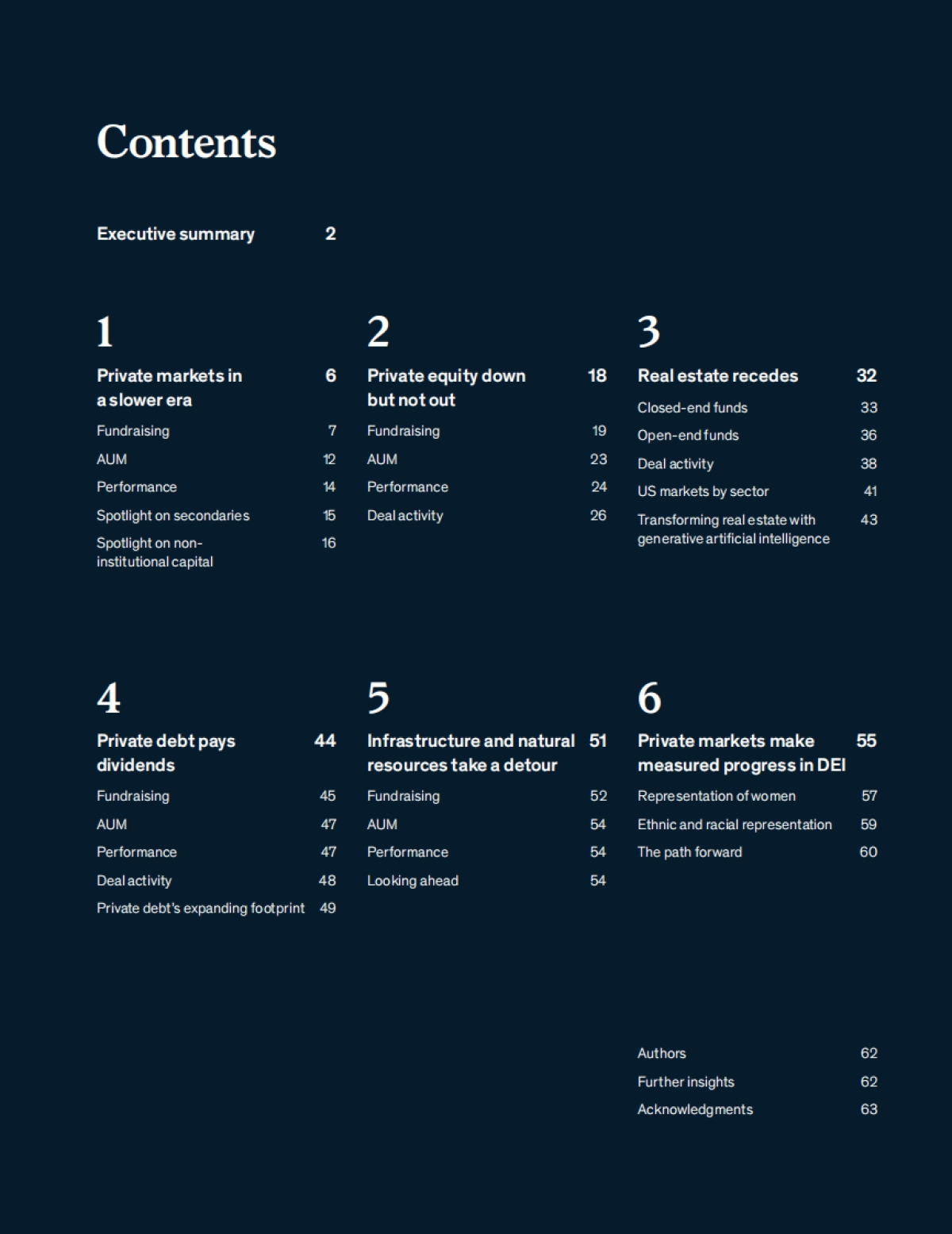
ContentsExecutive summary 21Private markets in 6 a slower era Fundraising 7AUM 12Performance 14Spotlight on secondaries 15Spotlight on non- 16 institutional capital2Private equity down 18 but not outFundraising 19AUM 23Performance 24Deal activity 263Real estate recedes 32Closed-end funds 33Open-end funds 36Deal activity 38US markets by sector 41Transforming real estate with 43 generative artificial intelligence4Private debt pays 44 dividendsFundraising 45AUM 47Performance 47Deal activity 48Private debt’s expanding footprint 495Infrastructure and natural 51 resources take a detour Fundraising 52AUM 54Performance 54Looking ahead 546Private markets make 55 measured progress in DEIRepresentation of women 57Ethnic and racial representation 59The path forward 60Authors 62Further insights 62Acknowledgments 63
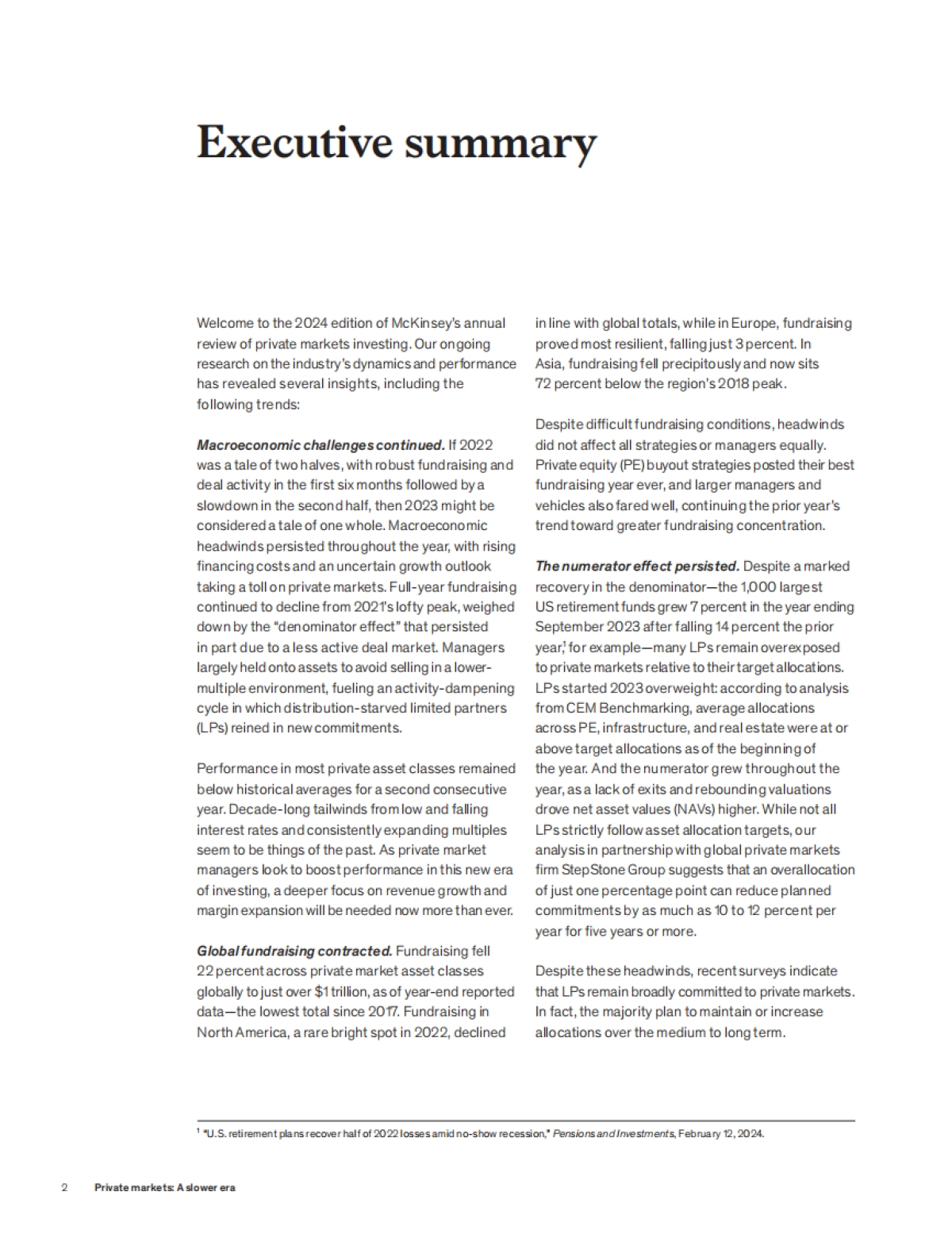
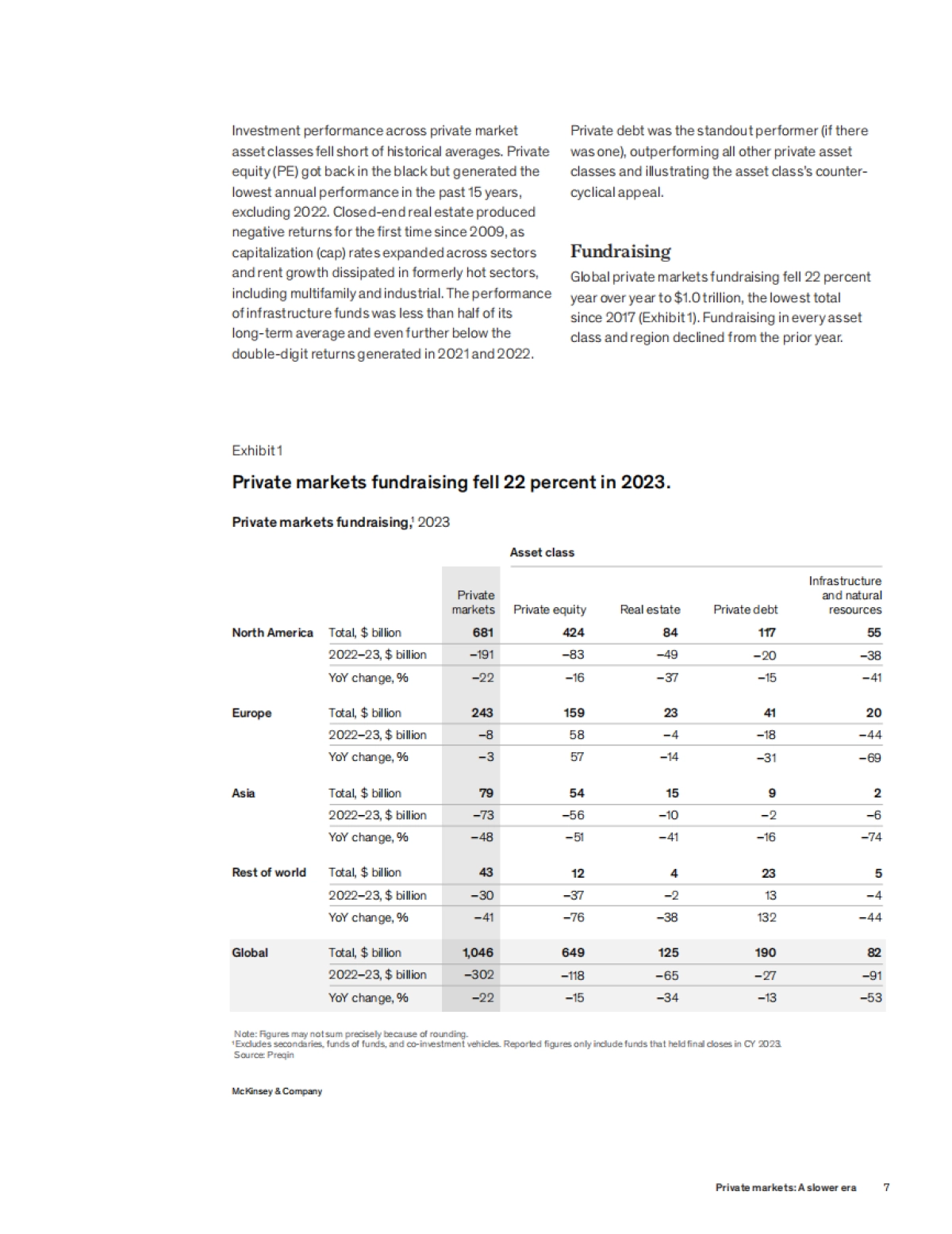
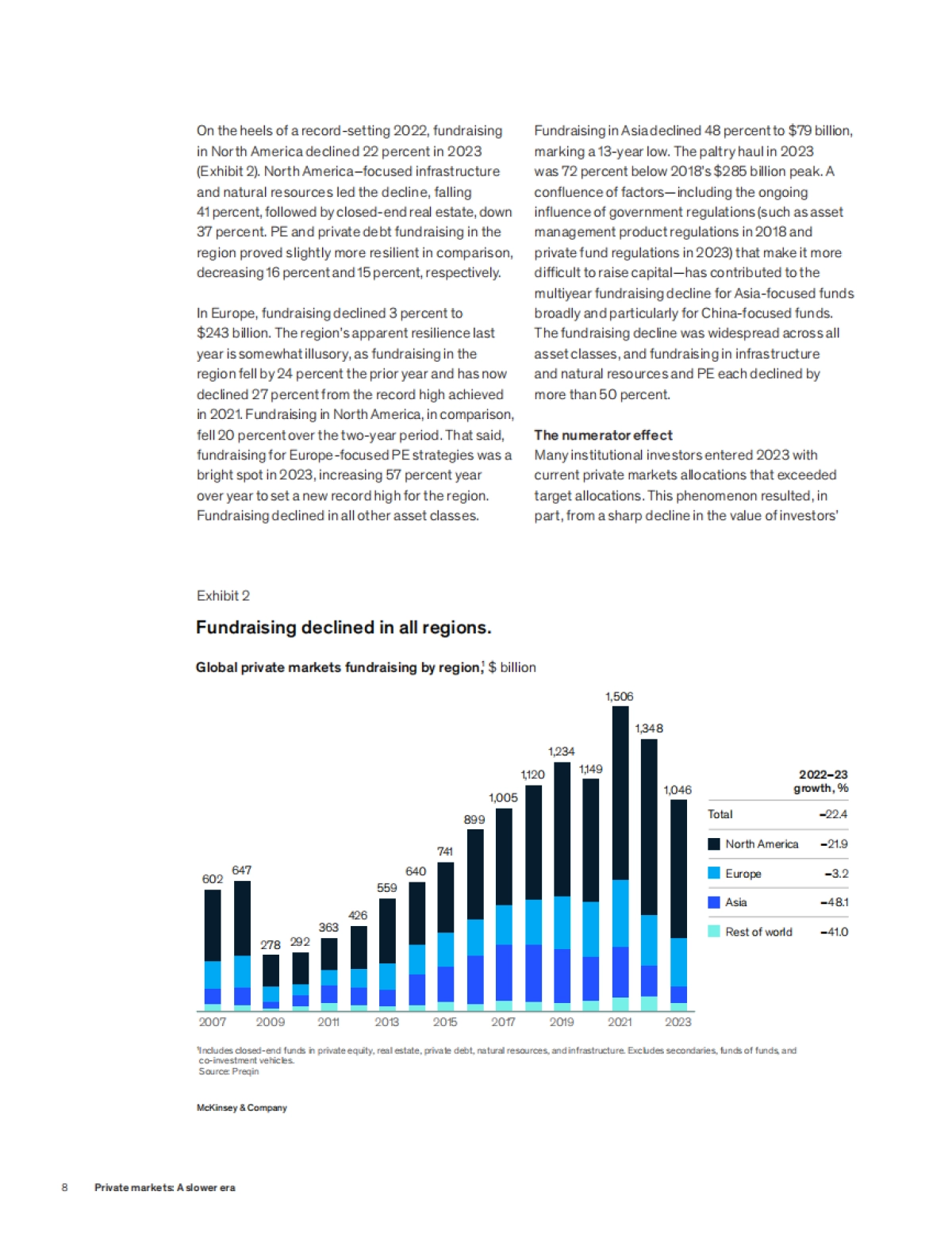
Welcome to the 2024 edition of McKinsey’s annual review of private markets investing. Our ongoing research on the industry’s dynamics and performance has revealed several insights, including the following trends:Macroeconomic challenges continued. If 2022 was a tale of two halves, with robust fundraising and deal activity in the first six months followed by a slowdown in the second half, then 2023 might be considered a tale of one whole. Macroeconomic headwinds persisted throughout the year, with rising financing costs and an uncertain growth outlook taking a toll on private markets. Full-year fundraising continued to decline from 2021’s lofty peak, weighed down by the “denominator effect” that persisted in part due to a less active deal market. Managers largely held onto assets to avoid selling in a lower-multiple environment, fueling an activity-dampening cycle in which distribution-starved limited partners (LPs) reined in new commitments. Performance in most private asset classes remained below historical averages for a second consecutive year. Decade-long tailwinds from low and falling interest rates and consistently expanding multiples seem to be things of the past. As private market managers look to boost performance in this new era of investing, a deeper focus on revenue growth and margin expansion will be needed now more than ever.Global fundraising contracted. Fundraising fell 22 percent across private market asset classes globally to just over $1 trillion, as of year-end reported data—the lowest total since 2017. Fundraising in North America, a rare bright spot in...