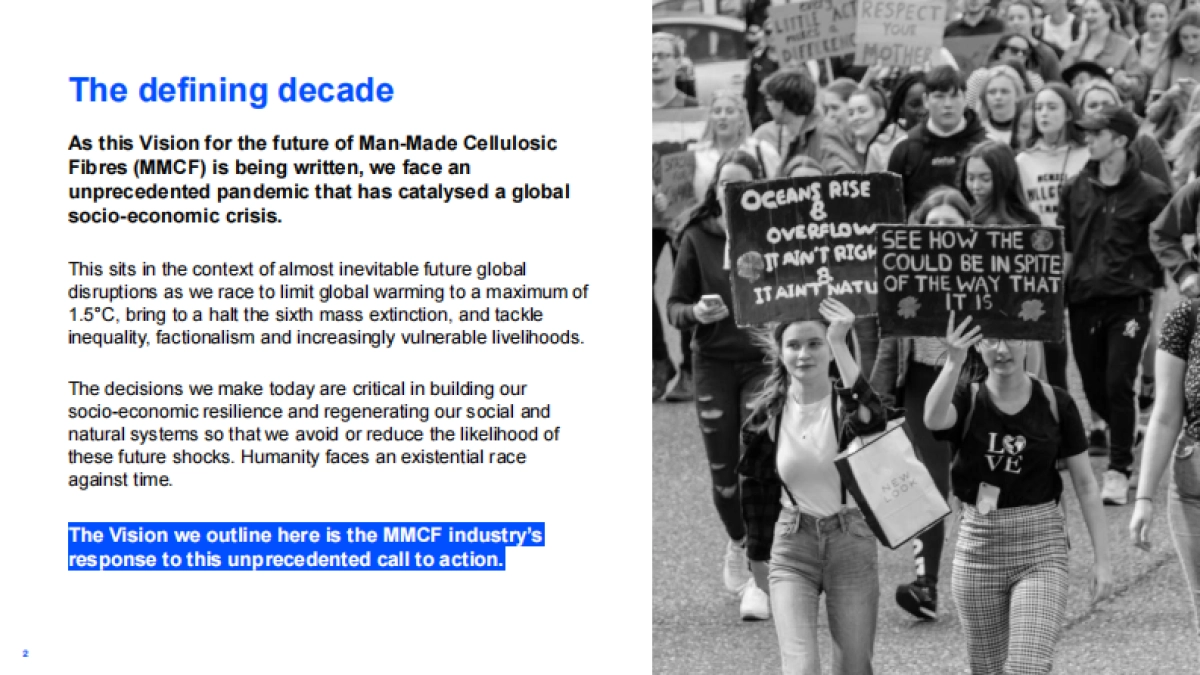
As this Vision for the future of Man-Made Cellulosic Fibres (MMCF) is being written, we face an unprecedented pandemic that has catalysed a global socio-economic crisis. This sits in the context of almost inevitable future global disruptions as we race to limit global warming to a maximum of 1.5°C, bring to a halt the sixth mass extinction, and tackle inequality, factionalism and increasingly vulnerable livelihoods. The decisions we make today are critical in building our socio-economic resilience and regenerating our social and natural systems so that we avoid or reduce the likelihood of these future shocks. Humanity faces an existential race against time. The Vision we outline here is the MMCF industry’s response to this unprecedented call to action.The defining decade2
The role of the MMCF value chainMMCF such as Viscose/Rayon, Lyocell, Modal and Cupro constitute the second most important group of cellulosic fibres after cotton, with an annual production volume of around 6.7 million tons annually - or approximately 6.2% of the total fibre production volume.1 Prior to COVID-19, MMCF volumes were expected to increase rapidly over the next 15 years, possibly reaching 10 million tons annually.2 The MMCF value chain has the potential to tackle some of the apparel and broader textile industry’s most significant sustainability challenges and, as a consequence, make a very real contribution to building resilience and accelerating regeneration. Its unique prospects for realising circular fashion, for instance, contrast sharply with the linear models of economic growth that have left many of our ecosystems on the verge of collapse. As a derivative of wood pulp and other natural plant materials, MMCF can play an important role in regenerating many of these ecosystems, as well as ensuring the health of carbon sinks, which play an essential role in stabilising the Earth’s climate. To date, however, the sector has faced considerable social and environmental challenges – from deforestation and biodiversity impacts related to raw material sourcing, to safe chemical use and labour rights concerns in the production process. As an industry on the cusp of massive growth, there is a narrow window of opportunity to fully harness MMCF’s potential. The MMCF 2030 Vision aims to do just that.3
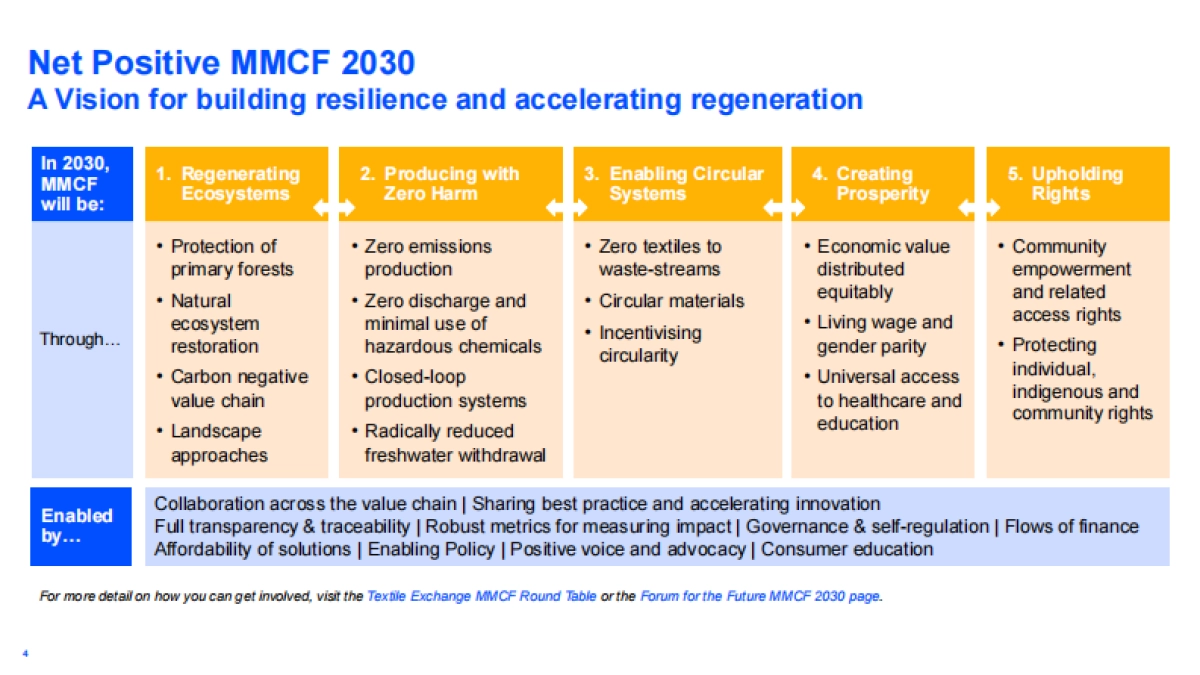
1. Regenerating Ecosystems2. Producing with Zero Harm3. Enabling Circular Systems4. Creating Prosperity5. Upholding Rights Collaboration across the value chain | Sharing best practice and accelerating innovation Full transparency & traceability | Robust metrics for measuring impact | Governance & self-regulation | Flows of financeAffordability of solutions | Enabling Policy | Positive voice and advocacy | Consumer education• Protection of primary forests• Natural ecosystem restoration • Carbon negative value chain• Landscape approaches• Zero emissions production• Z...