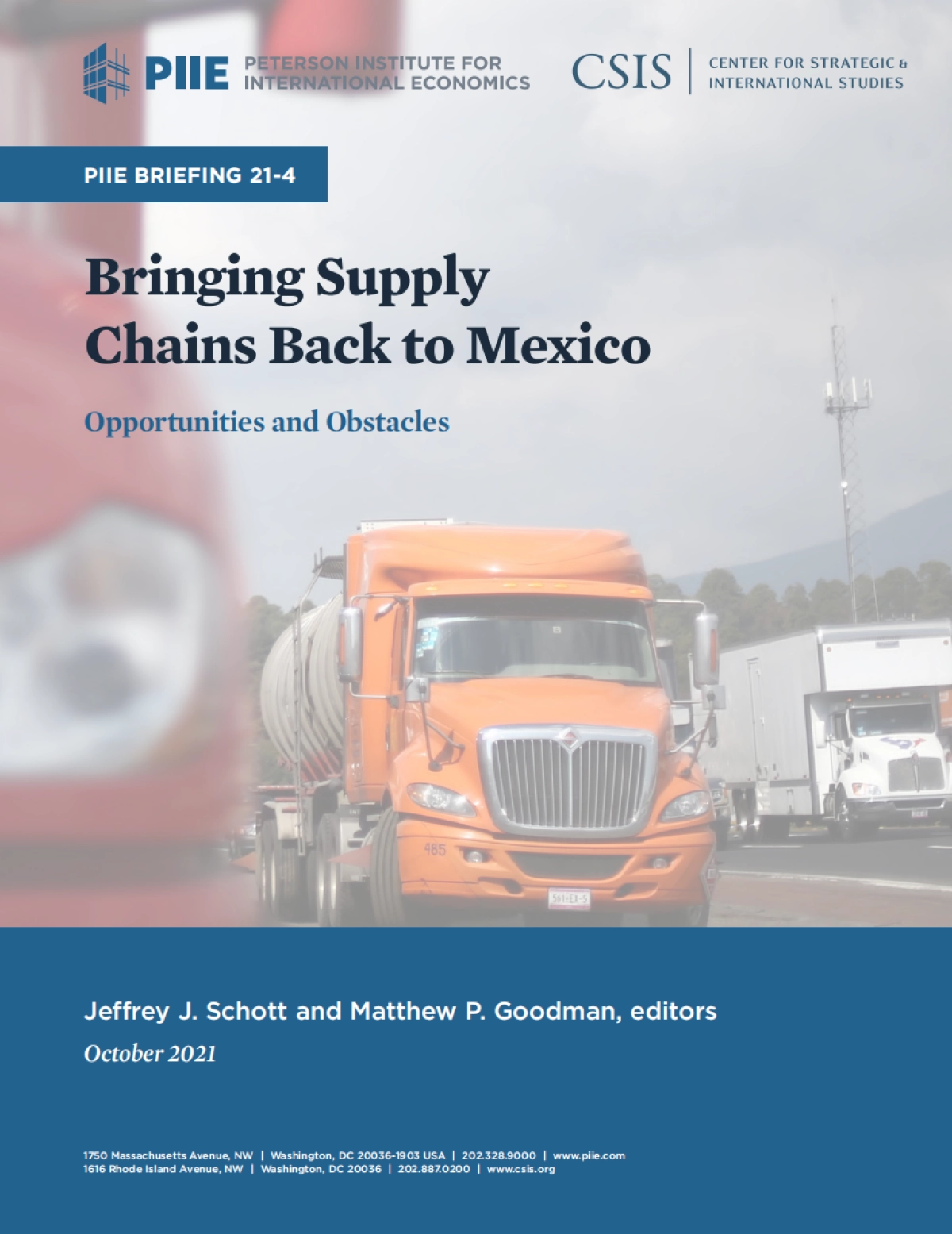
1750 Massachusetts Avenue, NW | Washington, DC 20036-1903 USA | 202.328.9000 | www.piie.com1616 Rhode Island Avenue, NW | Washington, DC 20036 | 202.887.0200 | www.csis.orgPIIE BRIEFING 21-4Jeffrey J. Schott and Matthew P. Goodman, editorsOctober 2021Bringing Supply Chains Back to MexicoOpportunities and Obstacles
ContentsFOREWORD 3 John J. Hamre and Adam S. Posen1 CAN MEXICO HELP BRING SUPPLY CHAINS BACK TO 5 NORTH AMERICA? Jeffrey J. Schott2 COMPETITION WITH CHINA IS IN THE REALM OF 11 IDEAS: WILL MEXICO PARTICIPATE? Luis de la Calle3 THE US-CHINA TARIFF WAR DIVERTED TRADE TO 15 MEXICO, BUT NOT BY MUCH Mary E. Lovely and David Xu 4 THE PAST IS DRAGGING MEXICO AWAY FROM A 20 PROSPEROUS FUTURE Mariana Campero5 WILL MEXICO’S INSECURITY SCUTTLE ITS 24 NEARSHORING MOMENT? Ryan C. Berg6 USING NADBANK TO PROMOTE REGIONAL 27 INTEGRATION IN NORTH AMERICA Sherman Robinson and Raul Hinojosa-Ojeda7 A REVIVED US-MEXICO DIALOGUE ENHANCES 31 ECONOMIC COOPERATION Earl Anthony (Tony) Wayne ABOUT THE CONTRIBUTORS 342 PIIE BRIEFING 21-4 | OCTOBER 2021
3 PIIE BRIEFING 21-4 | OCTOBER 2021ForewordJohn J. Hamre and Adam S. PosenCOVID-19 has reinforced a trend toward economic decoupling from China. Foreign companies operating in China face recurrent discrimination, mounting pressure from the US government to leave, and an understandable need to diversify supply chains geographically. There is also a growing desire in the business community to create more resilient supply chains, in part by expanding outside of China. This set of forces raises questions around the feasibility and benefits of nearshoring or reorienting US supply chains to North America, and whether or how that should be promoted. The challenge in any nearshoring scenario is finding trusted partner countries that can provide an alternative to production in China and simultaneously allow for the creation of resilient supply chains. The most promising candidate for large-scale nearshoring is Mexico, due to its geography, existing high level of economic integration with the United States, and participation in the high-standards United States-Mexico-Canada Agreement. Significant concerns remain, however, about Mexico’s viability as a nearshoring location. Even before the COVID-19 pandemic buffeted Mexico’s economy, an array of structural impediments—including trade barriers, regulatory rigidities, energy sector interventions, and inadequate intellectual property protection—had impeded Mexico’s attractiveness as an investment destination. The Biden administration has made progress in the important area of labor reforms, thereby making an expansion of US supply chains in Mexico politically viable. The Biden administration, however, has so far shown little interest in engaging constructively with the administration of Andrés Manuel López Obrador on broader improvement of Mexico’s trade and investment climate. Lab...