热门文档
- 2025-04-21 11:02:12 2025年中国宠物行业白皮书
- 2024-11-17 13:23:03 Mckinsey:2024中国消费趋势调研
- 2025-06-17 17:31:50 2024中国医疗器械行业发展报告
- 2024-07-31 22:30:59 城市飞行营地总体规划及主题体验区概念设计规划案
- 2025-10-14 11:53:22 中国微短剧精品化发展研究报告(2025)-新京智库
- 2025-03-07 11:57:25 【剧星传媒】《哪吒2》资源推荐0205
- 2024-12-23 13:57:51 哩哔哩《灵笼2》招商方案
- 2025-01-16 15:13:48 2025年全新品牌屋框架模型
- 2024-10-13 08:47:52 联合国:2024世界投资报告
- 2024-05-19 21:59:54 2024小红书餐饮行业方法论
- 2025-05-13 10:34:19 中国茶叶品牌发展报告(2024)会
- 2025-06-10 15:18:07 2025年秋冬淘宝服饰白皮书-篆商业智库

1、本文档共计 0 页,下载后文档不带水印,支持完整阅读内容或进行编辑。
2、当您付费下载文档后,您只拥有了使用权限,并不意味着购买了版权,文档只能用于自身使用,不得用于其他商业用途(如 [转卖]进行直接盈利或[编辑后售卖]进行间接盈利)。
3、本站所有内容均由合作方或网友上传,本站不对文档的完整性、权威性及其观点立场正确性做任何保证或承诺!文档内容仅供研究参考,付费前请自行鉴别。
4、如文档内容存在违规,或者侵犯商业秘密、侵犯著作权等,请点击“违规举报”。
2、当您付费下载文档后,您只拥有了使用权限,并不意味着购买了版权,文档只能用于自身使用,不得用于其他商业用途(如 [转卖]进行直接盈利或[编辑后售卖]进行间接盈利)。
3、本站所有内容均由合作方或网友上传,本站不对文档的完整性、权威性及其观点立场正确性做任何保证或承诺!文档内容仅供研究参考,付费前请自行鉴别。
4、如文档内容存在违规,或者侵犯商业秘密、侵犯著作权等,请点击“违规举报”。
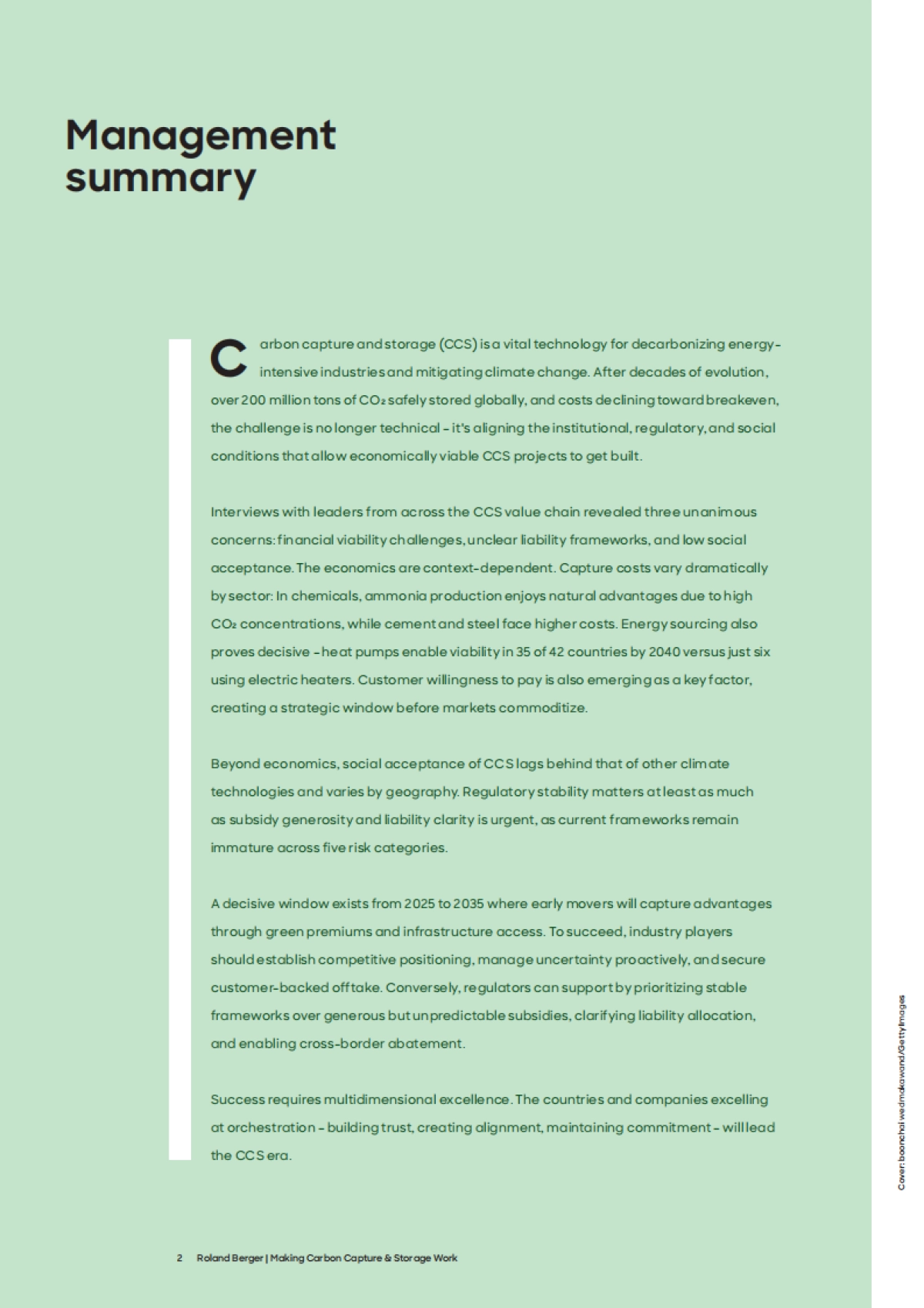
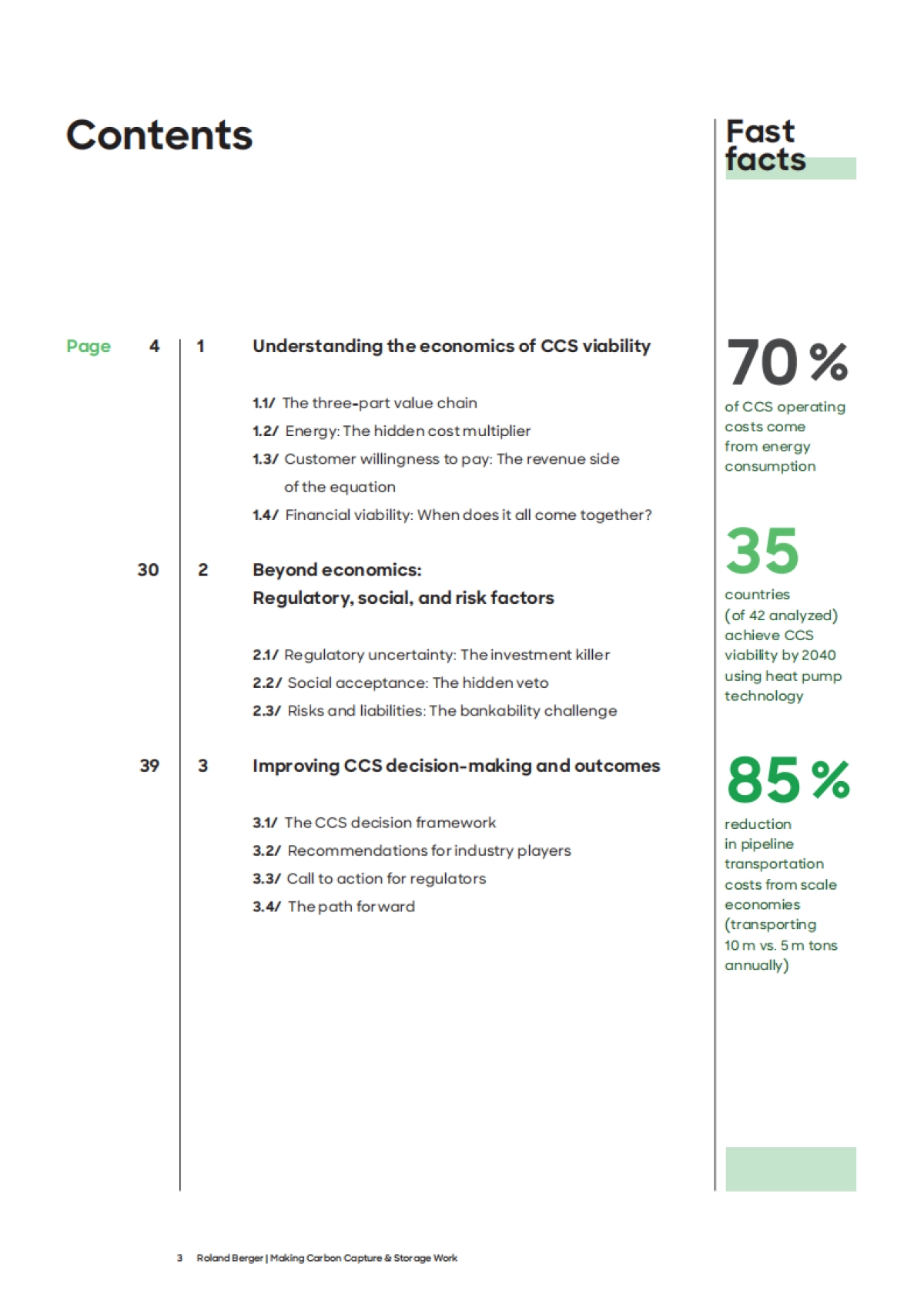
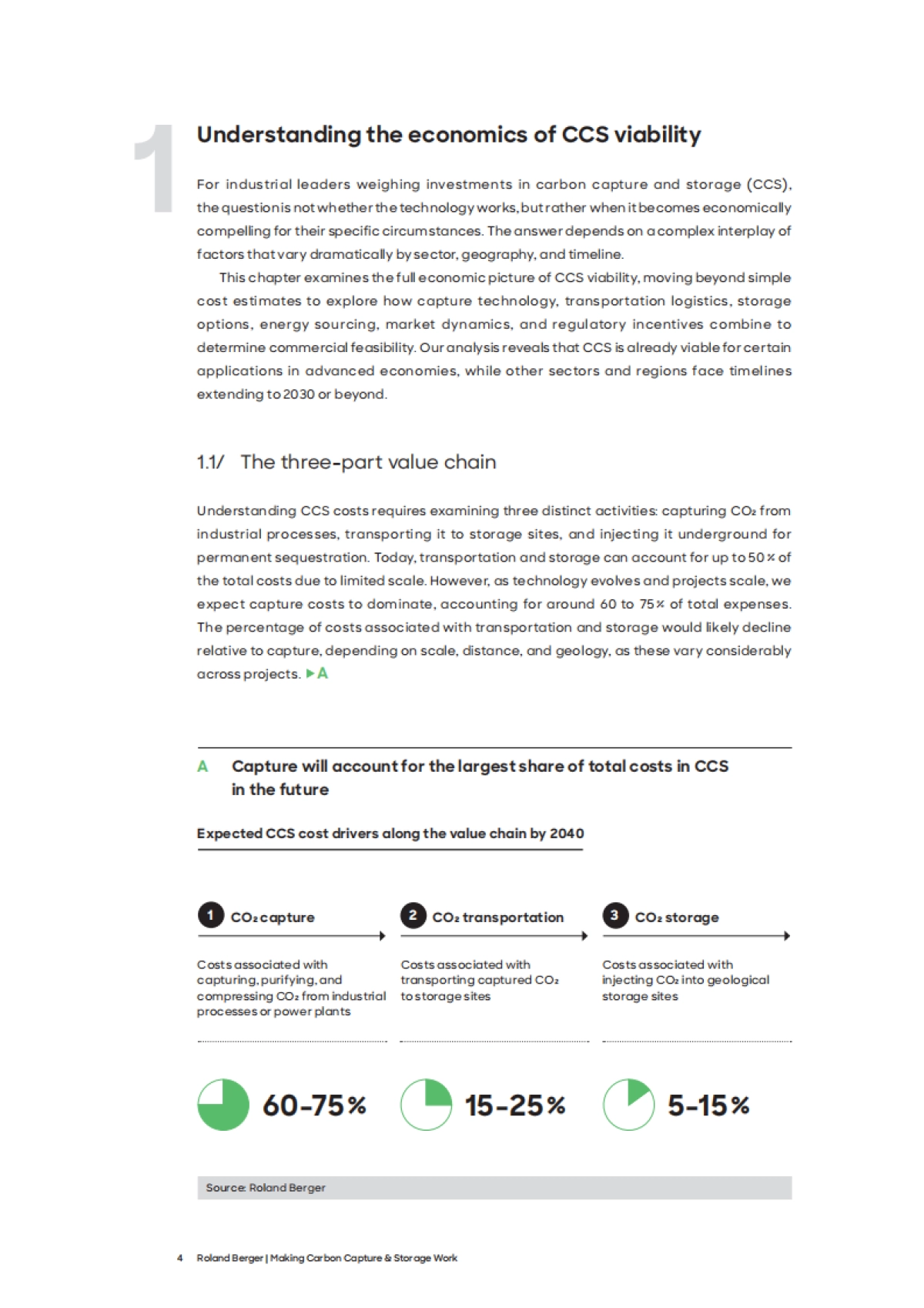
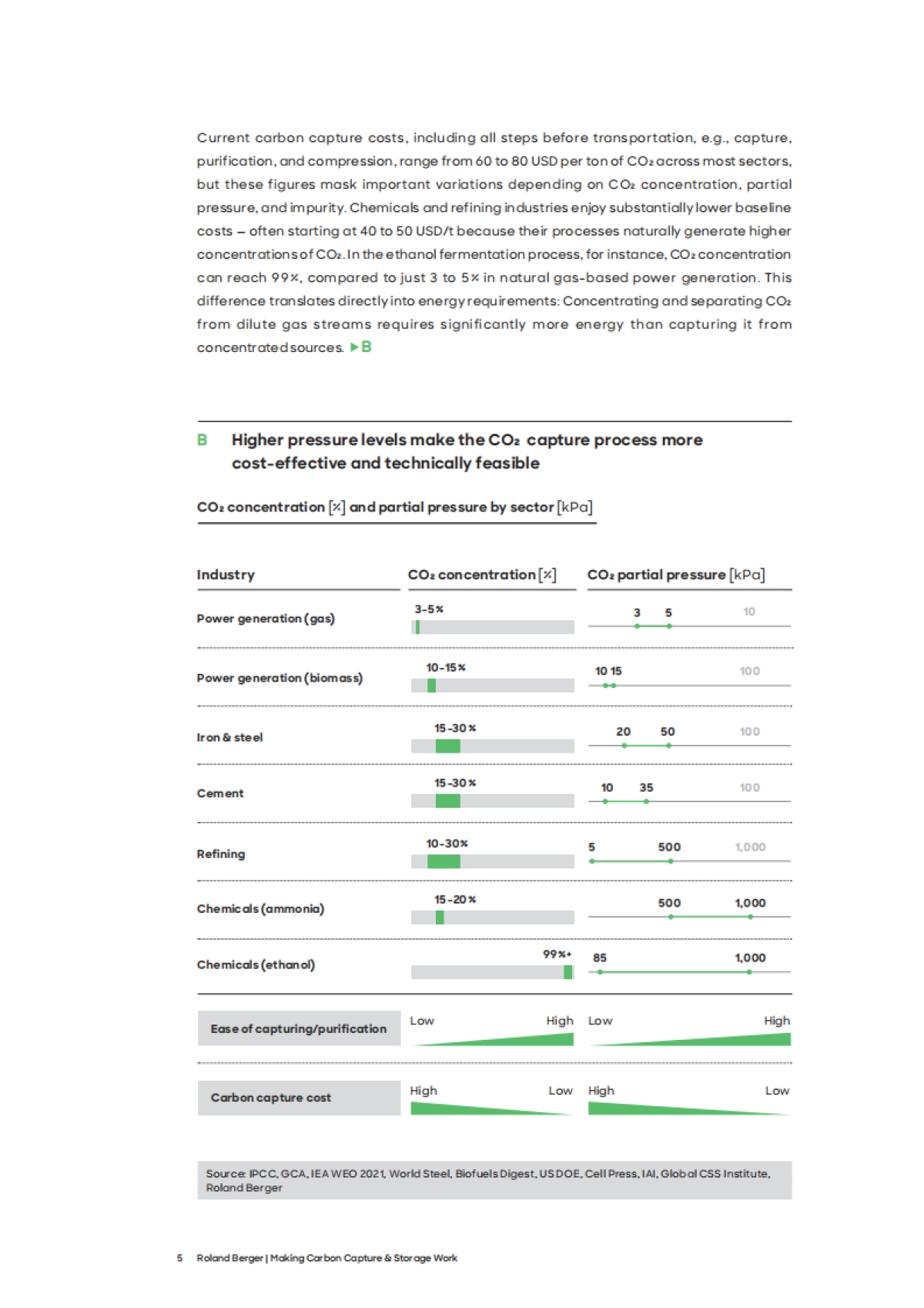
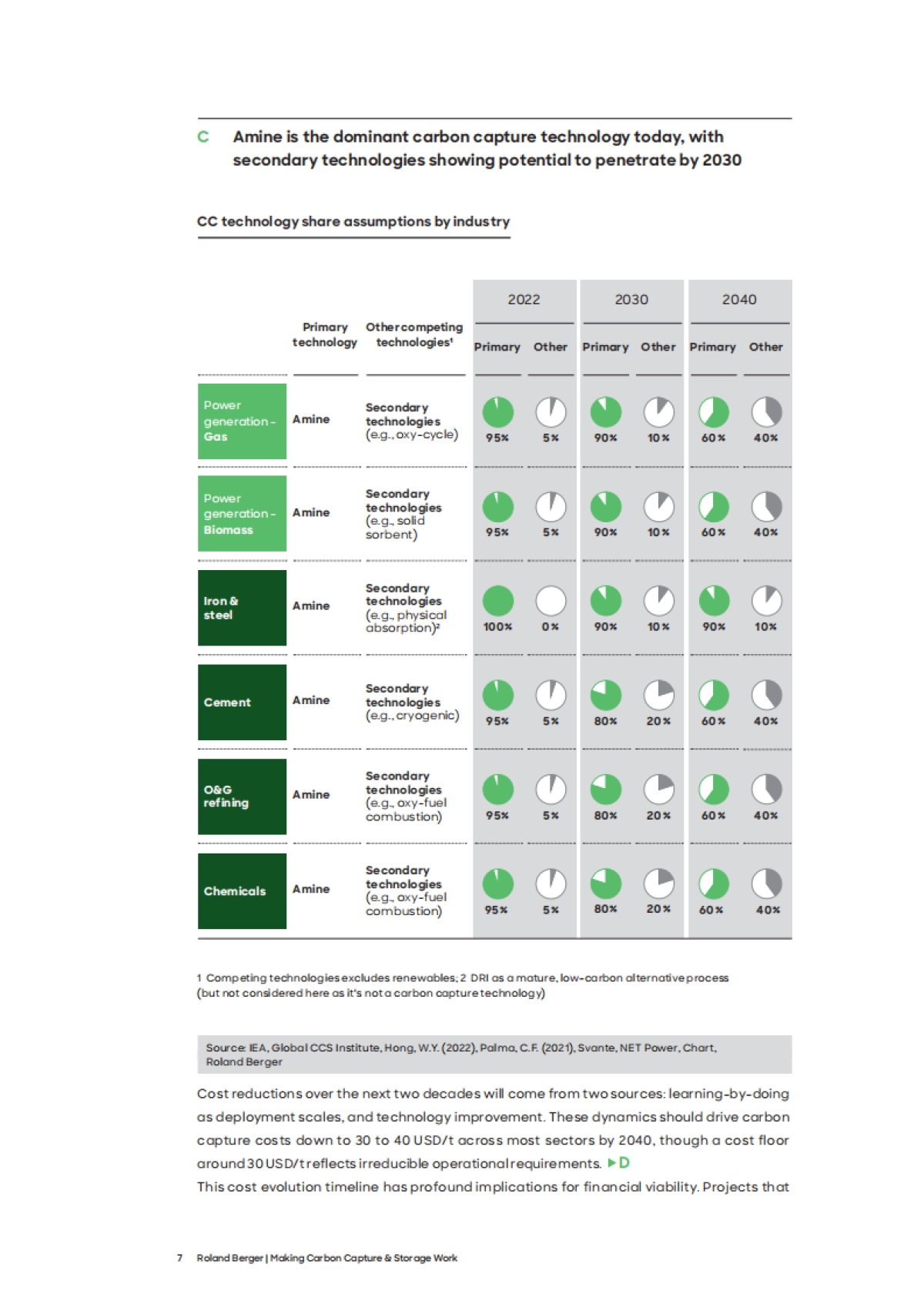
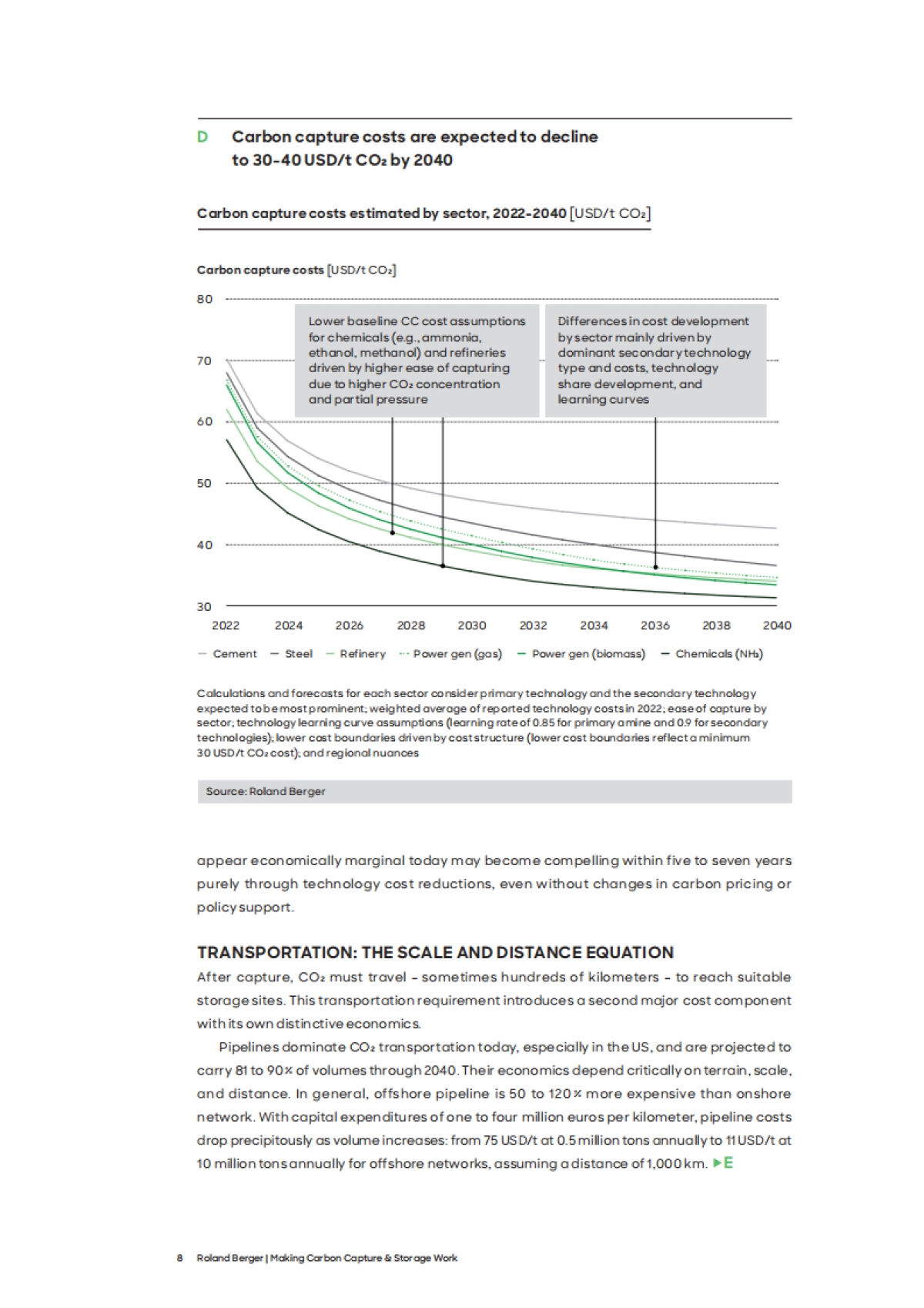
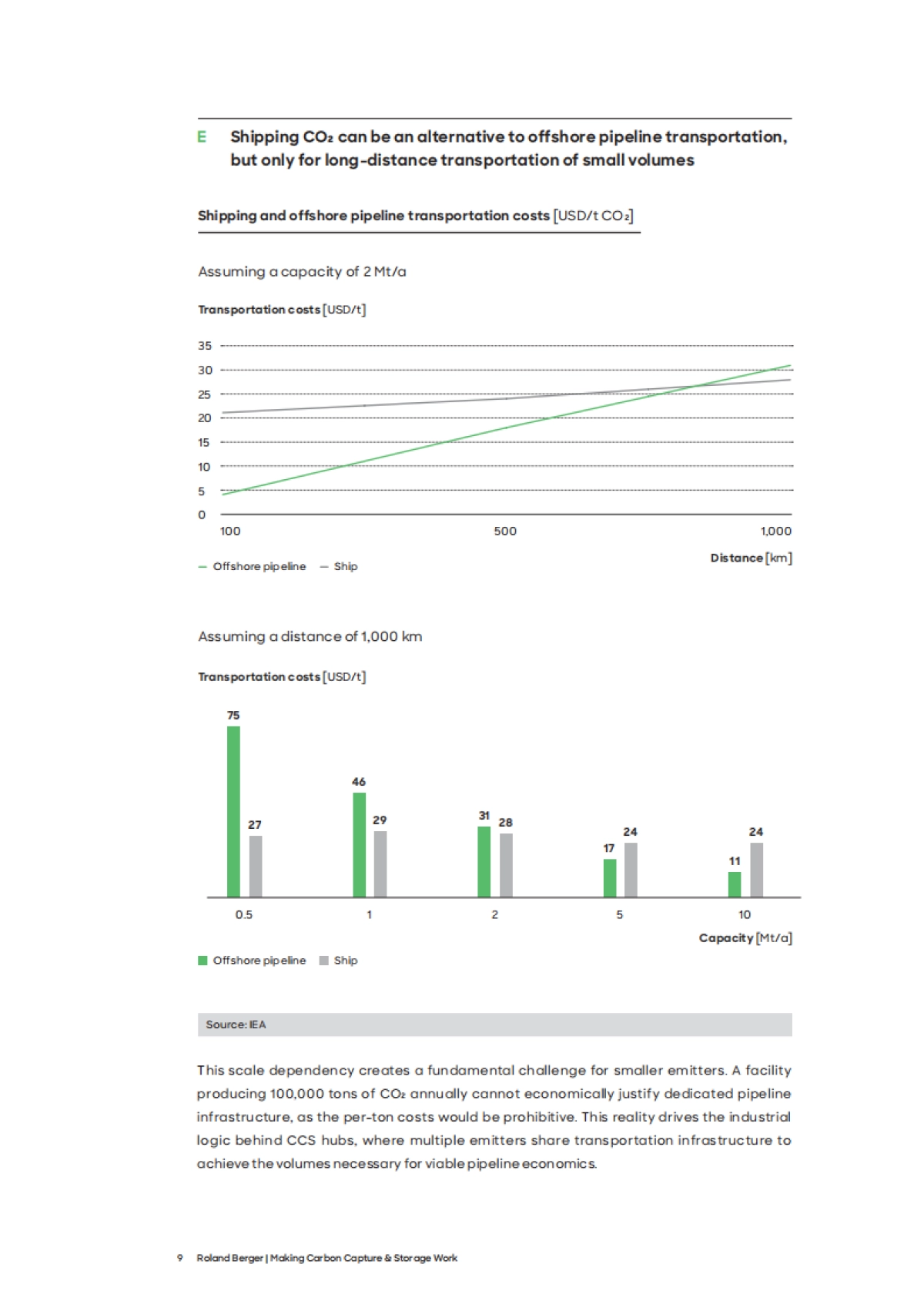
Making Carbon CaptureStorage WorkA strategic guide to economicviability and enabling conditionsRolandBergerManagementsummaryarbon capture and storage(CCS)isa vital technology for decarbonizing energy-intensive industriesand mitigating climate change.After decades of evolution,over 200 million tons of CO2 safely stored globally,and costs declining toward breakeven,the challenge is no longer technical-it's aligning the institutional,regulatory,and socialInterviews with leaders from across the CCS value chain revealed three unanimousconcerns:financial viability challenges,unclear liability frameworks,and low socialacceptance.The economics are context-dependent.Capture costs vary dramaticallyby sector:In chemicals.ammonia production enjoys natural advantages due to highCO2 concentrations,while cement and steel face higher costs.Energy sourcing alsoproves decisive-heat pumps enable viability in 35 of 42 countries by 2040 versus just sixusing electric heaters.Customer willingness to pay is also emergingas a keyfactor.creating a strategic window before markets commoditize.Beyond economics,social acceptance of CCS lags behind that of other climatetechnologies and varies by geography.Regulatory stability matters atleast as muchas subsidy generosity and liability clarity is urgent,as current frameworks remainimmature across five risk categories.A decisive window exists from 2025 to 2035 where early movers will capture advantagesthrough green premiums and infrastructure access.To succeed,industry playersshould establish competitive positioning,manage uncertainty proactively,and securecustomer-backed offtake.Conversely,regulators can supportby prioritizing stableframeworks over generous but unpredictable subsidies,clarifying liability allocation,and enabling cross-border abatement.Success requires multidimensional excellence.The countries and companies excellingat orchestration-buildingtrust,creating alignment,maintaining commitment-willeadthe CCSera.Roland Berger Making Carbon Capture Storage WorkContentsFastfactsPage4Understanding the economics of CCS viability70%1.1/The three-part value chainof CCS operating1.2/Energy:The hidden costmultipliercosts comefrom energy1.3/Customer willingness to pay:The revenue sideconsumptionof the equation1.4/Financial viability:When does it all come together?302Beyond economics:35Regulatory,social,and risk factorscountries(of 42 analyzed)achieve CCS2.1/Regulatory uncertainty:The investment killerviability by 20402.2/Social acceptance:The hidden vetousing heat pumptechnology2.3/Risks and liabilities:The bankability challenge39Improving CCS decision-making and outcomes85%3.1/The CCS decision frameworkreduction3.2/Recommendations for industry playersin pipelinetransportation3.3/Call to action for regulatorscosts from scale3.4/The path forwardeconomies(transporting10m vs.5m tonsannually)Understanding the economics of CCS viabilityFor industrial leaders weighing investments in carbon capture and storage (CCS).the questionis not whether the technology works,butrather when it becomes economicallycompelling for their specific circumstances.The answer depends on a complex interplay offactors that vary dramatically by sector,geography,and timeline.This chapter examines the full economic picture of CCS viability,moving beyond simplecost estimates to explore how capture technology,transportation logistics,storageoptions,energy sourcing.market dynamics,and regulatory incentives combine todetermine commercial feasibility.Our analysis reveals that CCS is already viable for certainapplications in advanced economies,while other sectors and regions face timelinesextending to 2030 or beyond.1.1/The three-part value chainUnderstanding CCS costs requires examining three distinct activities:capturing COz fromindustrial processes,transporting it to storage sites,and injecting it underground forpermanent sequestration.Today,transportation and storage can account for up to 50x ofthe total costs due to limited scale.However,as technology evolves and projects scale,weexpect capture costs to dominate,accounting for around 60 to 75%of total expenses.The percentage of costs associated with transportation and storage would likely declinerelative to capture.depending on scale,distance,and geology,as these vary considerablyacross projects.AACapture will account for the largest share of total costs in CCSin the futureExpected CCS cost drivers along the value chain by 20401COzcapture23Costs associated withCosts associated withCosts associated withcapturing.purifying.andtransporting captured COainjecting CO:into geologicalcompressing CO:from industrialto storage sitesstorage sitesprocesses or power plants60-75%15-25%5-15%Source Roland Berger4Roland Berger Making Carbon Capture Storage WorkCurrent carbon capture costs,including all steps before transportation,e.g.,capturepurification,and compression,range from 60 to 80 USD per ton of COzacross most sectors,but these figures mask important variations depending on COa concentration,partialpressure,and im purity.Chemicals and refining industries enjoy substantially lower baselinecosts-often starting at 40 to 50 USD/t because their processes naturally generate highercan reach 99x,compared to just 3 to 5x in natural gas-based power generation.Thisdifference translates directly into energy requirements:Concentrating and separating COafrom dilute gas streams requires significantly more energy than capturing it fromconcentratedsources.BBHigher pressure levels make the COz capture process morecost-effective and technically feasibleCO:concentration [and partial pressure by sector [kPa]IndustryCOz concentration [x]COz partial pressure [kPa]3-5%5Power generation (gas)10-15×Power generation(biomass)101510015-30×Iron steel205010015-30×Cement03510010-30×Refining50015-20%5001,00099%+851,000Ease of capturing/purificationLowHigh LowHighCarbon capture costHighLow HighLowSource IPCC.GCA.IEA WEO 2021 World Steel,Biofuels Digest,US DOE,Cell Press.IAl.Global CSS Institute.Roland Berger5The relationship between COa concentration,partial pressure,and capture costs createsa natural hierarchy of sectoral readiness.Industries producing concentrated and pureCO2 streams can potentially implement CCS more cost-effectively,giving them earlieraccess to viable decarbonization pathways.This technical reality shapes competitivedynamics and explains why chemicals and refining sectors show stronger near-termeconomics than power generation or steel.TECHNOLOGY EVOLUTION RESHAPES THE COST CURVEToday's carbon capture market relies heavily on first-generation amine technology.whichaccounts for the vast majority of current installations across most sectors.While proven andreliable,amine systems face competition from emerging alternatives,including solidsorbents,cryogenic separation,physical absorption,and advanced combustion cycles thatpromise improved efficiency or lower costs for specific applications.These secondary technologies currently cost between 30 and 150 USD/t depending onthe approach,comparedto amine's30to 50USD/t range.By 2040,our analysisprojects thatamine technology will retain the leading position,but that,secondary technologies willcapture 10 to 40x market share depending on the sector,driven by their advantages inspecific contexts.The oxy-cycle,for instance,has the potential to generate high thermalefficiency (approximately 60x)in power generation,while solid sorbents excel inapplications with low COz pressure with more than 85x adsorption efficiency.Cccs is technically matureand commercially proven.The challenge now is extendingviability to base commoditieslike steel,cement,ammonia.Product carbon standards asqualifying criteria for marketparticipation will be keyto scaling this industry."Niall Mac Dowell,Professor of Future Energy Systems,Imperial College LondonAmine is the dominant carbon capture technology today,withsecondary technologies showing potential to penetrate by 2030CC technology share assumptions by industry202220302040PrimaryOthercompetingtechnologytechnologies'PrimaryOtherPrimaryOtherPrimaryOtherPowerSecondarygenerationAminetechnologiesGas(e.g..oxy-cycle)90%10%PowerSecondarygeneration-AminetechnologiesBiomass(e.g.solidsorbent)60%40%SecondaryAminetechnologiessteel(e.g-physicalabsorption)100×0%10%90%10%SecondaryCementAminetechnologies(e.g..cryogenic)5%20%60%SecondarytechnologiesrefiningAmine(e.g_oxy-fuelcombustion)5%60%SecondaryChemicalsAminetechnologies(e.g.oxy-fuelcombustion)95%60%40%1 Competing technologies excludes renewables:2 DRl as a mature.low-carbon alternative process(but not considered here as it's nota carbon copture technology)Source IEA.Global CCS Institute.Hong.W.Y.(2022).Palma,C.F.(2021).Svante,NET Power.Chart.Roland BergerCost reductions over the next two decades will come from two sources:learning-by-doingas deployment scales,and technology improvement.These dynamics should drive carboncapture costs down to 30 to 40 USD/t across most sectors by 2040,though a cost flooraround 30 USD/treflects irreducible operationalrequirements.DThis cost evolution timeline has profound implications for financial viability.Projects thatRoland Berger Making Carbon Capture Storage WorkDCarbon capture costs are expected to declineCarbon capture costs estimated by sector,2022-2040 [USD/t COz]Carbon capture costs [USD/t CO:]80Lower baseline CC cost assumptionsDifferences in cost developmentfor chemicals (e.g.,ammonia,by sector mainly driven byethanol,methanol)and refineries70dominant secondarytechnologydriven by higher ease of capturingtype and costs,technologydue to higher CO2 concentrationshare development,andand partial pressurelearning curves6050402022202420262028203020322034203620382040Cement-Steel -Refinery.Power gen (gas)Power gen (biomass)-Chemicals (NH)Calculations and forecasts for each sector consider primary technology and the secondary technologyexpected tobe most prominent:weighted average of reported technology costs in 2022:ease of capture bytechnologies).lower cost boundaries driven by cost structure(lower cost boundaries reflect a minimumSource:Roland Bergerappear economically marginal today may become compelling within five to seven yearspurely through technology cost reductions,even without changes in carbon pricing orpolicy support.TRANSPORTATION:THE SCALE AND DISTANCE EQUATIONAfter capture,COa must travel-sometimes hundreds of kilometers-to reach suitablestorage sites.This transportation requirement introduces a second major cost componentwith its own distinctive economics.Pipelines dominate COa transportation today,especially in the US,and are projected tocarry 81 to 90%of volumes through 2040.Their economics depend critically on terrain,scale.and distance.In general,offshore pipeline is 50 to 120x more expensive than onshorenetwork.With capital expenditures of one to four million euros per kilometer,pipeline costsdrop precipitously as volume increases:from 75 US D/t at 0.5 million tons annually to 11USD/t at10 million tonsannually for offshore networks,assuming adistance of 1,000 km.EEShipping COa can be an alternative to offshore pipeline transportation,but only for long-distance transportation of small volumesShipping and offshore pipeline transportation costs [USD/t CO]Assuming a capacity of 2 Mt/aTransportation costs [USD/t]3025201001005001,000Offshore pipeline ShipDistance[km]Assuming a distance of 1,000 kmTransportation costs [USD/t]7562931272824240.510Capacity [Mt/a]Source:IEAThis scale dependency creates a fundamental challenge for smaller emitters.A facilityproducing 100.000 tons of COz annually cannot economically justify dedicated pipelineinfrastructure,as the per-ton costs would be prohibitive.This reality drives the industriallogic behind CCS hubs,where multiple emitters share transportation infrastructure toachieve the volumes necessary for viable pipeline economics.Roland Berger Making Carbon Capture Storage WorkFor some applications,particularly long-distance transportation of smaller volumes tooffshore storage,shipping offers a competitive alternative.Shiptransportation costs remainrelatively flat at 24 to 28 USD/t (assuming a distance of 1,000 km considering differenttransportation pressures,ship sizes,and volumes),making it attractive for distancesexceeding 1,000 kilometers at capacities below two million tons annually.The flexibility toroute COa to different storage facilities as opportunities arise provides additional value,particularly in regions developing multiple offshore storage sites.The most economically attractive scenario,however,involves repurposing existing oiland gas pipelines for COa transportation.Where feasible,this approach can reduce costs byemitters located near legacy fossil fuel infrastructure.STORAGE:BALANCING CAPACITY,COST,AND ACCEPTABILITYThe final link in the core CCS value chain-permanent underground storage-presentsabundant global capacity but significant variation in costs,technical requirements,andpublic acceptability.Depleted oil and gas fields currently dominate operational storage projects.These sitesoffer several advantages:Existing geological data reduces exploration costs,wells andfacilities can potentially be repurposed,and the presence of a caprock that successfullytrapped hydrocarbons for millions of years provides confidence in long-term containment.Levelized costs vary between 5 USD/t and 20 USD/t depending on onshore or offshorelocation,though concerns about well integrity and potential leakage from aginginfrastructure require carefulmanagement.Saline aquifers-deep underground formations containing brackish water-offer thelargest theoretical storage capacity globally,with costs ranging from 20 to 50 USD/t,depending on the region and the geological conditions.However,developing new aquifersites requires complete reservoir characterization in the absence of prior production data.The need for ongoing monitoring to detect potential groundwater contamination adds tolong-term costs.Basalt formations represent an intriguing alternative with unique long-term advantages.despite lower efficiency andhigher water consumption.When COz comes into contact withbasalt rock in the presence of water,it mineralizes over time into solid carbonate minerals,effectively converting the gas into stone.This eliminates long-term leakage concerns andreduces monitoring requirements.However,basalt storage is a relatively new storagesolution,with higher upfront capitalinvestmentrequired.Global storage capacity is not alimiting factor for CCS deployment in the medium term,with 2,000 Gt of storage available.Depleted oil and gas fields alone offer approximately300 billion tons of capacity,with the United States accounting for 205 billion tons.Salineaquifers provide severaltimes this amount.Major offshore storage developments inthe NorthSea-including Northern Lights(up to six million tons per annum).Smeaheia(around 20 milliontons per annum).and a potential Dutch Sea project exceeding 100 million tons per annum-demonstrate the availability and accessibility of large-scale storage infrastructure.FStorage resources for CCS are available at high capacities in allgeographiesGlobal COz storage resource estimates-Example:Depleted oil or gas fields'[millions of tonsUKNorwayRussia2,80016.00010.000Canada2,400EuropeUSA9.700205.000ChinaKSA8,0005.000MalaysiaIndonesia13,300Brazil13,0004.000Australia16.600UAEThe focus is on the storage of CO:in depleted oiland gas fields at-300 billion tons.In addition,there are other storage options with high future capacities,e.g.salt cavernsseveral times as much as in oll or gas fieldsThe constraint is not geological but social and regulatory.European publics show greateracceptance of offshore storage compared to onshore options,while the United States andCanada have successfully operated onshore storage for decades,even including enhancedoil recovery.These divergent attitudes shape regional CCS strategies and influence projecteconomics through permitting time lines and regulatory requirements.Aggregating costs across the full value chain reveals significant sectoral variation.Usingmid-range 2024 cost assumptions,total CCS expenses range from 96 EUR/t for chemicals(ammonia)to 106 EUR/t for cement.Steel,power generation via gas and biomass,andrefining cluster in the 99 to 104 EUR/t range.In comparison to mid-cost ranges,min-costranges can vary byup to 36 USD/t andmax-cost ranges by up to 50 USD/t.By 2040,costs converge substantially as learning effects compound and infrastructurematures.The range falls between 77 and 87EUR/t.This convergence suggests that sectorsapplications become more accessible.G&HRoland Berger Making Carbon Capture Storage WorkGCCS costs vary between different industry sectors,but all of themshow declining trends,which become flatter after 2035CCS costs estimated by sector-Mid-cost range1301201101009080702022202420262028203020322034203620382040Cement -SteelRefinery -Power gen(gas)-Power gen(biomass)-Chemicals (NH)1 Estimated CCS costs include cost ranges for carbon capture,transportation,and storogeSource Roland BergerH High-cost ranges are approximately 40-50 USD/t higher thanthe mid-ranges but more aligned with bottom-up estimationsCCS top-down cost estimation by sector-High-costrangeCCS costs'[USD/t COz]1601501401301202022202420262028203020322034203620382040-Cement Steel-Refinery.Power gen(gas)-Power gen (biomass)Chemicals (NHa)1 Estimated CCS costs include cost ranges for carbon capture.transportation.and storageSource Roland Berger1.2/Energy:The hidden cost multiplierWhile capital expenditure for capture equipment and infrastructure receives considerableattention,operational energy consumption often determines whether CCS projectssucceed or fail economically.Energy typically represents approximately 70x of totallevelized costs,with the amine reboiler,which regenerates the chemical solvent thatabsorbs COz,consuming roughly two-thirds of energy-related operating expenses.Thisenergy intensity creates sharp cost differentialsacross countriesand fundamentally shapesthe geography of CCS competitiveness.A project that achieves financial viability in SaudiArabia or Norway may struggle in Germany or Poland,not due to differences in capturetechnology or CO:characteristics,but because of energy prices and grid carbon intensity.To understandthese dynamics,we analyzed three energy sourcingscenarios for powergeneration vianatural gas with carbon capture across 42 countries,examining how energysourcing technology choices affect viability timelines.In our analysis,realistic butconservative assumptions are applied.SCENARIO 1:WASTE HEAT-BEST USE OF WASTE ENERGY,BUT LIMITED APPLICABILITYThe most economic approach uses waste heat from the power generation process itself todrive amine regeneration.This largely eliminates incremental energy costs for the reboiler.keeping total CCS costs at their lowest possible levels.Under this scenario,three countries-Kazakhstan,Saudi Arabia,and Norway-achievefinancial viability by 2030,when their CCS costs fall below projected carbon prices.By 2040,thirteen countries reach viability,adding the United States,Ukraine,Thailand,Malaysia,Azerbaijan,Canada,Brazil,Turkiye,Japan,and China.However,waste heat integration requires careful system design and may not be feasible forall installations,particularly retrofit applications at existing facilities.Its applicability istherefore limited,even though it offers the most attractive economics,where achievable.SCENARIO 2:ELECTRIC HEATER-SIMPLIFIED,BUT CONSTRAINEDElectric resistance heaters simplify system design and eliminate the need for systemintegration,reducing capital expenditure.However,their lower energy efficiency comparedto heat pumps creates higher operating costs that prove economically challengingin most markets.Under this scenario,no countries achieve CCS viability by 2030.Even by 2040,onlysix countries-Norway,Saudi Arabia,Canada,Finland,Sweden,and Ukraine-reachbreakeven,all characterized by low electricity prices and relatively clean grid mixes thatminimize the cost of grid decarbonization.JCost curve for global abatement-Gas power generationAmine reboiler energy source:Waste heat,2040ETS20402EUR 205CCS costs'[EUR/t COz]Singapore481Sweden430Finland380Denmark377Poland333Slovakia322Netherlands321Germany319France316South Korea315Luxembourg310Hungary306Czechia302Ireland293Slovenia286Estonia280Austria274Latvia270Italy265Belgium262Croatia261PortugalRomaniaSpainLithuania243United Kingdom243Bulgaria230India227Greece225China202Japan200198Brazil179Canada167Azerbaijan59MalaysiaThailand5Ukraine143United States140Norway124SaudiArabia115Kazakhstan109343%■CAPEX■OPEX-Labor■Transportation1 Assumptions:Electricity is decarbonized.grid mix and carbon intensity are stable since 2024.anddecarbonization costs is break even at ETS price:2 ETS price considered based onIEA NZEscenario-EUR 205Source:Oxford Economics,Bloomberg.Global CCS Institute.Roland BergerCost curve for global abatement-Gas power generationAmine reboiler energy source:Electric heater,2040ETS20402EUR 205CCS costs'[EUR/t COz]Poland399Germany381Ireland374Hungary358Croatia351Czechia344Denmark344Italy344Netherlands336Slovenia308Austria307Slovakia302United Kingdom298Belgium296Luxembourg292RomaniaGreece86France27India27LithuaniaLatvia259Singapore256ThailandSouth KoreaJapanBulgariaSpainEstoniaChina242Malaysia241Portugal2Kazakhstan226BrazilUnited StatesAzerbaijan208Ukraine188Sweden187Finland180Canada70SaudiArabia169Norway148+169%■CAP EX■OPEX-Other■Storoge1 Assumptions:Electricity is decarbonized.grid mix and carbon intensity are stable since 2024.anddecarbonization costs is break even at ETS price:2 ETS price considered based onIEA NZEscenario-EUR 205Source:Oxford Economics,Bloomberg.Global CCS Institute.Roland Berger

请如实的对该文档进行评分-
-
-
-
-
0 分