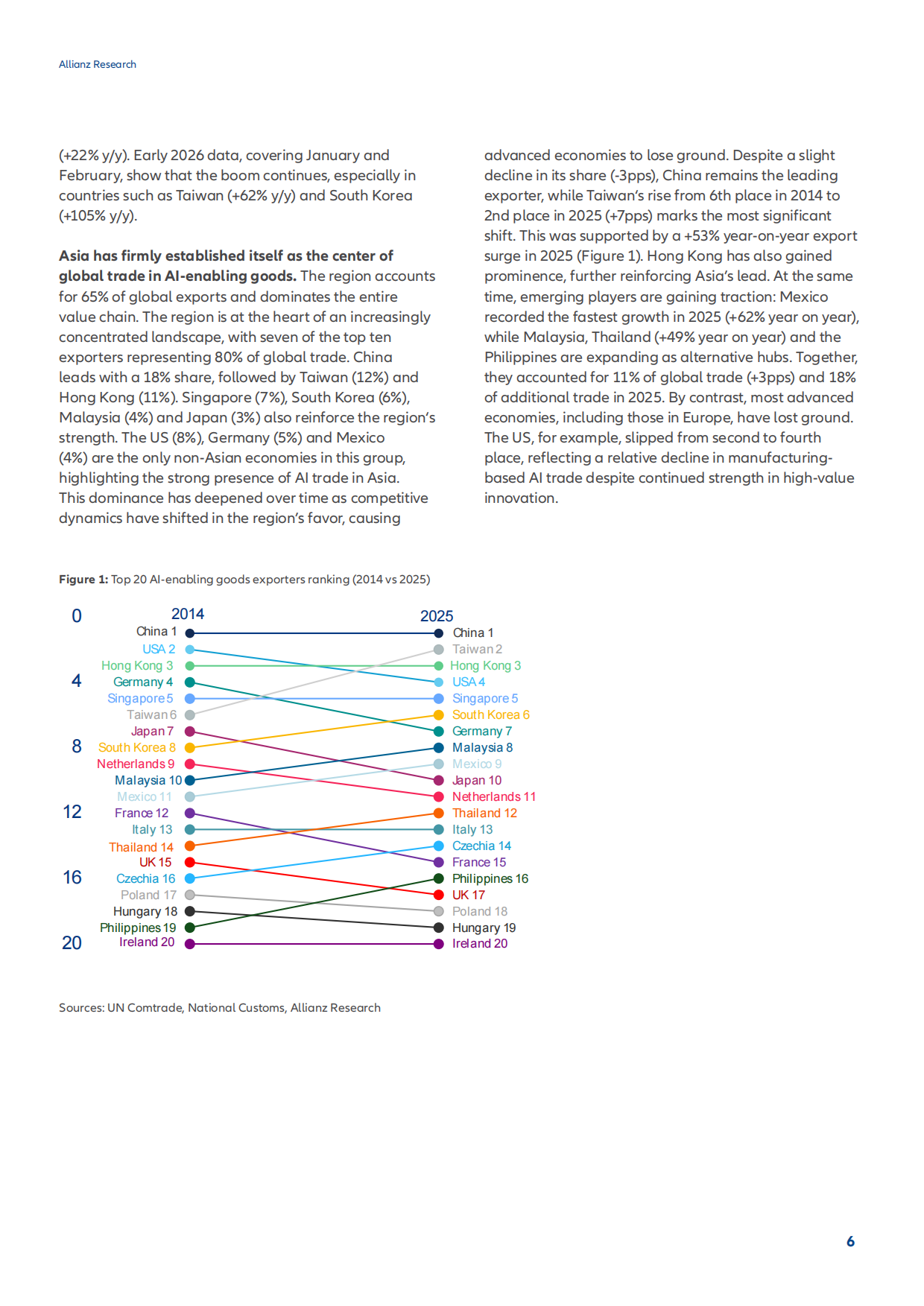
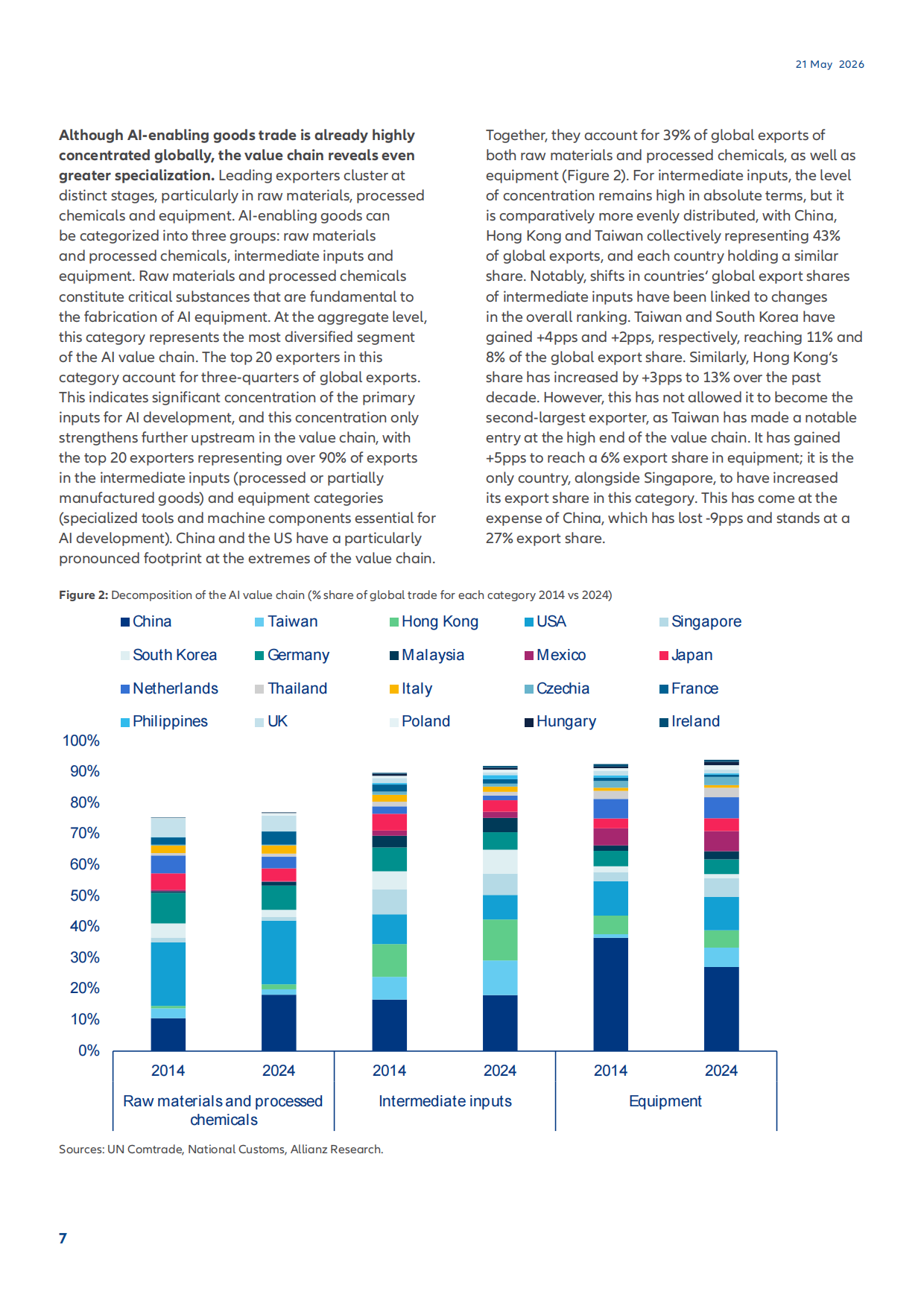
Allianz ResearchHow AI is rewiring global trade21 May 2026Concentrating Power, Dependencies, and Supply Chains
Allianz Research2Content Page 3-4 Executive SummaryPage 5-11 An AI boom built in Asia Page 12-20 The growth in trade in services and data flows is accelerating with the diffusion of AIPage 21-24 The world is flat: AI reconfigures the geography of trade and dependencies Page 25-29 The race for AI dominance is increasingly also being fought through industrial policy
21 May 20263SummaryExecutiveJasmin GröschlSenior Economist for Europejasmin.groeschl@allianz.comAI and trade are no longer separate policy domains. AI growth depends on globalized supply chains for semiconductors, computing infrastructure and digital services while trade is increasingly shaped by who controls AI infrastructure, data flows and cloud capacity. • Trade openness is a structural precondition for AI-driven productivity gains. Open economies benefit disproportionately from cheaper inputs, faster innovation diffusion and AI adoption spillovers. Trade openness accounts for 23% of the variation in AI adoption across countries with highly open economies, such as Singapore, UAE and Ireland, leading in diffusion. However, while AI can significantly boost growth, its benefits are unlikely to be evenly distributed. • Export volumes of AI-enabling goods have surged from USD1trn in 2014 to USD3.8trn in 2025 (+280%), accounting for 15% of global trade and far outpacing the 40% growth in goods trade overall. Asia dominates the supply side, accounting for 65% of global AI-related exports and seven of the top ten exporters, led by China (18% of AI-related exports), Taiwan (12%) and Hong Kong (11%). The composition remains concentrated in intermediate inputs (76%) and equipment (23%), reflecting deep dependence on semiconductors and data-center infrastructure. On the demand side, the US has tripled its AI-related imports since 2023, underpinned by 5,427 operational data centers, 45% of the global total. Europe‘s import growth of just +40% underscores a widening infrastructure gap. • Services imbalances could scale with AI. ICT services trade reached USD900bn in 2024 (11% of global services trade), with Ireland alone exporting USD173bn, exceeding both the rest of the EU (USD142bn) and the US (USD108bn), and reflecting its role as a billing hub for US multinationals. However, it masks structural dependence, with the EU excluding Ireland running a USD45bn ICT services deficit (mainly with Ireland), highlighting its reliance on US digital ecosystems. And things could get worse. Hypothetically, if the AI services subscription penetration rate of US providers such as ChatGTP Plus and Claude Pro increases from 3% to 50% in a high adoption scenario in the Eurozone, annual payments to US providers could reach EUR34bn (currently EUR2.7bn), equivalent to 20% of the current EU–US goods servi...