首页研究报告机构研究汽车交通2025年全面激活美国汽车制造业竞争力:驱动供应商能力转型的战略杠杆研究报告(英文版)-理特咨询
十一

文档

7254

关注

2

好评

0
PDF

2025年全面激活美国汽车制造业竞争力:驱动供应商能力转型的战略杠杆研究报告(英文版)-理特咨询

阅读 802 下载 92 大小 8.04M 总页数 0 页 2025-11-28 分享
价格:¥ 9.90
下载文档
/ 0
全屏查看
2025年全面激活美国汽车制造业竞争力:驱动供应商能力转型的战略杠杆研究报告(英文版)-理特咨询
还有 0 页未读 ,您可以 继续阅读 或 下载文档
1、本文档共计 0 页,下载后文档不带水印,支持完整阅读内容或进行编辑。
2、当您付费下载文档后,您只拥有了使用权限,并不意味着购买了版权,文档只能用于自身使用,不得用于其他商业用途(如 [转卖]进行直接盈利或[编辑后售卖]进行间接盈利)。
3、本站所有内容均由合作方或网友上传,本站不对文档的完整性、权威性及其观点立场正确性做任何保证或承诺!文档内容仅供研究参考,付费前请自行鉴别。
4、如文档内容存在违规,或者侵犯商业秘密、侵犯著作权等,请点击“违规举报”。
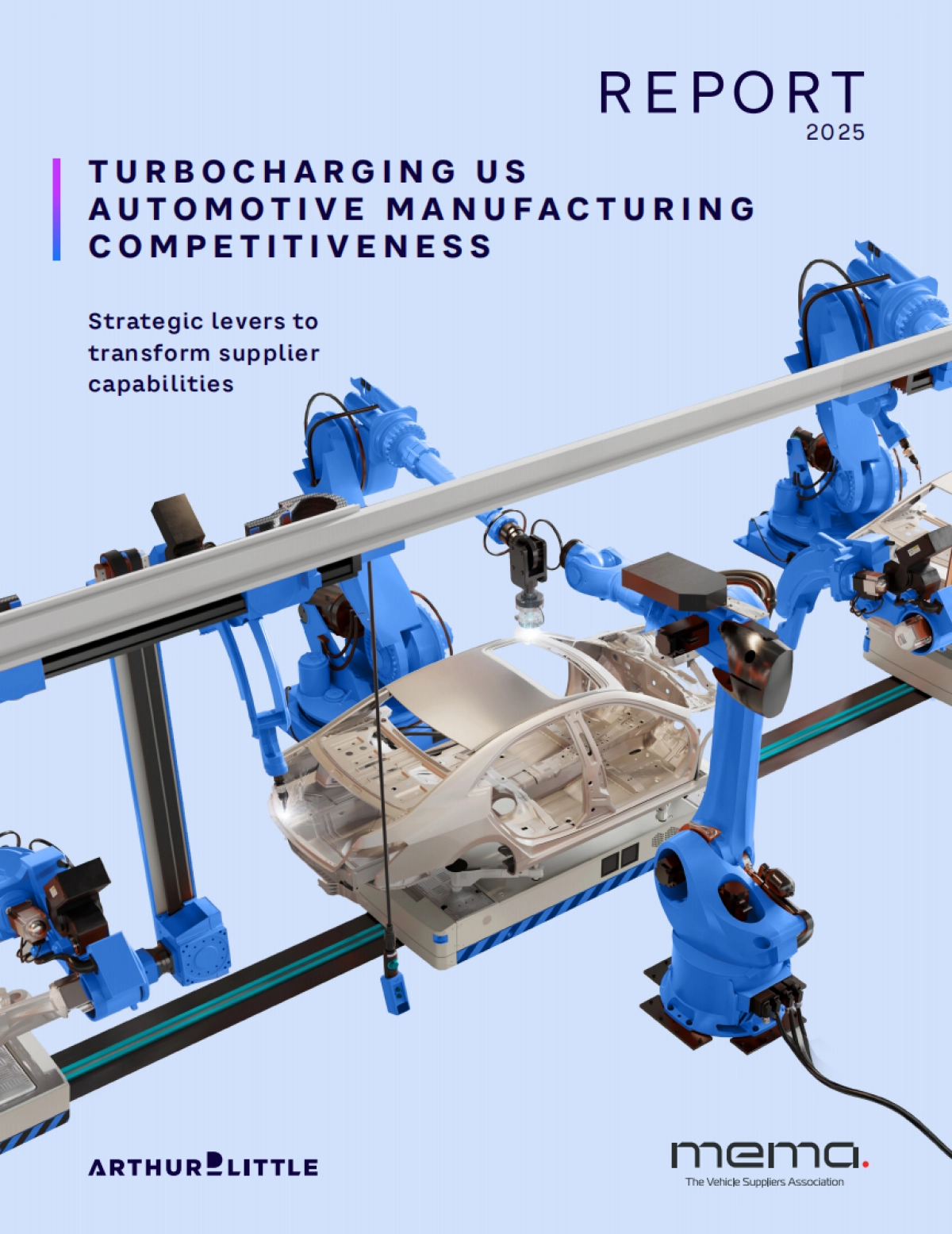
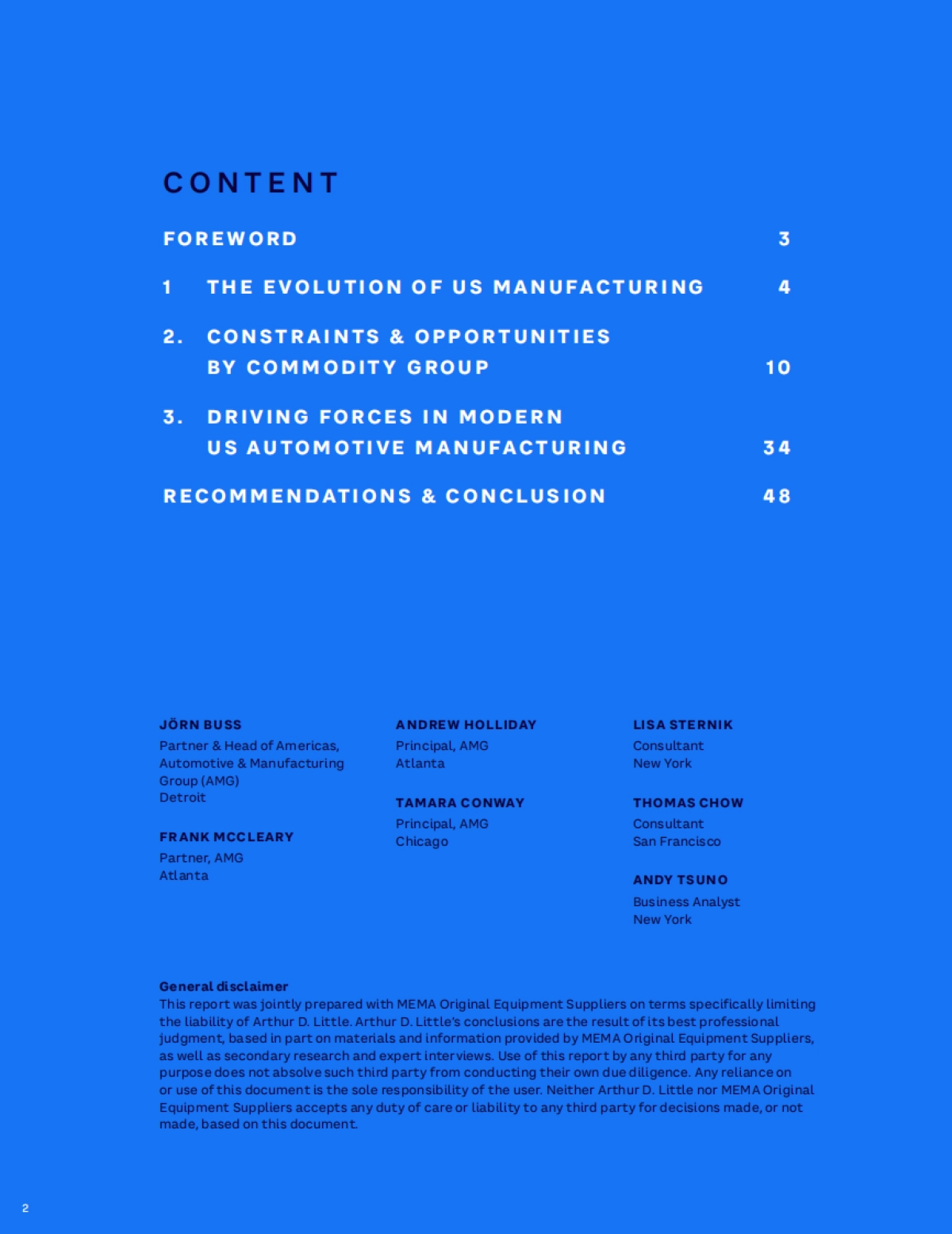
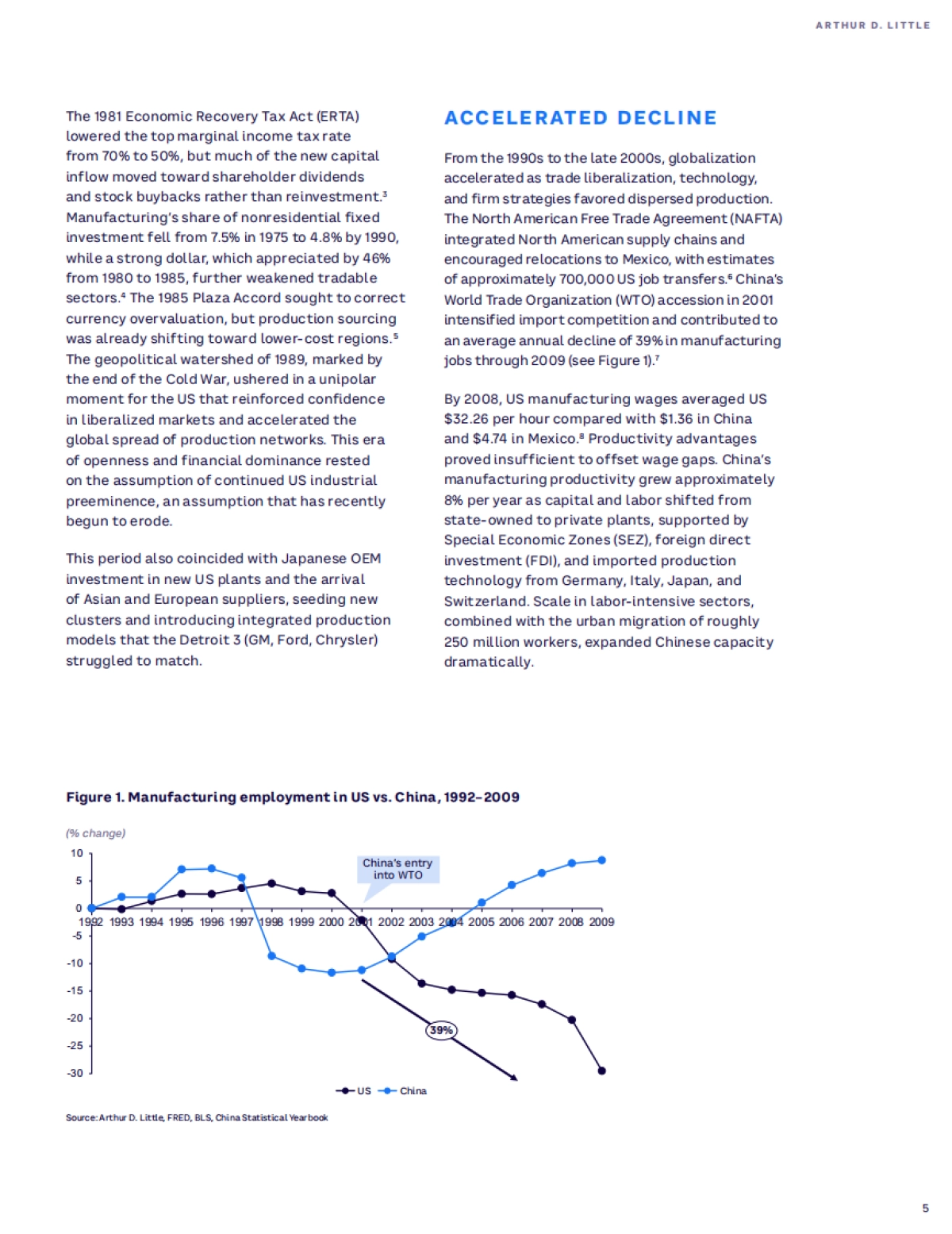
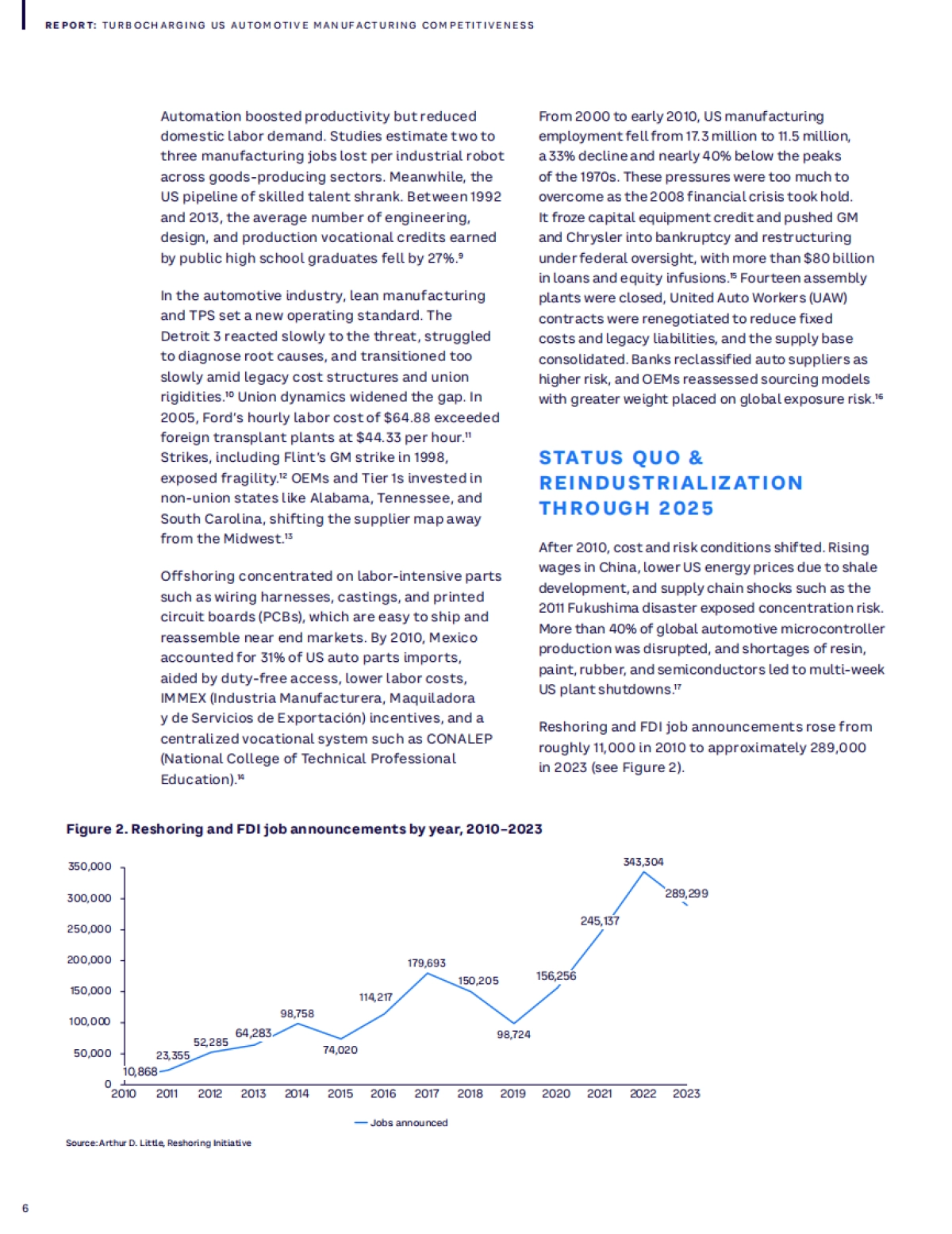
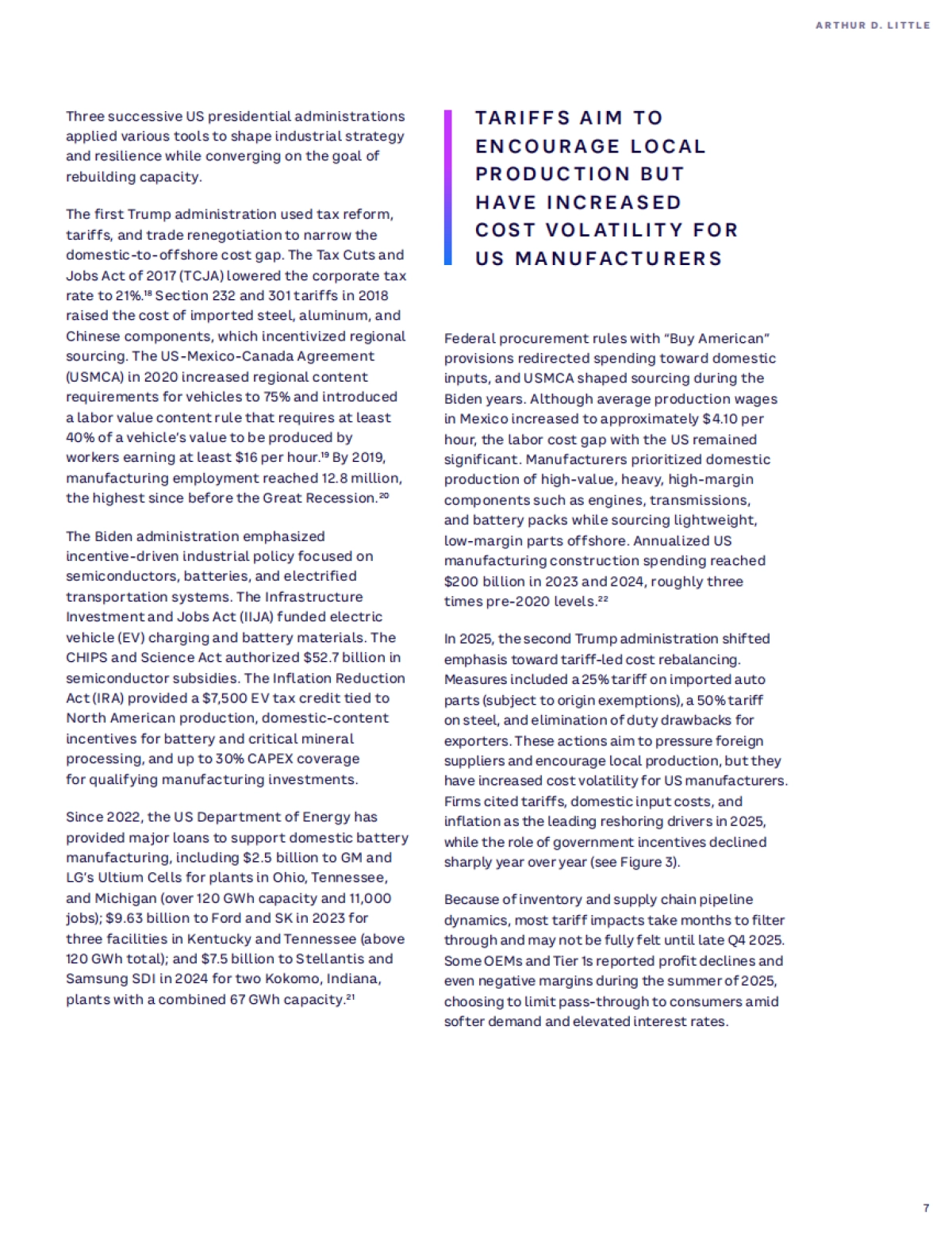
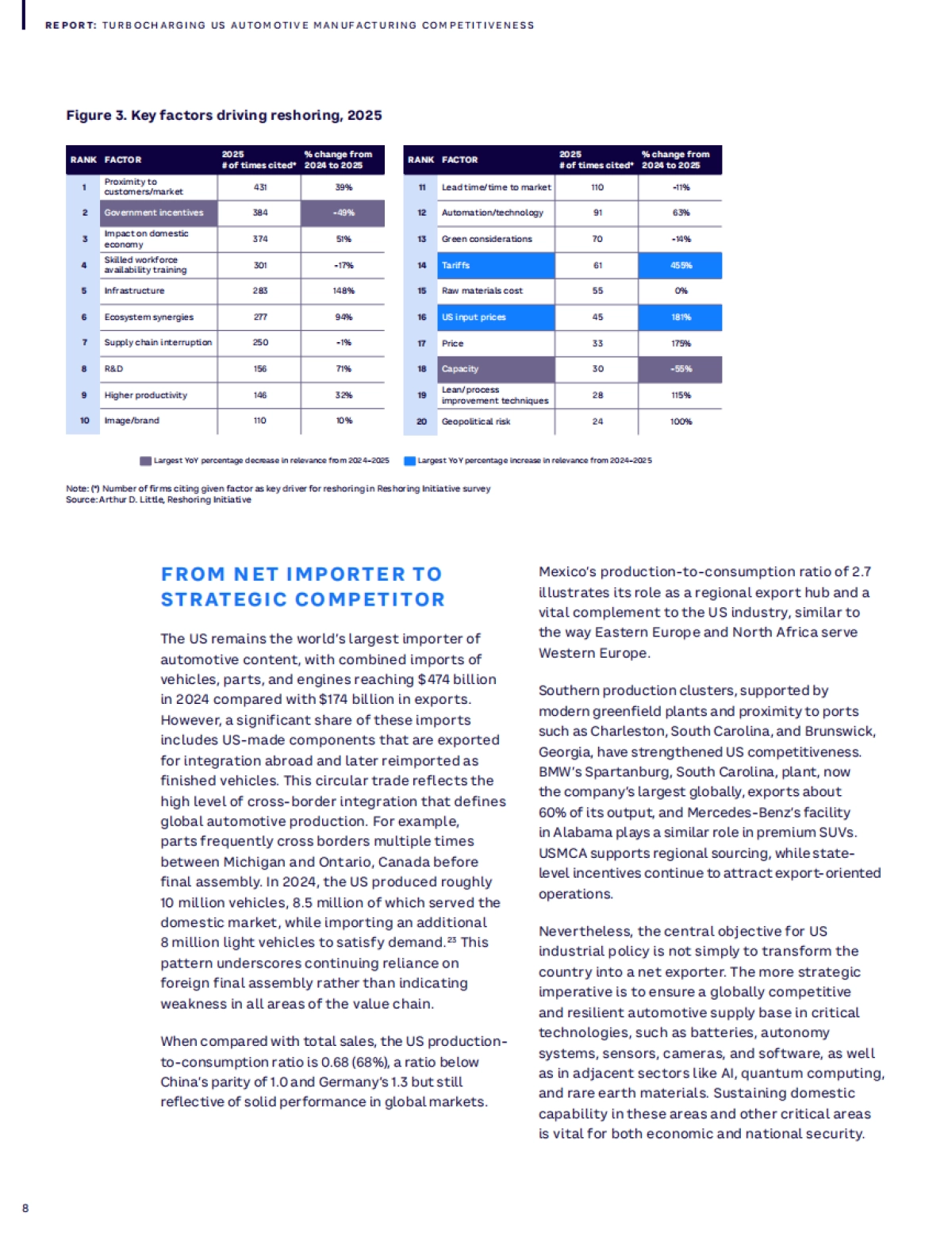
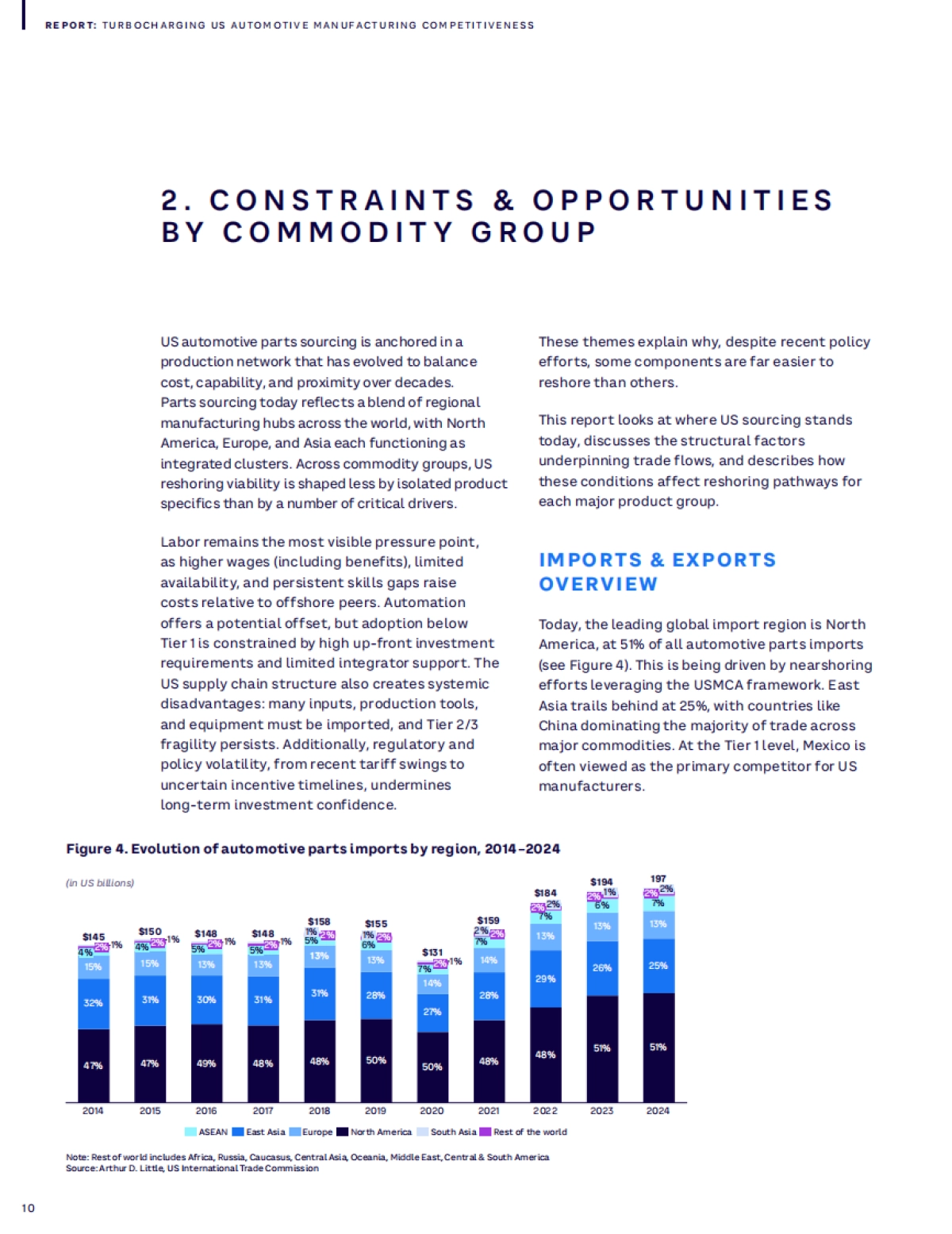
REPORT2025TURBOCHARGING USAUTOMOTIVE MANUFACTURINGCOMPETITIVENESSStrategic Levers totransform suppliercapabilitiesThe Vehicle Suppliers AssociationCONTENTFOREWORD3THE EVOLUTION OF US MANUFACTURING2.CONSTRAINTS OPPORTUNITIESBY COMMODITY GROUP103.DRIVING FORCES IN MODERNUS AUTOMOTIVE MANUFACTURING34RECOMMENDATIONS CONCLUSION48JORN BUSSANDREW HOLLIDAYLISA STERNIKPartner Head of Americas,Principal,AMGConsultantAutomotive ManufacturingAtlantaNew YorkGroup(AMG)DetroitTAMARA CONWAYTHOMAS CHOWPrincipal,AMGConsultantFRANK MCCLEARYChicagoSan FranciscoPartner,AMGAtlantaANDY TSUNOBusiness AnalystNew YorkGeneral disclaimerThis report was jointly prepared with MEMA Original Equipment Suppliers on terms specifically Limitingthe liability of Arthur D.Little.Arthur D.Little's conclusions are the result ofits best professionaljudgment,based in part on materials and information provided by MEMA Original Equipment Suppliers,as well as secondary research and expert interviews.Use of this report by any third party for anypurpose does not absolve such third party from conducting their own due diligence.Any reliance onor use of this document is the sole responsibility of the user.Neither Arthur D.Little nor MEMA OriginalEquipment Suppliers accepts any duty of care or liability to any third party for decisions made,or notmade,based on this document.ARTHUR D.LITTLEFOREWORDDear reader,US manufacturing has entered a period of unprecedentedrecalibration,shaped not by choice but by necessity.Technologyshifts,pandemic-induced shocks,and geopolitical tensions haveclearly demonstrated that the US must reimagine industrial self-reliance if it aims to secure competitiveness and reliable accessto system-critical products.We see signs of accelerated movements across the automotive supplychain,historically a delicate and evolving global system.Recently,the US government enacted several major initiatives,and OEMs arereinvesting in US production footprints.Yet much of this activity isconcentrated in Tier 1 segments,leaving Tier 2 and Tier 3 supplierswith little structural support.Seeing suppliers struggle in this VUCA(volatile,uncertain,complex,ambiguous)landscape,Arthur D.Little(ADL)and MEMAOriginal Equipment Suppliers worked together to examine thedrastic changes that brought us to this point and provide specificdirectives for suppliers,OEMs,and policymakers.This landmark study offers an in-depth view of what a potentialtransformation entails.By analyzing the viability of US-basedproduction by commodity,labor market dynamics,automationbottlenecks,and more,we highlight where the real levers lieand where action is most urgently needed.Jorn BussFrank McClearyPartnerPartnerArthur D.LittleArthur D.LittleCollin ShawPresidentMEMA Original Equipment SuppliersREPORT:TURBOCHARGING US AUTOMOTIVE MANUFACTURING COMPETITIVENESS1.THE EVOLUTION OFUS MANUFACTURINGPOST-WORLD WAR IIGRADUAL DECLINEMANUFACTURING ADVANTAGEBy the mid-1970s,the singular US advantageIn the decades after 1945,the US was the onlybegan to narrow as Europe rebuilt its industrialadvanced economy with an intact industrial base.base and convergence dynamics took hold.JapanDomestic demand surged from pent-up needsled with disciplined quality management,andand the baby boom,creating the world's largestToyota's launch of the Toyota Production Systemconsumer market.Fiscal and industrial policy(TPS)redefined benchmarks for efficiency andfollowed a broadly Keynesian template,whichreliability.Japanese automotive OEMs leveragedincluded large-scale infrastructure investmentsthis to deliver higher-quality vehicles at lowersuch as the national highway system,as well ascosts.sustained public support for higher education,R&D,and defense programs.This,combined withMacroeconomic shocks compounded competitiverapid suburbanization and mass automobilepressure.Inflation carried over from the 1970s wasownership,created a powerful flywheel forfueled by deficit spending tied to the Vietnammanufacturing growth across steel,automotive,War,Loose monetary policy,and oil-price spikes inaerospace,defense,and machinery.1973 and 1979.Temporary wage and price controlsfailed to restore balance,and the US's shift,underThis period also saw a looser regulatoryPresident Richard Nixon,away from the goldenvironment that allowed rapid industrialstandard and fixed exchange rates(the collapseexpansion,although the creation of modernof the Bretton Woods Agreement),introducedregulatory institutions in the early 1970scurrency volatility that drove import inflation.(including CARB [California Air Resources Board],To anchor prices,the Federal Reserve,under PaulEPA [Environmental Protection Agency],NHTSAVolcker,lifted the effective federal funds rate to[National Highway Traffic Safety Administration],19.1%in 1981,which triggered a severe recessionand OSHA [Occupational Safety and Healthand a permanent contraction in parts of industry.3Administration])did not prevent the US fromAlthough painful for the US economy,this actionremaining a net exporter.The supplier ecosystemwas necessary to bring inflation under control.that formed in these years was characterizedby Long-term transactional relationships andPolicy choices in the late 1970s and 1980s markedgeographic clustering.Suppliers were oftena decisive turn away from post-war industriallocated near OEM plants to tighten integration,intervention and toward market liberalization.Lower logistics costs,and improve throughput.Influenced by the emerging concept ofMany current suppliers trace their origins toglobalization,described by economist Theodorefounders and entrepreneurs from this era,withLevitt,and by the political shift embodied infootprints extending into Mexico and Canadathe Reagan and Thatcher revolutions,economicas cross-border networks matured.strategy increasingly favored deregulation,tax reduction,and financialization over directindustrial reinvestment.ARTHUR D.LITTLEThe 1981 Economic Recovery Tax Act (ERTA)ACCELERATED DECLINELowered the top marginal income tax ratefrom 70%to 50%,but much of the new capitalFrom the 1990s to the late 2000s,globalizationinflow moved toward shareholder dividendsaccelerated as trade liberalization,technology,and stock buybacks rather than reinvestment.3and firm strategies favored dispersed production.Manufacturing's share of nonresidential fixedThe North American Free Trade Agreement(NAFTA)investment fell from 7.5%in 1975 to 4.8%by 1990,integrated North American supply chains andwhile a strong dollar,which appreciated by 46%encouraged relocations to Mexico,with estimatesfrom 1980 to 1985,further weakened tradableof approximately 700,000 US job transfers.5 China'ssectors.4 The 1985 Plaza Accord sought to correctWorld Trade Organization(WTO)accession in 2001currency overvaluation,but production sourcingintensified import competition and contributed towas already shifting toward lower-cost regions.5an average annual decline of 39%in manufacturingThe geopolitical watershed of 1989,marked byjobs through 2009(see Figure 1).7the end of the Cold War,ushered in a unipolarmoment for the US that reinforced confidenceBy 2008,US manufacturing wages averaged USin Liberalized markets and accelerated the$32.26 per hour compared with $1.36 in Chinaglobal spread of production networks.This eraand $4.74 in Mexico.Productivity advantagesof openness and financial dominance restedproved insufficient to offset wage gaps.China'son the assumption of continued US industrialmanufacturing productivity grew approximatelypreeminence,an assumption that has recently8%per year as capital and Labor shifted frombegun to erode.state-owned to private plants,supported bySpecial Economic Zones(SEZ),foreign directThis period also coincided with Japanese OEMinvestment(FDI),and imported productioninvestment in new US plants and the arrivaltechnology from Germany,Italy,Japan,andof Asian and European suppliers,seeding newSwitzerland.Scale in Labor-intensive sectors,clusters and introducing integrated productioncombined with the urban migration of roughlymodels that the Detroit 3(GM,Ford,Chrysler)250 million workers,expanded Chinese capacitystruggled to match.dramatically.Figure 1.Manufacturing employment in US vs.China,1992-2009(change)10China's entryinto WTO01992199319941995199619971998199920002120022003200420052006200720082009-10-1539%30Source:Arthur D.Little FRED,BLS,China Statistical YearbookREPORT:TURBOCHARGING US AUTOMOTIVE MANUFACTURING COMPETITIVENESSAutomation boosted productivity but reducedFrom 2000 to early 2010,US manufacturingdomestic labor demand.Studies estimate two toemployment fell from 17.3 million to 11.5 million,three manufacturing jobs lost per industrial robota33%decline and nearly 40%below the peaksacross goods-producing sectors.Meanwhile,theof the 1970s.These pressures were too much toUS pipeline of skilled talent shrank.Between 1992overcome as the 2008 financialcrisis took hold.and 2013,the average number of engineering,It froze capital equipment credit and pushed GMdesign,and production vocational credits earnedand Chrysler into bankruptcy and restructuringby public high school graduates fell by 27%.under federal oversight,with more than $80 billionin loans and equity infusions.Fourteen assemblyIn the automotive industry,lean manufacturingplants were closed,United Auto Workers(UAW)and TPS set a new operating standard.Thecontracts were renegotiated to reduce fixedDetroit 3 reacted slowly to the threat,struggledcosts and legacy liabilities,and the supply baseto diagnose root causes,and transitioned tooconsolidated.Banks reclassified auto suppliers asslowly amid legacy cost structures and unionhigher risk,and OEMs reassessed sourcing modelsrigidities.10 Union dynamics widened the gap.Inwith greater weight placed on global exposure risk.62005,Ford's hourly labor cost of $64.88 exceededforeign transplant plants at $44.33 per hour."Strikes,including Flint's GM strike in 1998,STATUS QUOexposed fragility.12 OEMs and Tier 1s invested inREINDUSTRIALIZATIONnon-union states like Alabama,Tennessee,andTHROUGH 2025South Carolina,shifting the supplier map awayfrom the Midwest.13After 2010,cost and risk conditions shifted.RisingOffshoring concentrated on labor-intensive partswages in China,Lower US energy prices due to shalesuch as wiring harnesses,castings,and printeddevelopment,and supply chain shocks such as the2011 Fukushima disaster exposed concentration risk.circuit boards(PCBs),which are easy to ship andreassemble near end markets.By 2010,MexicoMore than 40%of global automotive microcontrolleraccounted for 31%of US auto parts imports,production was disrupted,and shortages of resin,aided by duty-free access,lower labor costs,paint,rubber,and semiconductors led to multi-weekUS plant shutdowns.7IMMEX (Industria Manufacturera,Maquiladoray de Servicios de Exportacion)incentives,and aReshoring and FDI job announcements rose fromcentralized vocational system such as CONALEProughly 11,000 in 2010 to approximately 289,000(National College of Technical Professionalin 2023(see Figure 2)Education).Figure 2.Reshoring and FDI job announcements by year,2010-2023350.000343,304300,000289,299250,000245,137200.000179,693150,205156,256150,000114,2798,758100,0005228564,28398,72450.00023,35574,02010,868-20102011201220132014201520162017201820192020202120222023Jobs announcedSource:Arthur D.Little Reshoring InitiativeARTHUR D.LITTLEThree successive US presidential administrationsTARIFFS AIM TOapplied various tools to shape industrial strategyand resilience while converging on the goal ofENCOURAGE LOCALrebuilding capacity.PRODUCTION BUTHAVE INCREASEDThe first Trump administration used tax reform,tariffs,and trade renegotiation to narrow theCOST VOLATILITY FORdomestic-to-offshore cost gap.The Tax Cuts andUS MANUFACTURERSJobs Act of 2017(TCJA)Lowered the corporate taxrate to 21%.1 Section 232 and 301tariffs in 2018raised the cost of imported steel,aluminum,andChinese components,which incentivized regionalFederal procurement rules with"Buy American"sourcing.The US-Mexico-Canada Agreementprovisions redirected spending toward domestic(USMCA)in 2020 increased regional contentinputs,and USMCA shaped sourcing during therequirements for vehicles to 75%and introducedBiden years.Although average production wagesa labor value contentrule that requires at leastin Mexico increased to approximately $4.10 per40%of a vehicle's value to be produced byhour,the labor cost gap with the US remainedworkers earning at least $16 per hour.19 By 2019,significant.Manufacturers prioritized domesticmanufacturing employment reached 12.8 million,production of high-value,heavy,high-marginthe highest since before the Great Recession.20components such as engines,transmissions,and battery packs while sourcing lightweight,The Biden administration emphasizedLow-margin parts offshore.Annualized USincentive-driven industrial policy focused onmanufacturing construction spending reachedsemiconductors,batteries,and electrified$200 billion in 2023 and 2024,roughly threetransportation systems.The Infrastructuretimes pre-2020 levels.22Investmentand Jobs Act (IIJA)funded electricvehicle (EV)charging and battery materials.TheIn 2025,the second Trump administration shiftedCHIPS and Science Act authorized $52.7 billion inemphasis toward tariff-led cost rebalancing.semiconductor subsidies.The Inflation ReductionMeasures included a 25%tariff on imported autoAct(IRA)provided a $7,500 EV tax credit tied toparts (subject to origin exemptions),a 50%tariffNorth American production,domestic-contenton steel,and elimination of duty drawbacks forincentives for battery and critical mineralexporters.These actions aim to pressure foreignprocessing,and up to 30%CAPEX coveragesuppliers and encourage local production,but theyfor qualifying manufacturing investments.have increased cost volatility for US manufacturers.Firms cited tariffs,domesticinput costs,andSince 2022,the US Department of Energy hasinflation as the leading reshoring drivers in 2025,provided major loans to support domestic batterywhile the role of government incentives declinedmanufacturing,including $2.5 billion to GM andsharply year over year(see Figure 3).LG's Ultium Cells for plants in Ohio,Tennessee,and Michigan (over 120 GWh capacity and 11,000Because of inventory and supply chain pipelinejobs);$9.63 billion to Ford and SK in 2023 fordynamics,most tariff impacts take months to filterthree facilities in Kentucky and Tennessee(abovethrough and may not be fully felt until late Q4 2025.120 GWh total);and $7.5 billion to Stellantis andSome OEMs and Tier 1s reported profit declines andSamsung SDI in 2024 for two Kokomo,Indiana,even negative margins during the summer of 2025,plants with a combined 67 GWh capacity.21choosing to limit pass-through to consumers amidsofter demand and elevated interest rates.REPORT:TURBOCHARGING US AUTOMOTIVE MANUFACTURING COMPETITIVENESSFigure 3.Key factors driving reshoring,2025RANK FACTOR2025change fromRANK FACTOR2025%change from#of times cited 2024 to 2025#of times cited 2024 to 2025customers/market431Leadtime/time to market1%Automation/technology9137451%Green considerations7030145Raw materials cost550%94%US input prices45181%2501%Price33R&D158Capacity30Higher productivity146Lean/process1159%Image/brand24100%12024-202512024.2025Note:()Number of firms citing given factor as key driver for reshoringin Reshoring Initiative surveyFROM NET IMPORTER TOMexico's production-to-consumption ratio of 2.7STRATEGIC COMPETITORillustrates its role as a regional export hub and avital complement to the US industry,similar toThe US remains the world's Largest importer ofthe way Eastern Europe and North Africa serveautomotive content,with combined imports ofWestern Europe.vehicles,parts,and engines reaching $474 billionin 2024 compared with $174 billion in exports.Southern production clusters,supported byHowever,a significant share of these importsmodern greenfield plants and proximity to portssuch as Charleston,South Carolina,and Brunswick,includes US-made components that are exportedfor integration abroad and later reimported asGeorgia,have strengthened US competitiveness.finished vehicles.This circular trade reflects theBMW's Spartanburg,South Carolina,plant,nowhigh level of cross-border integration that definesthe company's largest globally,exports aboutglobal automotive production.For example,60%of its output,and Mercedes-Benz's facilityin Alabama plays a similar role in premium SUVsparts frequently cross borders multiple timesbetween Michigan and Ontario,Canada beforeUSMCA supports regional sourcing,while state-final assembly.In 2024,the US produced roughlylevel incentives continue to attract export-oriented10 million vehicles,8.5 million of which served theoperations.domestic market,while importing an additionalNevertheless,the central objective for US8 million light vehicles to satisfy demand.25 Thisindustrial policy is not simply to transform thepattern underscores continuing reliance oncountry into a net exporter.The more strategicforeign final assembly rather than indicatingimperative is to ensure a globally competitiveweakness in all areas of the value chain.and resilient automotive supply base in criticaltechnologies,such as batteries,autonomyWhen compared with total sales,the US production-systems,sensors,cameras,and software,as wellto-consumption ratio is 0.68(68%),a ratio belowChina's parity of 1.0 and Germany's 1.3 but stillas in adjacent sectors like Al,quantum computing,reflective of solid performance in global marketsand rare earth materials.Sustaining domesticcapability in these areas and other critical areasis vital for both economic and national security.6REPORT:TURBOCHARGING US AUTOMOTIVE MANUFACTURING COMPETITIVENESS2.CONSTRAINTS OPPORTUNITIESBY COMMODITY GROUPUS automotive parts sourcing is anchored in aThese themes explain why,despite recent policyproduction network that has evolved to balanceefforts,some components are far easier tocost,capability,and proximity over decades.reshore than others.Parts sourcing today reflects a blend of regionalmanufacturing hubs across the world,with NorthThis report looks at where US sourcing standsAmerica,Europe,and Asia each functioning astoday,discusses the structural factorsintegrated clusters.Across commodity groups,USunderpinning trade flows,and describes howreshoring viability is shaped less by isolated productthese conditions affect reshoring pathways forspecifics than by a number of critical drivers.each major product group.Labor remains the most visible pressure point,as higher wages(including benefits),limitedIMPORTS EXPORTSavailability,and persistent skills gaps raiseOVERVIEWcosts relative to offshore peers.Automationoffers a potential offset,but adoption belowToday,the leading global import region is NorthTier 1is constrained by high up-front investmentAmerica,at 51%of all automotive parts importsrequirements and limited integrator support.The(see Figure 4).This is being driven by nearshoringUS supply chain structure also creates systemicefforts leveraging the USMCA framework.Eastdisadvantages:many inputs,production tools,Asia trails behind at 25%,with countries likeand equipment must be imported,and Tier 2/3China dominating the majority of trade acrossfragility persists.Additionally,regulatory andmajor commodities.At the Tier 1level,Mexico ispolicy volatility,from recent tariff swings tooften viewed as the primary competitor for USuncertain incentive timelines,underminesmanufacturers.Long-term investment confidence.Figure 4.Evolution of automotive parts imports by region,2014-20241941971841%$158$159139%1451501482%2%5%1%%59%3%13%$13115%13%1%149%269%25%29%32%3%30%31%27%48%5%5%47%47%49%48%46%50%50%48%201420152016207201820202021202220232024ASEAN East AsiaEuropeSouth Asia Rest of the worldNote:Rest of world includes Africa,Russia,Caucasus,Central Asia Oceania,Middle East,Central South America10ARTHUR D.LITTLEHowever,at the Tier 2/3+Levels,suppliers viewDespite this shift,dependencies persist,China as the primary competitor(see Figure 5)with mature-node semiconductors,rare earthWith nearly half of all parts imported originatingmagnets,and battery-grade materials stillfrom the USMCA region,this suggests theseconcentrated in a handful of foreign markets,imports often embed content sourced from ChinaLeaving domestic suppliers vulnerable to pricespikes and supply disruptions.As a resultPolicy shifts have altered some of these patterns.reshoring viability is uneven across commodityUSMCA's tighter rules-of-origin and labor-groups(see Figure 6).These dynamics underscorevalue-content requirements have encouragedwhy commodity-specific analysis is critical toregionalization,particularly in high-valuedeveloping realistic strategies for suppliers,powertrain components and final module assemblyOEMs,and policymakers.At the same time,the combination of tariffs onimported raw materials and feedstock implementedin 2018,as well as incentive programs such as theCHIPS Act and IRA,is tilting cost structures in favorof domestic production for selected commodities.2Figure 5.Location of key competitors across US-based Tier1-3 suppliers7%6%8%9%13%13%7%13%5%7%13%26%19%30%36%38%28%ChinaWestern EuropeMexicoJapan/South Korea Eastem EuropeSource:Arthur D.LittleFigure 6.Automotive partimport share by commodity group,2014-20243%32%30%26%15%14%12%12%1%8%Body &chassisPowertrainElectricalInterior plasticsEV batteriesTires tubesmotors■2014■202411REPORT:TURBOCHARGING US AUTOMOTIVE MANUFACTURING COMPETITIVENESSUnderstanding these group-specific dynamicsHEAVIER BATTERYis essential for manufacturers evaluating wheredomestic capacity can realistically scale,wherePACKS ARE PUSHINGtargeted intervention may close the gap,andOEMS TOWARDwhere long-term foreign reliance must beLIGHTER STRUCTURALmanaged through risk diversification rather thanlocalization.Each of the six commodity groupsCOMPONENTS TO OFFSETassessed in this report presents a different setOVERALL VEHICLE WEIGHTof operational constraints,policy levers,andinvestment thresholds that determine whetherreshoring is commercially viable or out of reach.Suppliers like Gestamp,Magna,and Tower areabsorbing more responsibility for colocatedBODY CHASSIS PARTSstamping operations,including full press-shopmanagement.Although OEMs generally continueThe body and chassis category includes theto own the dies to safeguard intellectual propertystructural and dynamic systems that form theand sourcing flexibility,Tier 1s carry the capitalbackbone of the vehicle,including stamped panels,and operating burden of running the presses andcast metal parts,suspension,steering,brakingensuring uptime.With average stamping marginssystems,and glass.Today,body and chassisaround 1.4%,the economics of absorbing theseproduction is highly capital-and materials-costs remain challenging.2intensive,relying on imported machinery(e.g.,presses,glass laminators)that is subject to tariffs.Material substitution in EVs has not reduceddemand for stamping,butit is driving a shift inmaterials and specifications.Heavier batteryMetal stampingspacks are pushing OEMs toward Lighter structuralLarge exterior and structural panels(e.g.,hoods,components to offset the overall vehicle weight.doors,body sides,underbody stampings)areThis shiftrequires new joining methods,dietypically produced close to OEM assembly plantsdesigns,and tighter tolerances,capabilitiesbecause of their size,weight,and transportconcentrated among suppliers with in-housesensitivity.Smaller stamped parts,such asengineering,tool and die making,and flexiblebrackets,braces,and reinforcements,can bepress lines.Companies that do not adopt thesemore easily shipped and are often sourced fromnew die and tooling innovations (e.g.,hot-Low-costregions.stamping of ultra-high-strength steel)risk beingleft behind by increasingly advanced metalThe US retains strong capacity in large exterior andstamping requirements by OEMs.These capabilitystructural stampings,while Mexico and Canadagaps could lock traditional stampers out of RFQssupply a mix of midsized and Labor-intensive(requests for quotes)for battery enclosures,assemblies.Logistics costs,damage risk,and just-B-pillars,and crash-critical structures.in-sequence delivery requirements keep large-panel stamping anchored regionally.However,OEMsMetal stamping companies report thatare increasingly offloading press-shop operationsautomation opportunities are somewhat limitedto Tier1 suppliers without adjusting commercialand require large capital investments.Al providesterms to reflect the capitaland operating riskssome quick wins to save time and improvebeing transferred."Many carmakers are planningefficiency(e.g.,analyzing production data andto completely outsource the press shop,"saidproviding machine-specific troubleshooting),Gestamp Executive Chairman Francisco Riberasbut the industry remains dependent on skilledciting JLR's move to Slovakia,with GestampLabor for the short and medium term.Findingoperating the stamping operation in-house.25skilled labor,particularly tool and die makersand maintenance technicians,remains criticalfor operationsARTHUR D.LITTLEDespite tariffs resulting in higher demand andMECHANICAL SYSTEMSquoting volumes for locally sourced metalCAN BE RESHORED ORstampings,reshoring isn't viable at the momentUS suppliers lackaccess to capital to expandMAINTAINED REGIONALLY,production and continue to rely on materials andBUT ELECTRONICSequipment sourced from overseas.Both steel andaluminum present challenges.Domestic steelREMAIN TIED TOproduction is relatively strong,but suppliers noteOFFSHORE ECOSYSTEMSissues with specific grades,volumes,and pricingvolatility.Key automotive-grade aluminum alloys,such as high-strength 5xxx and 6xxx series sheetfor body panels,are not produced at sufficientThere is,however,potential in the wider adoptionscale in the US and are imported from Europe andof air suspension systems that use fewerAsia.Scrap aluminum is not a viable substitutetraditional steel components(coils and leaves),for OEMs due to quality and consistencyinstead relying on mechatronic systems (flexiblerequirements.Offering globally competitiverubber air springs/bellows,air compressors,airpricing remains challenging with tariffs in placetanks,suspension control modules,ride heightand could require manufacturers to seek worksensors,and air lines)from local,non-automotive customers.Larger parts,such as exterior panels,are strongSteering systemscandidates for reshoring,provided manufacturersThe global shift to electric power steering(EPS)are equipped with modern presses and hot-has transformed sourcing from hydraulics andstamping lines.Smaller parts are likely to remaincolumns toward electronics-rich modules.nearshored (e.g.,Mexico)for costand labor-Mechanical steering components can beflexibility reasons.regionalized,but EPS systems remain electronics-dependent and tied to offshore electronics andSuspension systemssemiconductors.Major EPS suppliers such asBosch,JTEKT,ZF,NSK,and Nexteer control theSuspension components reflect the duality ofglobal market,with Asian plants supplying muchUS manufacturing strengths and gaps.Premiumof the engine control unit content.One playerand heavy-duty suspensions and axles are stillthat retains assembly operations in Michiganbuilt in the Midwest,where proximity to OEMcontinues to rely on imported semiconductorsplants supports just-in-time(JIT)logistics.and controllers,exposing supply vulnerabilities.Commoditized control arms,springs,and swayMechanical systems can be reshored orbars have shifted to Mexico,China,and Southmaintained regionally,but electronics remainKorea.Asian forging capacity undercuts UStied to offshore ecosystems until CHIPS Actsuppliers,particularly as electrification shiftsinvestments extend to mature-node automotivedemand to lightweight alloys,mirroring thechips and PCBs.Steering systems are an examplebroader casting/forging constraint acrossof a category in which localization(eithercategories.European competitors already havein the US or greater North American region)advanced hot-forming and aluminum suspensionshows potential,but subcomponent availabilitymodules capabilities and capacities,underscoring(especially semiconductors)and skilled-laborthe investment gap faced by US suppliers.availability limit willing suppliers'options.High-end suspension assemblies that demandprecision and close engineering integration can beproduced in the US,but mass-market componentswill remain global unless/until US forging capacityand alloy specialization are strengthened.13REPORT:TURBOCHARGING US AUTOMOTIVE MANUFACTURING COMPETITIVENESSBraking systemsAutomotive glass is heavy and fragile,favoringregional production.US capacity remains thin andBraking systems combine heavy mechanicalfragmented despite strong JIT demand.Technicalcomponents with increasingly complexrequirements for auto glass are increasing,electronics.US plants can competitively producebut capital investment remains limited to top-rotors and calipers,which are freight-sensitivetier suppliers.Modern windshields now includeand benefit from strong regional machiningembedded advanced driver assistance systemscapability.However,electronic modules(ABS(ADAS)sensors,defrosting elements,acoustic[anti-lock braking systems]and ESC [electroniclaminates,and heads-up display(HUD)zones.stability control]systems)remain concentratedThis significantly increased costs and increasedamong a small number of global Tier 1 suppliers,demand for OEM glass for replacement parts,with much of the assembly occurring in Europesince traditional aftermarket suppliers haveand Asianot been able to meetthe advanced technologyrequirements.Firms like Corning and SchottAs with steering systems,domestic firmssecured OEM partnerships in HUD and solar-glassstruggle to localize electronics content(thoughLocalization within the North American region ofsystems;most smaller manufacturers remainmechanical content remains viable).The impactLocked out of these programs due to equipmentof electrification on braking systems,such asand certification barriers.regenerative braking,reduces the use of frictionThe US Lacks commercial-scaleinfrastructureforbrakes but increases the demand for advancedLamination,optical coatings,and precision forming,integration between software and hardware.but under the right capital and policy conditions,For the US,the immediate opportunity lies inUS producers can succeed by focusing on high-expanding rotor/caliper machining and EV-complexity or premium segment glass.High-featurespecific braking integration while acknowledgingwindshields and panoramic roofs,especially thosethat ABS/ESC electronics will remain globallywith embedded sensors,HUD zones,or advanceddependent in the near term.coatings,are strong candidates for US reshoringbecause automation potential,freightrisk,andGlassjust-in-sequence delivery requirements outweighMexico and Asia's labor-cost advantage.CommodityUS automotive glass capacity remains fragileside and rear glass are likely to remain regionallydespite rising technical content and supplysourced from Mexico,where cost structure andrisk.It contracted sharply during the 2000s asthroughput favor high-volume SKUs.However,production offshored.Employ ment fell by moreLike body and chassis components,reshoringthan 30%between 2000 and 2010.2 Today,mostrequires cutting-edge manufacturing technology,Legacy domestic producers,such as PPG andequipment,and skilled labor and cannot be greatlyGuardian,have exited automotive or shifted focusimpacted by tariffs.to construction markets.2 The 2020s broughtpartial reshoring,but growth is concentrated.For example,Fuyao Group invested more thanSummary$1 billion in its US operations in Ohio,Illinois,In the body and chassis category,metal stampingSouth Carolina,and Michigan with the intenttoand glass are the most viable reshoring candidates,fit one in four US cars with Fuyao-made glass.2with limited scope in suspension.Braking andHowever,much of its equipmentand productionsteering remain strategically important but aredesign originates in China.3oless viable.Tariff-exposed equipment,Labor-costpressures,and Mexico's supply chain densityconstrain viability across the category.14ARTHUR D.LITTLEPOWERTRAINThe cost differential is driven by scale,verticallyintegrated alloy production,labor costs,andThe powertrain category covers internalamortized capital in modern facilities.Smallercombustion engines(ICE),transmissions,andUS metal casting firms cite limited access todriveline assemblies:the mechanical systemscapital as a primary constraint on investment inthat convert energy into vehicle motion.Thisnew equipment,digital tooling,and compliancecategory remains a significant share of importsystems.More than 30%of small foundriesflows,accounting for approximately one-operate with aging infrastructure or legacyquarter of US auto parts imports(see Figure 7).melting equipment that cannot meet modernUnlike more modular components,powertrainenergy or emissions standards.33 In an interview,systems are highly complex,requiring precisionone Tier 1executive pointed to forging capacity asmachining,advanced metallurgy,and system-"the biggest barrier"to reshoring the company'sLevel integration.operations,noting that even with available laborand machining capability,the lack of domesticforging assets prevents localized production ofCastings forgingscritical driveline components.The same executiveCasting/forging capacity is a bottleneck acrossadded that sourcing steel from China remainspowertrain components.US metal casting output,significantly cheaper than sourcing domestically,including both automotive and defense sectors,reinforcing offshoring economics for forged parts.fell from $41 billion in 2006 to $27.8 billion in 2020.Despite earlier projections of a rebound,outputEV and hybrid technology adoption is reshapingis only expected to reach $31.4 billion by 2030,material demand and part design,creating bothrepresenting a net increase of just 1.2%over therisks and opportunities.Electric drivetrainsdecade;this trend is supported by the decline ofsimplify vehicle architecture by eliminatingUS metal casting facilities,which fell by nearlycomplex multipart assemblies such as engine40%between 2000 and 2022.3blocks and multispeed transmissions.However,this shift is driving demand for lightweightThe economics of reshoring are challenging,castings in integrated e-motor housings andespecially for small and midsized domesticstructural components like battery enclosures,suppliers.According to the US Departmente-axles,inverter housings,and crossmembers.of Defense(DOD),Chinese suppliers can oftenThe added weight of hybrid and electricdeliver fully finished castor forged parts forpowertrains has intensified the need for weightthe same price that US firms pay for rawreduction,prompting greater use of aluminummaterial inputs.32and magnesium alloys.Figure 7.Evolution of powertrain imports by country share,2014-202423%23%20%21%23%22%2421%5%5%5%6%7%13%12%10%10%12%11%1%10%12%13%12%13%13%12%12%13%14%1%12%15%16%7%16%15%13%17%14%38%29%30%33%33%33%34%32%34%37%2014201520162072018201920202021202220232024Mexico■Japan■CanadaGermanySouth KoreaIRest of the world15
文档评分
    请如实的对该文档进行评分
  • 0
发表评论

特惠

限量优惠活动

正在火热进行

站长

添加站长微信

领取新人礼包

下载

便携运营智库

立即下载APP

工具

运营导航

工具推荐

帮助

帮助中心

常见问题

分销

50%直推收益

30%间推分成

AI

智能对话

办公助手

顶部