Carbon CaptureUtilization and StorageTowards Net-Zero2021KFARNFY
Compiled by the Kearney Energy Transition InstituteCarbonCapture Utilization and Storage,AcknowledgementsTheKearneyEnergyTransitionInstitutewishestoacknowledaethefollowinapeoolefortheirreviewofthisFactBookKamel Bennaceur, CEO at Nomadia Energy Consulting, Former Director of Sustainable Energy Policies and Technologiesat IEA, former Minister of Industry, Energy and Mines of Tunisia; as well as Dr. Adhan Shihab-Eldin, Claude Mandil,AntoineRostand. and Richard Forrest. members of the board for the Kearnev EneravTransition InstituteTheirreviewdoesnotimolvthatthevendorsethisFactBookoraareewithanv soecific statements hereinI latest chandes in the carbon capture, utilization and storage landscapeIt summarizes the main research and development priorities in carbon capture, utilisation and storage, analyses theAbouttheKearnevEneravTransitionInstitutaTihe Keamey Energy TransionIistitde s a non-poftorganization that provides leading insights on global trends inenergy transition, technologies, and strategic implications for private-sector businesses and publi-sector institutions. Theconsequences and opoortunities for decision-makers in a rapidly changing energy landscape. The independence of theInstitute fosters unbiased primary insights and the ability to co-create new ideas with interested sponsors and relevantAuthorsRomain Debarre, Prashant Gahlot, Celeste Grillet and Mathieu PlaisantKEARNEYEnergyTranstionInstiule
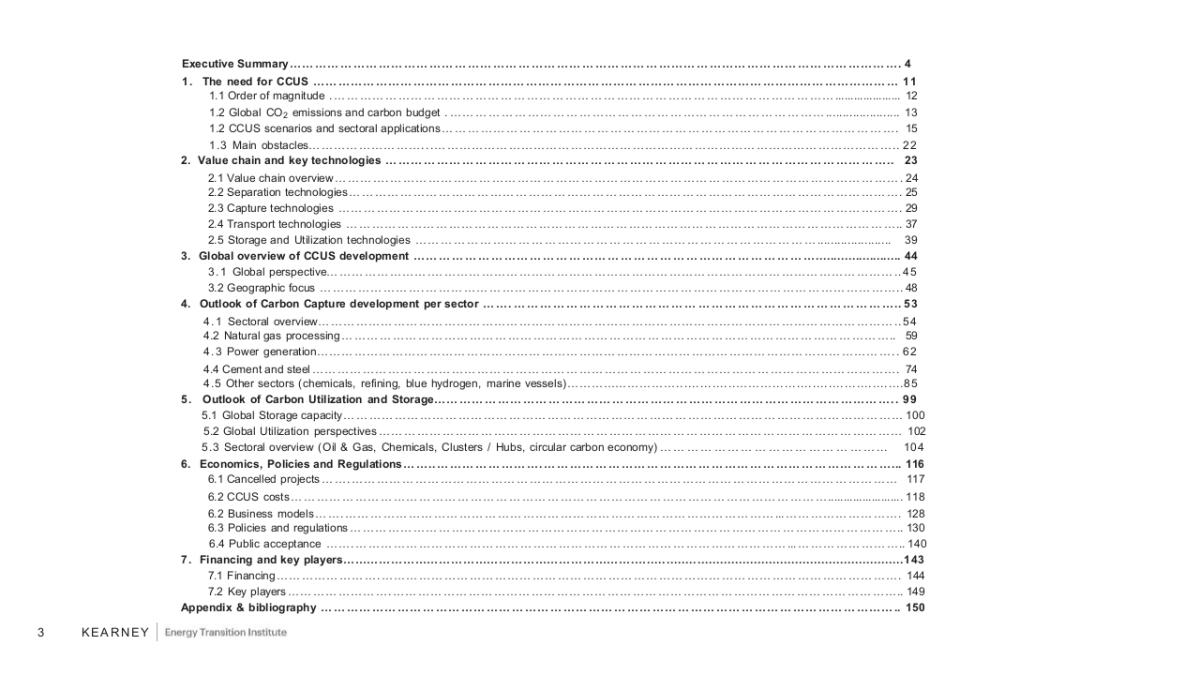
2emissions and carbon budigetrageand Uton techndlogie:3.GlobaloverviewofCCUSdevelopment3.13.2GOual gasprocessingEconomics66.1Cancelledprojects6.2CCUScosts.68del6regulations心cing and key players.72KeyplayersAppendix&bibliography,3KEARNEY
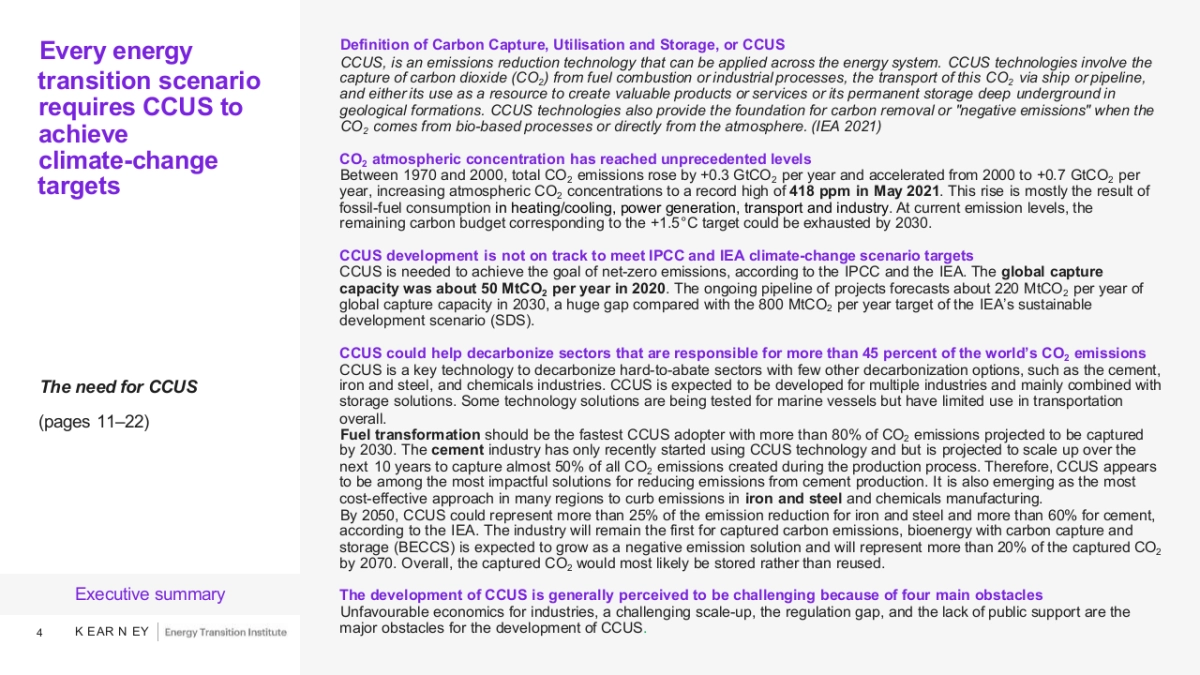
EveryenergyDefinitionofCarbonCapture.UtilisationandStorae.orCCUStransition scenariosport ofthis CO,viashiporpipeline,ht storagedeep undergroundinrequiresCCUS toCCUStechnoloaiesalsoprovide1carbonremovalor"negativeemissions"when theachieveclimate-changeVear and accelerated from 2000 to+0.7GICO,pertargetscurrent emission levels, theA.The global captureasts about 220MtCO, peryearofTheneedfor CCUSsandmainlycombined withve limited use in transportation(pages11-22)hissions projected to be capturedTherefore,CCUS appearshorethan60%forcement,according to theIEA.The indtstorage (BECCS) is expected to grow as a negative emon and will represent more than 20% of the captured COby 2070. Overall, the captured CO, would most likely be stored rather than reusedExecutivesummaryThe development ofCCUS is generally perceived to be challenging because of four main obstaclesUnfavourable ecs for industries, a challenging scale-up, the regulation gap, and the lack of public support are theKEARNEY|EnryTrmahionhntiutemajor obstacles for the development of CCUS
The CCUS valueCCUS refers to aset ofCO, capture transport, utilization, and storage technologies combined to abateCO,emissions.CO,isgerror industrial plants), transportedchain includes threein a gaseous or liquefied state bypipelines orships and stored in...