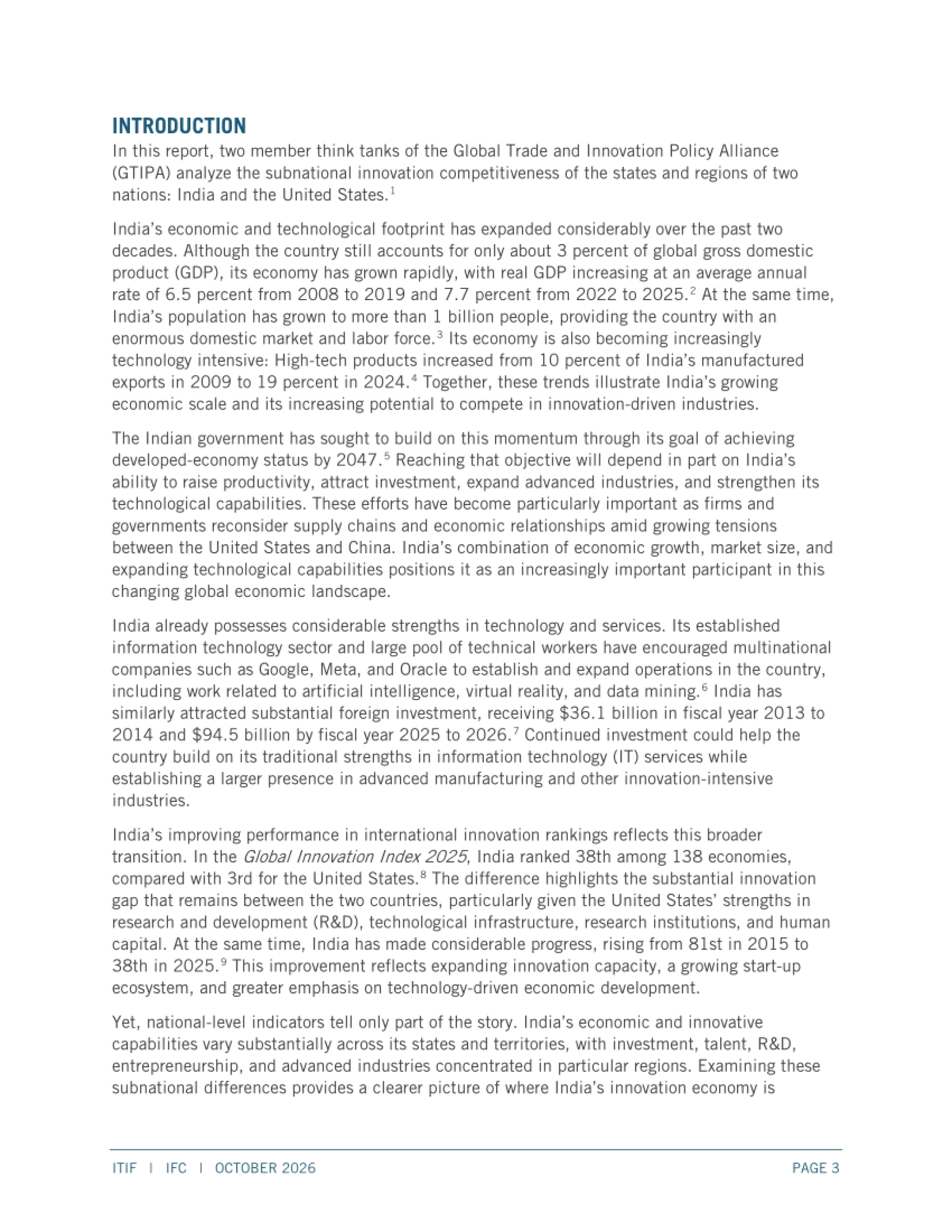
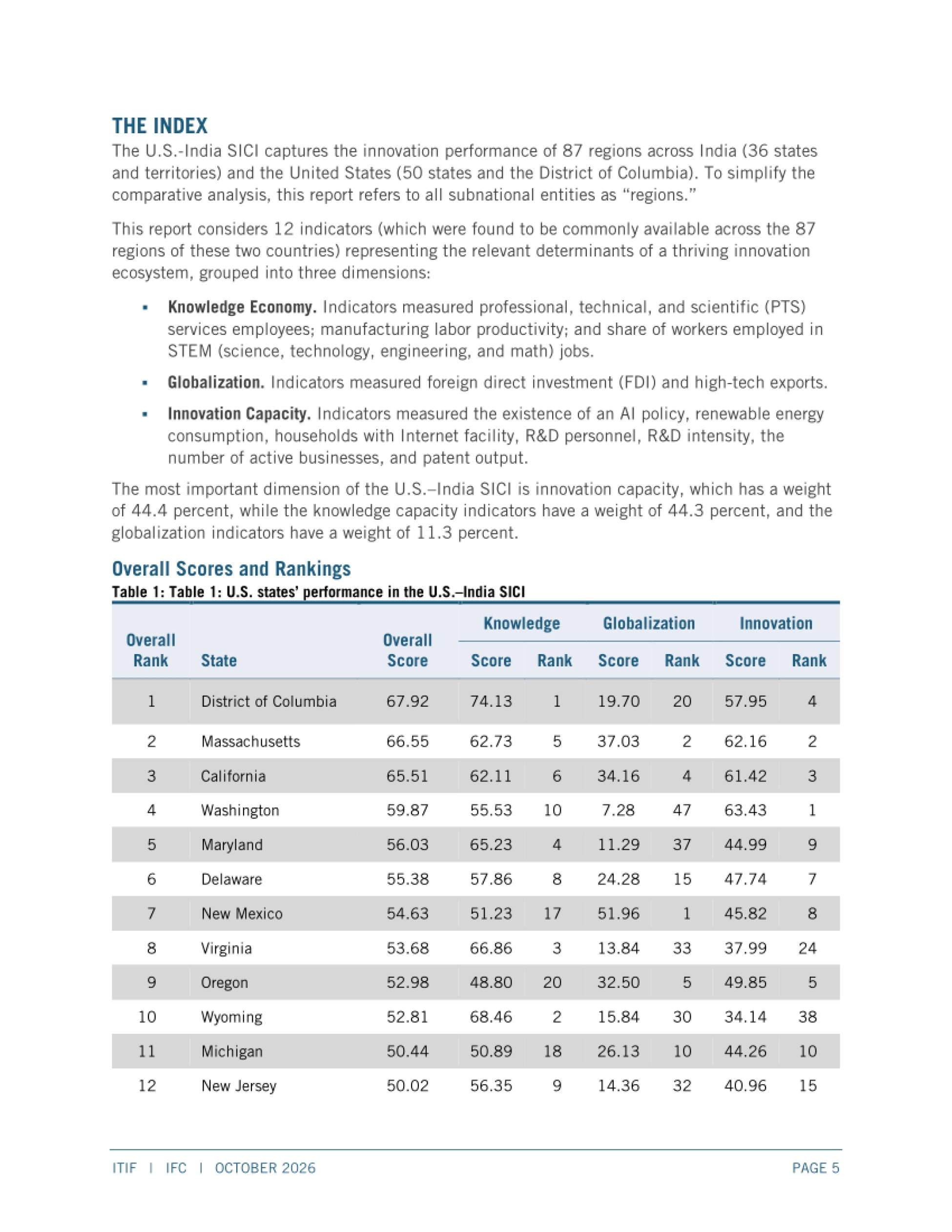
itif.org | competitiveness.in The 2026 US-India Subnational Innovation Competitiveness Index AMIT KAPOOR, STEPHEN EZELL, TRELYSA LONG, AND SHEEN ZUTSHI | OCTOBER 2026 For policymakers to bolster regional competitiveness in the global economy, they first must know where they stand. This report—coauthored by ITIF and the Institute for Competitiveness, India—benchmarks the 87 regions of India and the United States using 12 commonly available indicators of strength in the knowledge economy, globalization, and innovation capacity. KEY TAKEAWAYS The United States claims the top 51 regions, with the District of Columbia (DC), Massachusetts, and California ranking in the top three. The top three Indian states are Chandigarh, Maharashtra, and Delhi, although they rank below all U.S. states. The highest scoring U.S. states for the knowledge economy pillar are DC, Wyoming, and Virginia. The top-ranking regions for India are Chandigarh, Puducherry, and Goa. Chandigarh has also surpassed Mississippi’s and Hawaii’s scores. The highest-scoring U.S. states for the globalization pillar are New Mexico, Massachusetts, and Arizona; for India, these are Karnataka, Delhi, and Maharashtra. Besides New Mexico, they have surpassed all other U.S. states in this category. The top-scoring U.S. states for the innovative capacity pillar are Washington, Massachusetts, and California. The top-scoring Indian regions are Maharashtra, Delhi, and Haryana. Maharashtra has surpassed 10 U.S. states; Delhi has surpassed Alaska. Policymakers must continue to strengthen U.S.–India relations, focusing on building and strengthening critical and emerging technology and R&D collaboration initiatives, which connect start-ups, universities, and venture capitalists in both countries. Indian policymakers should prioritize expanding the innovative capacities of states beyond concentrated regions by strengthening skills, research capabilities, digital infrastructure, and access to global investment across all regions. ITIF | IFC | OCTOBER 2026 PAGE 2 CONTENTS Key Takeaways ................................................................................................................. 1 Introduction ..................................................................................................................... 3 The Index ........................................................................................................................ 5 Overall Scores and Rankings ........................................................................................... 5 Index Scoring System ..................................................................................................... 9 Knowledge Economy ....................................................................................................... 11 Professional, Scientific, and Technical Employees ........................................................... 11 Manufacturing Productivity ...................................