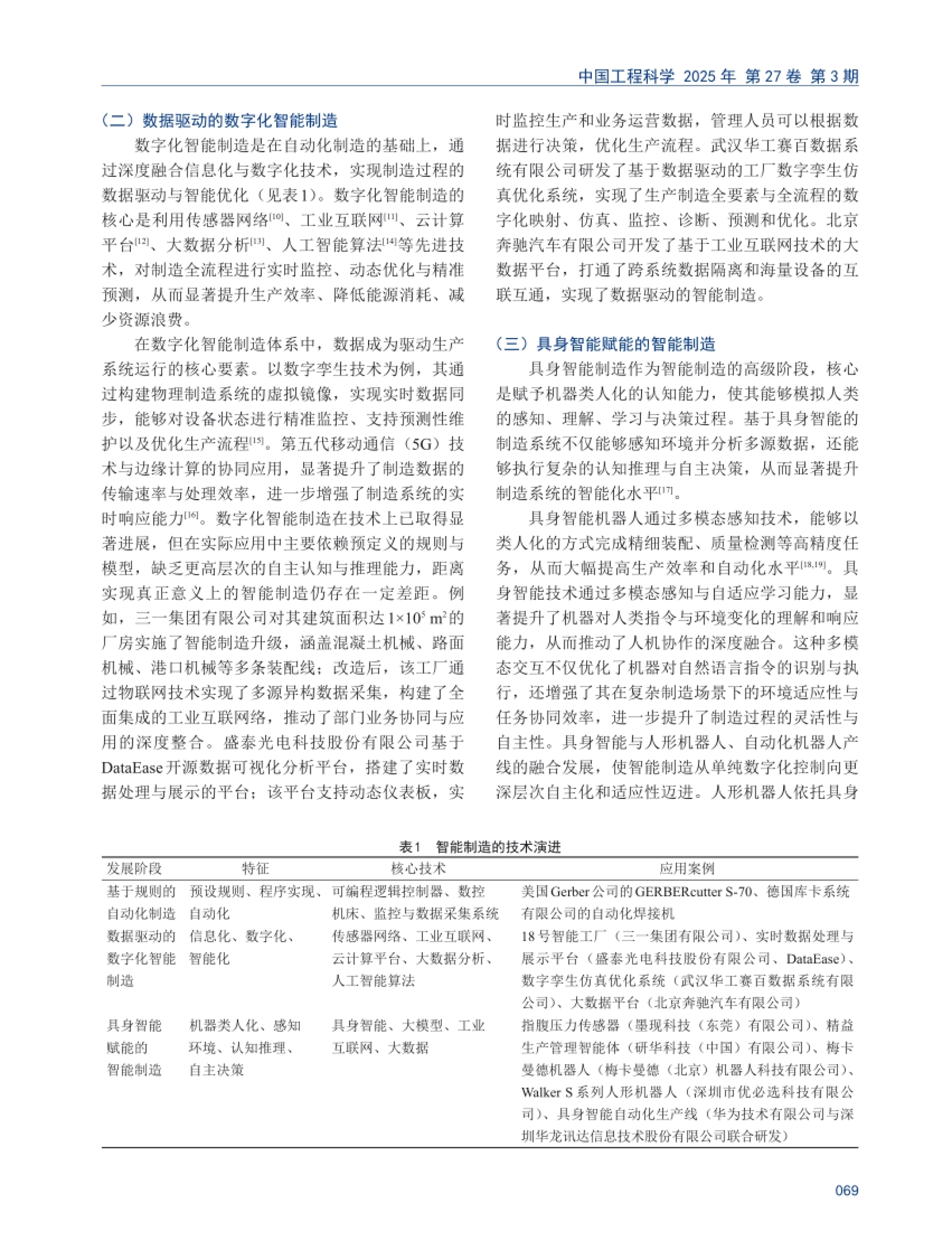
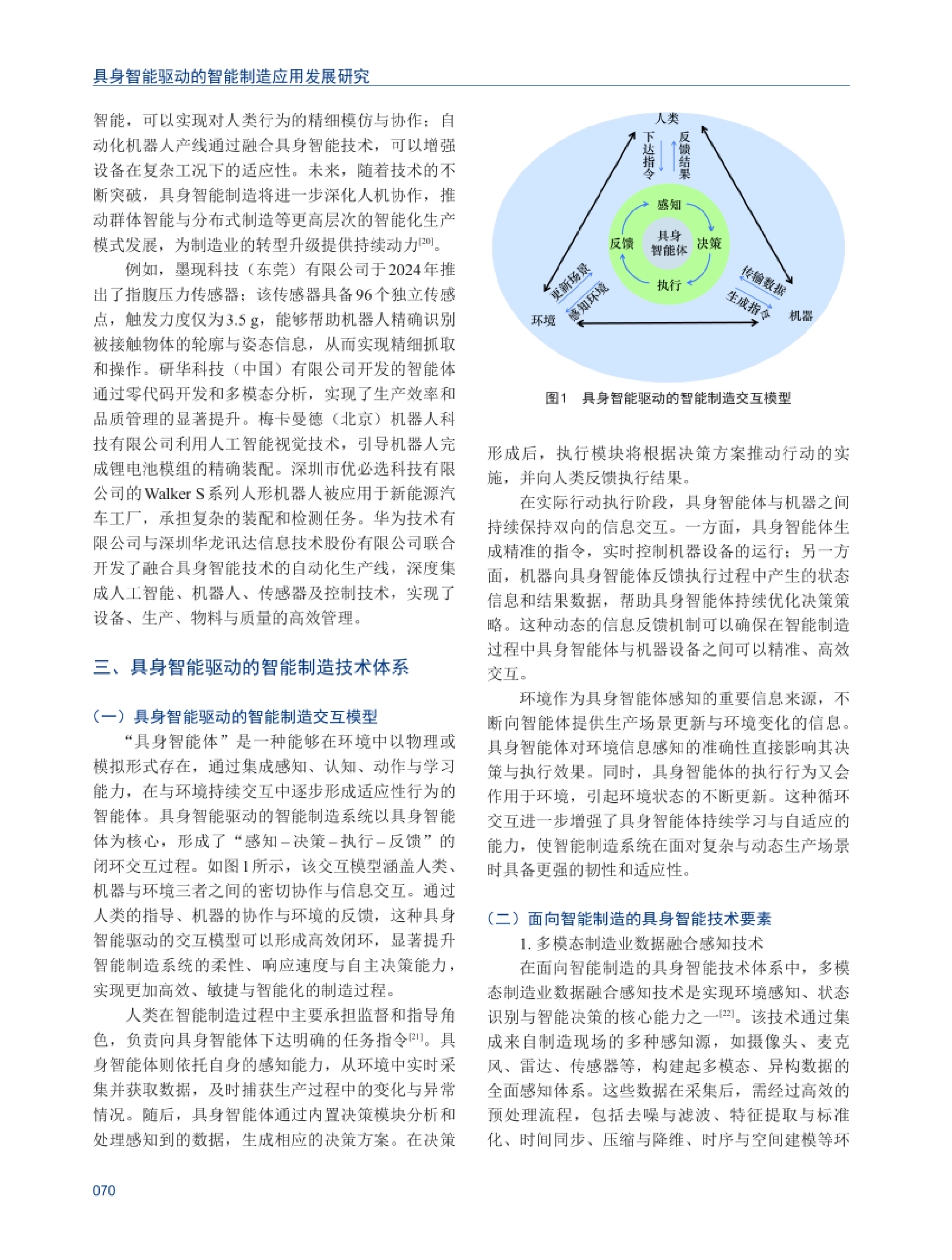
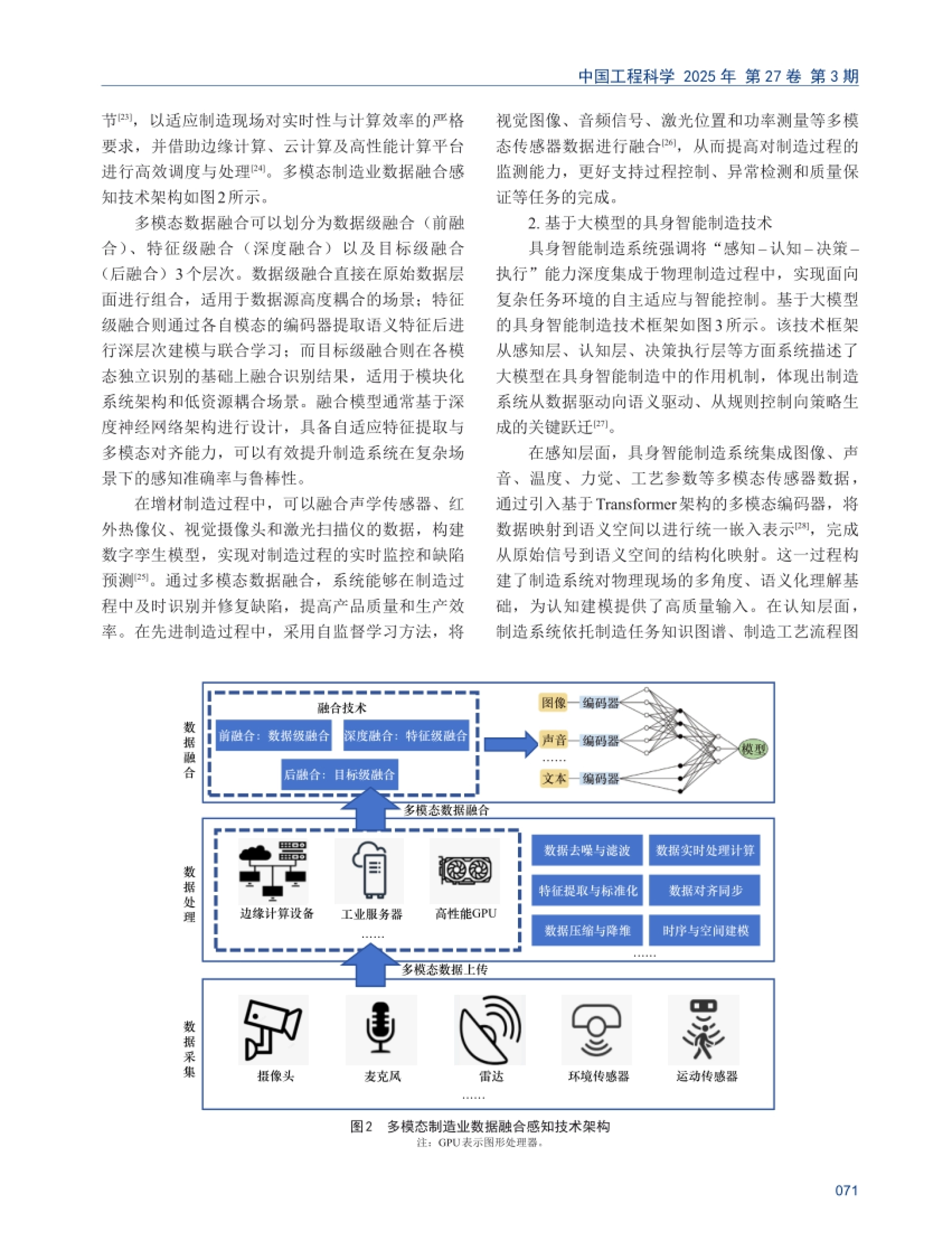
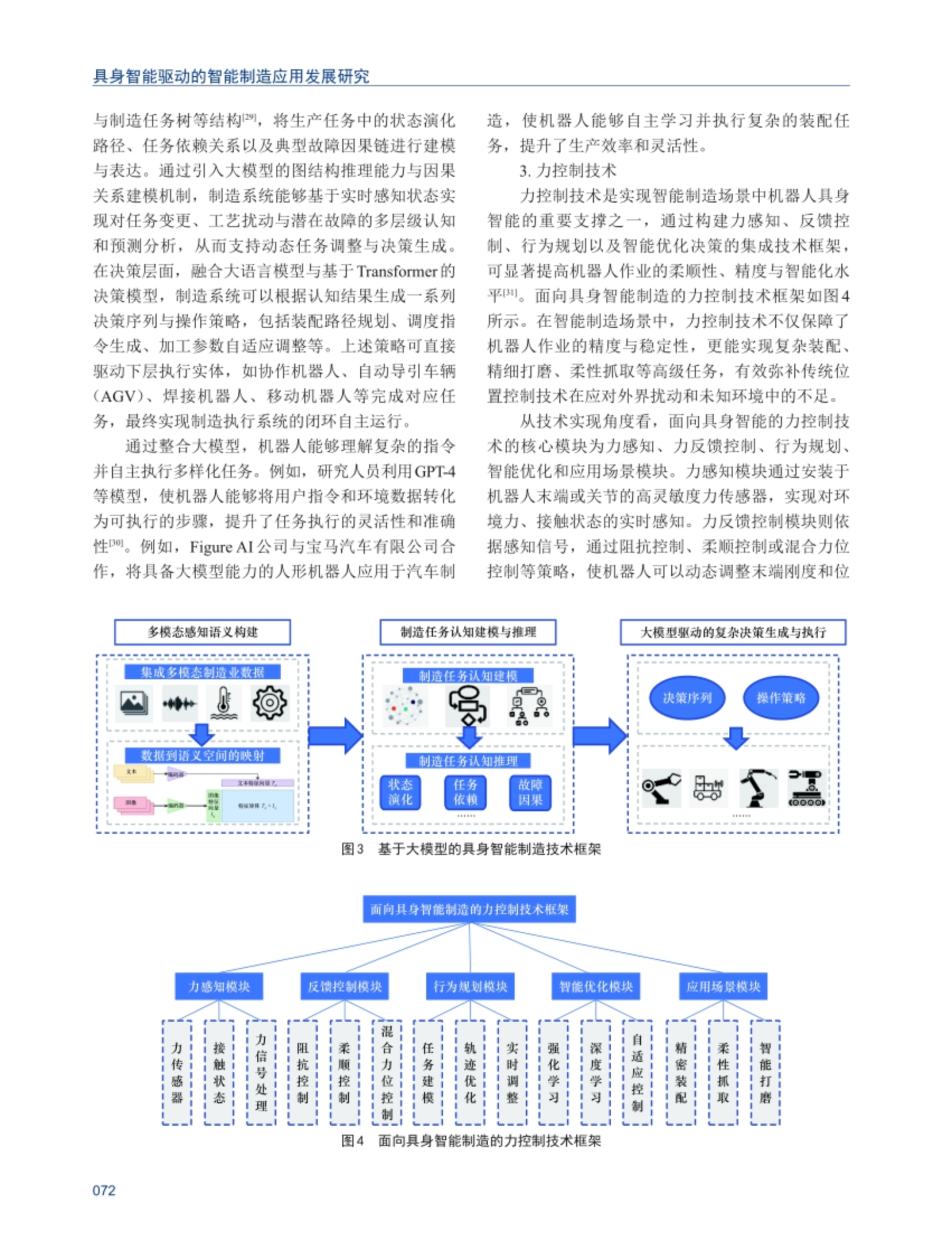
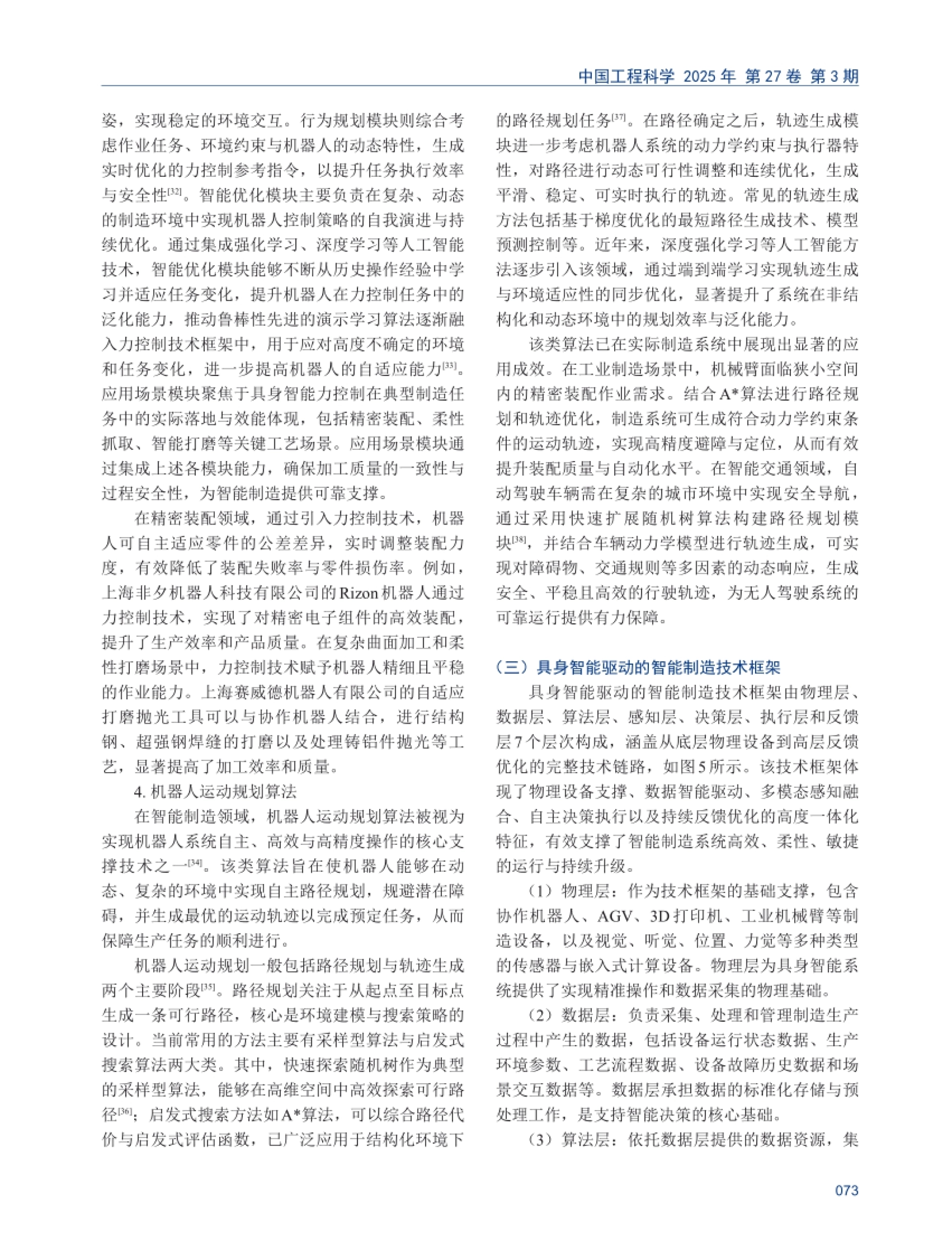
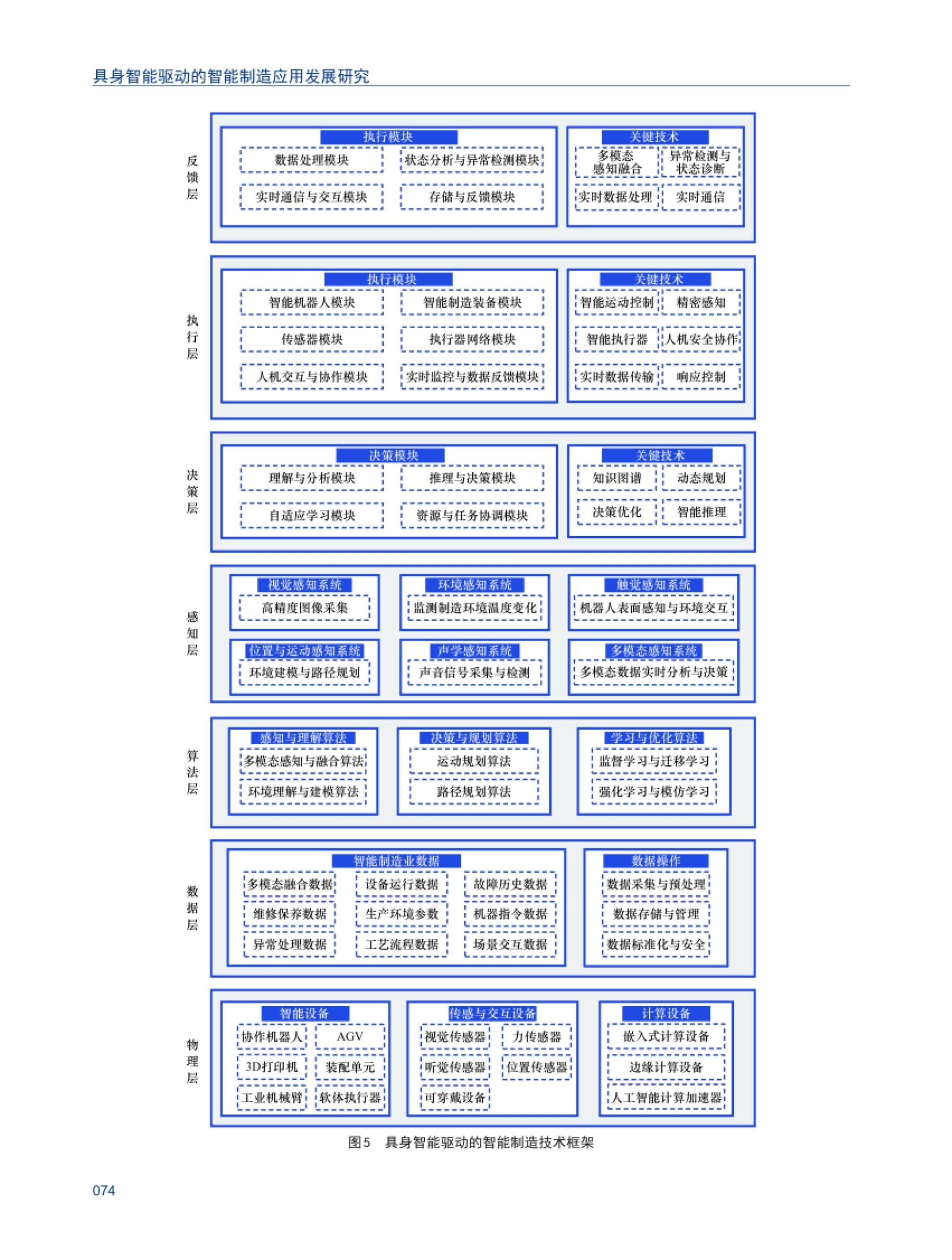
DOI 10.15302/J-SSCAE-2025.04.016中国工程科学 2025 年 第 27 卷 第 3 期具身智能驱动的智能制造应用发展研究袁依格 1,何卓丰 1, 2,李威 1, 2,胡东滨 1, 2*(1. 湘江实验室,长沙 410205;2. 中南大学商学院,长沙 410083)摘要:本文旨在探讨具身智能技术在智能制造领域的应用与发展,为具身智能在智能制造领域的落地应用提供理论支持与实践指导,促进制造业高质量发展与转型升级。按照基于规则的自动化制造、数据驱动的数字化智能制造、具身智能赋能的智能制造的三阶段划分,系统回顾了智能制造的技术演进过程;从交互模型、技术要素、技术框架3个层面出发,构建了具身智能驱动的智能制造技术体系,重点阐述了多模态制造业数据融合感知、基于大模型的具身智能制造、力控制、机器人运动规划等技术要素。具身智能对智能制造在生产制造、仓储物流、检测维护、人机协作等方面具有直接的赋能作用,但也面临多模态数据缺乏制约实际应用成效发挥、复杂制造环境增大感知理解难度、人工智能幻觉导致应用安全风险、软硬件结合问题影响智能能力提升、伦理法律缺失带来标准合规挑战等应用难点。研究建议,加强技术攻关、突破关键瓶颈,完善产业生态、推动应用落地,制定标准规范、保障生产安全,拓展应用场景、开辟市场空间,推动具身智能驱动的智能制造应用发展。关键词:智能制造;具身智能;数据融合;大模型;人机协作中图分类号:TP18 文献标识码:ADevelopment of Intelligent Manufacturing Driven by Embodied IntelligenceYuan Yige 1, He Zhuofeng 1, 2, Li Wei 1, 2, Hu Dongbin 1, 2*(1. Xiangjiang Laboratory, Changsha 410205, China; 2. Business School, Central South University, Changsha 410083, China)Abstract: This study aims to explore the application of embodied intelligence in the field of intelligent manufacturing, providing both theoretical support and practical guidance for its implementation, thereby promoting the high-quality development and upgrading of the manufacturing industry. The evolution of intelligent manufacturing is reviewed across three stages: rule-based automated manufacturing, data-driven digital intelligent manufacturing, and embodied-intelligence-enabled intelligent manufacturing. From the perspectives of interaction models, key technical elements, and architectural frameworks, a technical system for embodied intelligence-driven intelligent manufacturing is constructed, emphasizing core technologies such as multimodal industrial data fusion and perception, embodied-intelligence-enabled intelligent manufacturing powered by foundation models, force control, and robotic motion planning. Embodied intelligence drives the development of intelligent manufacturing from the aspects of production, warehousing and logistics, inspection and maintenance, and human‒robot collaboration. However, it also faces practical challenges, including limitations due to a lack of multimodal data, difficulties in perception and understanding in complex manufacturing environments, application security risks caused by AI hallucinations, bottlenecks in software‒hardware integration, and compliance issues caused by the absence of ethical and legal standards. The study proposes the following recommendations: intensifying technical research to overcome key bottlenecks, improving the industrial ecosystem to promote real-world application, est...