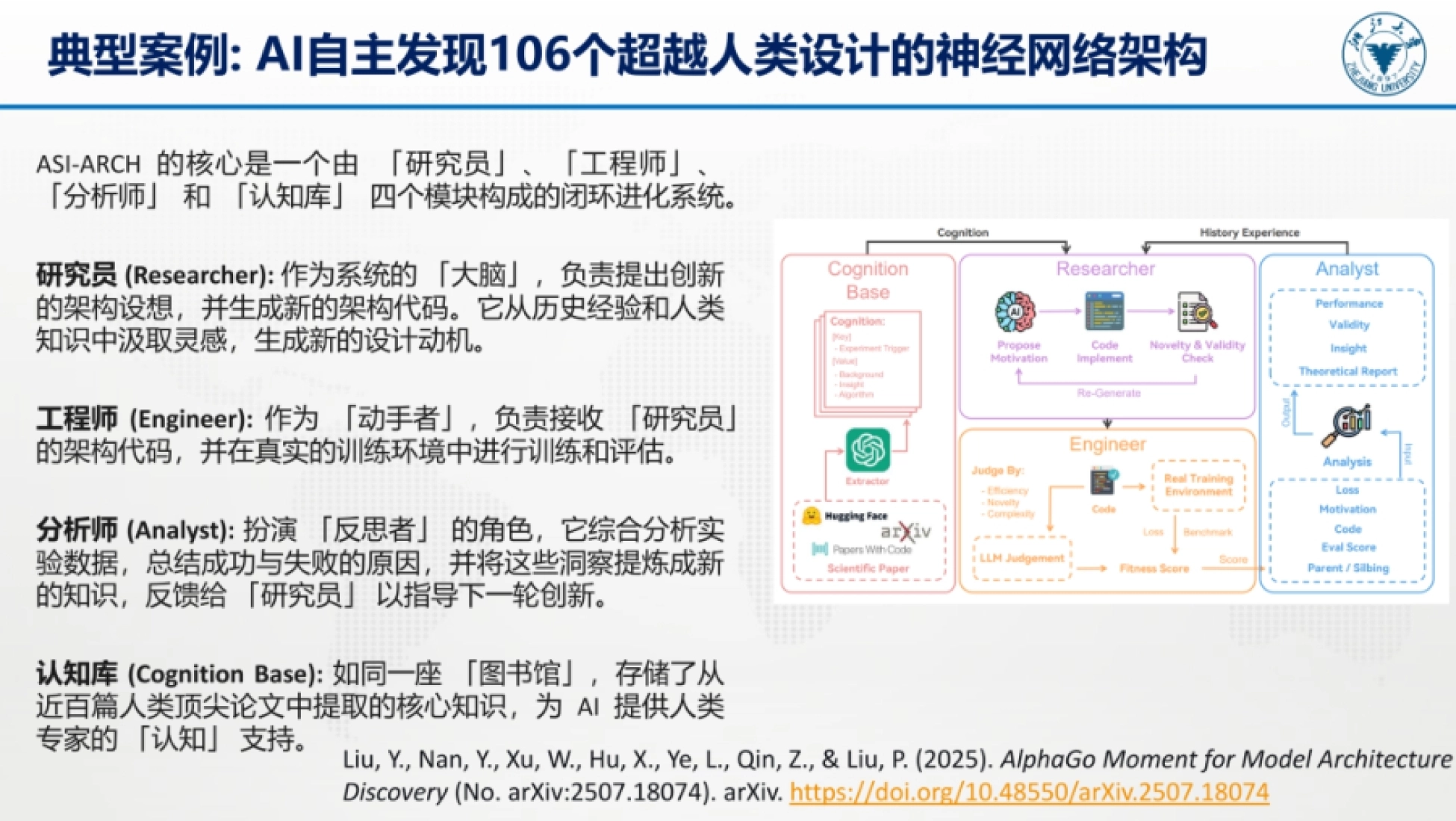
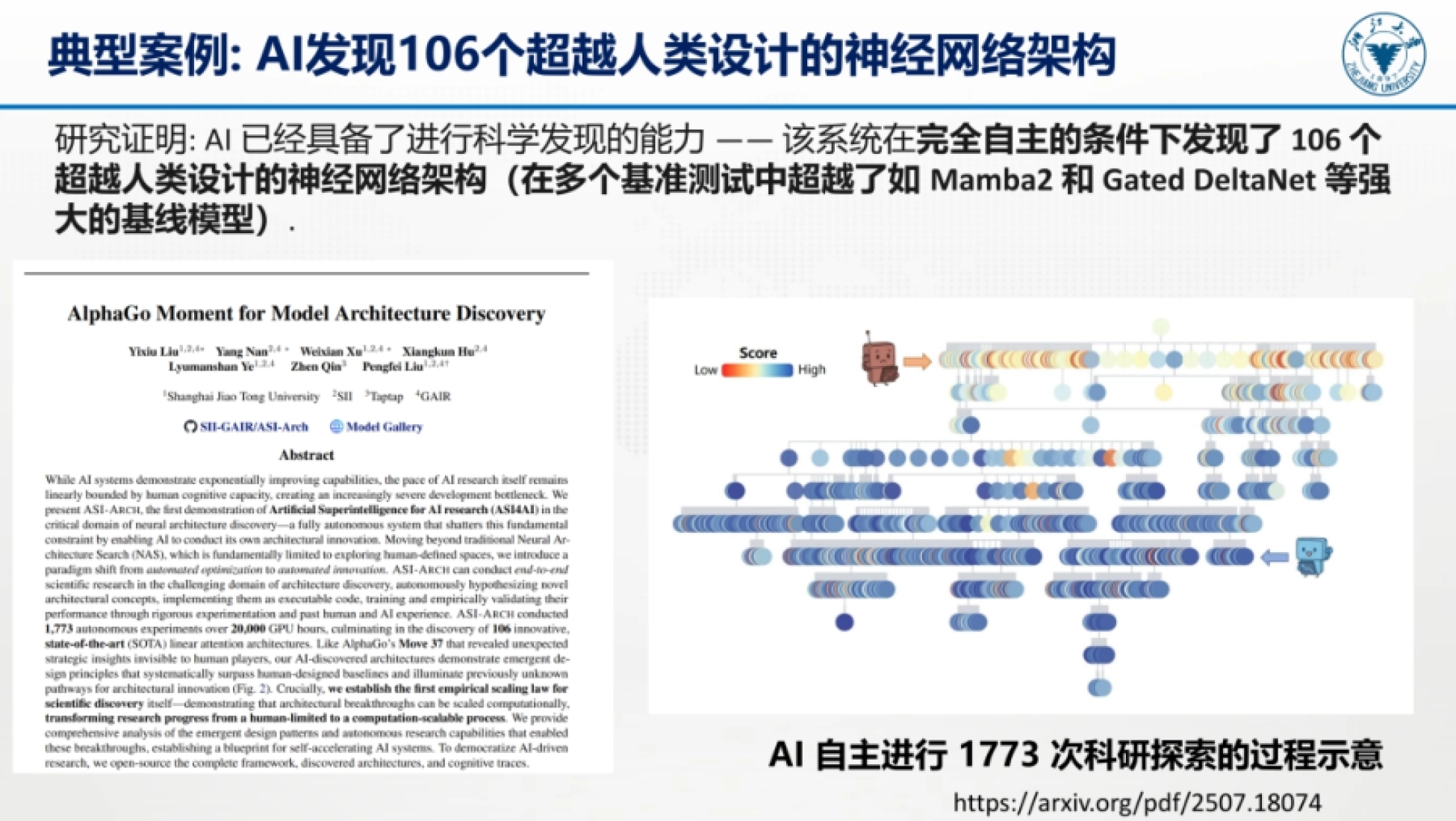
人工智能制冷应用大会暨能源创新论坛能源系统人工智能若干思考和产业应用趋势赵阳浙江大学能源工程学院AI+科研的底层逻辑报告提纲AI+能源的几个发展方向23浙大团队的一些尝试未来展望典型案例:AI自主发现106个超越人类设计的神经网络架构ASI-ARCH的核心是一个由「研究员」、「工程师」[分析师」和「认知库」四个模块构成的闭环进化系统研究员(Researcher):作为系统的「大脑」,负责提出创新CognitionResearchelAnalystBase的架构设想,并生成新的架构代码。它从历史经验和人类国一Validity知识中取灵感,生成新的设计动机。Insight工程师(Engineer):作为「动手者」,负责接收「研究员的架构代码,并在真实的训练环境中进行训练和评估。Engineer分析师(Analyst):扮演「反思者」的角色,它综合分析实MotivatieCod验数据,总结成功与失败的原因并将这些洞察提炼成新Eval Scor的知识,反馈给「研究员」以指导下一轮创新。认知库(CognitionBase):如同一座「图书馆」,存储了从近百篇人类顶尖论文中提取的核心知识,为AI提供人类专家的「认知」支持。Liu, Y.,Nan, Y., Xu, W., Hu, X., Ye, L.,Qin,Z., & Liu, P. (2025).A/phaGo Moment for Model ArchitectureDiscovery (No.arXiv:2507.18074).arXiv.https://doi.org/10.48550/arXiv.2507.18074典型案例:AI发现106个超越人类设计的神经网络架构研究证明:AI 已经具备了进行科学发现的能力 一一该系统在完全自主的条件下发现了 106 个大的基线模型)AlphaGoMomentforModelArchitectureDiscoveryScoreLyumanshan Yel.2.4Zhen Qin*Pengfei Liui.2,.4LowHighQ SII-GAIR/ASI-Arch@Model GalleryAbstractWhile Al systems demonstrate exponentially improving capabilities, the pace of Alresearch itself remainslinearly bounded by human cognitive capacity, creating an increasingly severe development botleneck. Wepresent ASI-ARCH, the first demonstration of Artificial Superintelligence for AIresearch (ASI4AD) in thecritical domain of neural architecture discoverya fully autonomous system that shatters this fundamentalCCCCCCCCconstraint by enabling Al to conduct its own architectural innovation, Moving beyond traditional Neural Architecture Search (NAS), which is fundamentally limited to exploring human-defined spaces, we introduce"paradigm shift frotedoprimization to autovation. ASI-ARCH can conducscientific research in the challenging domain ofarchitecture discovery,autonomously hypothesizing novelcnd-to-endarchitectural concepts, implementing them as executable code, traiperformance through rigorous experimentation and past human and Alexperience, ASI-ARCH conducteding and empiricallyvalidating their1,773 autotousexpenstate-of-the-art (SOTA) linear attention architectures, Like AlphaGo's Move 37 that revealed unexpectedpathways for architecturalinnowation (Fig. 2),. Crucilly, we establish thefirst empiricalscaling law forscientifice discovery itself-dtransforming research progress from a human-limited to a computation-scalable process., We providedemonstrating that archicomprehensive analysis of the cmergent design pattems and autonomous research capabilities that enabledthese breakthroughs, establishing a blueprint for self-accelerating Al systems. To democratize Al-drivenAI 自主进行 1773次科研探索的过程示意research, we open-source the complete framework, discovered architectures, and cognitive tracshttps://arxiv.0rg/pdf/2507.18074谷歌进化式编...