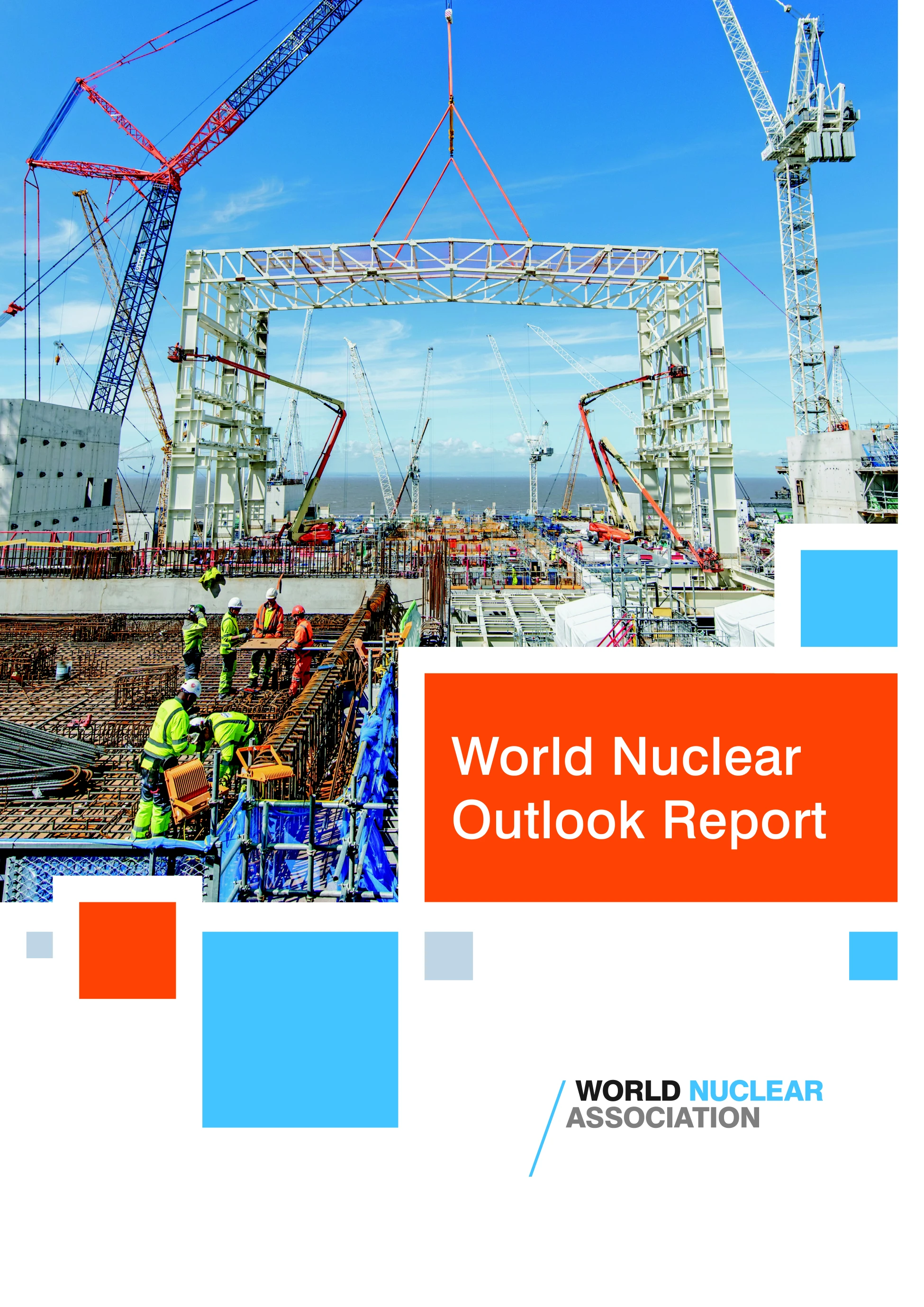
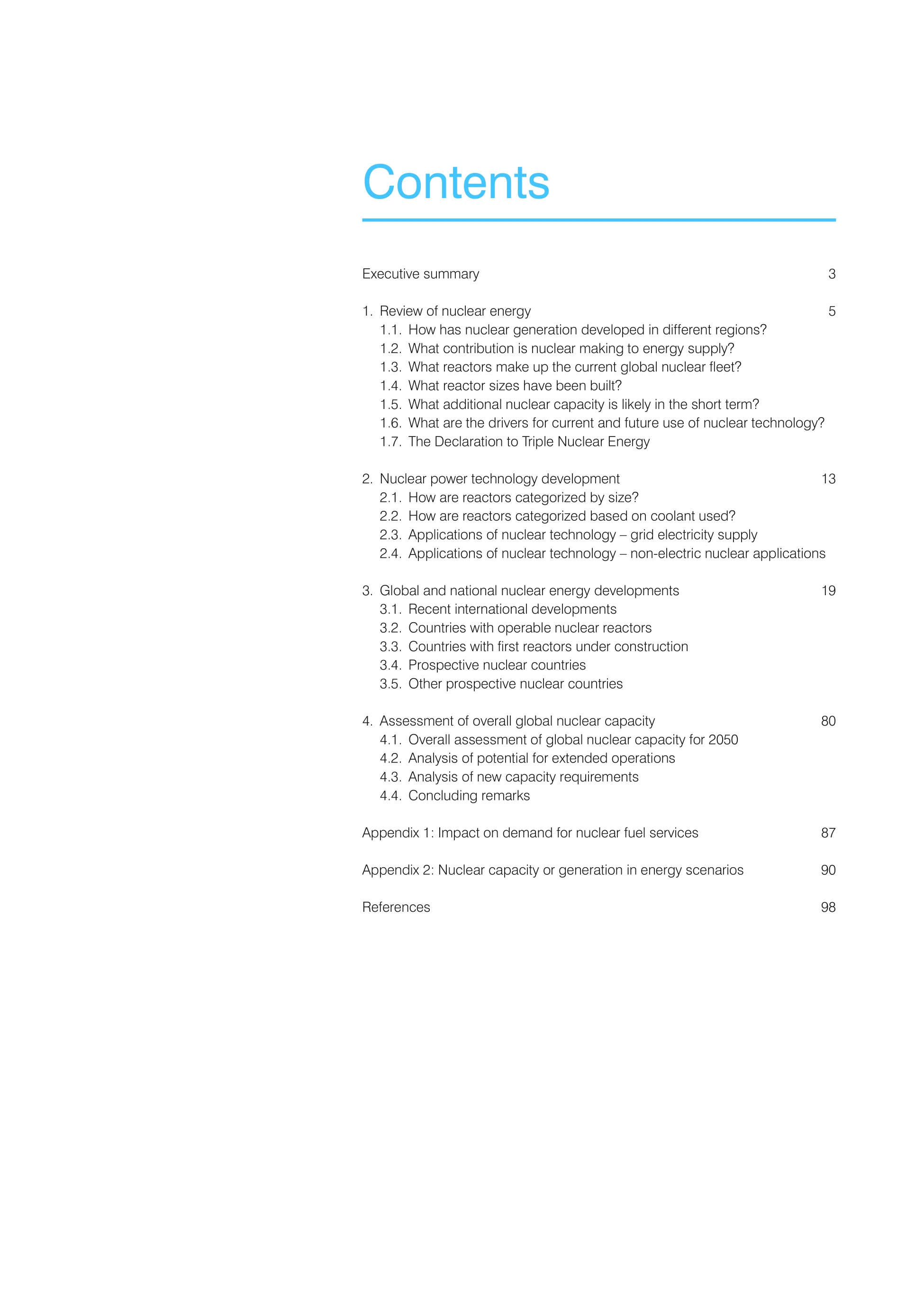
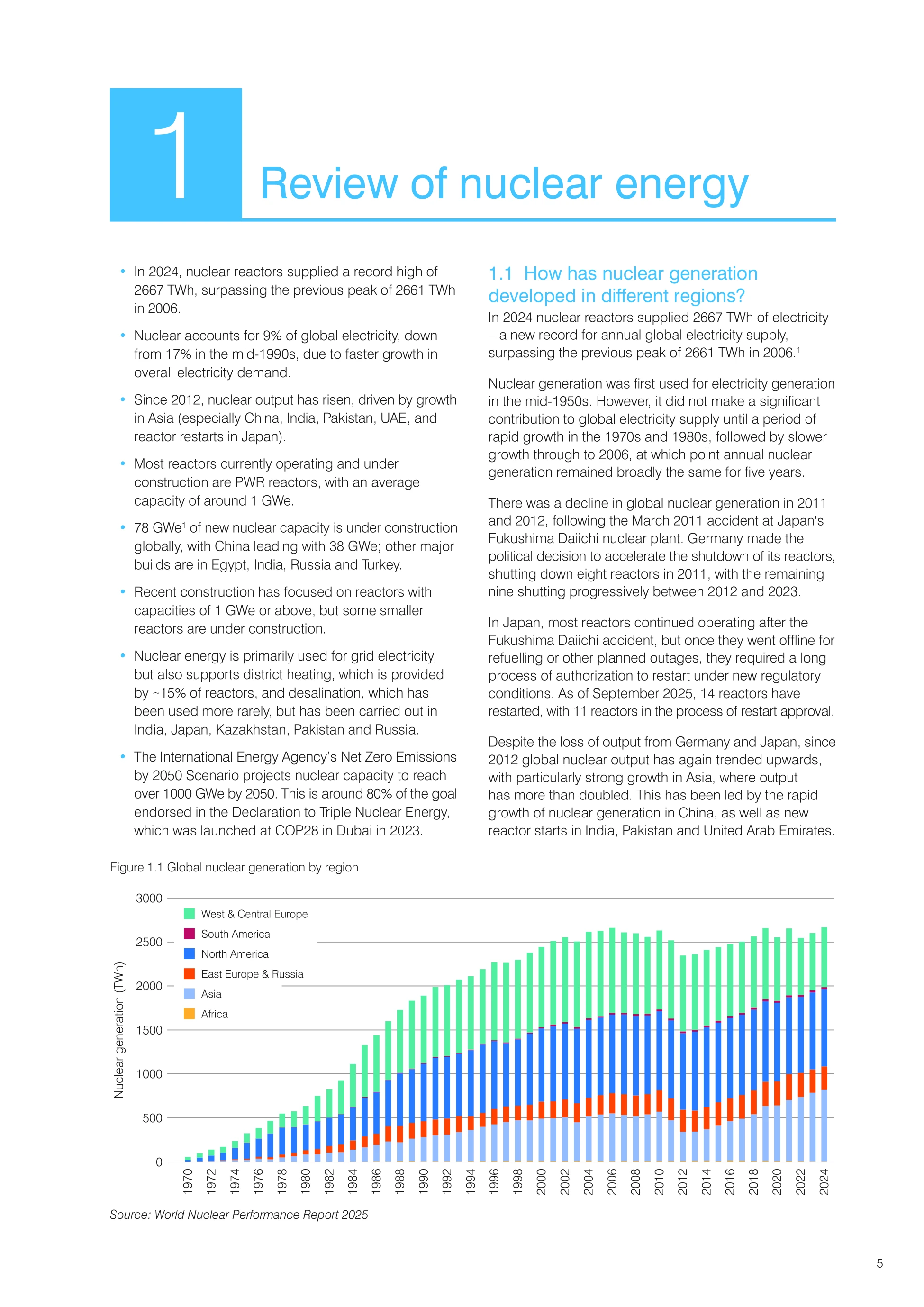
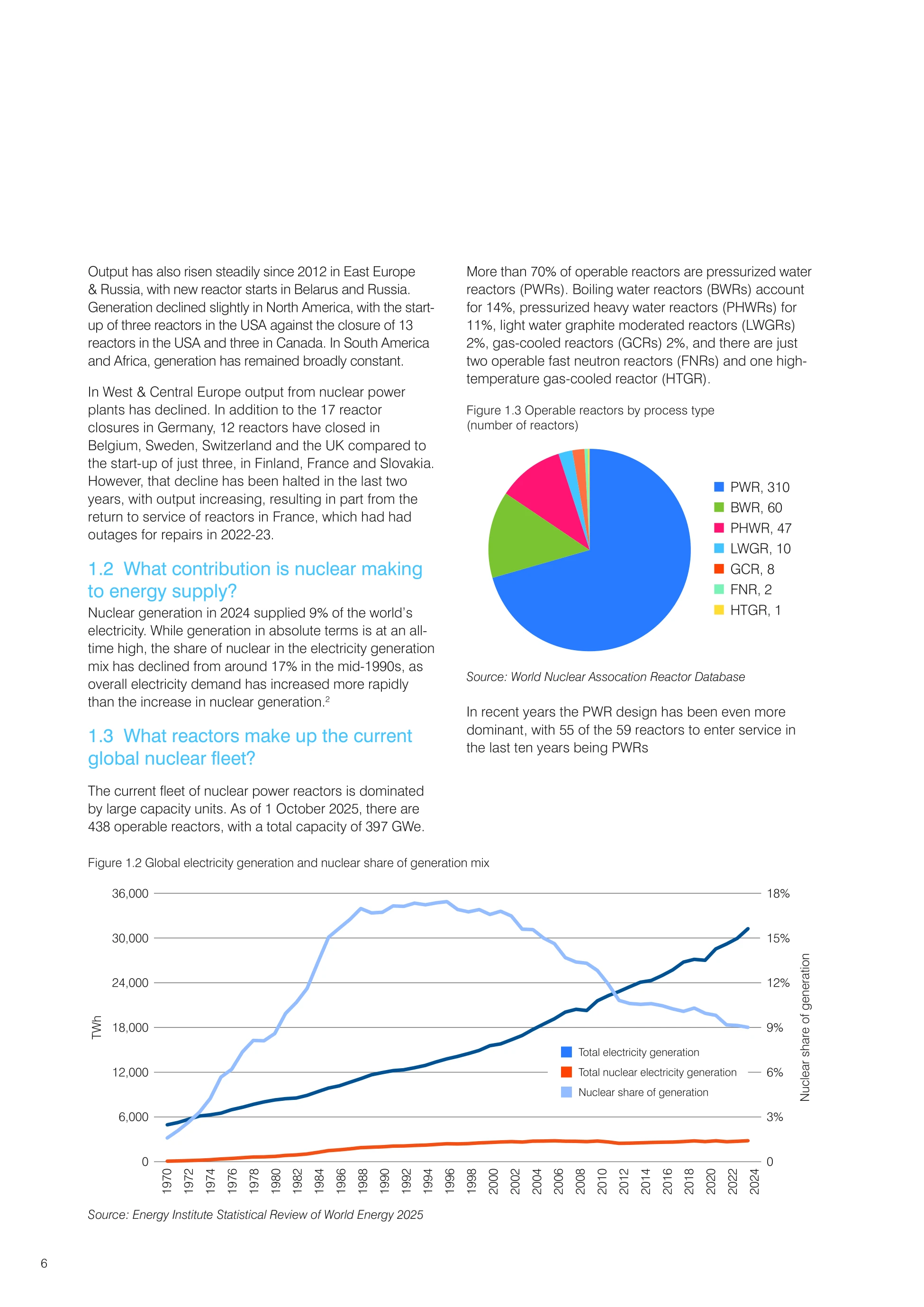
World Nuclear Outlook ReportTitle: World Nuclear Energy Outlook Produced by: World Nuclear Association Published: January 2026 Report No. 2026/001Cover image: EDF Energy© 2026 World Nuclear Association. Registered in England and Wales, company number 01215741 This report reflects the views of industry experts but does not necessarily represent those of World Nuclear Association’s individual member organizations.Executive summary 31. Review of nuclear energy 51.1. How has nuclear generation developed in different regions?1.2. What contribution is nuclear making to energy supply?1.3. What reactors make up the current global nuclear fleet?1.4. What reactor sizes have been built?1.5. What additional nuclear capacity is likely in the short term?1.6. What are the drivers for current and future use of nuclear technology?1.7. The Declaration to Triple Nuclear Energy2. Nuclear power technology development 132.1. How are reactors categorized by size?2.2. How are reactors categorized based on coolant used?2.3. Applications of nuclear technology – grid electricity supply2.4. Applications of nuclear technology – non-electric nuclear applications3. Global and national nuclear energy developments 193.1. Recent international developments3.2. Countries with operable nuclear reactors3.3. Countries with first reactors under construction3.4. Prospective nuclear countries 3.5. Other prospective nuclear countries4. Assessment of overall global nuclear capacity 804.1. Overall assessment of global nuclear capacity for 20504.2. Analysis of potential for extended operations4.3. Analysis of new capacity requirements4.4. Concluding remarksAppendix 1: Impact on demand for nuclear fuel services 87Appendix 2: Nuclear capacity or generation in energy scenarios 90References 98Contents3Key Findings1. Global nuclear capacity outlook• Total capacity in 2050 could reach 1446 GWe by 2050, surpassing the approximately 1200 GWe target established under the Declaration to Triple Nuclear Energy.• Most growth to 2030 stems from reactors currently under construction; planned projects drive expansion to 2035; and proposed, potential, and government-driven programmes account for the increase in capacity after 2035.• Five countries — China, France, India, Russia, and the USA — would represent nearly 980 GWe of total global nuclear capacity in 2050.• Newcomer nuclear nations have ambitions for nuclear capacity to reach 157 GWe by 2050, highlighting rising interest beyond traditional nuclear operators.2. Reactor long-term operation could contribute more than one-quarter of 2050 capacity• Of the global reactor fleet operable in 2025, 189 GWe would have operated for up to 60 years by 2050; up to an additional 213 GWe could continue to operate if operating lifetimes were extended up to 80 years.• Historical performance data show no age-related decline in reactor capacity factors, and the average age of permanently ...