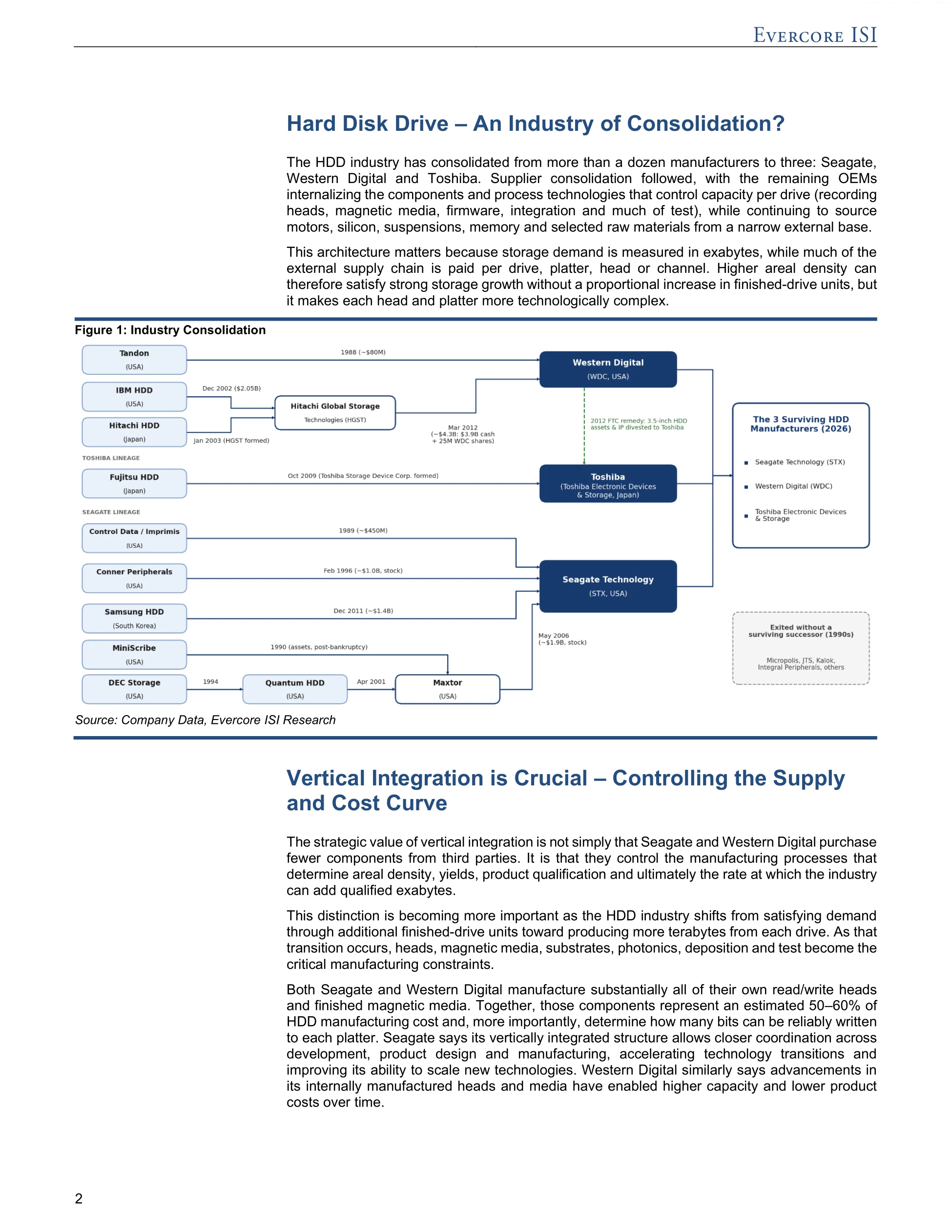
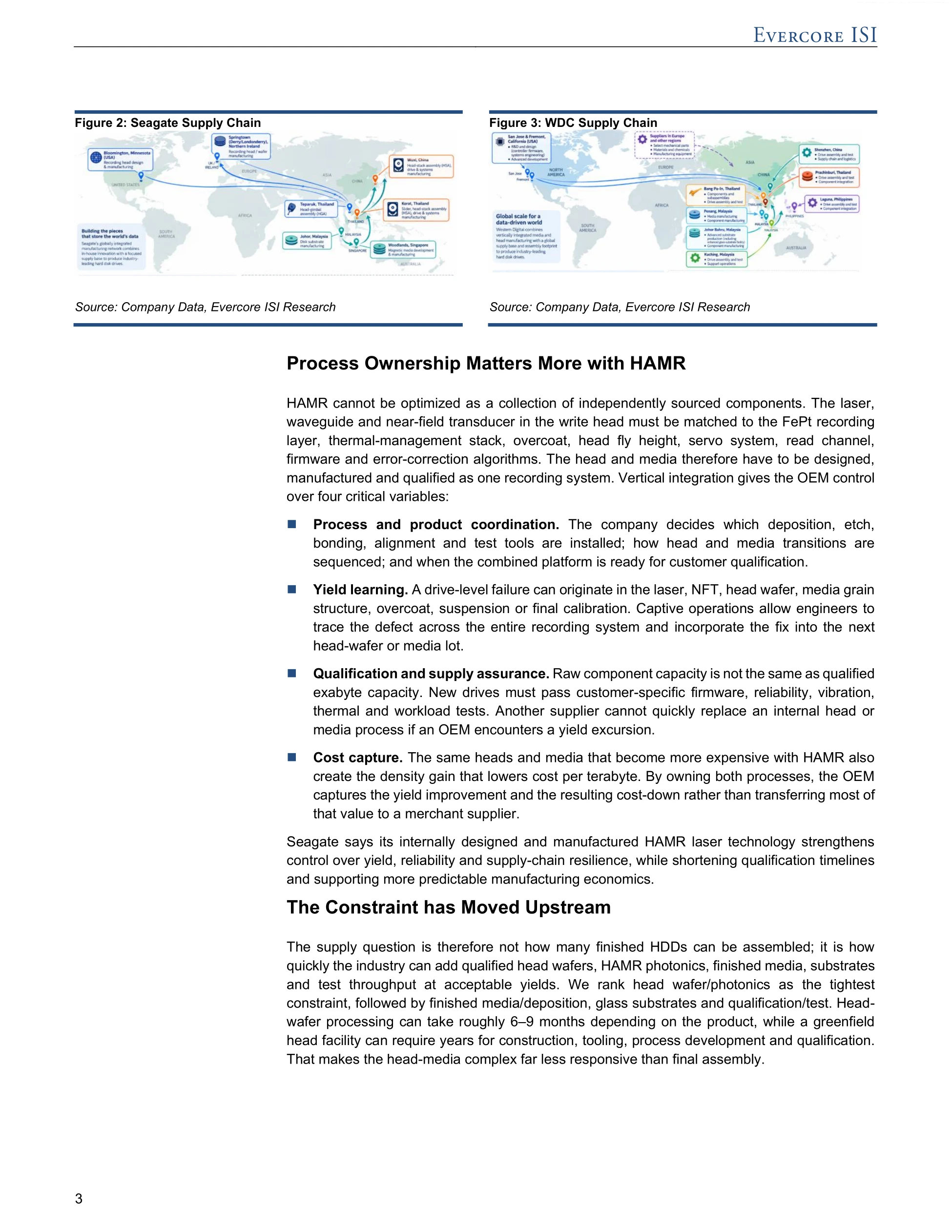
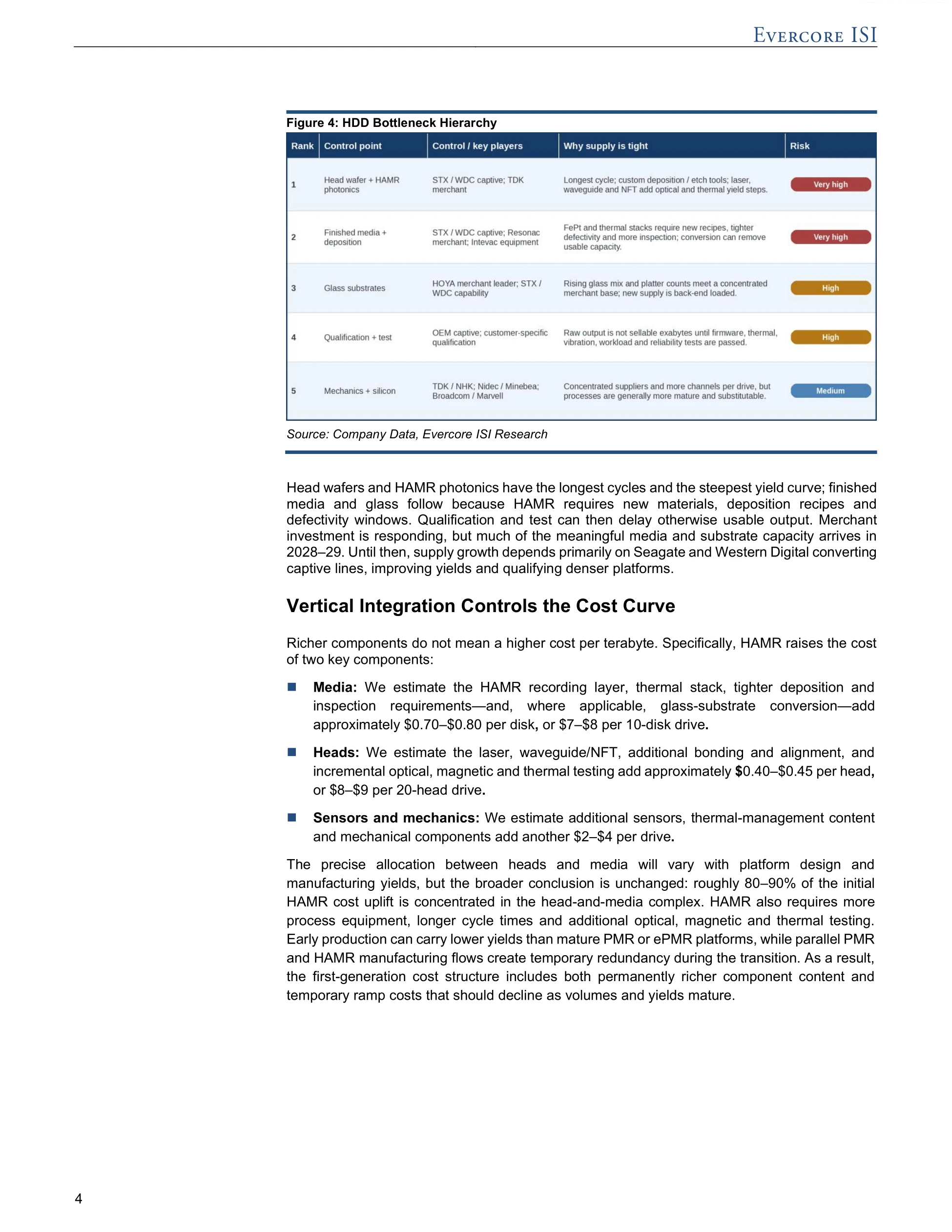
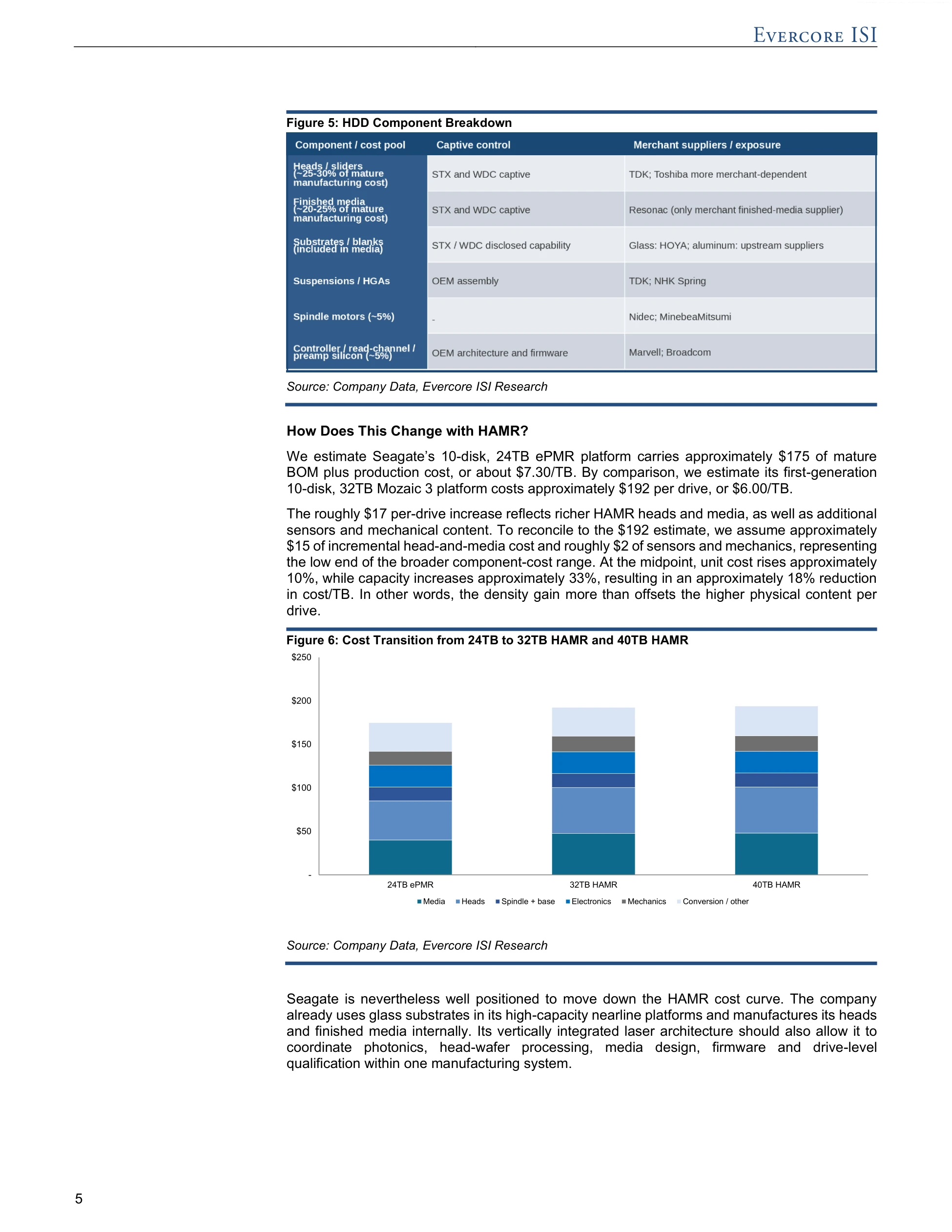
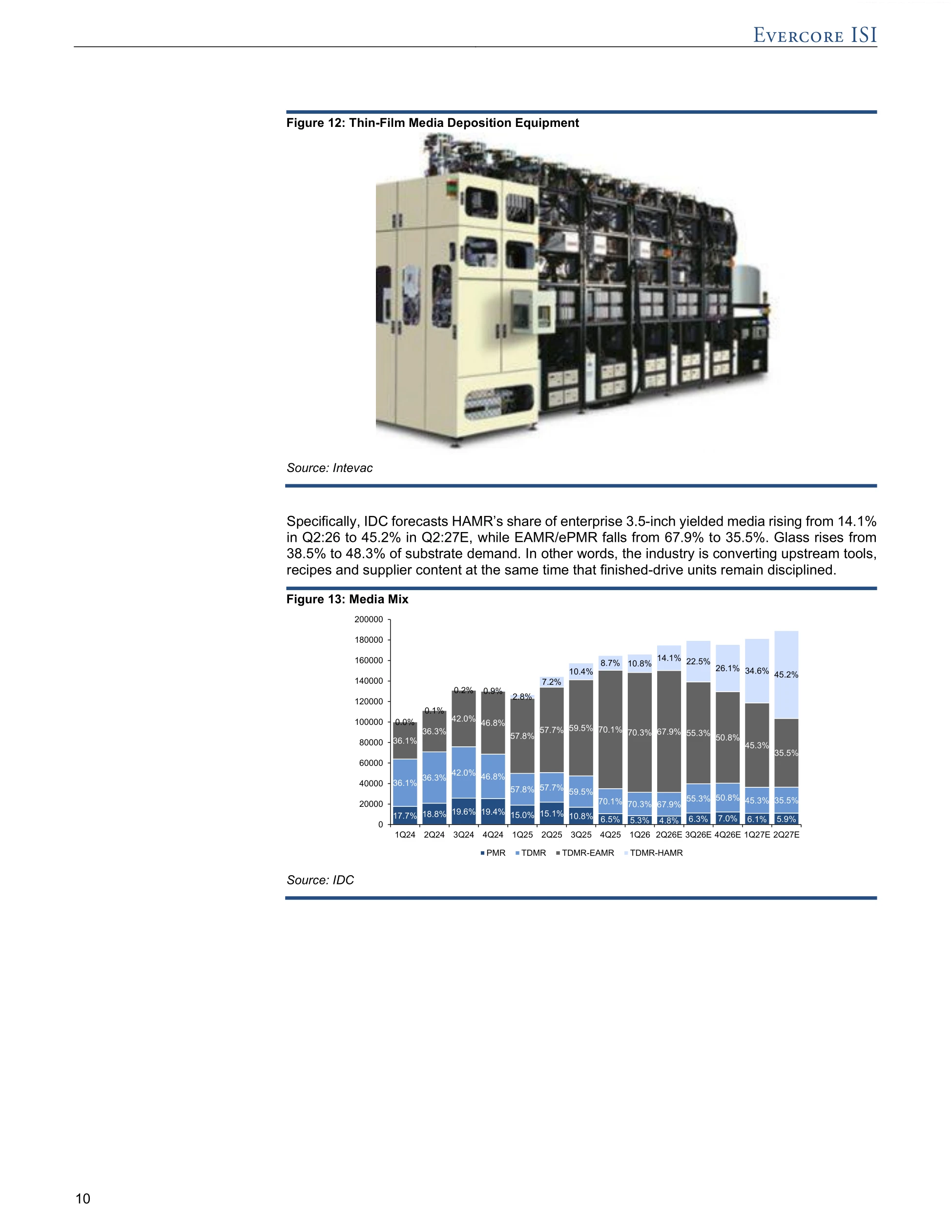
来源:发现报告(www.fxbaogao.com/view?id=5756638)| 引用请注明出处 Technology | IT Hardware & Networking Please see the analyst certification and important disclosures on page 15 of this report. Evercore ISI and affiliates do and seek to do business with companies covered in its research reports. Investors should be aware that the firm may have a conflict of interest that could affect the objectivity of this report. Investors should consider this report as only a single factor in making their investment decision. © 2026. Evercore Group L.L.C. All rights reserved. IT Hardware/Networking: DEEP DIVE into HDD Supply Chain, Vertical Integration Key ALL YOU NEED TO KNOW: A key investor question is how the HDD industry can meet strong exabyte demand while remaining disciplined on finished-drive units—particularly following Toshiba’s recent capacity announcement. We think the answer is higher areal density: producing more TB per drive shifts the bottleneck upstream from final assembly into head wafers, HAMR photonics, magnetic media, glass substrates, deposition and test. This favors STX and WDC, whose vertical integration across heads, media, firmware and qualification gives them greater control over technology ramps, yields and cost/TB. Toshiba’s planned exabyte expansion challenges the industry’s unit-discipline narrative, but its reliance on merchant suppliers means that added assembly and test capacity must still be matched by qualified heads, media, glass and suspensions—inputs that are slower and harder to scale. Key takeaways: 1) Vertical integration is crucial: Seagate and Western Digital manufacture substantially all of their heads and media, allowing them to co-optimize the recording system, accelerate yield learning and retain the resulting cost/TB benefit. 2) HAMR turning heads: Adding a laser, waveguide and near-field transducer turns the writer into a magnetic-photonic device. Specialized tools, difficult optical and thermal yields, and six-to-nine-month head-wafer cycles make qualified head capacity far less elastic than drive assembly. 3) Media and glass: HAMR requires FePt recording layers, tighter thermal stacks and greater defect control. Merchant supply is concentrated in HOYA for glass substrates and Resonac for finished media, with much of the meaningful capacity addition arriving in 2028–29. 4) Component demand outgrows drive units: Over 2025-30, IDC expects capacity-optimized HDD units to grow ~11% annually vs. ~13% for media, substrates, HGAs and suspensions. We view this as a component-content and process-conversion cycle, with the largest gap in 2027-28. 5) Density drives cost downs: We estimate a 32TB, 10-disk HAMR drive carries approximately ~$190-195 of BOM, including $15–$17 of incremental head and media cost and another $2–$4 from sensors and mechanical components. The larger benefit emerges near 40TB, where flat unit cost coul...