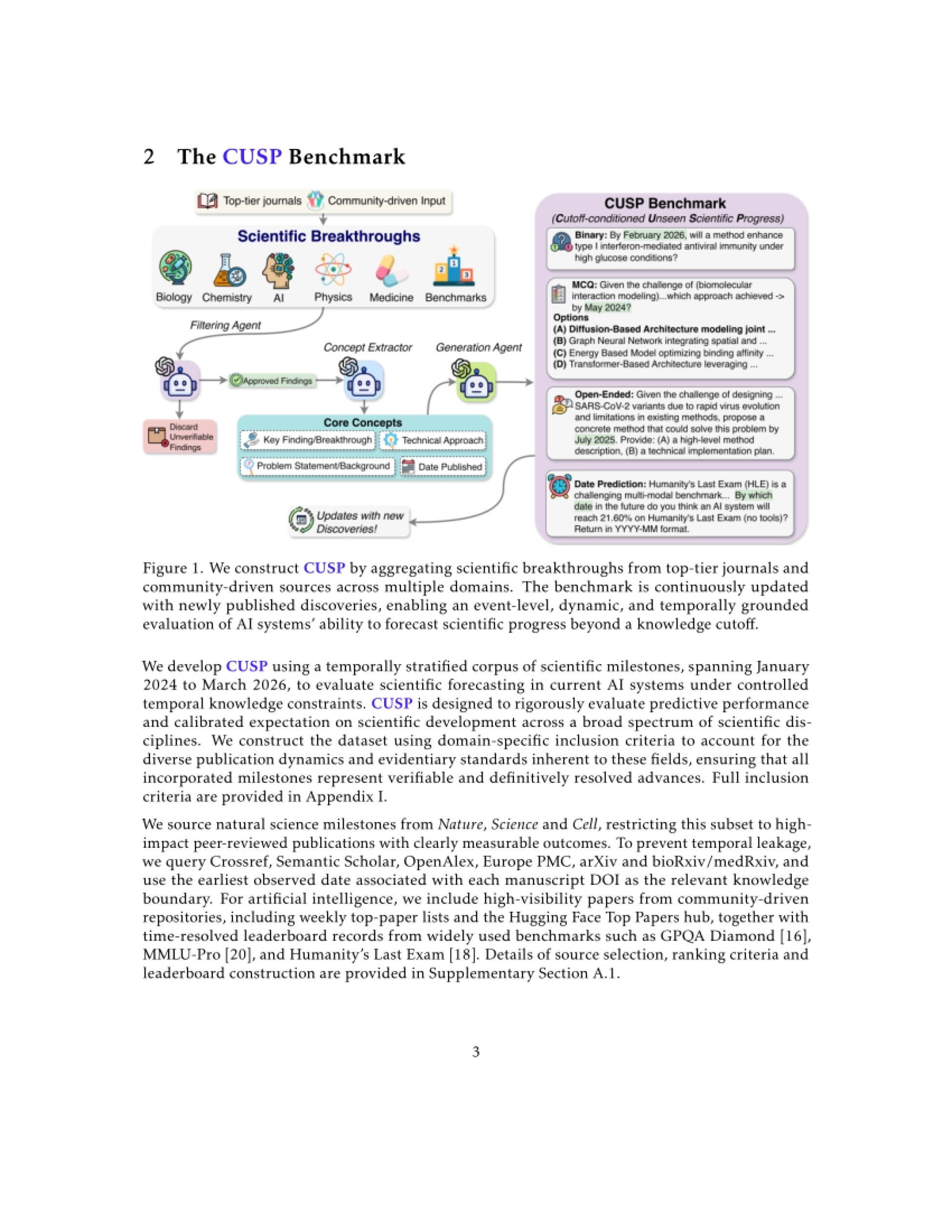
Forecasting Scientific Progress with Artificial IntelligenceSean Wu1,∗, Pan Lu2,∗, Yupeng Chen1, Jonathan Bragg3Yutaro Yamada4, Peter Clark3, David Clifton1, Philip Torr1,†, James Zou2,†, Junchi Yu1,†1 University of Oxford2 Stanford University3 Allen Institute for AI4 Sakana AIAbstractRepositoryHuggingFaceProject PageArtificial intelligence (AI) is increasingly embedded in scientific discovery, yet whether itcan anticipate scientific progress remains unclear. To study this question, we introduce a tem-porally grounded evaluation framework for forecasting scientific progress under controlledknowledge constraints. We present CUSP (Cutoff-conditioned Unseen Scientific Progress), amulti-disciplinary and event-level benchmark that evaluates scientific forecasting performancein AI systems through feasibility assessment, mechanistic reasoning, generative solution design,and temporal prediction. Across 4,760 scientific events, we observe systematic and domain-dependent limitations in current frontier models. While models can identify plausible researchdirections from competing candidates, they fail to reliably predict whether scientific advanceswill be realized and systematically misestimate when they will occur. Model performance ishighly heterogeneous across domains, with the timing of AI progress being more predictablethan advances in biology, chemistry, and physics. Performance is largely insensitive to whetherevents occur before or after the training cutoff, suggesting that these limitations cannot be ex-plained solely by knowledge exposure in training data. Under controlled information access,providing additional pre-cutoff knowledge improves performance but does not close the gap tofull-information settings, which becomes more pronounced for high-citation scientific advances.Moreover, models exhibit systematic overconfidence and strong response biases, indicating thattheir uncertainty estimation is unreliable in forecasting scientific progress. Taken together, thesefindings reveal that current AI systems fall short as predictive tools for scientific progress, asaccess to prior knowledge does not translate into reliable scientific forecasting. Instead, modelperformance benefits more from post-event information than from forward-looking prediction.1IntroductionScientific progress is often assumed to follow structured patterns [1, 2], with empirical regularitiessuch as Moore’s Law [3] in semiconductors and scaling relationships [4] in deep learning providingquantitative expectations about future developments. These patterns emerge from accumulatedscientific progress [5] and have long informed research roadmaps, funding priorities, and techno-logical forecasting [6, 7]. As artificial intelligence (AI) becomes increasingly embedded in scientificdiscovery and drives advances across domains such as biology, chemistry, physics, and AI itself[8, 9, 10, 11, 12], a question arises: can AI systems forecast the trajectory of scien...







































