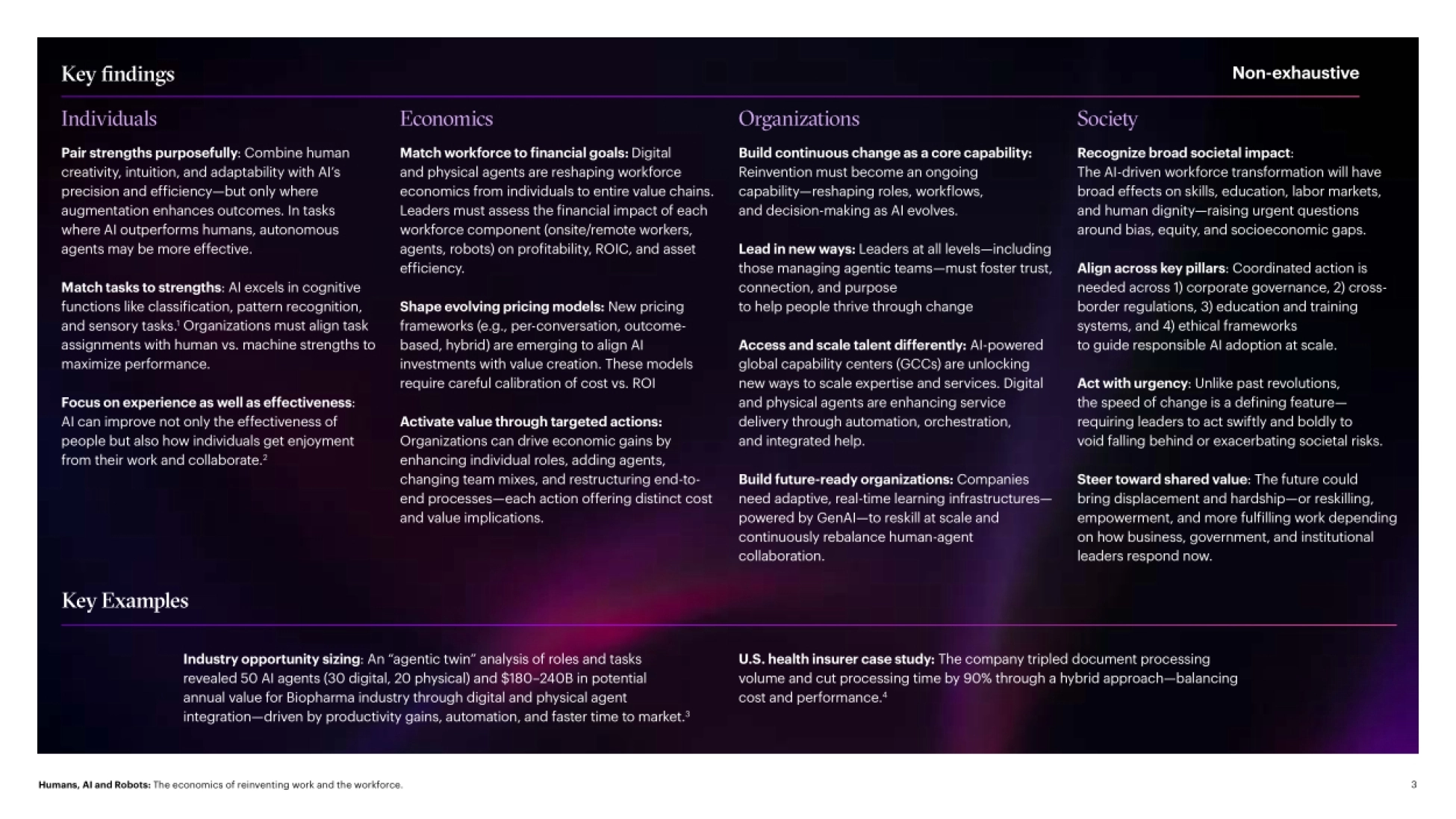

The economics of reinventing work and the workforceHumans,AI and RobotsAs AI technologies proliferate, industry leaders have a unique opportunity—not just to enhance efficiency but to unlock entirely new paradigms of individual, economic, organizational and societal value. The Wharton School of the University of Pennsylvania and Accenture are launching a global research initiative to help these leaders understand why and how to achieve that impact at scale. Our focus: Understanding how a future shaped by the deep integration of human strengths with generative AI-powered agents and robots can fundamentally redefine work across industries. How we define Human+ workforce: Seamless integration of onsite and remote employees with autonomous agents and intelligent robots, redefining productivity, collaboration, and decision-making. Our goal: Provide a robust fact-base and a suite of action-oriented insights to help executives architect this transformation—not as passive participants but as designers of a new economic and organizational reality.Early hypotheses and insights from Wharton and Accenture’s latest findings offer our starting point and a preliminary roadmap for executives and policymakers seeking to navigate the agentic age with responsibility and purpose.Executive summary 2Humans, AI and Robots: The economics of reinventing work and the workforce.Pair strengths purposefully: Combine human creativity, intuition, and adaptability with AI’s precision and efficiency—but only where augmentation enhances outcomes. In tasks where AI outperforms humans, autonomous agents may be more effective. Match tasks to strengths: AI excels in cognitive functions like classification, pattern recognition, and sensory tasks.1 Organizations must align task assignments with human vs. machine strengths to maximize performance . Focus on experience as well as effectiveness: AI can improve not only the effectiveness of people but also how individuals get enjoyment from their work and collaborate.2 IndividualsEconomicsMatch workforce to financial goals: Digital and physical agents are reshaping workforce economics from individuals to entire value chains. Leaders must assess the financial impact of each workforce component (onsite/remote workers, agents, robots) on profitability, ROIC, and asset efficiency . Shape evolving pricing models: New pricing frameworks (e.g., per-conversation, outcome-based, hybrid) are emerging to align AI investments with value creation. These models require careful calibration of cost vs. ROI Activate value through targeted actions: Organizations can drive economic gains by enhancing individual roles, adding agents, changing team mixes, and restructuring end-to-end processes—each action offering distinct cost and value implications .Key findingsKey ExamplesBuild continuous change as a core capability: Reinvention must become an ongoing capability—reshaping roles, workflows,...







































