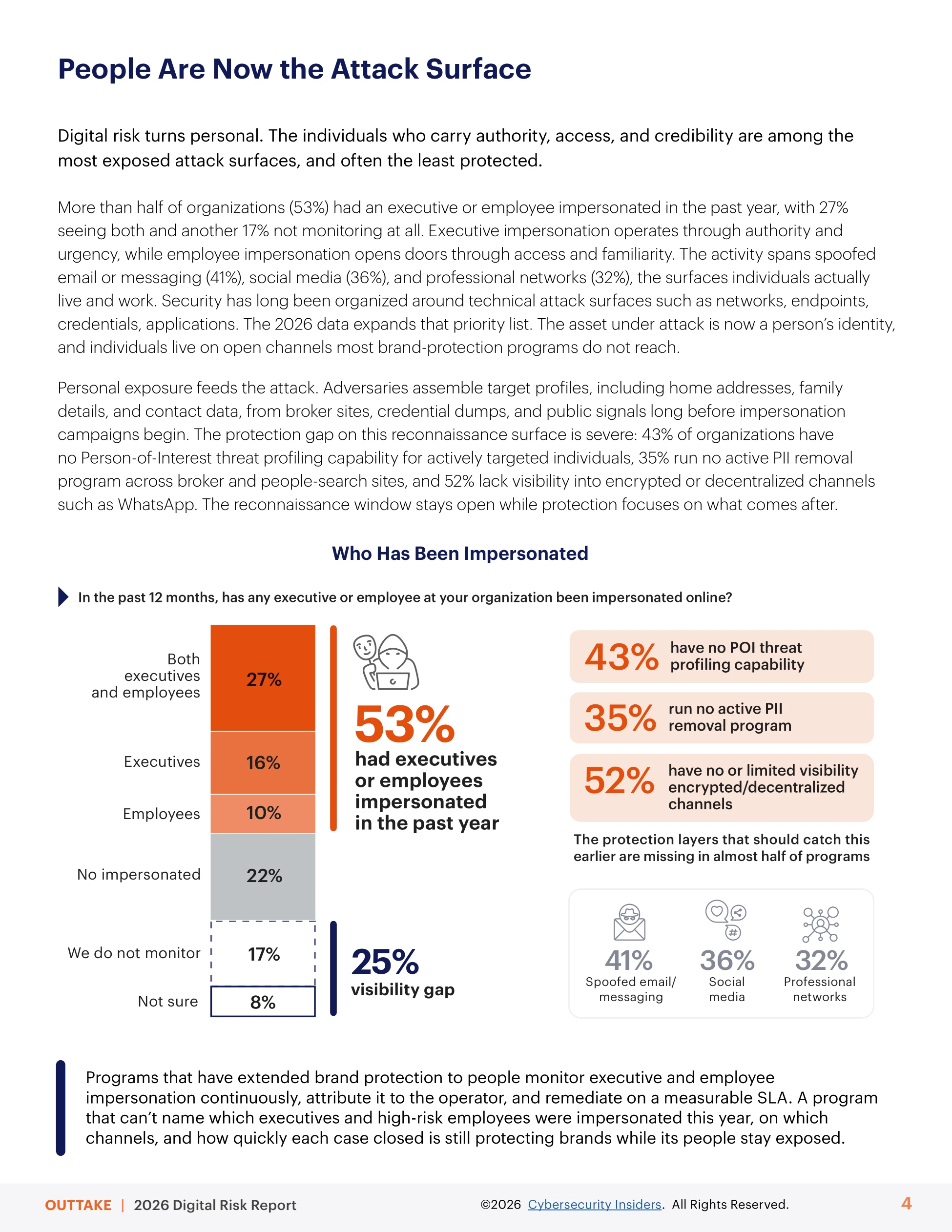
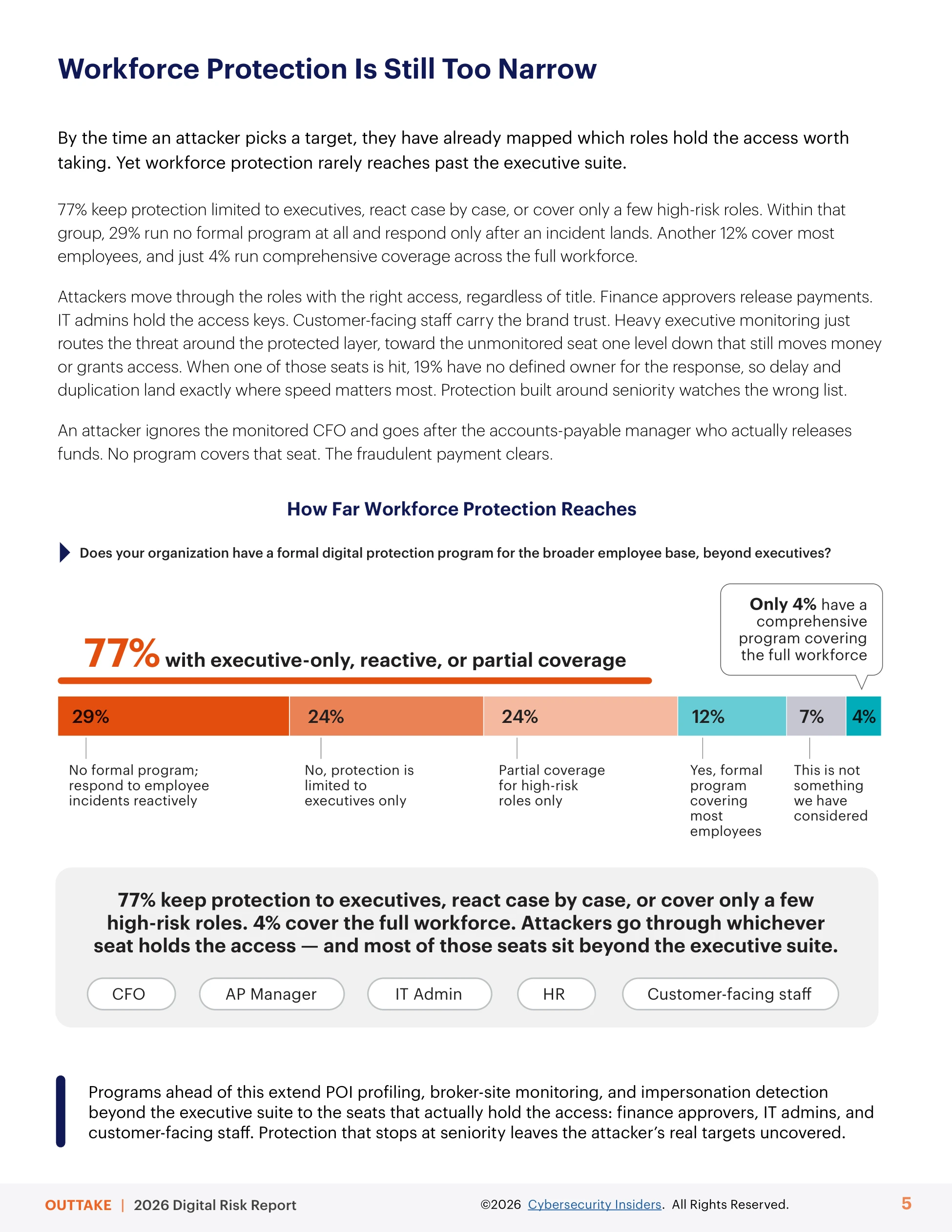
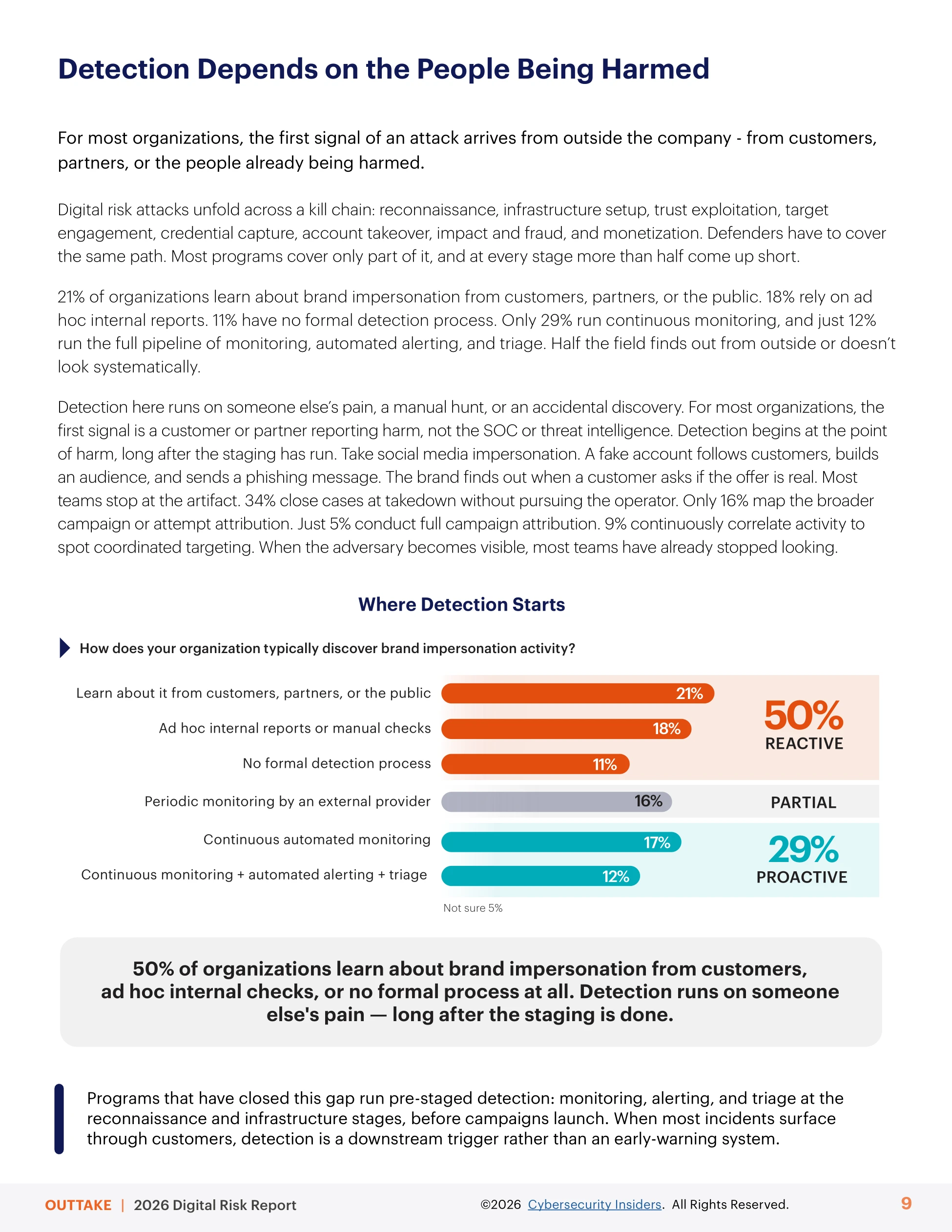
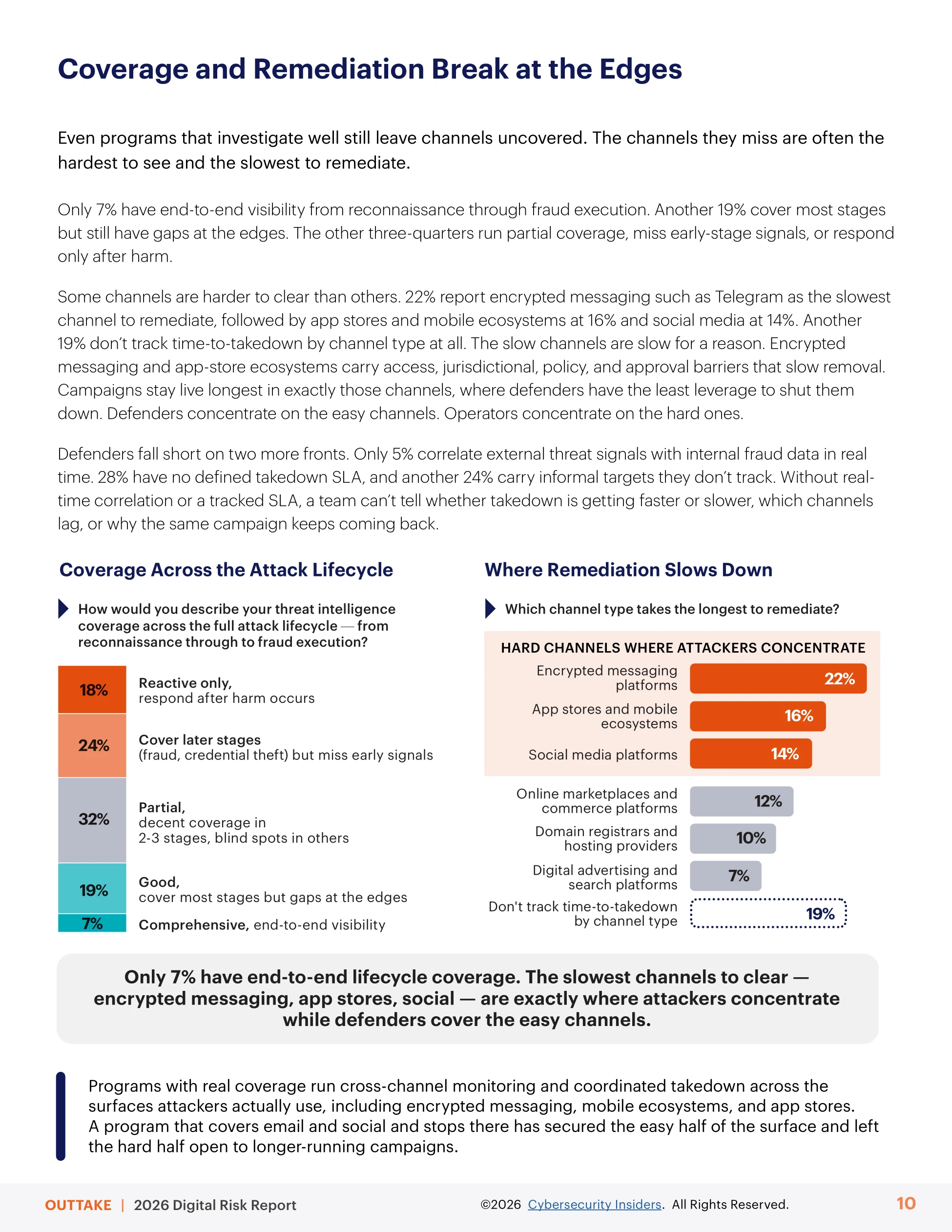
Protecting Digital Trust in the AI Era2026Digital Risk ReportOUTTAKE | 2026 Digital Risk Report2 ©2026 Cybersecurity Insiders. All Rights Reserved.Executive OverviewDigital risk has crossed a threshold. As enterprises hardened endpoint, identity, cloud, network, and email, adversaries shifted to the open internet where business trust is exposed. What once appeared as isolated impersonations and one-off fraud has become a coordinated, industrial-scale operation. The asset under attack is trust: trust in executives and employees, trust in brands, trust in the workflows that move money. Attackers now run campaigns end to end, while most digital risk programs still respond one incident at a time. That gap is visible across this survey of more than 1,100 security and risk leaders.Behind every visible artifact, from a spoofed domain or fake social account to a deepfake video or synthetic persona, sits an operator directing the campaign. These campaigns move through a recognizable kill chain: reconnaissance, infrastructure setup, trust exploitation, target engagement, credential capture, account takeover, impact and fraud, and monetization. Yet most programs still intercept visible artifacts case by case, without following the chain back to the operator behind them.Key findings:• Digital risk is a business risk category, not a security tool problem: 84% of organizations experienced material digital risk incidents in the past year, yet only 7% describe their program as leading. Costs spread across staff hours, customer support, legal response, and executive time, yet 21% have no single owner for digital risk at all. • People are the most exposed and least protected attack surface: Executive or employee impersonation hit 53% of organizations this year. Yet protection remains narrow: 77% limit workforce coverage to executives, a few high-risk roles, or reactive case-by-case response, and 43% run no person-of-interest threat profiling at all. • Detection, investigation, response, and measurement are broken across the kill chain: Only 7% have end-to-end visibility from reconnaissance through fraud. 42% say attacks now move faster than detection, 34% close cases at takedown without pursuing the adversary behind them, and 28% run no takedown SLA to measure response performance. Failures at one stage cascade into the next.Each finding traces back to the same problem: a coordinated, AI-amplified threat operating across channels and surfaces is being met by a fragmented response that no single team owns and no single platform defends against. Investment is rising into that gap, but the architecture hasn’t yet consolidated to close it. At this scale, and at machine speed, response has to be an agentic loop: AI agents running pre-staged detection, investigation, attribution, takedown, verification, and learning at machine speed, with humans setting policy and judg...