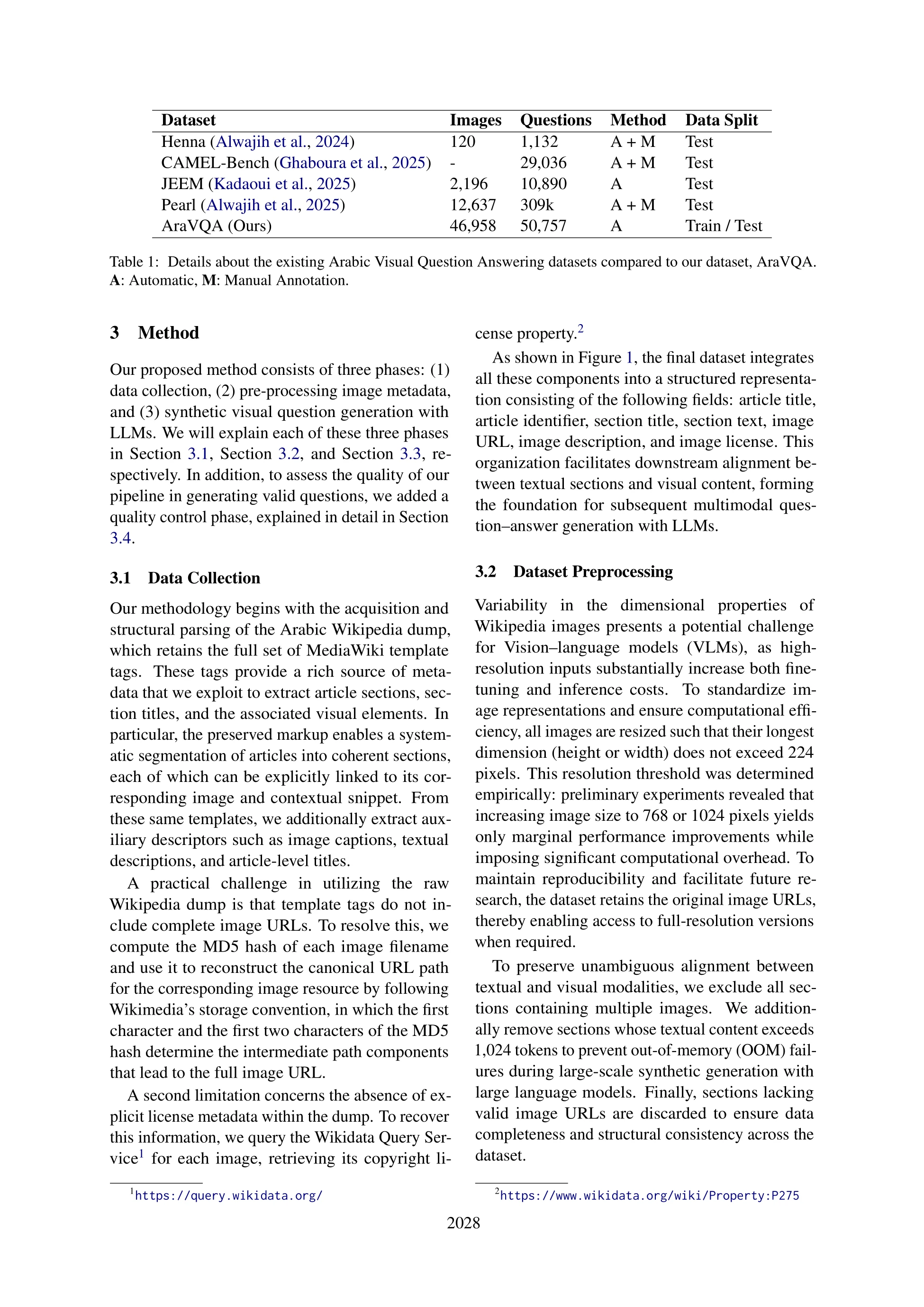
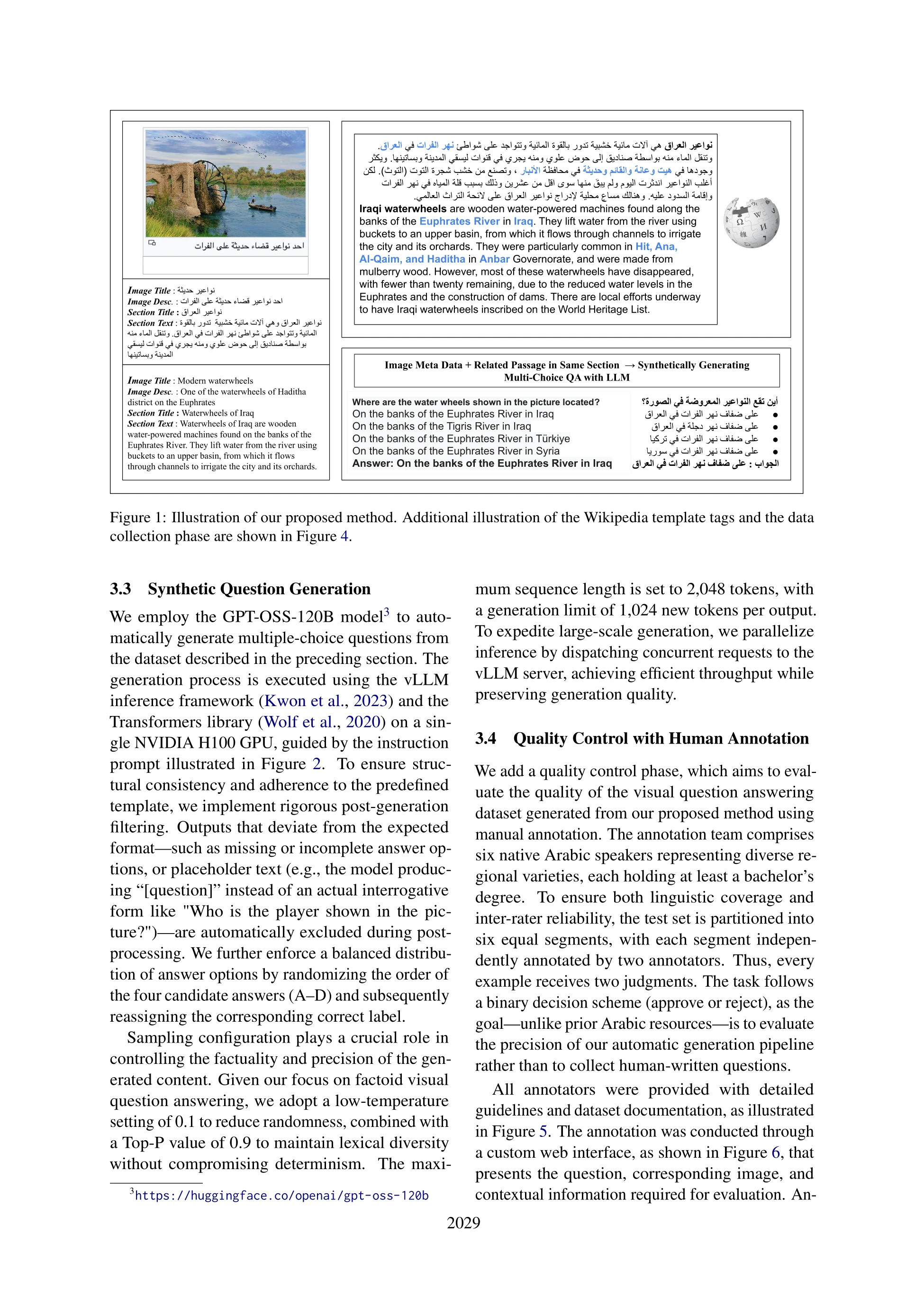
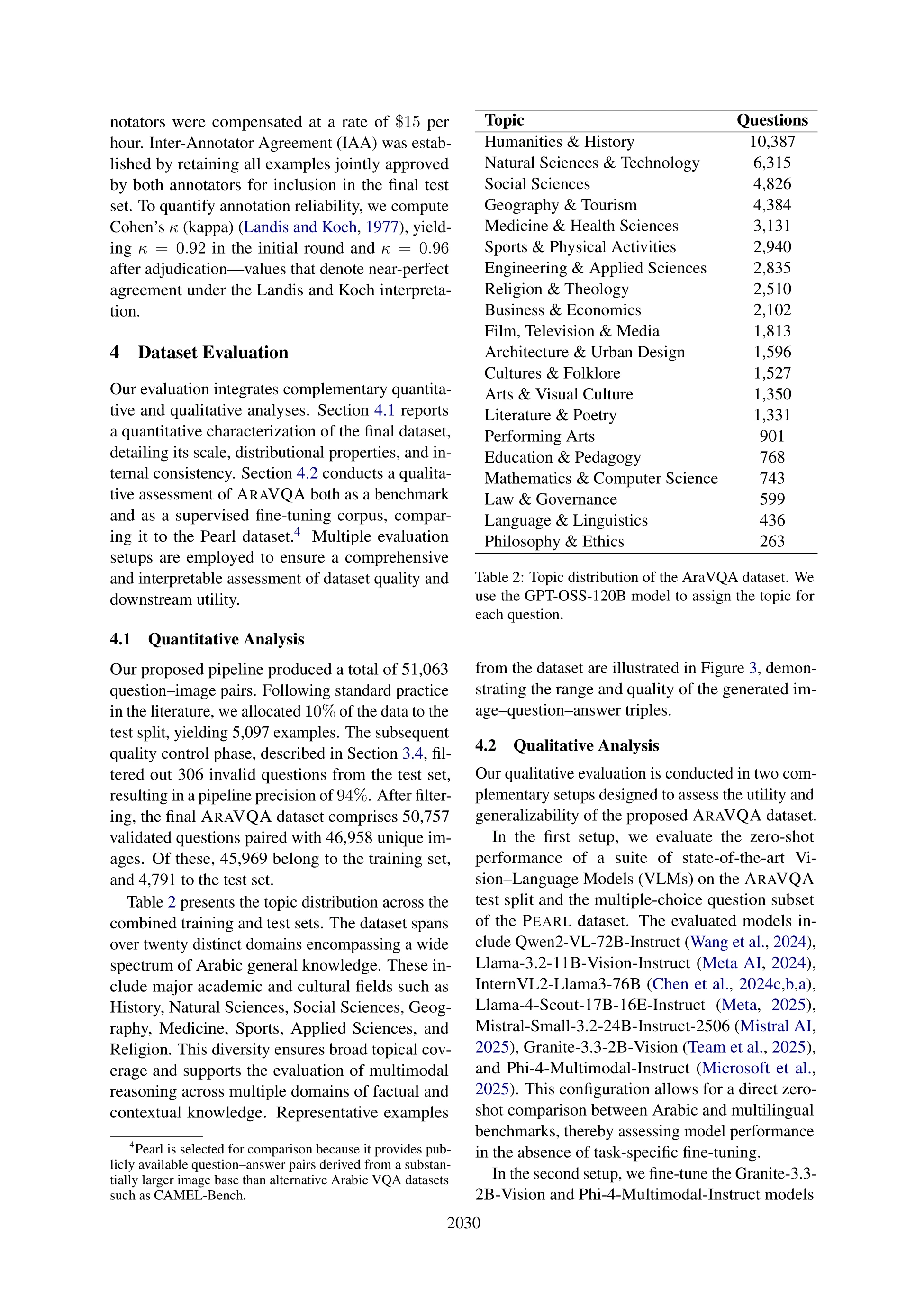
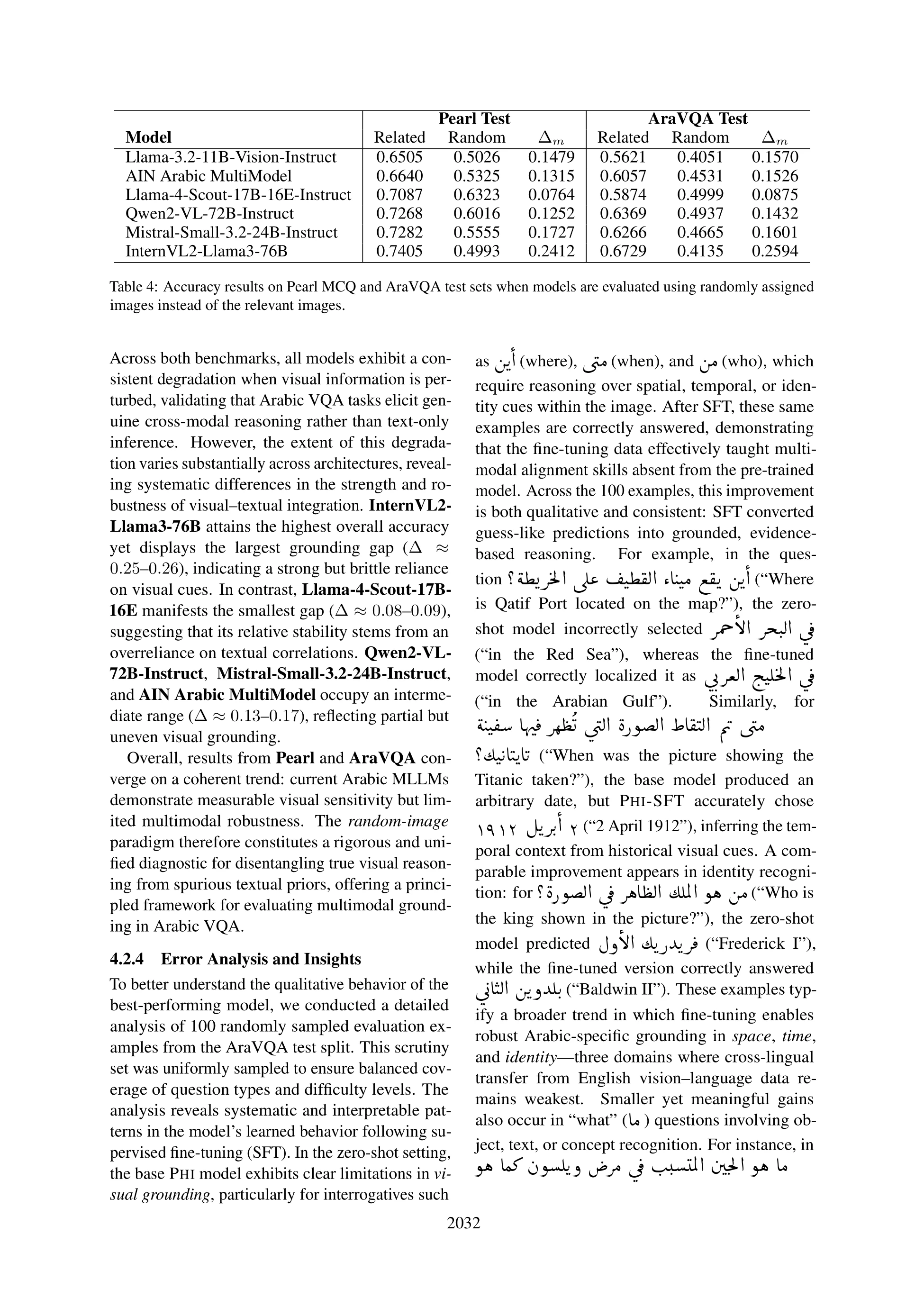
Proceedings of the 64th Annual Meeting of the Association for Computational Linguistics (Volume 1: Long Papers), pages 2026–2042July 2-7, 2026 ©2026 Association for Computational LinguisticsAraVQA: Building a New Arabic Factoid Visual Question AnsweringDataset from WikipediaSultan Alrowili1*, Younes Samih2*, Abed Alhakim Freihat3, Mathan Kumar Eswaran11 IBM Research AI, Riyadh, Saudi Arabia2 IBM Research AI, Abu Dhabi, UAE3 Mohamed bin Zayed University of Artificial Intelligence, Abu Dhabi, UAE{sultan.alrowili,younes.samih}@ibm.comAbstractThe development of large-scale Visual Ques-tion Answering (VQA) datasets has tradition-ally relied on resource-intensive manual anno-tation. In addition, most of the existing ArabicVQA datasets focus on culturally-specific anddialect-aware domains. To address these limita-tions, we propose a new pipeline that leveragesWikipedia template tags to extract the relevantinformation for each image, which is subse-quently utilized by the Large Language Model(LLM) to synthetically generate a new visualquestion answering dataset. Using this pipeline,we have constructed AraVQA, the most com-prehensive Arabic Factoid Visual Question An-swering dataset, containing more than 50,000questions and covering over 20 varied primarysubjects within Arabic general knowledge. Ourdetailed analysis shows that our dataset canserve as a post-training dataset to enhance theperformance of existing Visual Language Mod-els (VLMs) on Arabic VQA tasks. Further-more, we present a novel benchmark, derivedfrom our dataset and validated through manualannotation, that poses more challenges to Ara-bic VLMs than existing Arabic VQA datasets.1IntroductionLarge Language Models (LLMs) designed for Ara-bic have recently achieved substantial progress,with systems such as ALLaM (Bari et al., 2024),Jais (Sengupta et al., 2023), and Command R7BArabic (Alnumay et al., 2025) establishing newstate-of-the-art results on knowledge-intensivebenchmarks, including ArabicMMLU (Koto et al.,2024) and ArabicEXAMS (Hardalov et al., 2020).These advances illustrate the rapid maturation ofArabic Natural Language Processing (NLP) in text-only domains, particularly for tasks requiring fac-tual reasoning and broad domain coverage.Inparallel, Vision–Language Models (VLMs) havetransformed multimodal research in English and*Equal contribution.other high-resource languages. Yet the progressof Arabic VLMs has been markedly slower, leav-ing multimodal reasoning in Arabic comparativelyunderexplored.Existing benchmarks such as Henna (Alwajihet al., 2024), CAMEL-Bench (Ghaboura et al.,2025), Pearl (Alwajih et al., 2025), and JEEM(Kadaoui et al., 2025) have provided valuablebenchmarks for evaluating Arabic VLMs. How-ever, these resources predominantly emphasize cul-turally grounded, dialect-sensitive tasks or are notpublicly accessible (e.g., CAMEL-Bench). Hennaand Pearl focus on culturally salient domains suchas cuisine, attire, and landmarks, while JEEM...







































