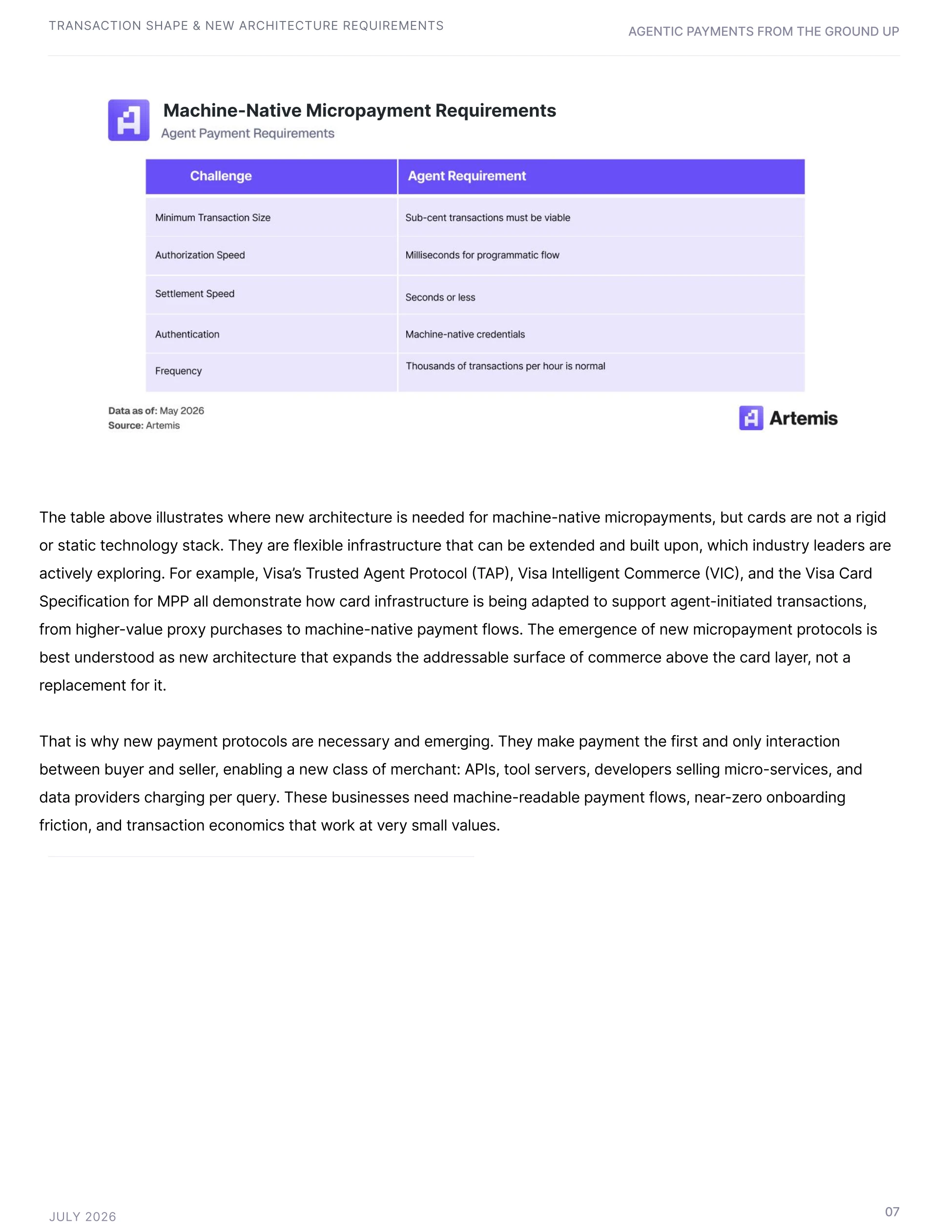
July 2026TRANSACTION SHAPE & NEWARCHITECTURE REQUIREMENTSJULY 2026JULY 20261.1 Defining Agentic CommerceAgentic commerce is a new economic surface where software autonomously discovers, evaluates, and executes transactions – continuously, programmatically, and across a far wider range of commerce than traditional payment infrastructure was designed to handle. The degree of autonomy varies. Some workflows keep a human in the loop to review or approve purchases, while others run fully autonomously once configured. Agents can buy SaaS licenses, book travel, automate accounts payable, reorder physical inventory, and commission creative work, often without human intervention at the moment of purchase. Within that broader landscape, a new sub-category of machine-native, sub-dollar transactions is also emerging: an AI agent calls an API, receives an HTTP 402 response (“Payment Required”), evaluates the price, pays, and consumes the resource. That cycle takes milliseconds and requires no checkout page, saved card, or browsing session – only a wallet or card, a budget, and an objective. For payment providers, the full spectrum of agentic commerce creates new transaction surfaces with different economics, risk controls, and infrastructure requirements from traditional e-commerce.AI crosses the line from chatbot to agent when it begins to reason through multi-step tasks, call external tools, evaluate results, and iterate on its approach autonomously. Agents built on frontier models like Claude, GPT, and Gemini are now deployed in production across every business vertical. Over the past year, these agents have become very capable at writing code and conducting research, but they are inherently limited by access.Giving agents the ability to pay removes that constraint:An IT agent purchases fifty additional seats on a SaaS platform after headcount changes.An administrative agent reorders printer toner and breakroom supplies when inventory runs low.A research agent queries five financial data providers a few cents each for the same company’s filings, then picks the most complete dataset.A marketing agent pays ten image-generation providers 5 cents each to render the same product shot, then selects the best output.Agentic payments span two distinct transaction categories. The first is macro, where an agent executes high-value, consumer-like purchases on behalf of a human (e.g., booking travel, managing subscriptions, ordering supplies). These transactions resemble traditional e-commerce, with the agent acting as a proxy for human intent. The second category is micro, characterized by high-frequency, low-value purchases (i.e., API calls, data queries, compute access, tool usage) initiated by the agent. Both categories are real and growing, but micro-transactions are the area where new payment architecture is most needed, and where new protocols are emerging to fill the gap....