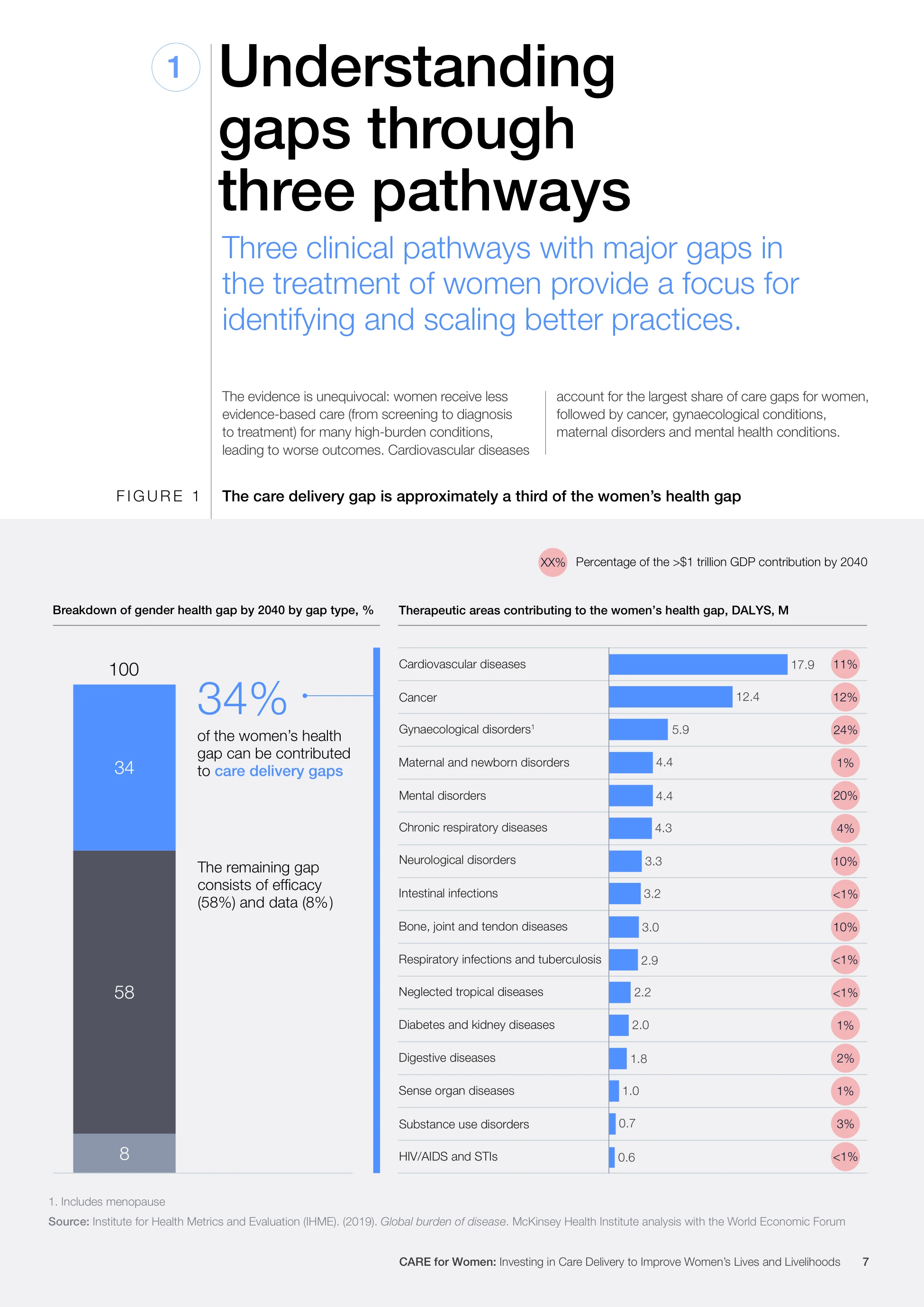
CARE for Women: Investing in Care Delivery to Improve Women’s Lives and LivelihoodsI N S I G H T R E P O R TM A Y 2 0 2 6In collaboration with McKinsey Health InstituteImages: Getty ImagesDisclaimer This document is published by the World Economic Forum as a contribution to a project, insight area or interaction. The findings, interpretations and conclusions expressed herein are a result of a collaborative process facilitated and endorsed by the World Economic Forum but whose results do not necessarily represent the views of the World Economic Forum, nor the entirety of its Members, Partners or other stakeholders.© 2026 World Economic Forum. All rights reserved. No part of this publication may be reproduced or transmitted in any form or by any means, including photocopying and recording, or by any information storage and retrieval system.ContentsForewordExecutive summaryIntroduction1 Understanding gaps through three pathways2 The challenges and chance to act: Key gaps in care pathways3 The economic case for strengthening care pathways3.1 BAC and cardiovascular disease3.2 Pregnancy and cardiovascular disease risk3.3 Perinatal depression4 Solutions4.1 Solutions for healthcare systems and practitioners4.2 Implementing CARE in action5 How the broader ecosystem can act to enable effective care delivery for women5.1 Payers5.2 Governments5.3 Private sector (biopharma, medtech and healthtech)5.4 Patients and patient advocacy groups5.5 Academia and researchConclusionContributorsEndnotes34671518191919212229303031313232343537CARE for Women: Investing in Care Delivery to Improve Women’s Lives and Livelihoods2ForewordOver the years of working to close the women’s health gap, it has become clear that health stakeholders often have knowledge, but face barriers in translating that knowledge into care. Across health systems, too many women still encounter missed screenings, delayed diagnoses and fragmented pathways that fall short of what is already achievable. The consequences are significant: worse outcomes for women, rising medical costs, reduced economic productivity and broader negative effects on women and communities.Improving care delivery is where intention meets impact. Today, it represents one of the most actionable – and addressable – opportunities to improve women’s health. This roadmap, based on work from the World Economic Forum, the McKinsey Health Institute and a consortium of more than 20 experts from different health institutions, shows that nearly one-third of the women’s health gap is driven by inequities in care delivery alone. This offers profound implications not only for health outcomes but for trust in health systems and economic participation. The encouraging news is that many of the solutions already exist. In screening, diagnosis, treatment and follow-up, we see clear evidence that earlier, more coordinated and more patient-centred care can ge...