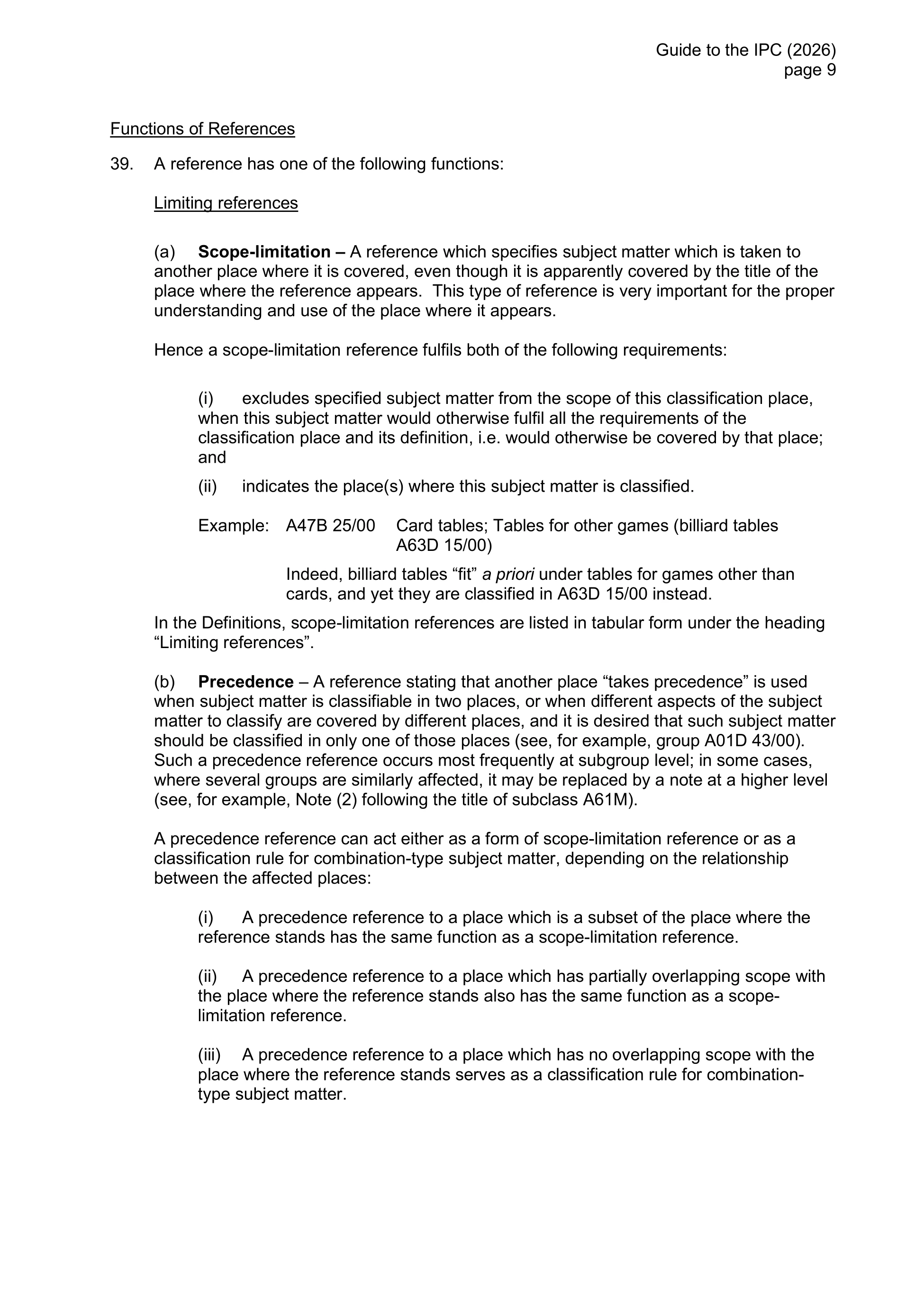
Guide to the International Patent Classification2026 edition GUIDE TO THE INTERNATIONAL PATENT CLASSIFICATION (2026) I. FOREWORD Objectives of the IPC; History of the IPC; Reform of the IPC; Assistance in the use of the Classification 1. The Strasbourg Agreement concerning the International Patent Classification (of 1971), which entered into force on October 7, 1975, provides for a common classification for patents for invention including published patent applications, inventors’ certificates, utility models and utility certificates (hereinafter referred to as “patent documents”). Under Article 1 of the Agreement, the Special (IPC) Union was established. The International Patent Classification is hereinafter referred to as “the Classification” or “the IPC”. 2. The Classification is established in the English and French languages, both texts being equally authentic. Pursuant to Article 3(2) of the Strasbourg Agreement, official texts of the Classification may be established in other languages. 3. The Internet version of the Classification, available on the WIPO IPC website (https://www.wipo.int/en/web/classification-ipc) represents the official publication of the IPC. It contains the complete text of the Classification in English and French of the edition/version in force as well as previous editions/versions. 4. In accordance with Article 4(5) of the Strasbourg Agreement, it has been determined that the abbreviation “Int.Cl.” of the words “International Patent Classification” may precede the classification symbols on published patent documents classified according to the Classification. More details on the presentation of these symbols are given in Section XII, below. 5. [Deleted] OBJECTIVES OF THE IPC 6. The Classification, being a means for obtaining an internationally uniform classification of patent documents, has as its primary purpose the establishment of an effective search tool for the retrieval of patent documents by intellectual property offices and other users, in order to establish the novelty and evaluate the inventive step or non-obviousness (including the assessment of technical advance and useful results or utility) of technical disclosures in patent applications. 7. The Classification, furthermore, has the important purposes of serving as: (a) an instrument for the orderly arrangement of patent documents in order to facilitate access to the technological and legal information contained therein; (b) a basis for selective dissemination of information to all users of patent information; (c) a basis for investigating the state of the art in given fields of technology; (d) a basis for the preparation of industrial property statistics which in turn permit the assessment of technological development in various areas. Guide to the IPC (2026) page 2 HISTORY OF THE IPC 8. The text of the first edition of the Classification was established p...







































