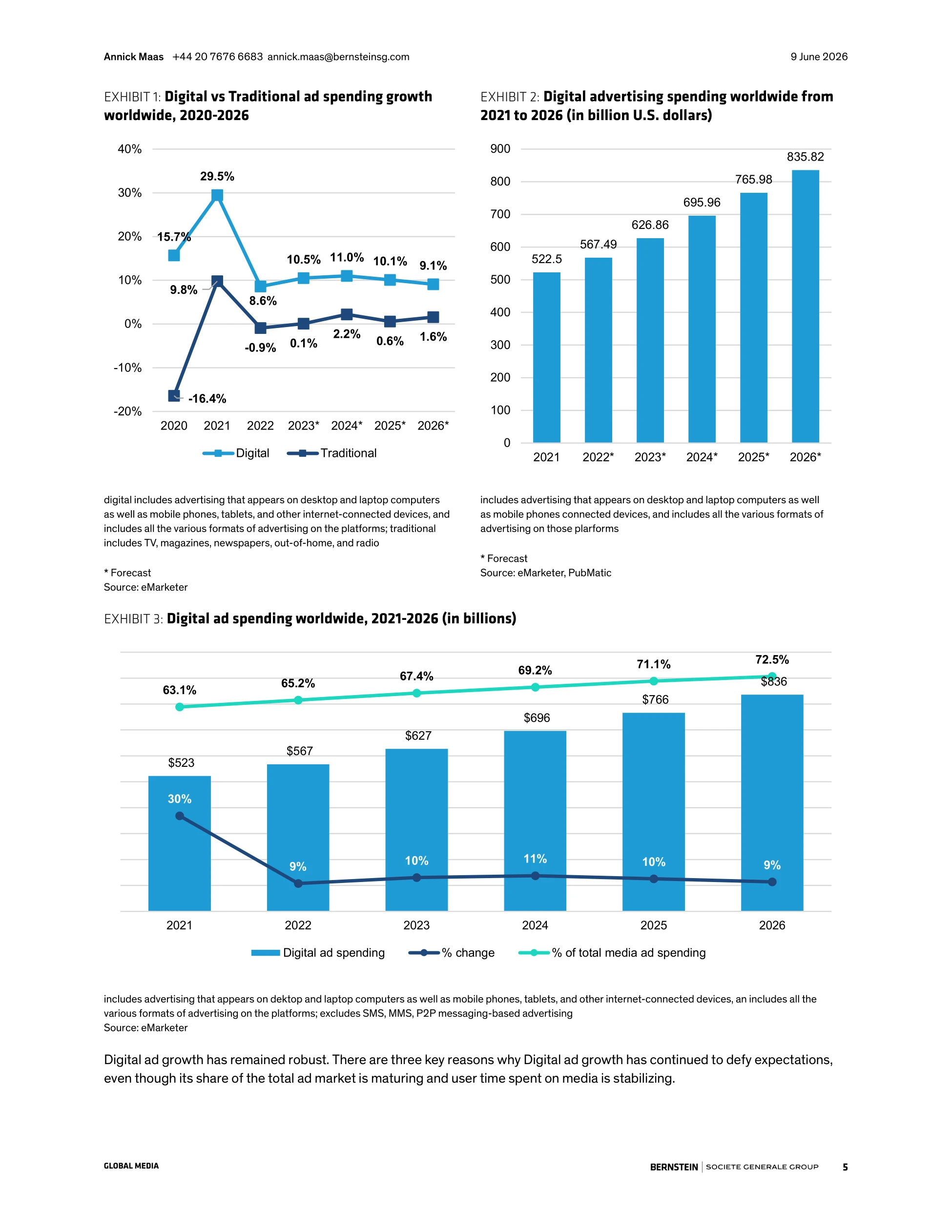
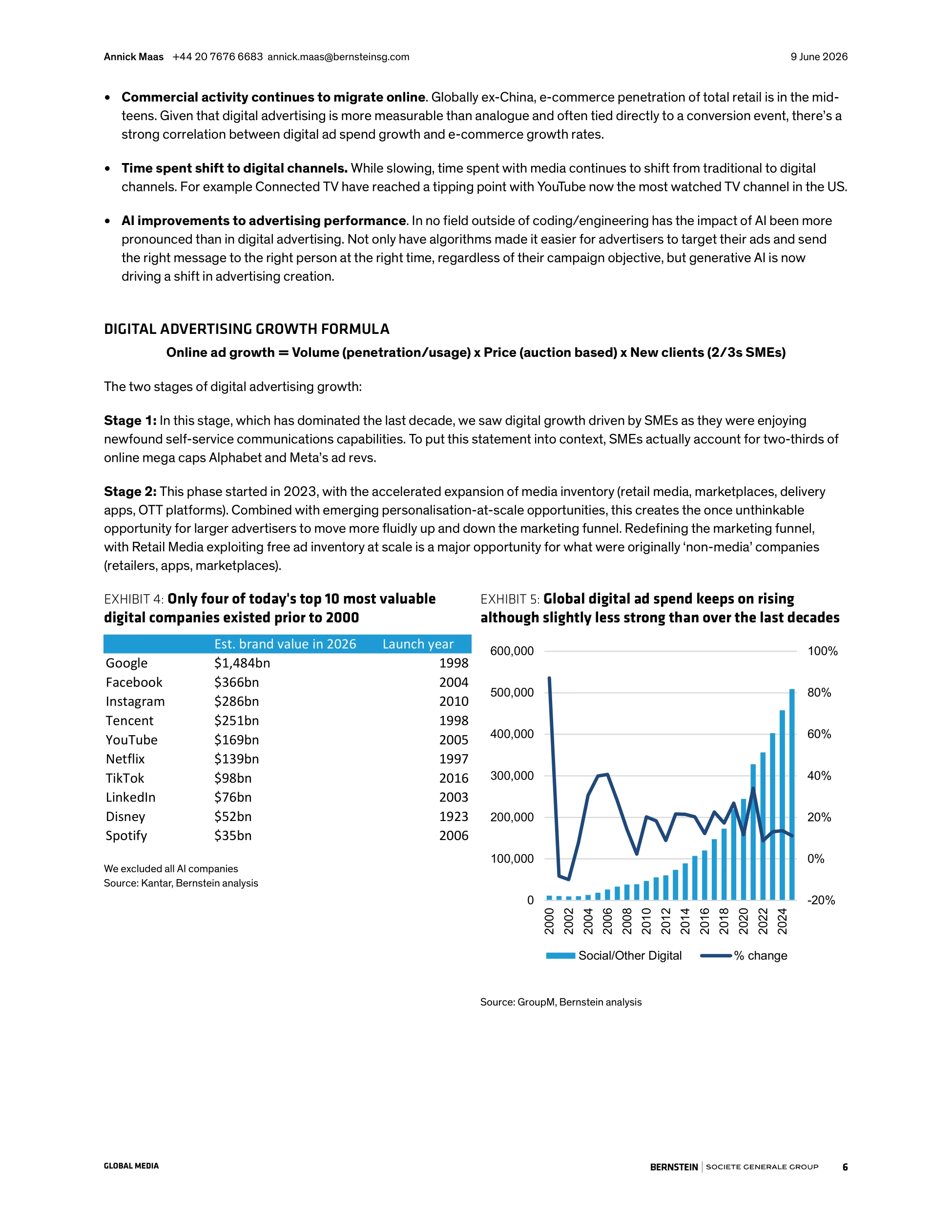
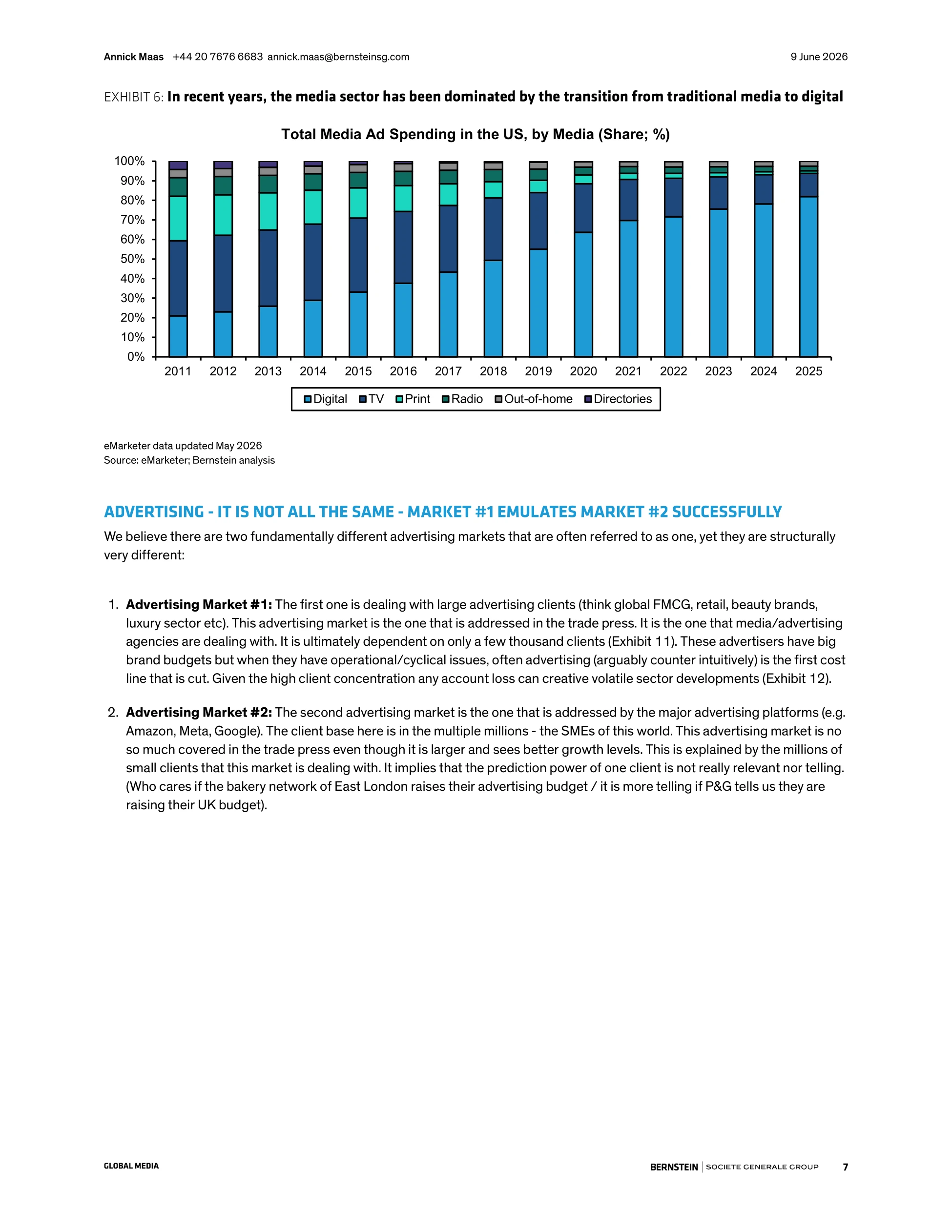
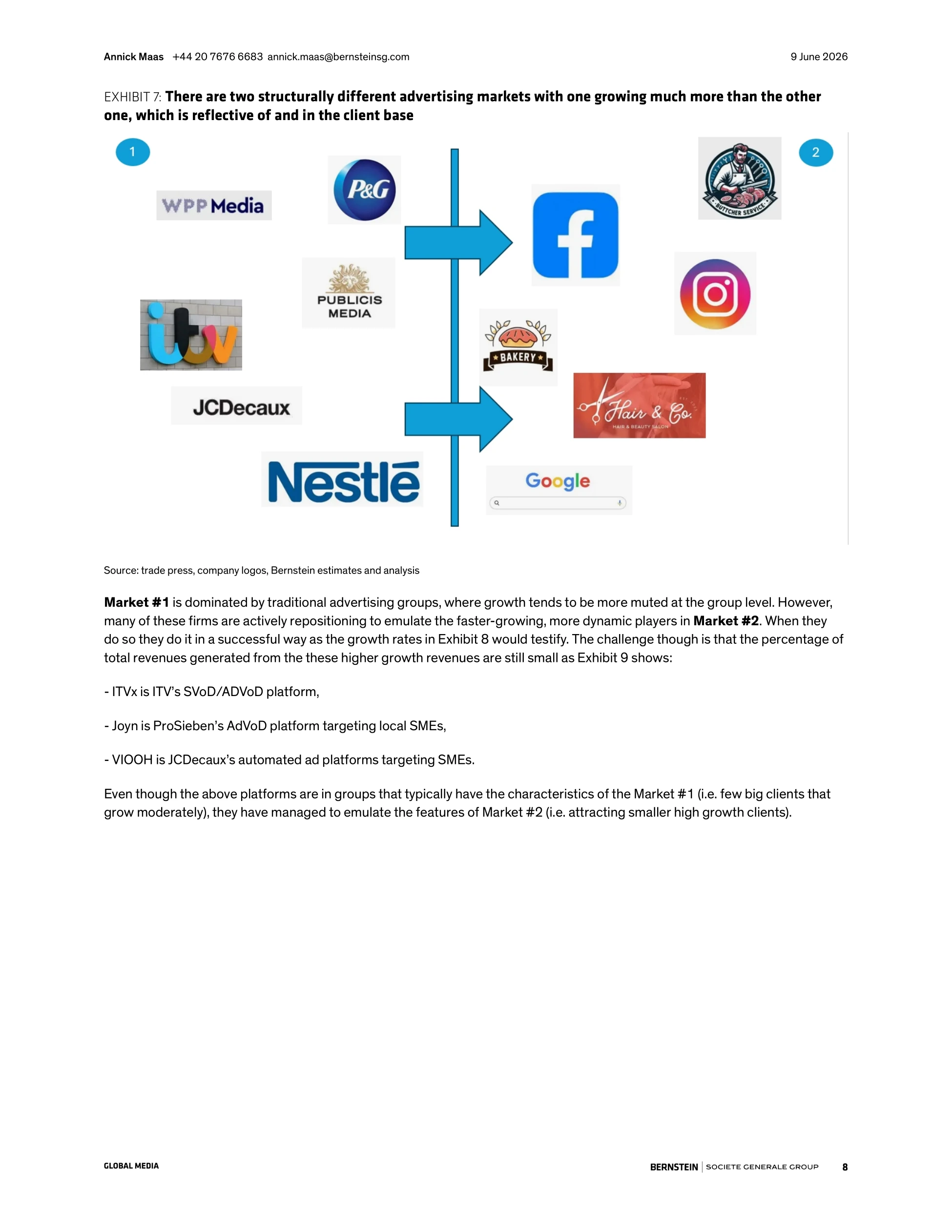
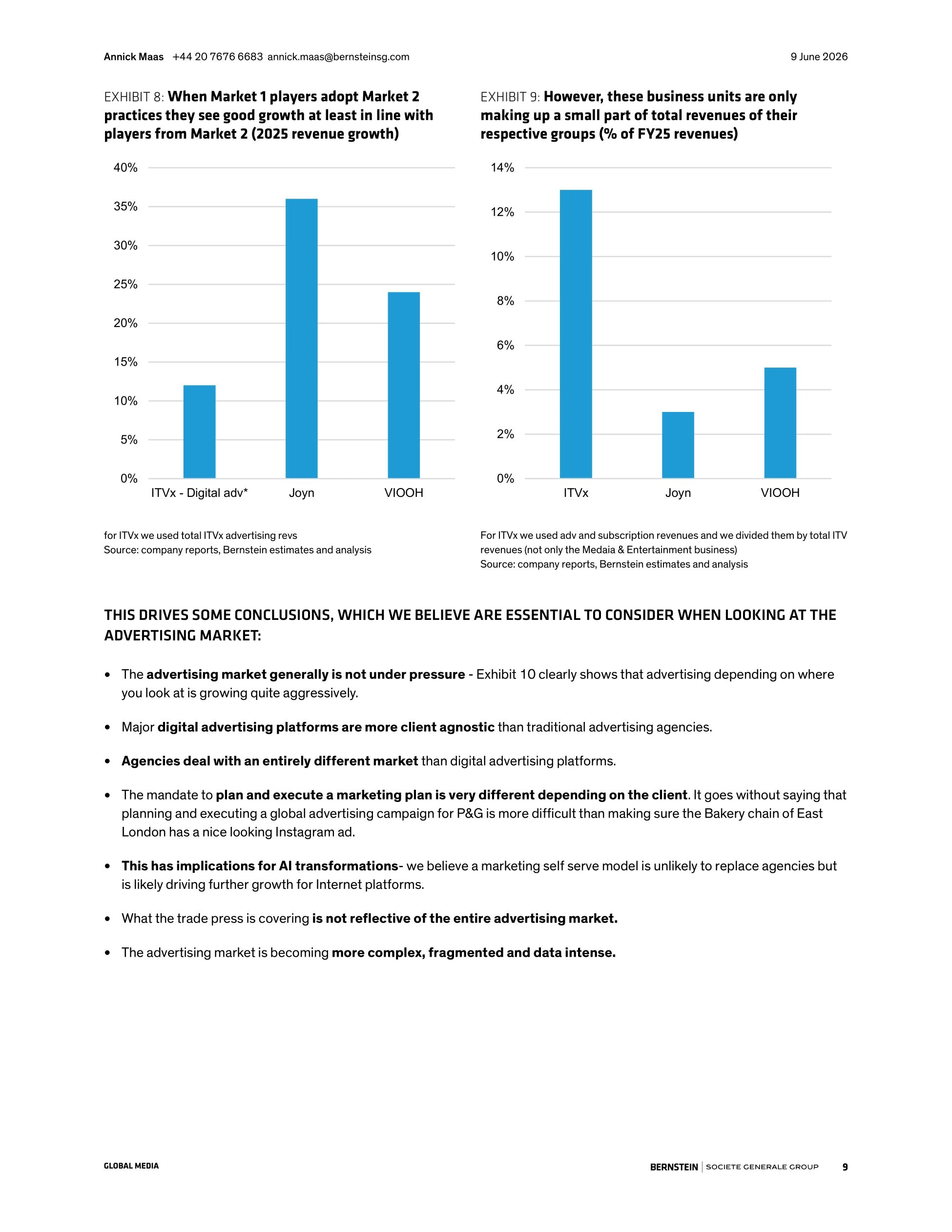
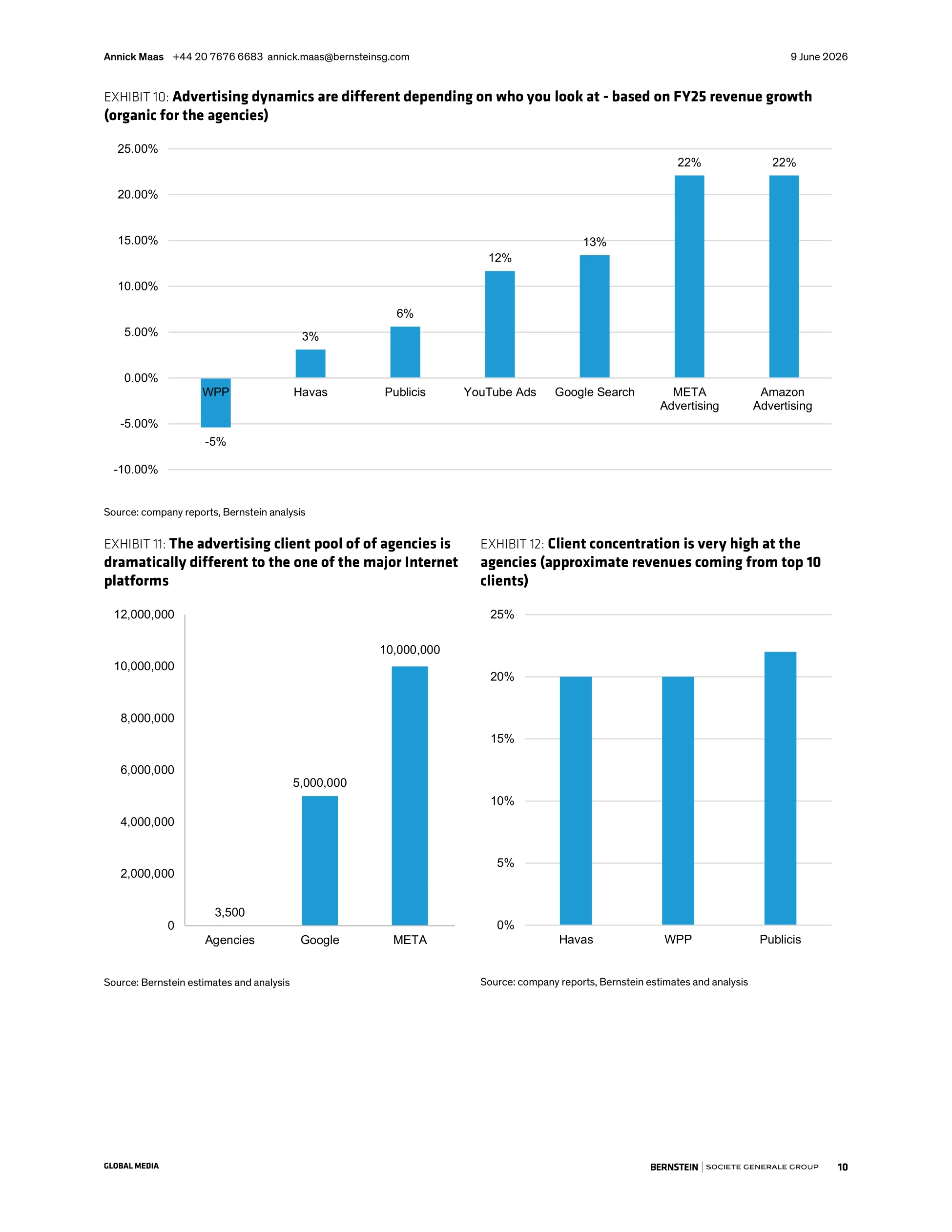
PRIMER9 June 2026Global MediaGlobal Media: A beginner's guide to investing in AdvertisingAnnick Maas+44 20 7676 6683annick.maas@bernsteinsg.comChristophe Cherblanc+41 582 723 540christophe.cherblanc@bernsteinsg.comMark Shmulik+1 917 344 8508mark.shmulik@bernsteinsg.comLaurent Yoon+1 917 344 8502laurent.yoon@bernsteinsg.comNikhil Devnani, CFA+1 917 344 8425nikhil.devnani@bernsteinsg.comAdvertising is totally unnecessary. Unless you hope to make money.” - Jef I. RichardsFollowing on from “A beginner's guide to investing in Media” published last year, we arefocusing this year on the sub-sector Advertising. From traditional media owners, overagencies, ad tech and martech to the big digital platforms, combined this ever evolvingindustry is worth $1trn globally. We look into the various sub-sectors, what KPis to look into,the share price drivers and how the US/European markets compare/contrast.The key structural insight: advertising growth is driven by redistribution, notconsumption expansion. Global media consumption has plateaued at ~11 hoursper day, constraining total inventory growth and implying intensifying competition forattention. Rather than structural volume expansion, value is shifting across formatsand platforms, with digital now accounting for over two-thirds of global ad spend. Thisfragmentation increases execution complexity and raises the premium on scale, targeting,and measurement—favouring large digital platforms with superior data ecosystemsTwo distinct advertising markets underpin diverging growth and risk profiles.Market #1 (agencies, traditional media) is concentrated, cyclical, and dependent on a fewthousand large clients; spend is volatile and often the first cost to be cut in downturns.Market #2 (digital platforms) is driven by millions of SMEs, structurally more resilient, andless predictable from top-down indicators. Our data shows SME-driven revenues accountfor roughly two-thirds of major platform ad revenues, highlighting a fundamentally differentgrowth engine. This distinction is often underappreciated by the market and explainspersistent outperformance of platform-led models.Digital advertising growth remains intact, but is evolving into a second phase.The first phase was driven by SME onboarding and self-serve tools; the second phase(since ~2023) is driven by inventory expansion (retail media, marketplaces, OTT) andpersonalisation at scale. Retail media in particular represents structurally high-margin,near-zero-cost inventory with strong targeting advantages, benefiting platforms likeAmazon and delivery ecosystems. AI acts as an accelerant—enhancing targeting, creativegeneration, and conversion—while reinforcing the competitive moat of scaled platformsTraditional players are adapting—but the mix shift remains insufficient.Broadcasters, OOH, and agencies are successfully replicating digital characteristics (e.g.,ITVx, VIOOH), achieving higher growth in these segments. However, these b...







































