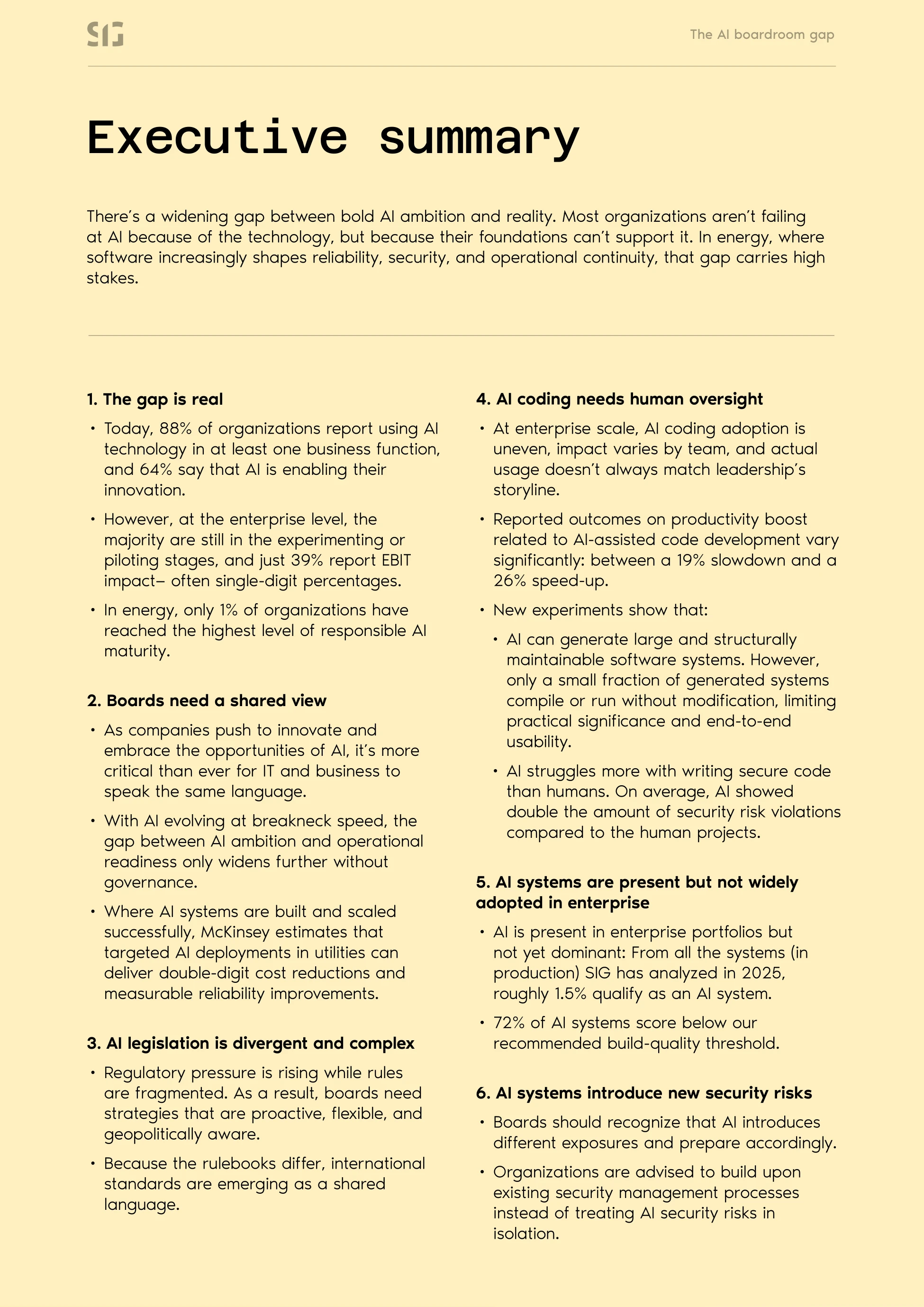

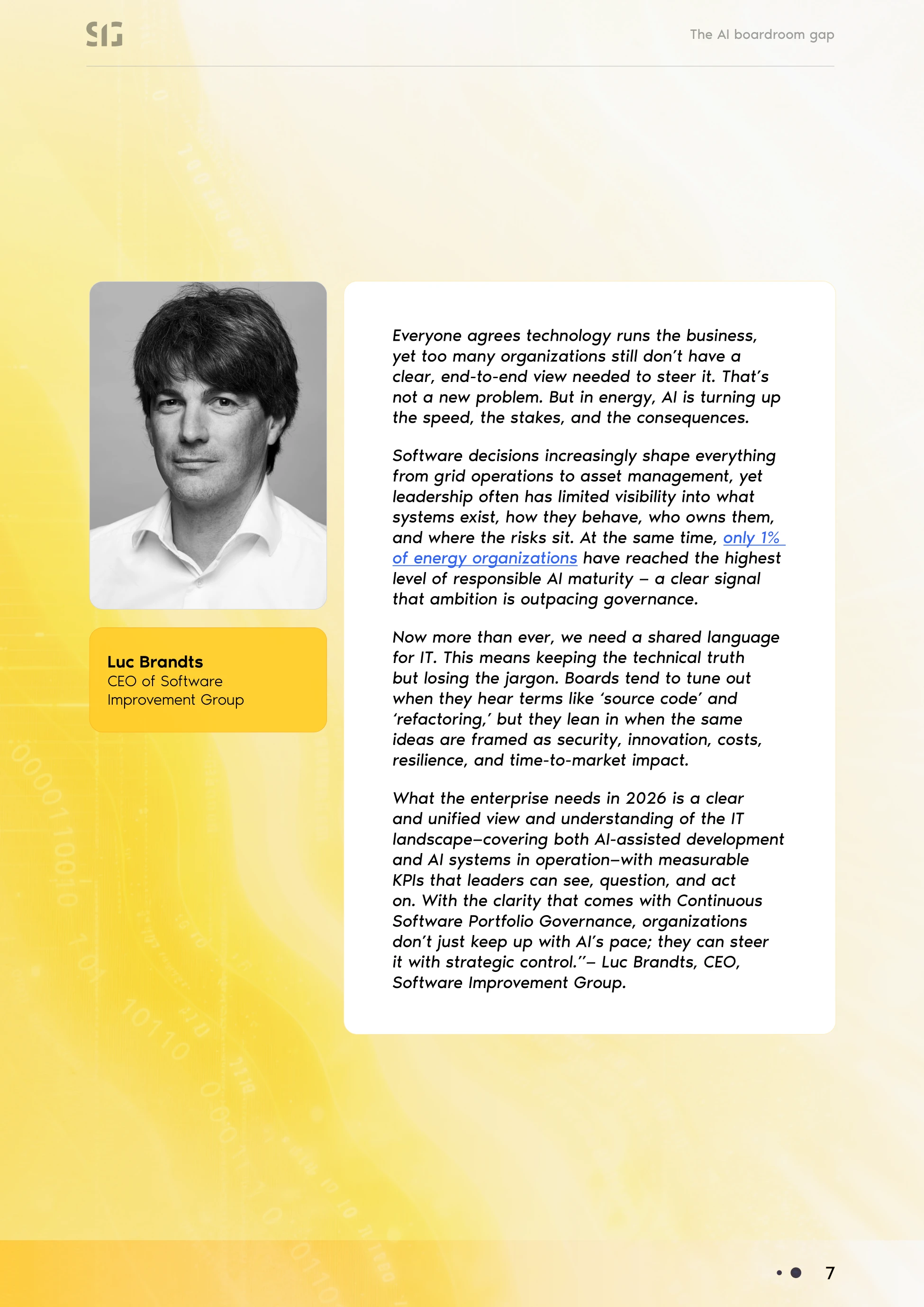
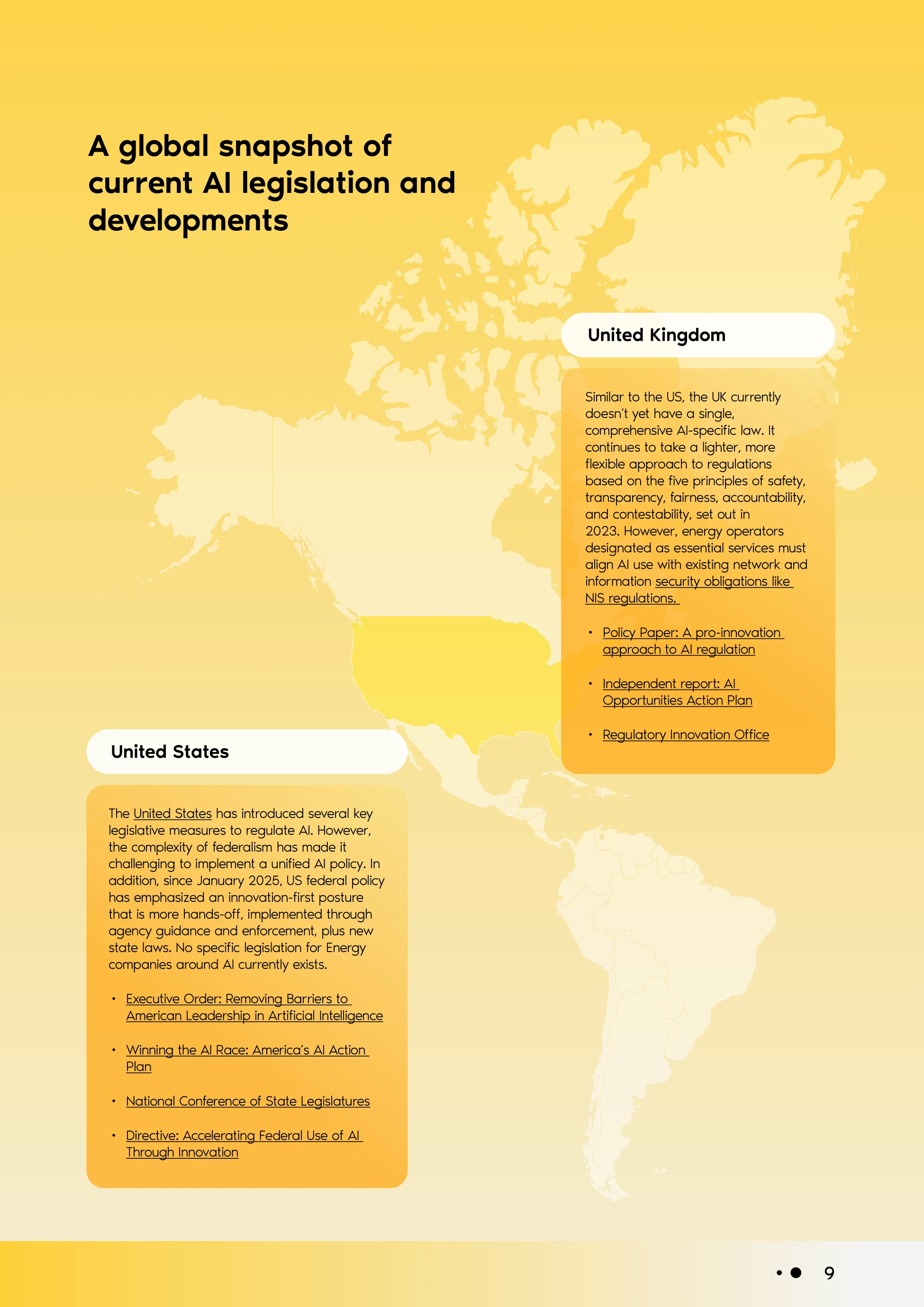
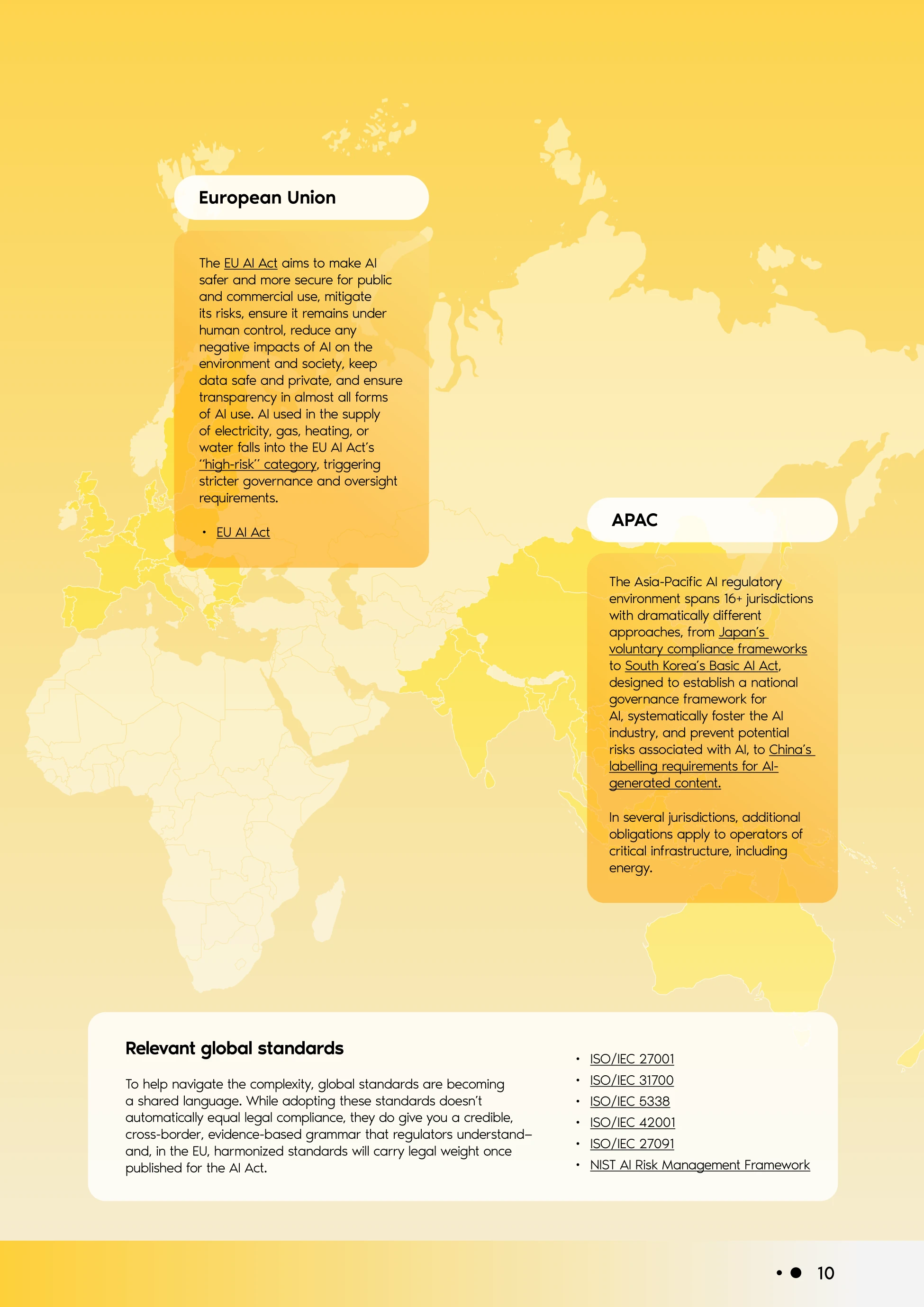
来源:发现报告(www.fxbaogao.com/view?id=5795983)| 引用请注明出处来源:发现报告(www.fxbaogao.com/view?id=5795983)| 引用请注明出处Table of contents3Executive summary4Foreword: The AI boardroom gap5Chapter 1: The need for AI Governance7Chapter 2: Compliance snapshot11Chapter 3: AI assisted software development16Chapter 4: AI system engineering20Chapter 5: AI systems and security risks24Written by Software Improvement Group来源:发现报告(www.fxbaogao.com/view?id=5795983)| 引用请注明出处3The AI boardroom gapThe AI boardroom gapThe AI boardroom gapExecutive summary1. The gap is real• Today, 88% of organizations report using AI technology in at least one business function, and 64% say that AI is enabling their innovation. • However, at the enterprise level, the majority are still in the experimenting or piloting stages, and just 39% report EBIT impact— often single-digit percentages. • In energy, only 1% of organizations have reached the highest level of responsible AI maturity. 2. Boards need a shared view• As companies push to innovate and embrace the opportunities of AI, it’s more critical than ever for IT and business to speak the same language. • With AI evolving at breakneck speed, the gap between AI ambition and operational readiness only widens further without governance. • Where AI systems are built and scaled successfully, McKinsey estimates that targeted AI deployments in utilities can deliver double-digit cost reductions and measurable reliability improvements. 3. AI legislation is divergent and complex• Regulatory pressure is rising while rules are fragmented. As a result, boards need strategies that are proactive, flexible, and geopolitically aware. • Because the rulebooks differ, international standards are emerging as a shared language. There’s a widening gap between bold AI ambition and reality. Most organizations aren’t failing at AI because of the technology, but because their foundations can’t support it. In energy, where software increasingly shapes reliability, security, and operational continuity, that gap carries high stakes. 4. AI coding needs human oversight• At enterprise scale, AI coding adoption is uneven, impact varies by team, and actual usage doesn’t always match leadership’s storyline.• Reported outcomes on productivity boost related to AI-assisted code development vary significantly: between a 19% slowdown and a 26% speed-up.• New experiments show that: • AI can generate large and structurally maintainable software systems. However, only a small fraction of generated systems compile or run without modification, limiting practical significance and end-to-end usability.• AI struggles more with writing secure code than humans. On average, AI showed double the amount of security risk violations compared to the human projects. 5. AI systems are present but not widely adopted in enterprise• AI is present in enterprise portfolios bu...







































