
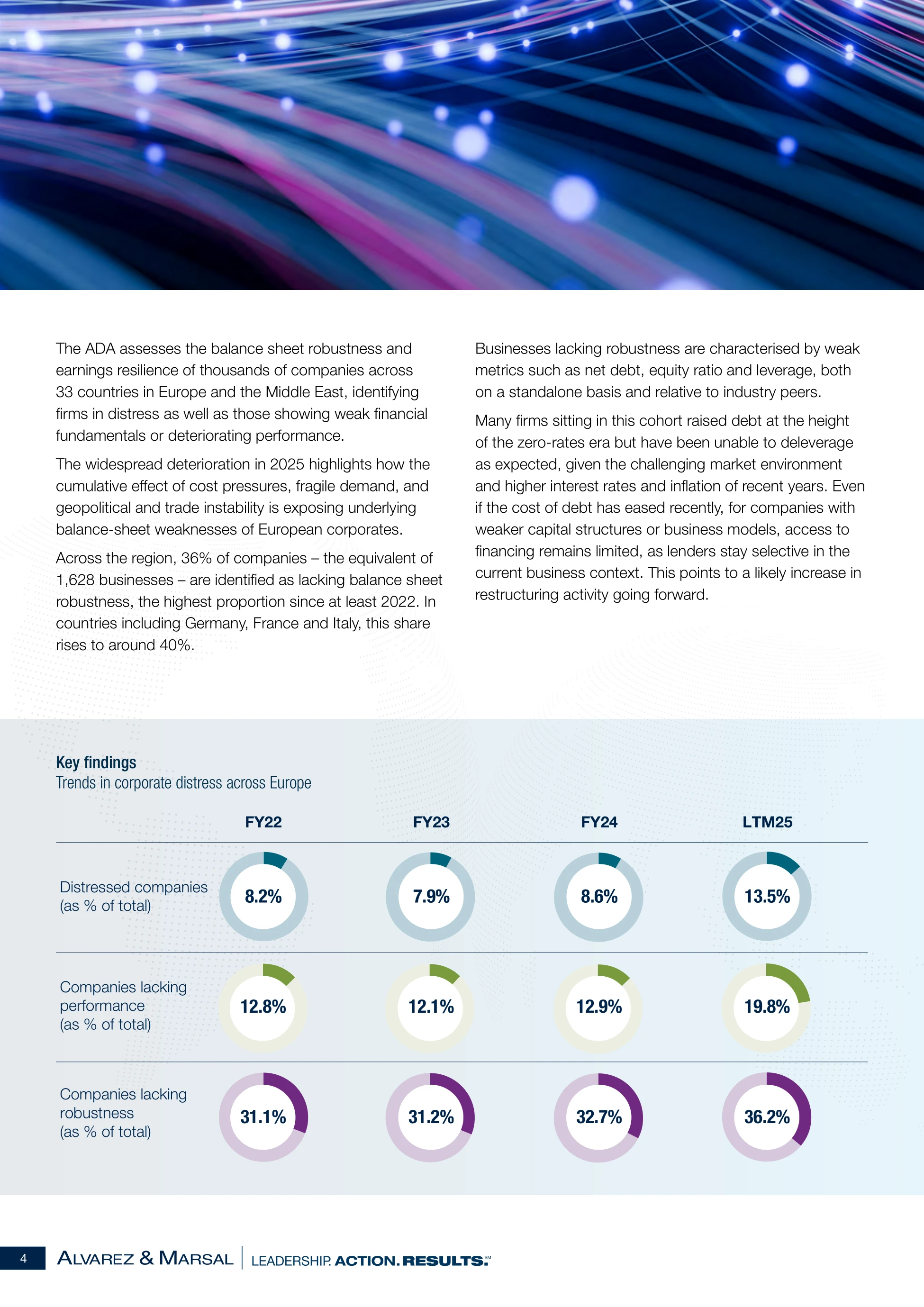
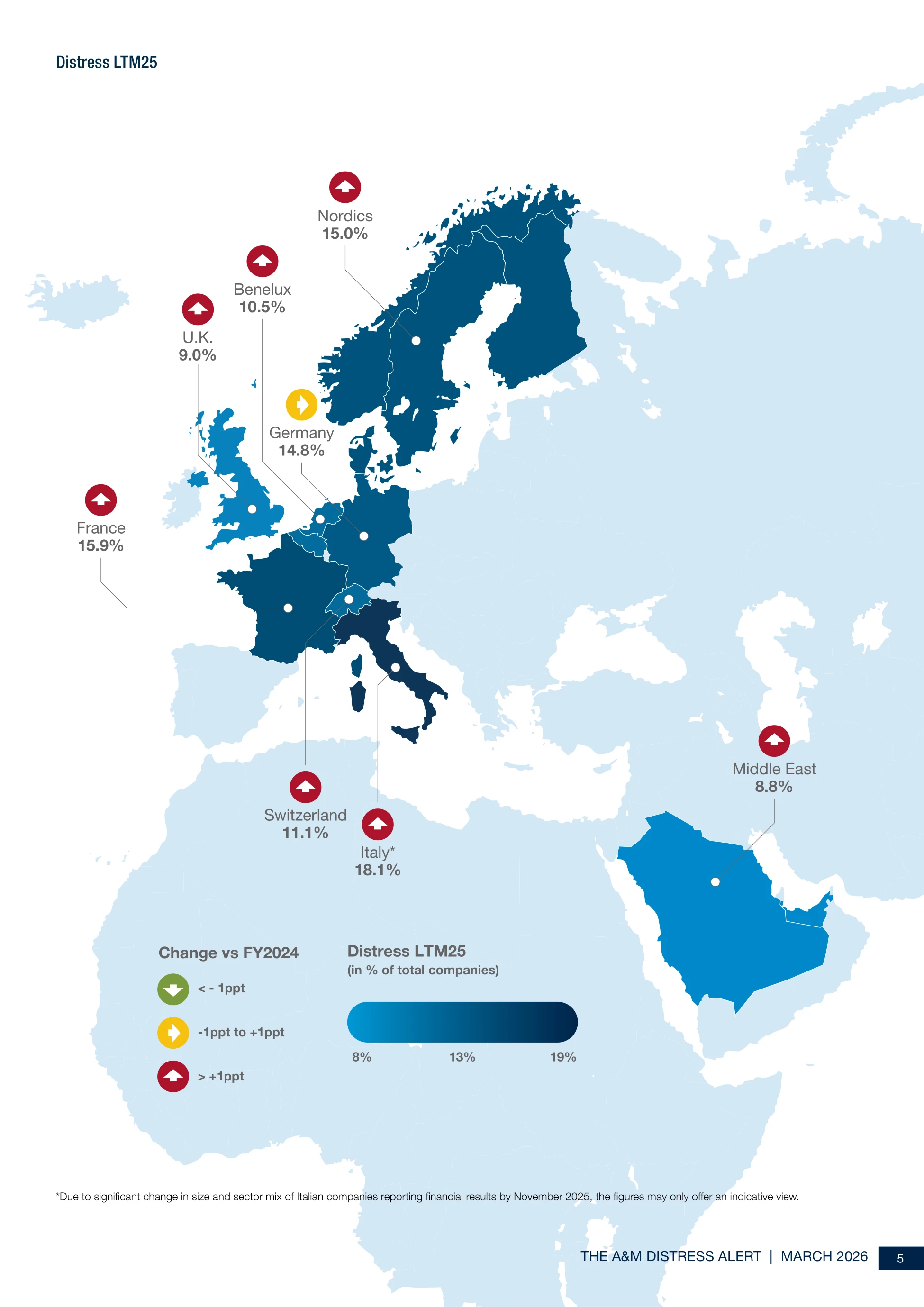
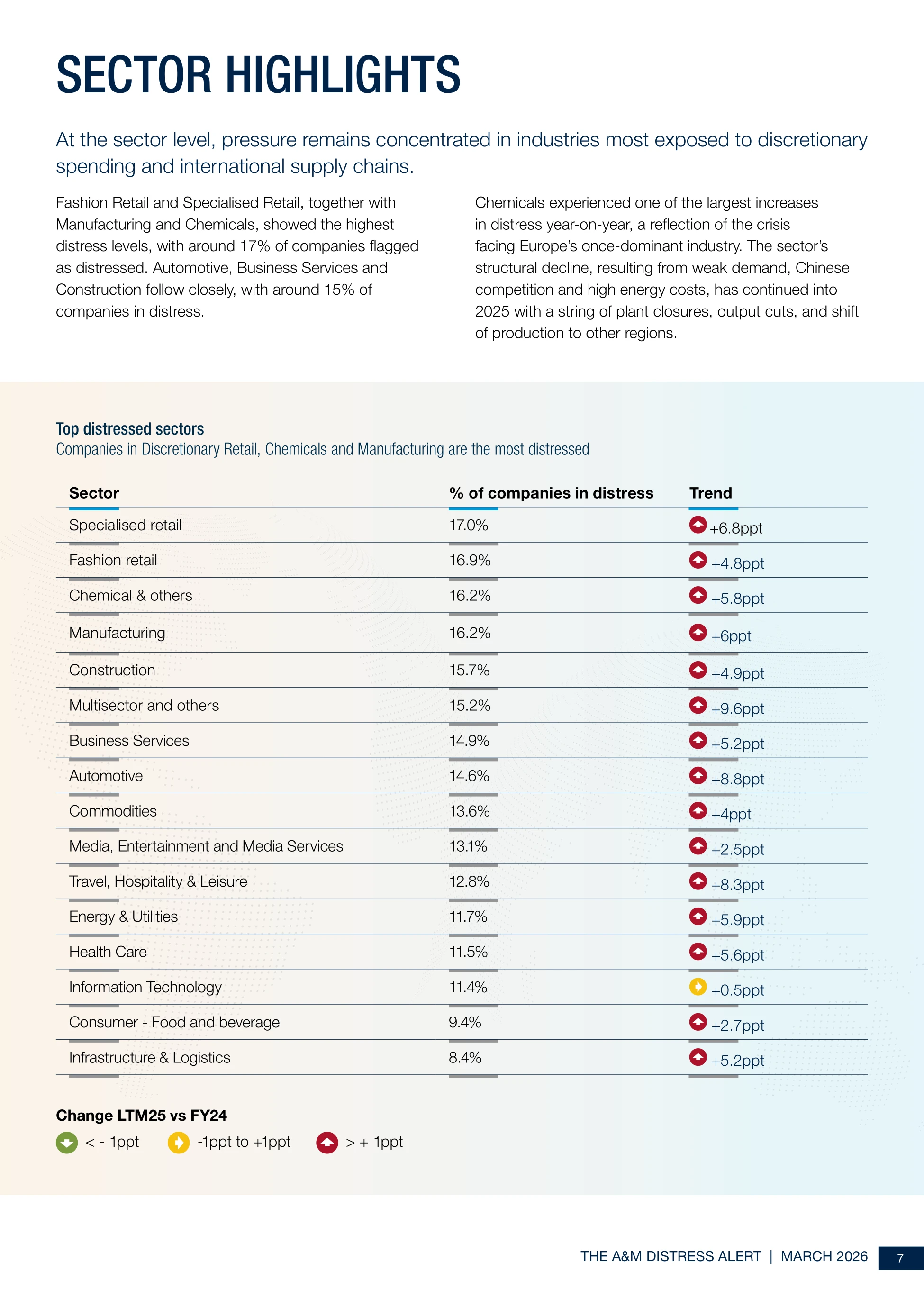
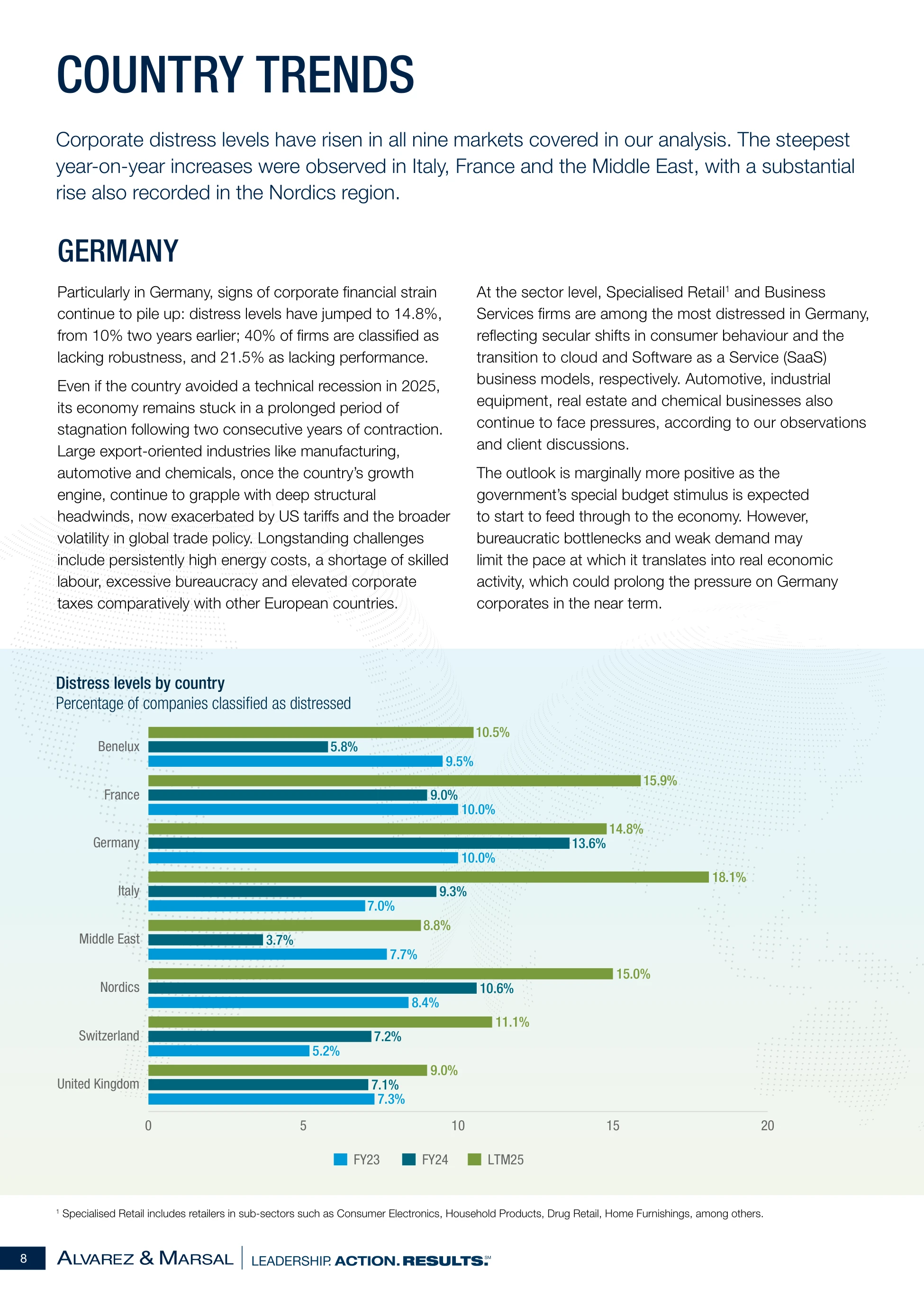
THE A&M DISTRESS ALERT March 2026CONTENTSINTRODUCTION 3KEY FINDINGS 6SECTOR HIGHLIGHTS 7COUNTRY TRENDS 8METHODOLOGY 12HOW A&M CAN HELP 12CONTACTS 132CORPORATE DISTRESS SPREADS ACROSS EUROPE AS BUSINESSES STRUGGLE WITH FRAGILE DEMAND AND TRADE INSTABILITYINTRODUCTIONFinancial distress is accelerating and becoming more entrenched across European businesses as mounting macroeconomic and geopolitical pressures eroded both earnings and balance sheet resilience in 2025.According to the latest Alvarez & Marsal (A&M) Distress Alert (ADA), 13.5% of companies in Europe are now classified as distressed, the highest level since at least 2022 and up from 8.6% in 2024. All nine regions covered in the analysis recorded an increase in the proportion of distressed companies in 2025. Among major economies, the weakest spots were Italy (18% of businesses identified as distressed), followed by France (16%), Nordics and Germany (both with around 15%). In the UK, corporate distress has continued to rise, with 9% of companies classified as distressed, up from 7% in 2024. How we define distressAccording to the ADA methodology, companies classified as likely to be in distress have significant deficits in terms of both their financial and earnings situation. They have insufficient liquidity and/or inadequate and unsustainable capital structures and, at the same time, weak/insufficient profitability, both on a stand-alone basis as well as compared to their industry peers. Read more about the methodology on page 12. France and Germany among the top distressed markets; UK distress levels continue to rise A record 36% of European businesses lack balance sheet robustness Discretionary Retail, Manufacturing, Chemicals, Automotive are some of the most distressed sectorsTHE A&M DISTRESS ALERT | MARCH 20263The ADA assesses the balance sheet robustness and earnings resilience of thousands of companies across 33 countries in Europe and the Middle East, identifying firms in distress as well as those showing weak financial fundamentals or deteriorating performance. The widespread deterioration in 2025 highlights how the cumulative effect of cost pressures, fragile demand, and geopolitical and trade instability is exposing underlying balance-sheet weaknesses of European corporates.Across the region, 36% of companies – the equivalent of 1,628 businesses – are identified as lacking balance sheet robustness, the highest proportion since at least 2022. In countries including Germany, France and Italy, this share rises to around 40%. Businesses lacking robustness are characterised by weak metrics such as net debt, equity ratio and leverage, both on a standalone basis and relative to industry peers. Many firms sitting in this cohort raised debt at the height of the zero-rates era but have been unable to deleverage as expected, given the challenging market environment and higher interest rates...







































