
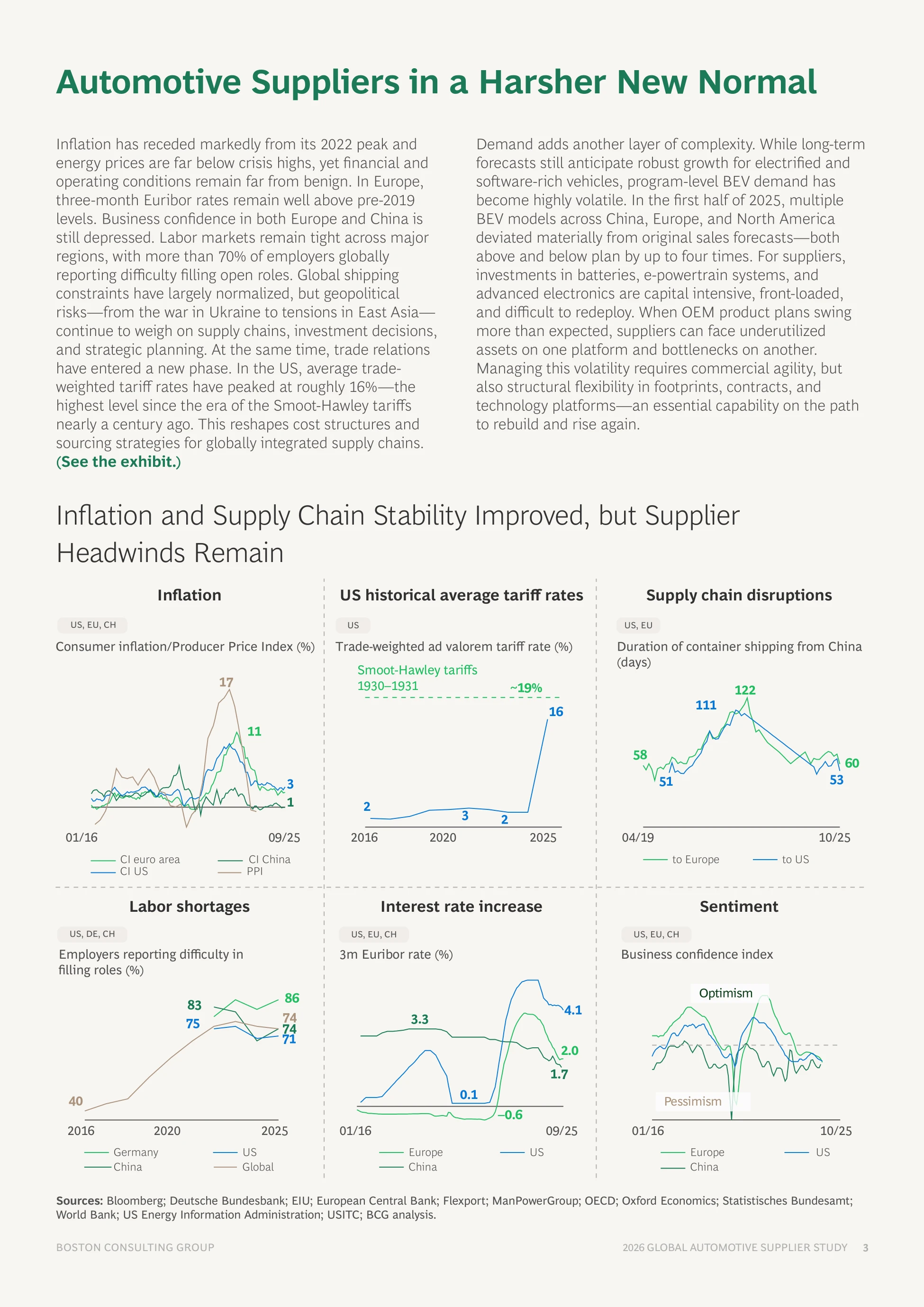
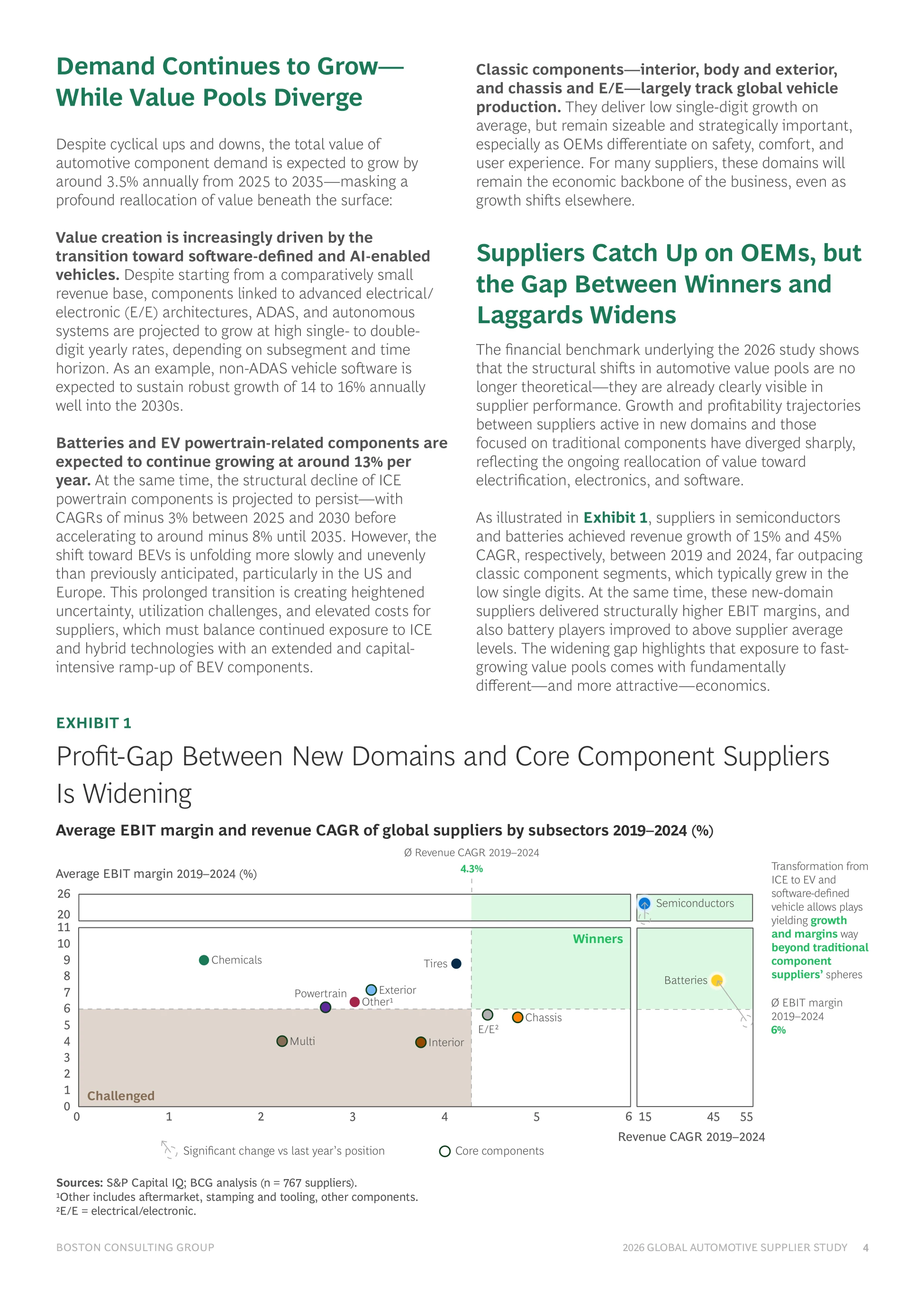
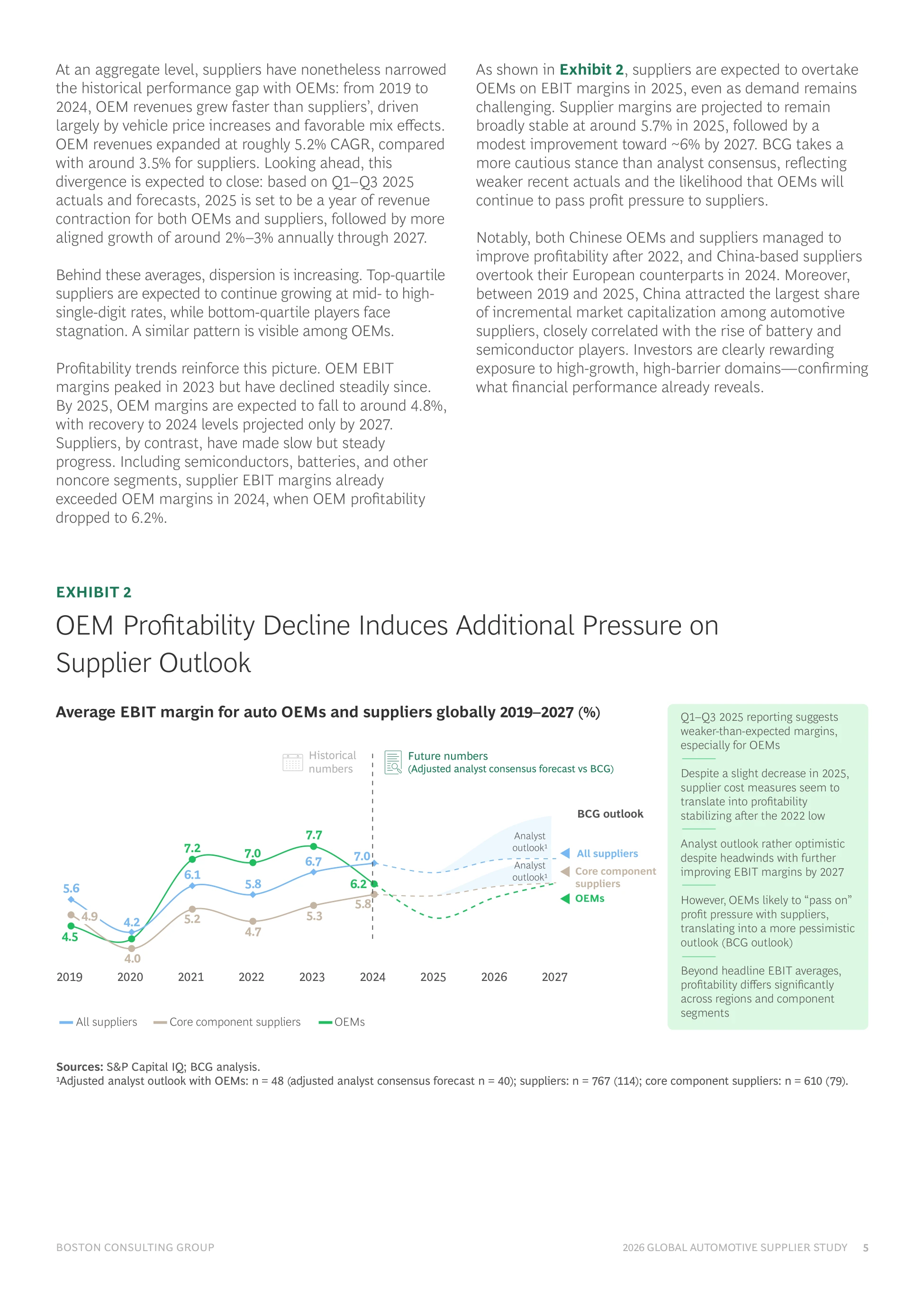

2026 Global Automotive Supplier StudyHow Auto Suppliers Can Rebuild and Rise AgainMarch 2026 By Rolf Kilian, Albert Waas, Alexander Brenner, Christopher Dehnel, Benedikt Fäßler, Aakash Arora, and Alex XieBOSTON CONSULTING GROUP2026 GLOBAL AUTOMOTIVE SUPPLIER STUDY 2The automotive supplier industry has exited the acute crisis years, but it has not returned to normal. Instead, suppliers now find themselves in a structurally tougher environment in which higher interest rates, sticky input costs, labor shortages, and geopolitical tensions have become part of the baseline rather than temporary shocks.At the same time, the shift toward electrified, software-defined, and increasingly automated vehicles continues to reshape value pools and competitive dynamics. (See “Automotive Suppliers in a Harsher New Normal.”)BCG’s 2026 Global Automotive Supplier Study takes a close look at how suppliers are navigating this landscape. It combines an in-depth financial analysis of more than 750 suppliers and almost 50 OEMs worldwide, a global sentiment survey of 127 C-suite executives, and a radar that analyzed 450 strategic moves plus earnings calls of 164 suppliers.We identify a recurring pattern among those suppliers that are moving beyond short-term survival and using today’s pressure as a catalyst to rebuild. Finally, we offer five strategic imperatives that can help suppliers prepare for what lies ahead.IntroductionBOSTON CONSULTING GROUP2026 GLOBAL AUTOMOTIVE SUPPLIER STUDY 3Automotive Suppliers in a Harsher New NormalInflation has receded markedly from its 2022 peak and energy prices are far below crisis highs, yet financial and operating conditions remain far from benign. In Europe, three-month Euribor rates remain well above pre-2019 levels. Business confidence in both Europe and China is still depressed. Labor markets remain tight across major regions, with more than 70% of employers globally reporting difficulty filling open roles. Global shipping constraints have largely normalized, but geopolitical risks—from the war in Ukraine to tensions in East Asia—continue to weigh on supply chains, investment decisions, and strategic planning. At the same time, trade relations have entered a new phase. In the US, average trade-weighted tariff rates have peaked at roughly 16%—the highest level since the era of the Smoot-Hawley tariffs nearly a century ago. This reshapes cost structures and sourcing strategies for globally integrated supply chains. (See the exhibit.)Demand adds another layer of complexity. While long-term forecasts still anticipate robust growth for electrified and software-rich vehicles, program-level BEV demand has become highly volatile. In the first half of 2025, multiple BEV models across China, Europe, and North America deviated materially from original sales forecasts—both above and below plan by up to four times. For suppliers, investments in batt...







































