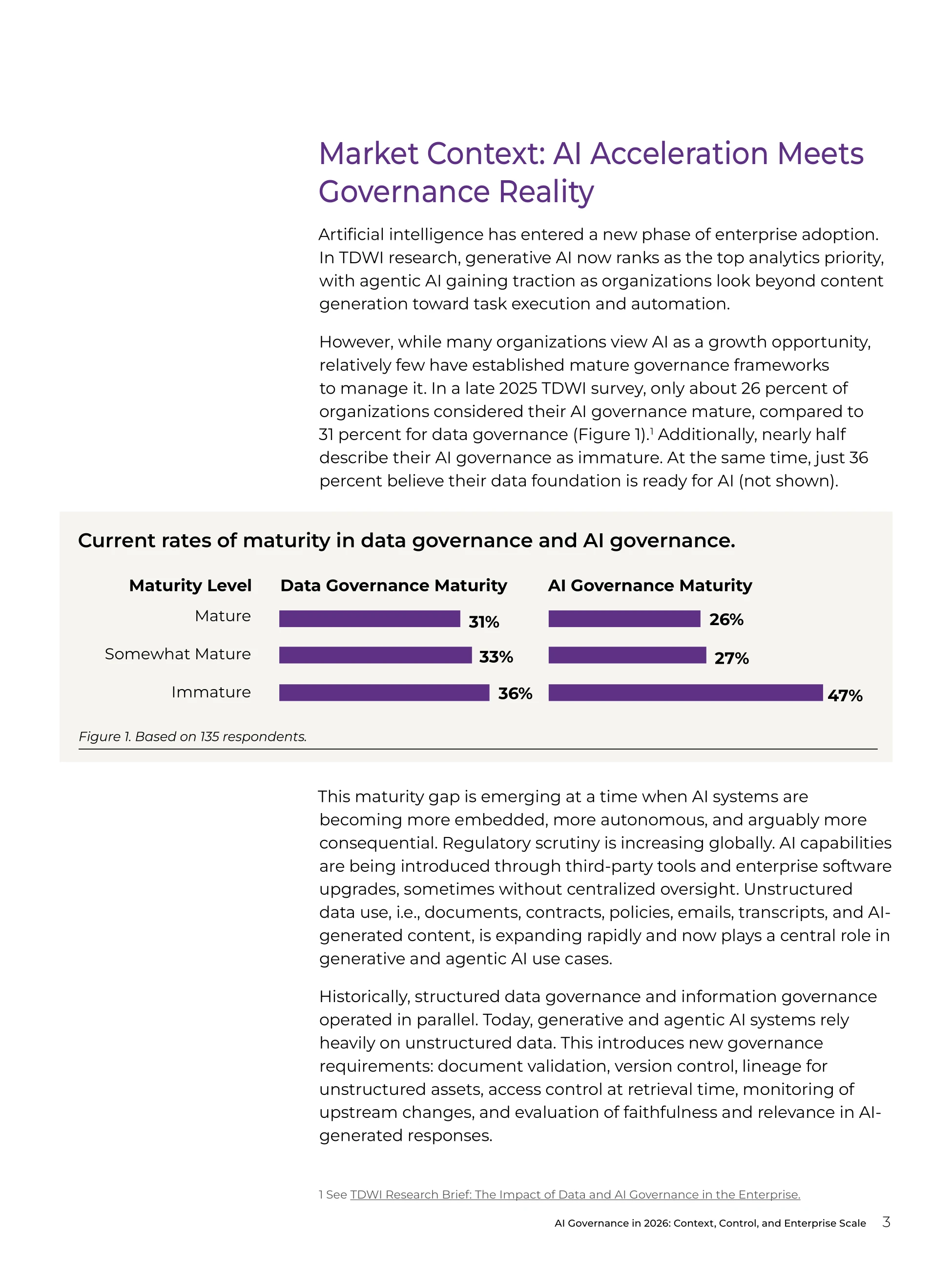
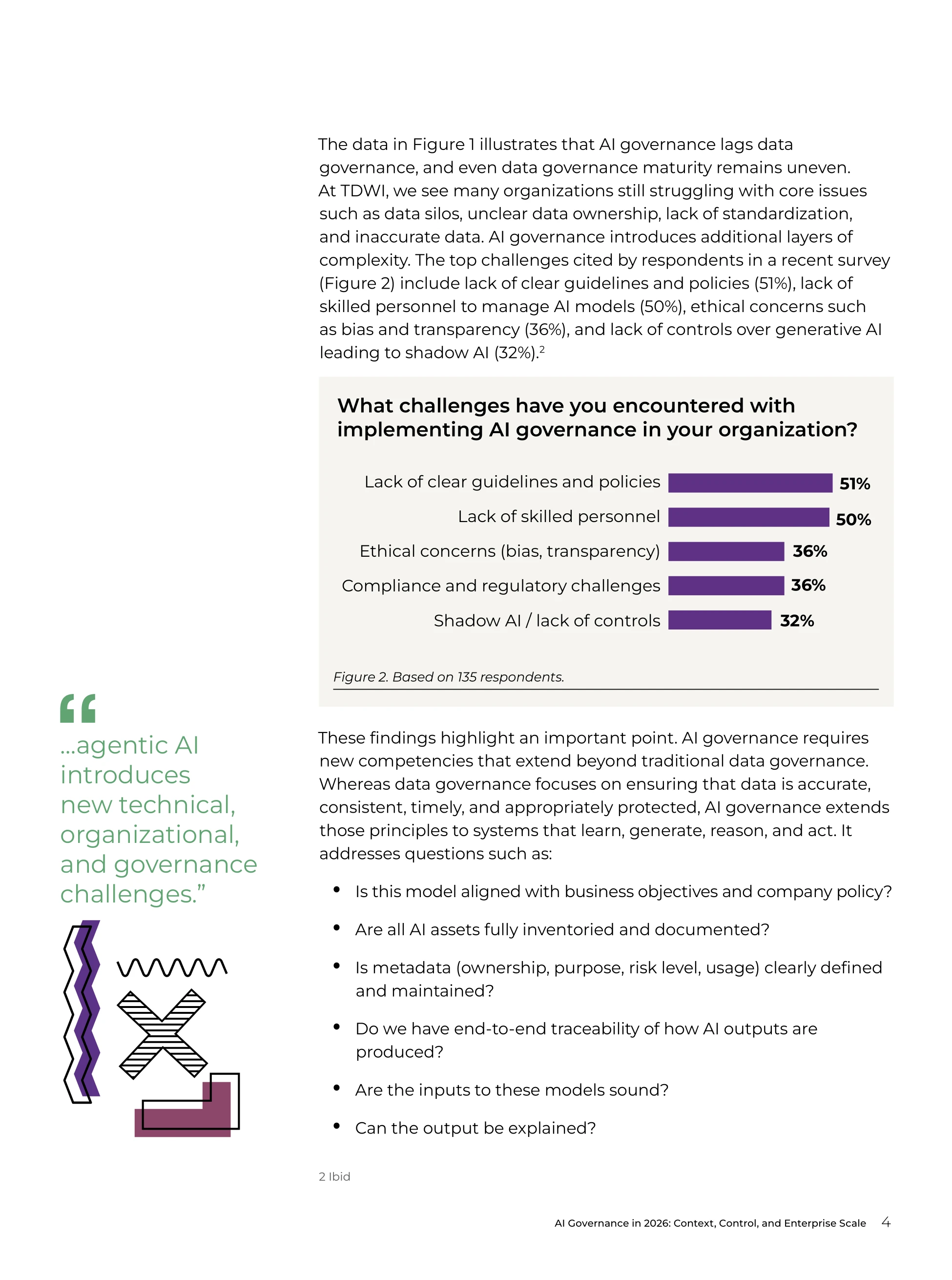
2026TOP TRENDSAI GOVERNANCE IN 2026: Context, Control, and Enterprise ScaleFern Halper, Ph.D.AI Governance in 2026: Context, Control, and Enterprise Scale2ContentsMarket Context: AI Acceleration Meets Governance Reality 3Key Trends in AI Governance 6Trend 1: The AI Data Foundation Remains a Moving Target . . . . . . . . . . . . . . . . . . . . . . . . . . . . . . . 6Trend 2: Context Is King . . . . . . . . . . . . . . . . . . . . . . . . . 7Trend 3: The Shift Toward Agentic AI Raises the Governance Stakes . . . . . . . . . . . . . . . . . . . . . . . . . . . . 8Trend 4: Unified and Automated Governance Becomes Essential . . . . . . . . . . . . . . . . . . . . . . . . . . . . 9Governance as the Foundation for Scalable AI 10Scaling Enterprise AI with Context, Control, and Unified Governance 11Context Gap, Platform Trap . . . . . . . . . . . . . . . . . . . . . . 11Governance Provides Context and Control . . . . . . . . . . . . 12Governance Everywhere . . . . . . . . . . . . . . . . . . . . . . . . 12About the Sponsor 14About the Author 15About TDWI Research 15AI Governance in 2026: Context, Control, and Enterprise ScaleAI Governance in 2026: Context, Control, and Enterprise Scale3Market Context: AI Acceleration Meets Governance RealityArtificial intelligence has entered a new phase of enterprise adoption. In TDWI research, generative AI now ranks as the top analytics priority, with agentic AI gaining traction as organizations look beyond content generation toward task execution and automation. However, while many organizations view AI as a growth opportunity, relatively few have established mature governance frameworks to manage it. In a late 2025 TDWI survey, only about 26 percent of organizations considered their AI governance mature, compared to 31 percent for data governance (Figure 1). 1 Additionally, nearly half describe their AI governance as immature. At the same time, just 36 percent believe their data foundation is ready for AI (not shown). This maturity gap is emerging at a time when AI systems are becoming more embedded, more autonomous, and arguably more consequential. Regulatory scrutiny is increasing globally. AI capabilities are being introduced through third-party tools and enterprise software upgrades, sometimes without centralized oversight. Unstructured data use, i.e., documents, contracts, policies, emails, transcripts, and AI-generated content, is expanding rapidly and now plays a central role in generative and agentic AI use cases. Historically, structured data governance and information governance operated in parallel. Today, generative and agentic AI systems rely heavily on unstructured data. This introduces new governance requirements: document validation, version control, lineage for unstructured assets, access control at retrieval time, moni...







































