

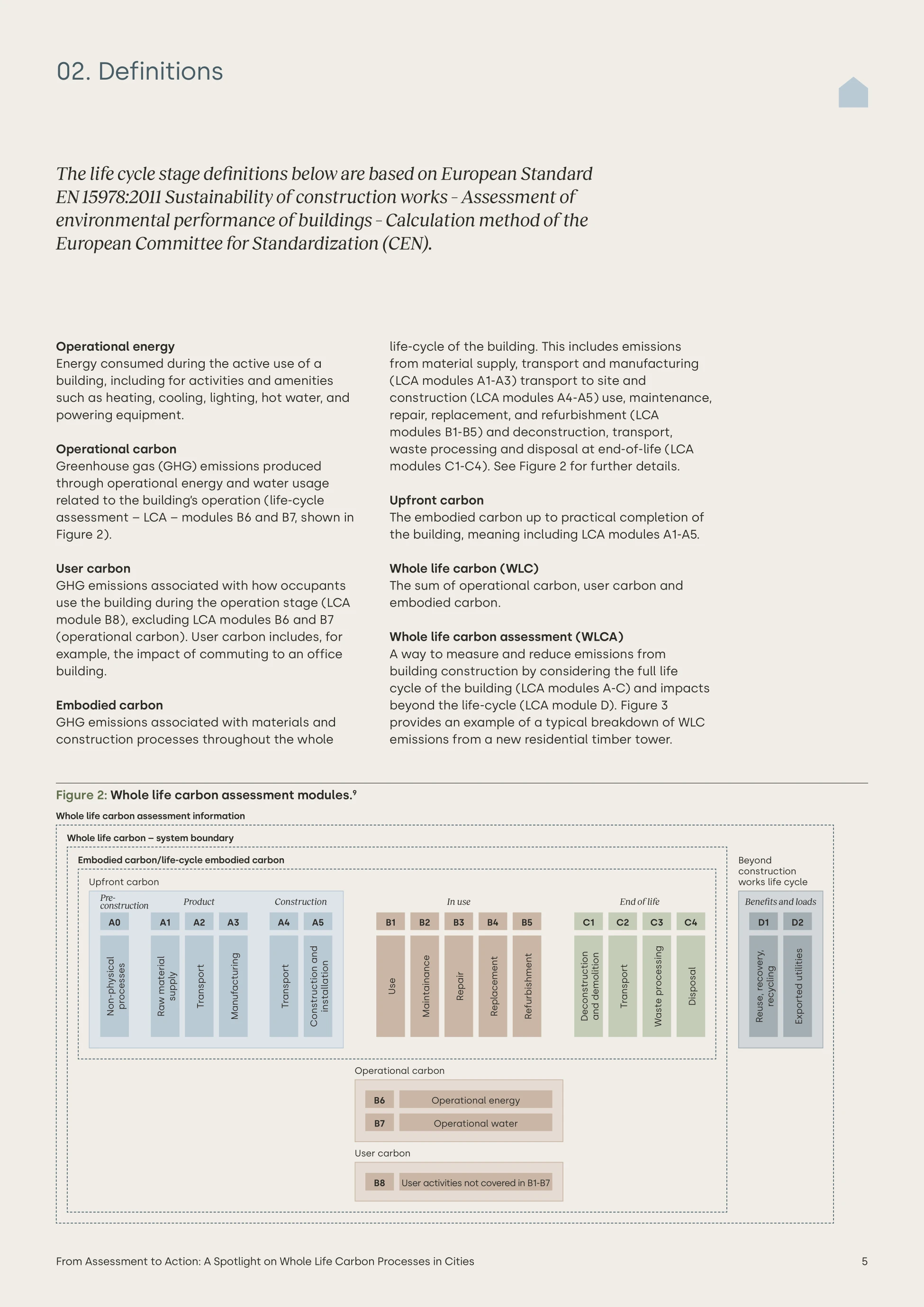
From Assessment to Action→ A Spotlight on Whole Life Carbon Processes in CitiesIFrom Assessment to Action: A Spotlight on Whole Life Carbon Processes in CitiesAssessment frameworkoverview and development 07Contents01.02.04.05.03.Tier 1 (Carbon Scope): Operational energy and carbon versus embodied and whole life carbon 09Tier 2 (Policy Instruments): Definition, transparency, performance floor and incentivized goal 10Tier 3 (Implementation Characteristics): Scope, application mechanism and effectiveness 11The criteria 12How the framework assesses cities 15Framework limitations 16Bogotá, Colombia 20Cape Town, South Africa 21London, UK 22New York, USA 23Paris, France 24Shanghai, China 25Introduction 01Definitions 04Pilot cities 17Conclusionand next steps 26Foreword IIExecutive summary IIIGlossary of termsand abbreviations 28Appendix A:Criteria-Based Assessment Framework 29Appendix B:City Assessments 29From Assessment to Action: A Spotlight on Whole Life Carbon Processes in CitiesIIForewordGlobal CO2 emissions from buildings have stabilized (at a high level of ca. 14Gt per year, or almost 40% of total emissions) but we are not yet seeing the necessary steep decline that would bring us within reach of keeping global warming to between 1.5-2ºC. While ca. 70% of these emissions are related to the energy used to heat, cool and run buildings (operational carbon), another 30% are due to the production emissions of construction materials (embodied carbon). We need to address both operational and embodied carbon emissions in conjunction, and we need to urgently work toward halving emissions from new construction by 2030 and deeply retrofitting the existing inefficient building stock (while not adding new embodied carbon).This is why the implementation of Whole Life Carbon processes is critical, as it allows us to understand the full emissions profile of building projects and take a holistic approach to reducing them, from the earliest phase of decision-making in any project when the impact on total carbon emissions is highest. Whole Life Carbon is the common language that can align the goals and actions by all actors involved in the process, from owners and investors, to developers, architects and construction companies, to all stakeholders along the value chain.With this report we are aiming to provide a consistent assessment framework and a spotlight on the implementation of Whole Life Carbon processes across 6 global cities, to share knowledge and best practice and to encourage more cities, regions as well as countries to adopt consistent and comparable Whole Life Carbon assessments as part of their planning processes. This will provide a level playing field for actors to come together and aim to achieve the best outcomes through collaboration and innovation, thereby driving carbon emissions out of buildings and construction projects, globally.Decarbonizing buildings ...







































