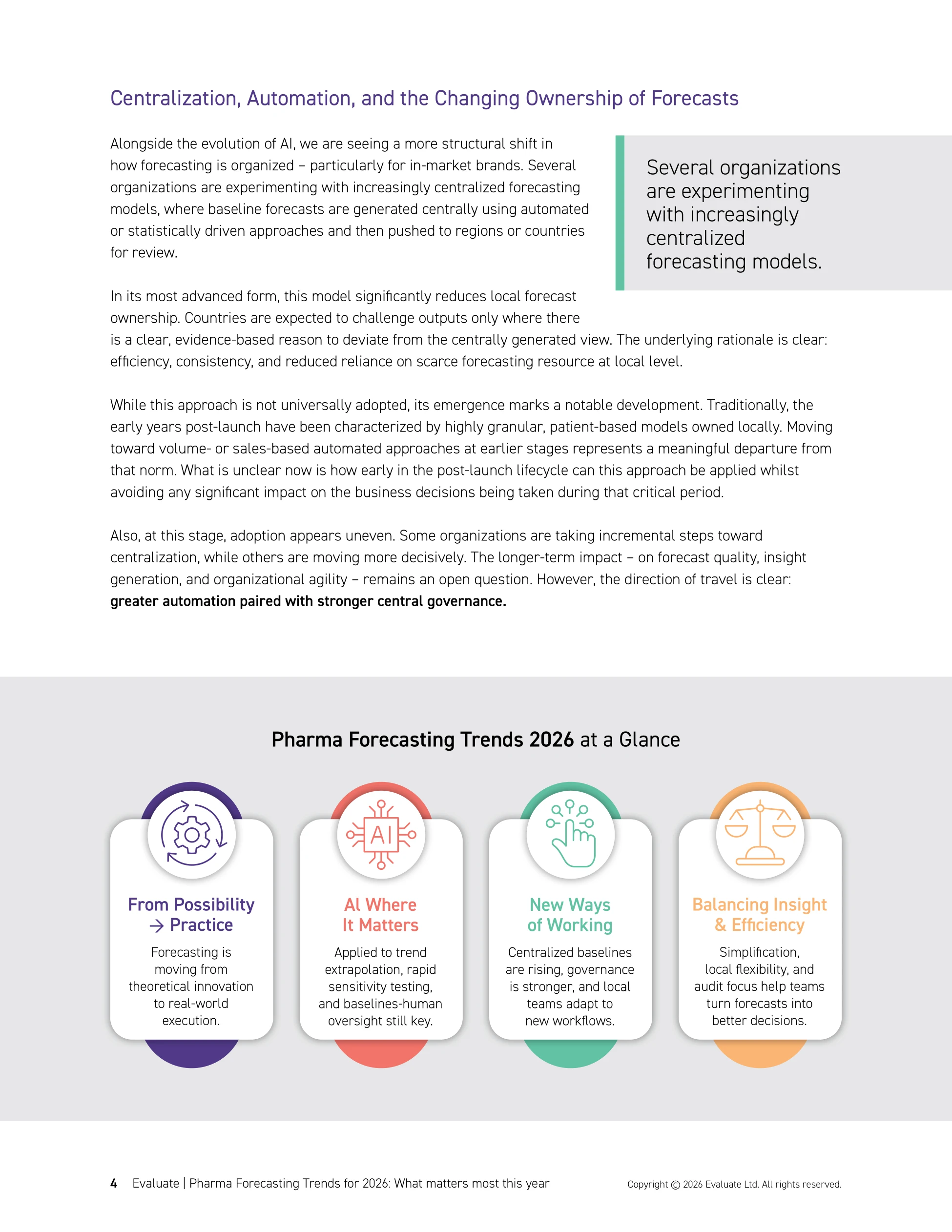
Pharma Forecasting Trends for 2026: What matters most this yearJANUARY 2026REPORTan Evaluate company2 Evaluate | Pharma Forecasting Trends for 2026: What matters most this year Copyright © 2026 Evaluate Ltd. All rights reserved.Pharma Forecasting Trends for 2026: What matters most this yearAs the pharmaceutical industry moves into 2026, forecasting teams are operating in a markedly different environment to even a year ago. The strategic importance of forecasting has not diminished, but expectations of how forecasting delivers value have become sharper, more operational, and more demanding.In our 2025 report, we explored how AI, automation, and efficiency pressures were reshaping the forecasting function. Many of those themes remain highly relevant. What has changed is the tone of the conversation. Forecasting leaders are no longer being asked whether AI can help, or whether processes could be streamlined. Instead, senior stakeholders want clear, defensible answers to a more pragmatic question: how are these approaches being used, today, to improve forecasting outputs, efficiency, and decision-making?The result is a shift from conceptual innovation to applied execution. Below, we outline the key forecasting trends we see defining 2026, drawing on recent client discussions, project proposals, and evolving operating models across global pharma.3 Evaluate | Pharma Forecasting Trends for 2026: What matters most this year Copyright © 2026 Evaluate Ltd. All rights reserved.From Generic AI Adoption to Practical Forecasting Use CasesAI continues to dominate discussions across the industry, but its role within forecasting is beginning to mature from pilots to workflow-level adoption. In previous years, much of the focus sat around data readiness, experimentation, or broad productivity use cases. Now, forecasting leaders are increasingly expected to demonstrate tangible, day-to-day applications of AI within core forecasting activities.Rather than positioning AI as a broad enabler, organizations are now exploring targeted use cases that directly support forecast generation and maintenance. These include automated trend extrapolation for in-market brands, rapid sensitivity testing across key assumptions, and machine learning approaches that support baseline forecasts where historical data exists.The emphasis is less on replacing forecasters, and more on removing friction from the process. AI is increasingly viewed as a mechanism for efficiency – reducing manual effort, accelerating iteration cycles, and freeing up expert time for interpretation, challenge, and strategic insight. It is being positioned as an enabler – empowering forecasting teams to do more in the same time, with the same resource.Importantly, this shift reflects a growing demand for specific examples rather than high-level ambition. Forecasting teams want to see what peers are doing in practice, what has s...







































