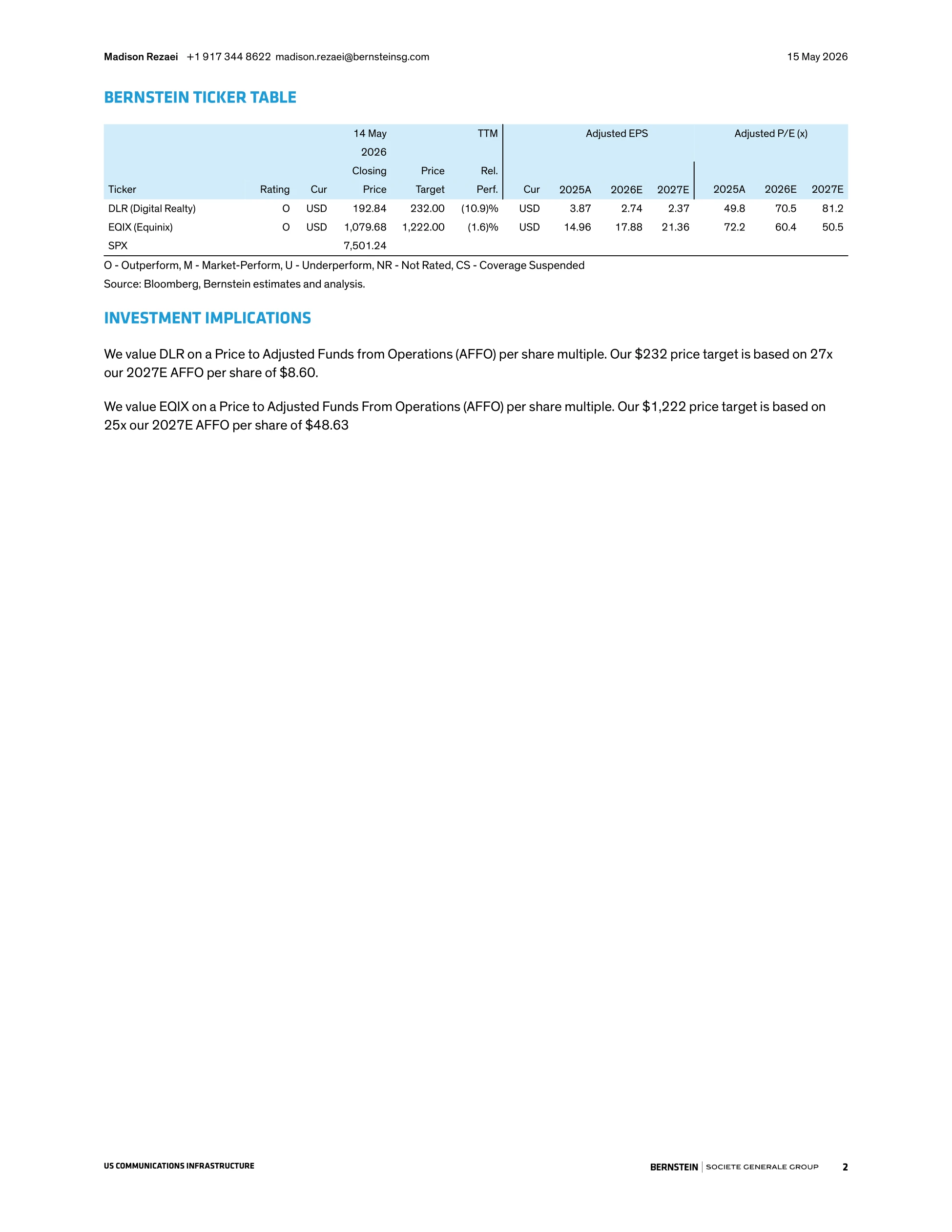
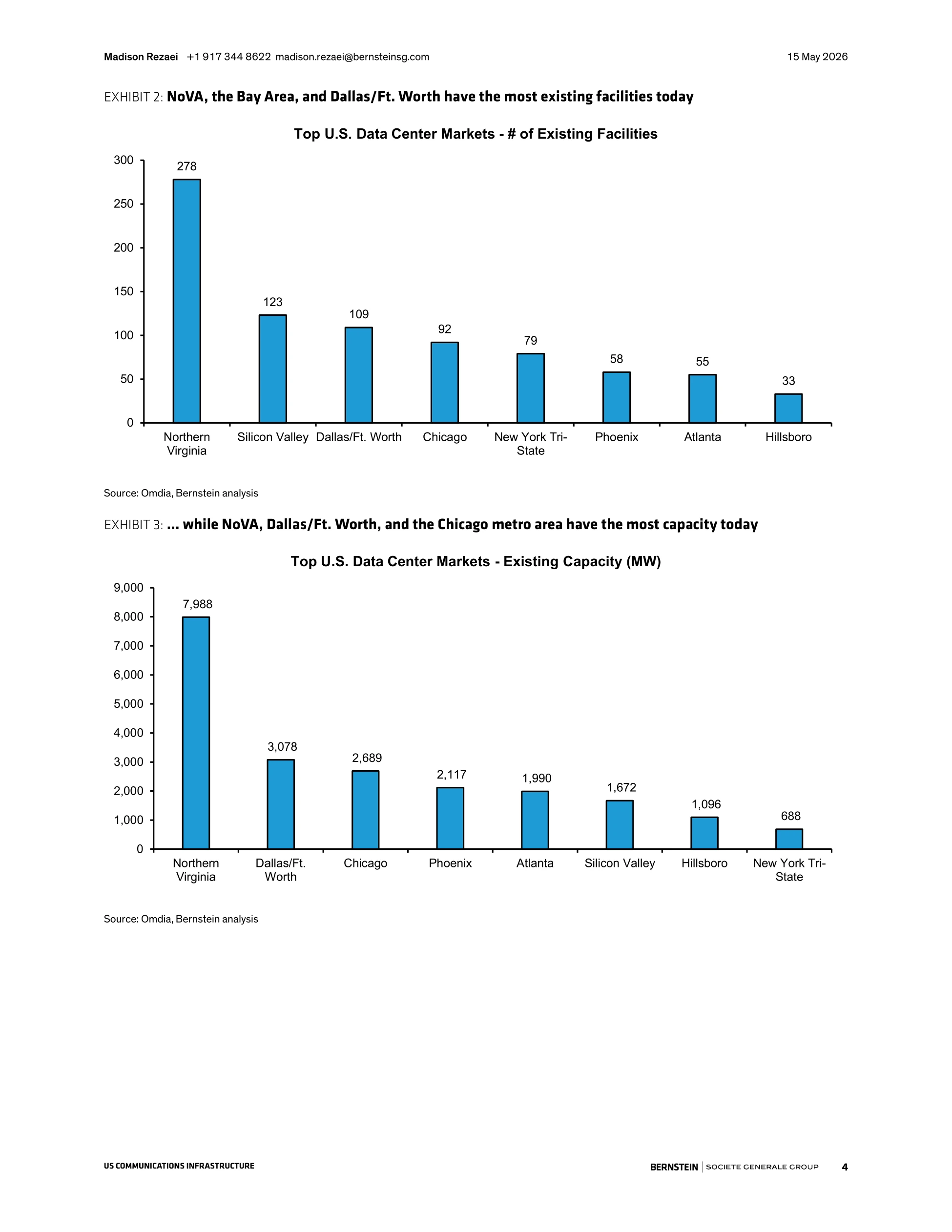
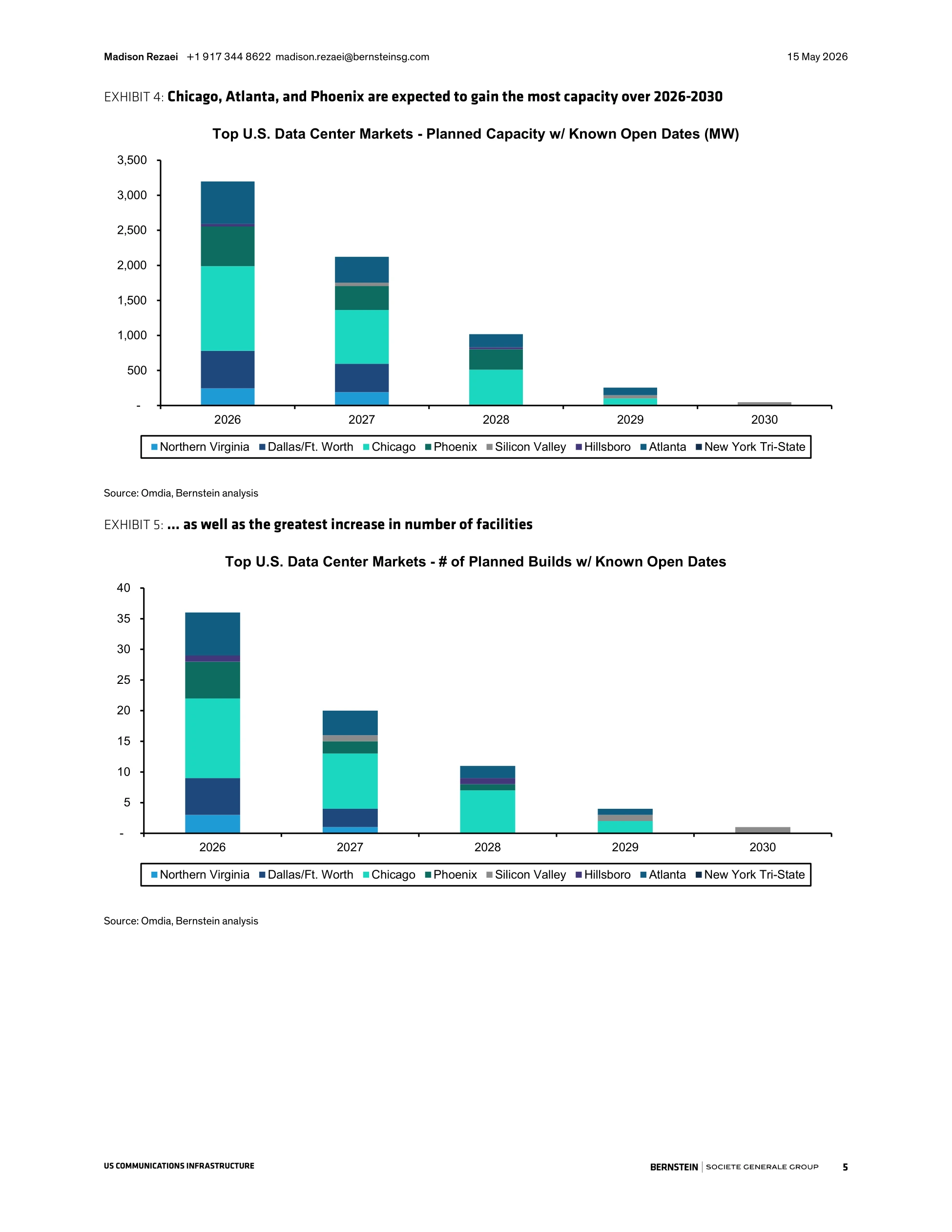
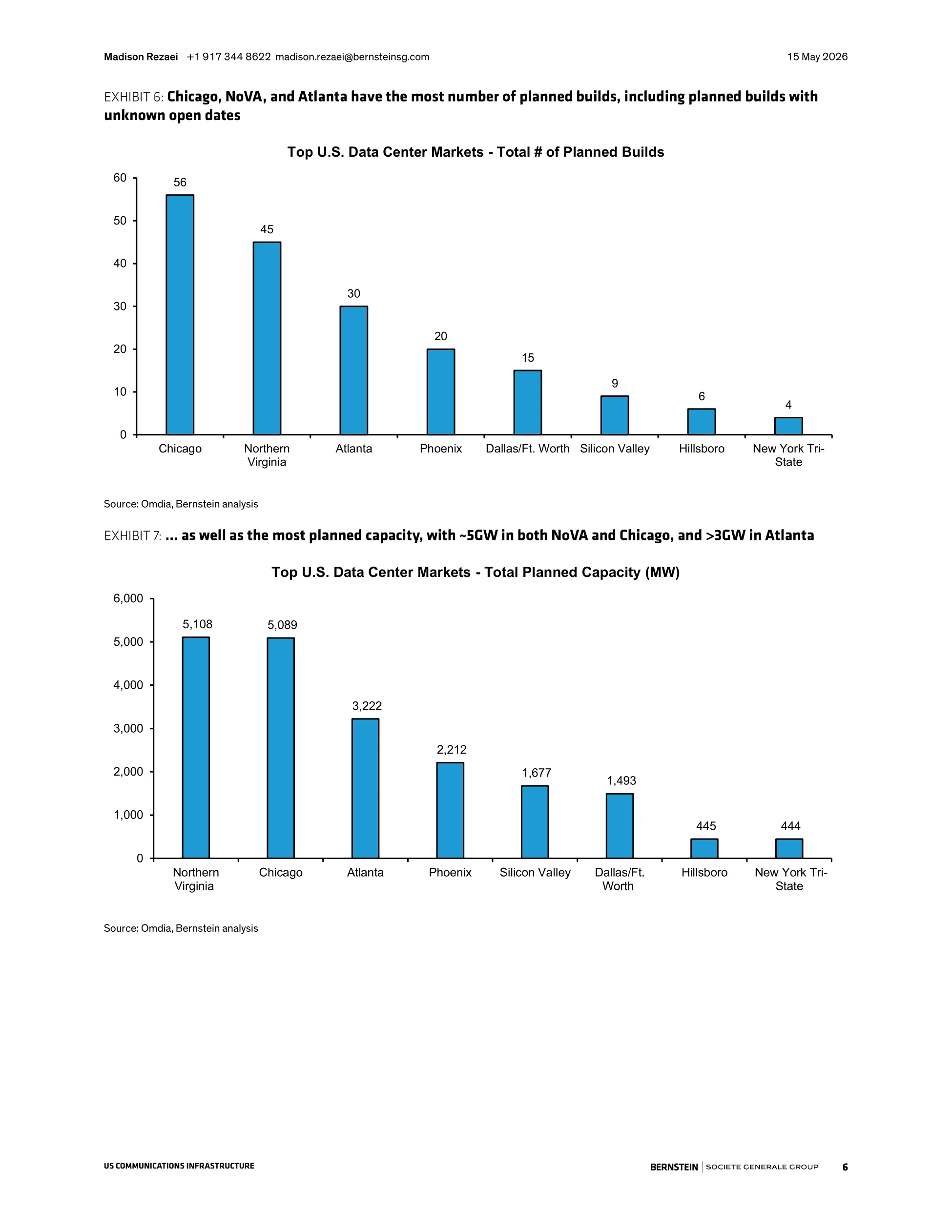
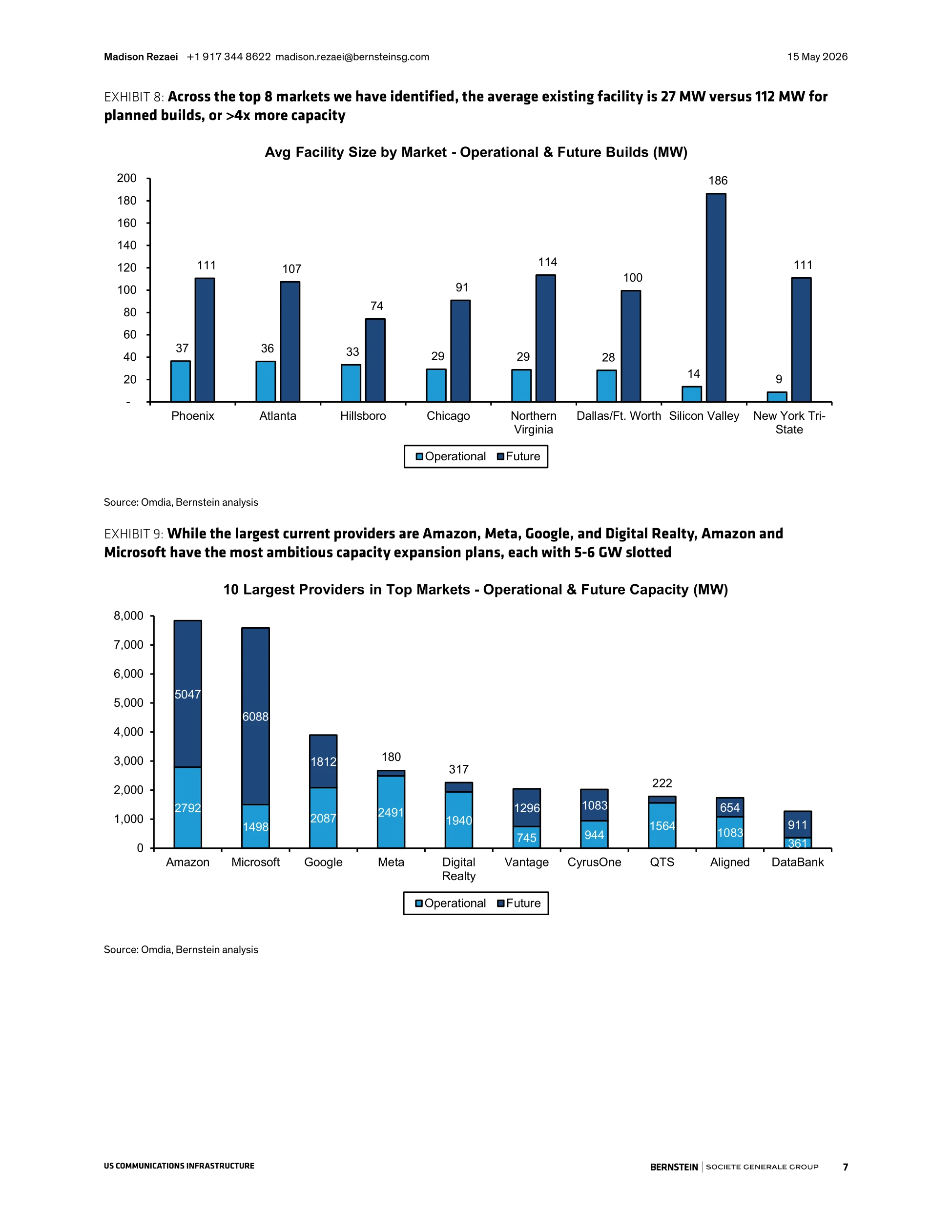
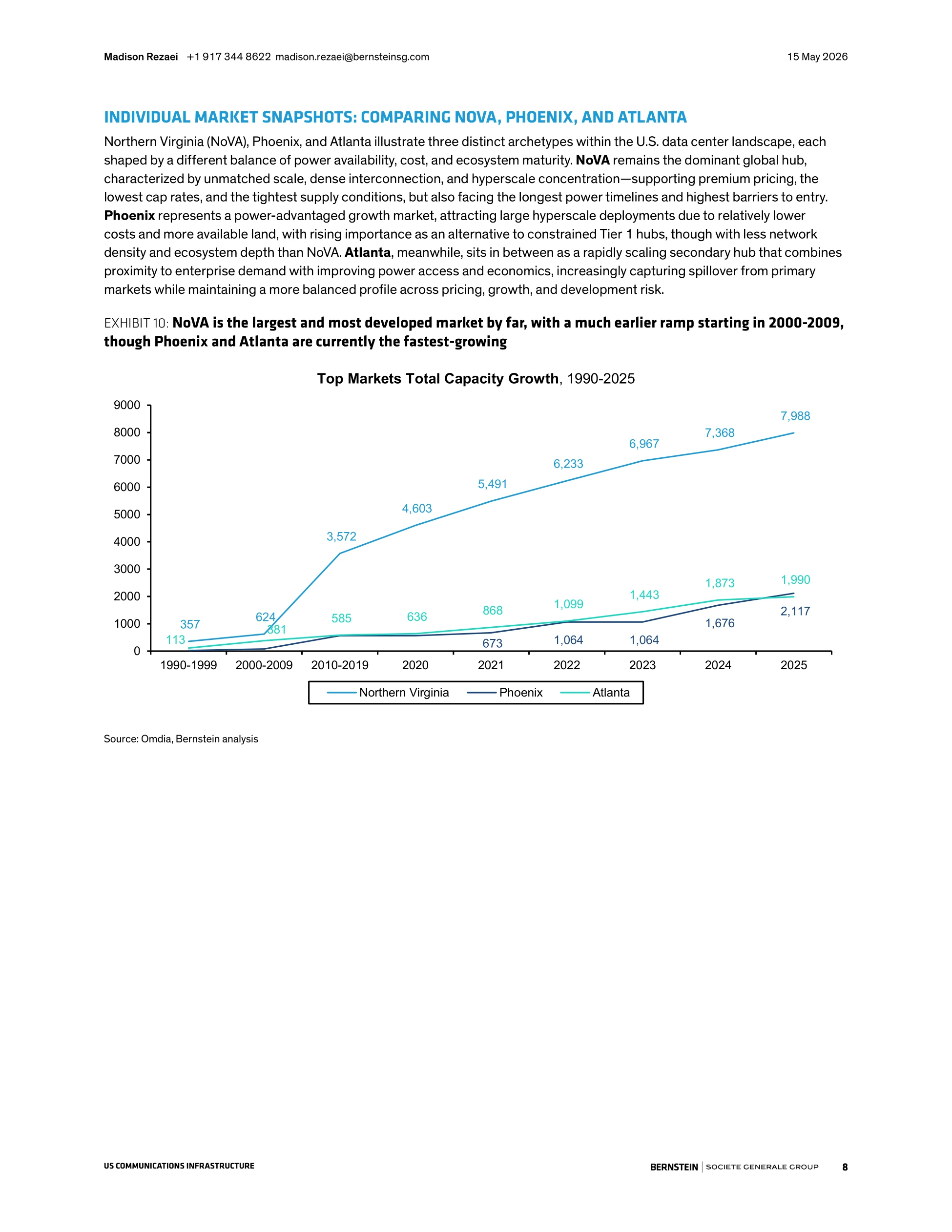
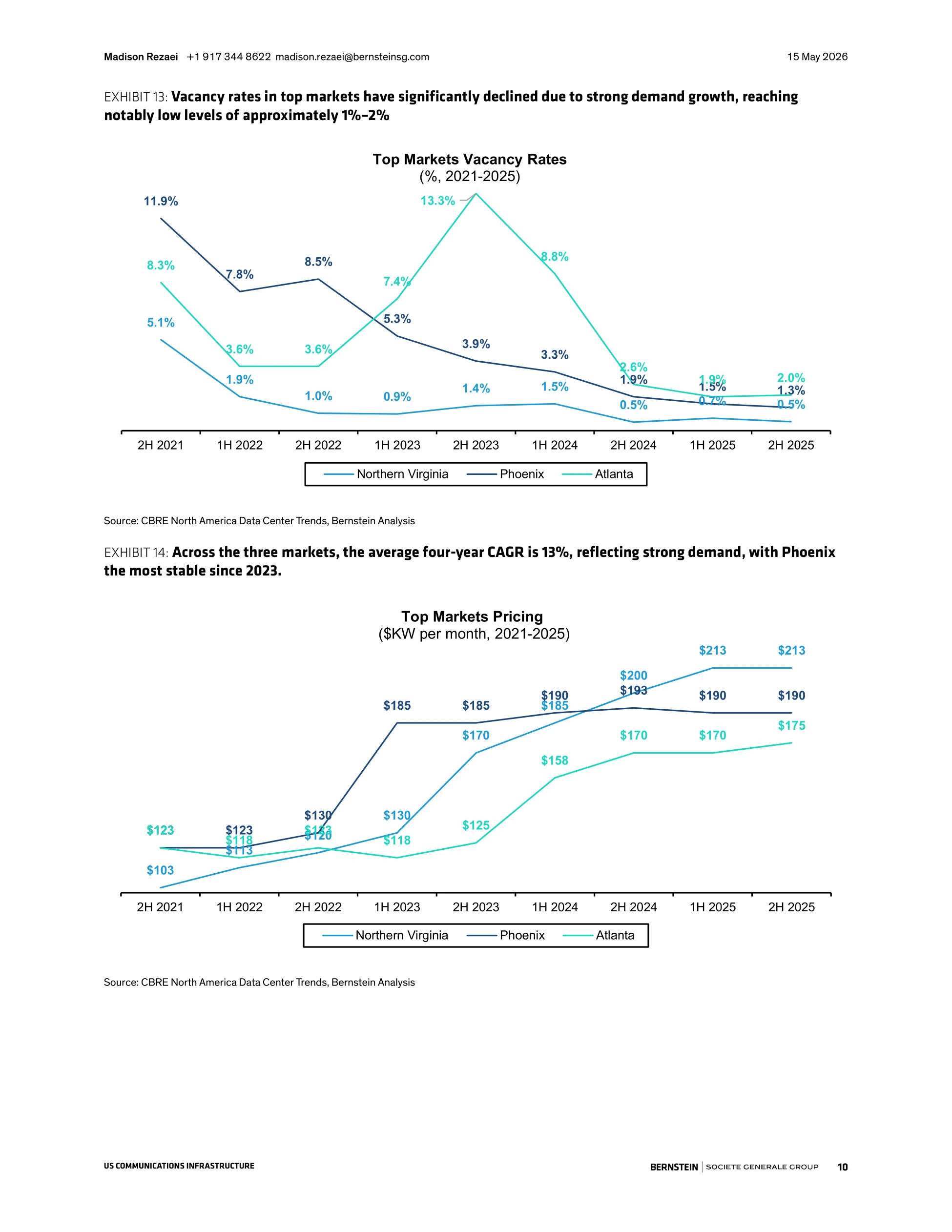
15 May 2026US Communications InfrastructureData Centers: What a top-tier data center market looks like—including the DLR and EQIX footprintsMadison Rezaei+1 917 344 8622madison.rezaei@bernsteinsg.comNancy Wu+1 917 344 8545nancy.wu@bernsteinsg.comWe’re fielding a lot of questions on data center buildouts, at least in part driven by the dailyheadlines on power delays, NIMBYism, and supply chain constraints. Most of our answers boildown to “it depends on what market(s) you’re looking at - we feel pretty good about MajorMetros and the players building / buying there”. In this note, we do a comparison of markettypes and a deep dive into three of the top U.S. markets.We think of three data center market archetypes: Major Metro markets (typically consideredthe top 8-10 in North America), Minor Metro markets (sometimes thought of as Tiers2-4, smaller cities or the extreme outskirts of Major Metros), and Rural markets. The twopublic data center company footprints, DLR (OP, $232) and EQIX (OP, $1,222) areoverwhelmingly concentrated in Major and Minor Metros; they are among the mostinsulated from market noise.Major Metros are and will continue to be the most important markets for latency-sensitiveuse cases (including inferencing), as well as enterprise colocation. These markets arewell established and hard to build in. Power queues are long, build costs are high, andsupply chains are tight. Existing capacity and in-progress, permitted builds are valuable.We are seeing an increase in NIMBYism in these markets, particularly NoVa and Phoenix,in part driven by rising power costs. We believe the established builders will manage thisappropriately, but it is an emerging risk.After Major Metros, overflow goes into Minor Metros. This works where there is marginallyless latency sensitivity and/or marginally more price sensitivity. There has been significantgrowth in these markets over the last ~5 years, which we anticipate continuing.Finally, training, latency-insensitive, and/or very price sensitive workloads take place inRural markets. These markets tend to have larger facilities, more speculative builds, andless experienced developers than Major Metros. On the positive side, there is faster poweravailability and lower cost to build. On the negative side, there is not as clear visibility tosustained demand.In the U.S., the biggest data center market is Northern Virginia (NoVa), which has ~8GW ofsupply today, ~5GW under construction, and power queues reportedly in the seven-yearrange. Pricing in NoVa has only gone up over the last several years, currently around $217/KW/mo, with vacancy stable below 1%. While there has been some recent news around theDigital Gateway Project (QTS and Compass), this market is typically a well-oiled machine.This quarter, both DLR and EQIX spoke about large hyperscale-focused builds outside ofAtlanta, another top U.S. data center market growi...







































