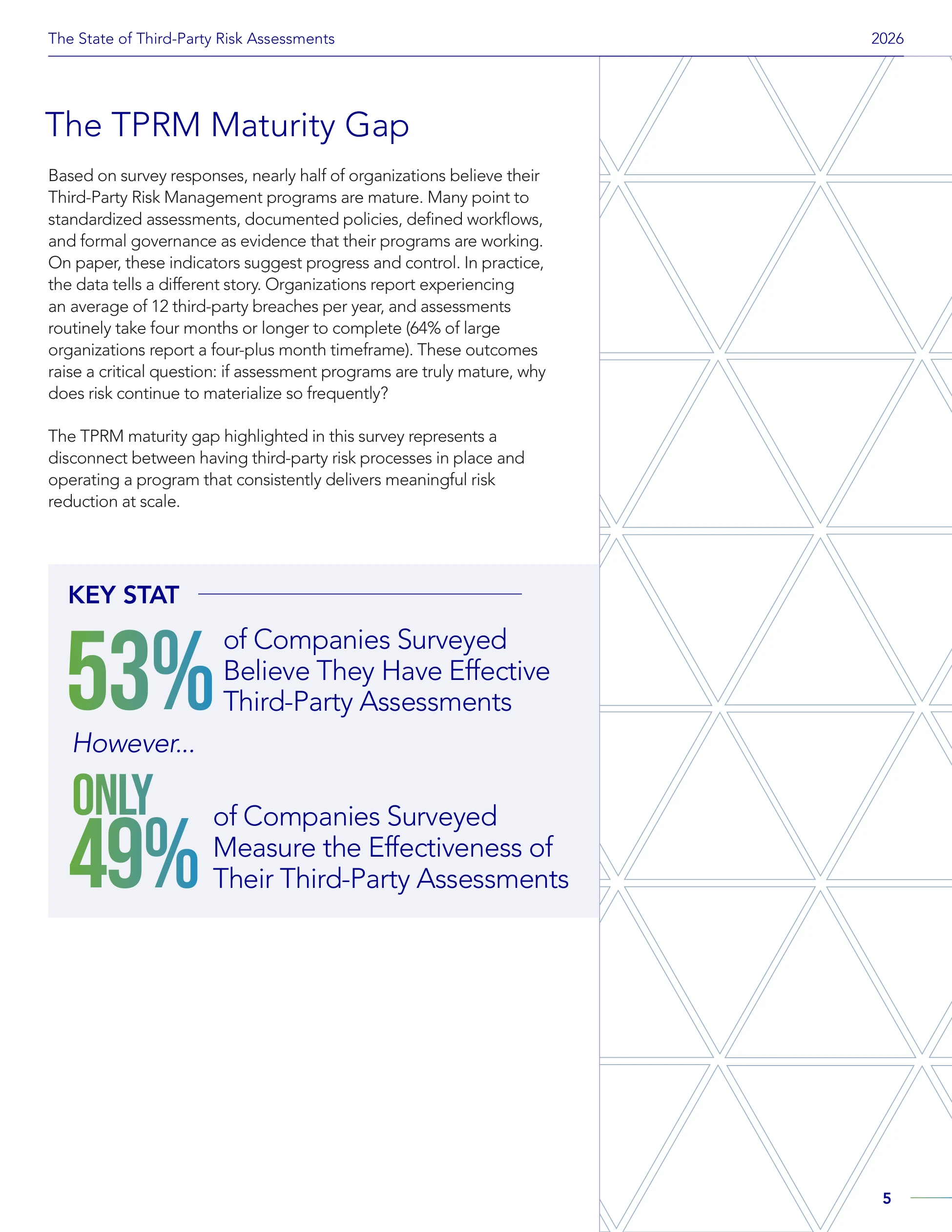
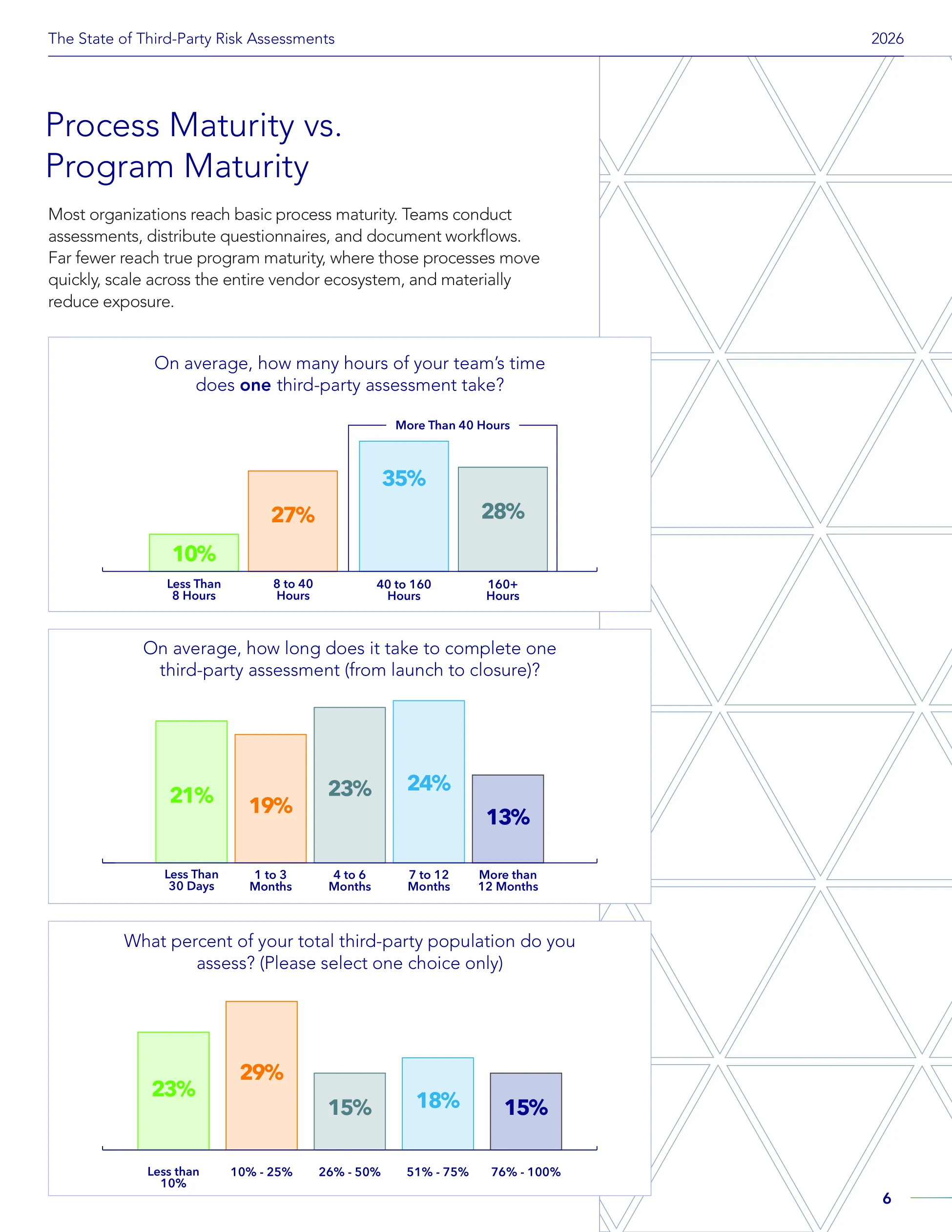
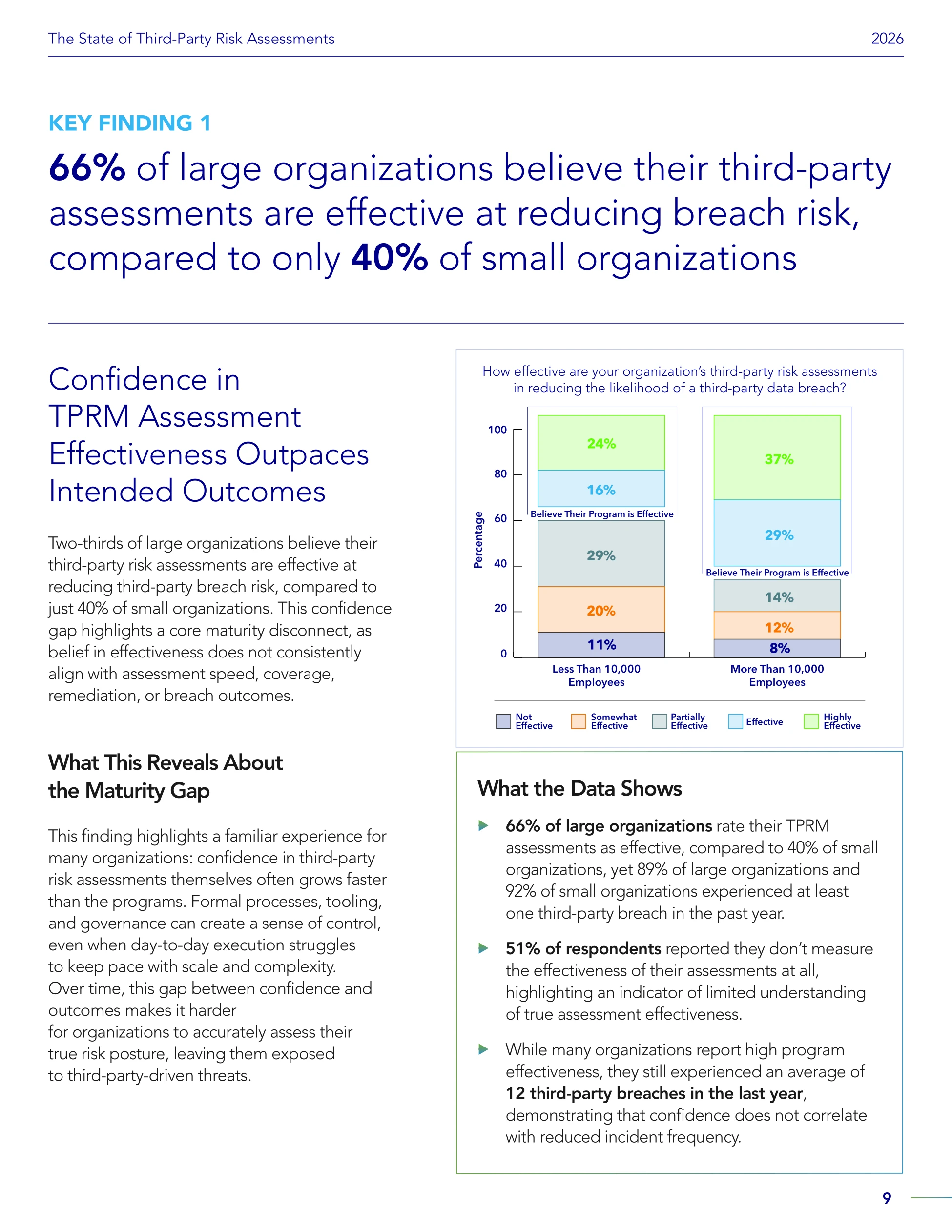
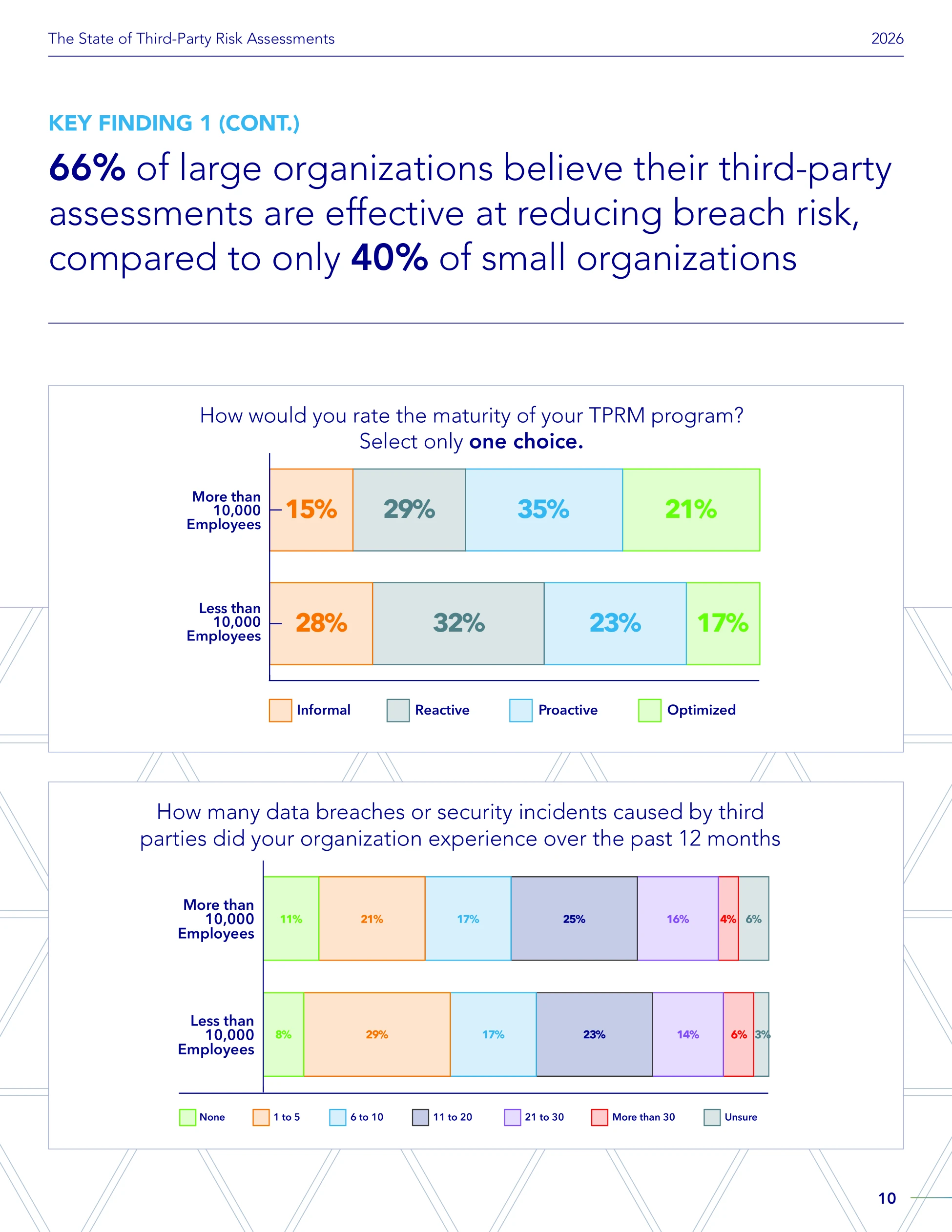
State of Third-Party Risk Assessments2026The Cost of the Maturity GapOrganizations today believe their TPRM processes are mature, but the data they shared via our 2026 survey tells a different story. Prepared in collaboration with Ponemon Institute Table of ContentsPart 1: IntroductionPart 3: Additional Survey InsightsPart 4: Implications for Third Party Risk LeadersAPPENDIX: Survey DataKey Finding 1 – Beliefs on TPRM EffectivenessAppendix 1 – Company LocationKey Finding 6 – Assessment ToolingKey Finding 2 – Third-Party Breaches Per MonthAppendix 2 – Company SizeKey Finding 7 – Vendor Response TimelinesKey Finding 3 – Breaches & Financial ServicesAppendix 3 – IndustryKey Finding 8 – Vendor Ecosystem & AssessmentsKey Finding 4 – Assessment TimelinesKey Finding 9 – Onboarding & RemediationKey Finding 5 – Assessment ResourcingKey Finding 10 – Assessing Fourth-Party Risk32531359361811581913772015221724Part 2: The Ten Findings That Will Reshape Your Approach to Third-Party Risk Assessments8The State of Third-Party Risk Assessments20262© ProcessUnity 2026Introduction to the Data & the Maturity GapPurpose of this StudyPART 1Organizations across many industries increasingly believe their Third-Party Risk Management (TPRM) programs are mature. The data in the ProcessUnity State of Third-Party Risk Assessments 2026 tells a more complex story. While most organizations have established assessment processes, policies, and frameworks, the data from our 1,465 respondents uncovers that many have not achieved true program maturity, and the gap between perception and reality is growing. That gap has a measurable cost. Organizations are experiencing frequent third-party breaches, prolonged assessment cycles, slow vendor responses, incomplete remediation, and persistent blind spots across their third-party ecosystems. In fact, organizations report experiencing an average of 12 third-party breaches per year, signaling that third-party risk is not an edge case, but a recurring operational reality. These outcomes highlight a critical truth: having processes in place is not the same as operating a mature, scalable, and effective TPRM program.The ProcessUnity State of Third-Party Risk Assessments 2026 , based on research conducted by the Ponemon Institute, examines how organizations assess and manage third-party risk and evaluates whether current Third-Party Risk Management (TPRM) assessment programs keep pace with the realities of modern third-party ecosystems. We studied how third-party risk assessment programs are executed in practice, how long they take, how consistently they scale across vendor portfolios, how confident organizations are in them, and whether they meaningfully reduce the likelihood and impact of third party-driven incidents.Third-party risk assessments represent a foundational component of TPRM programs. But while many organizations have formalized assessment processes,...







































