



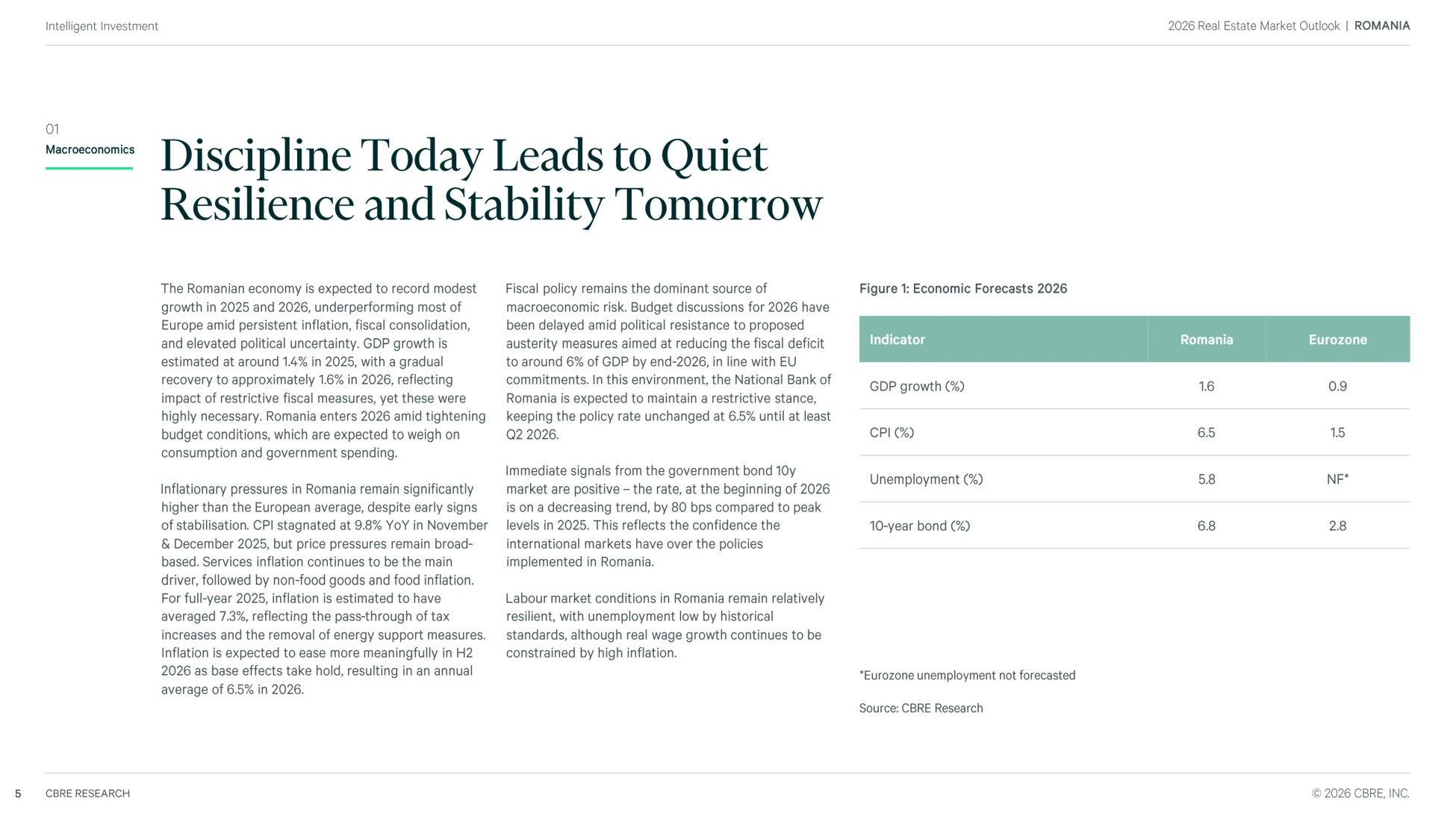

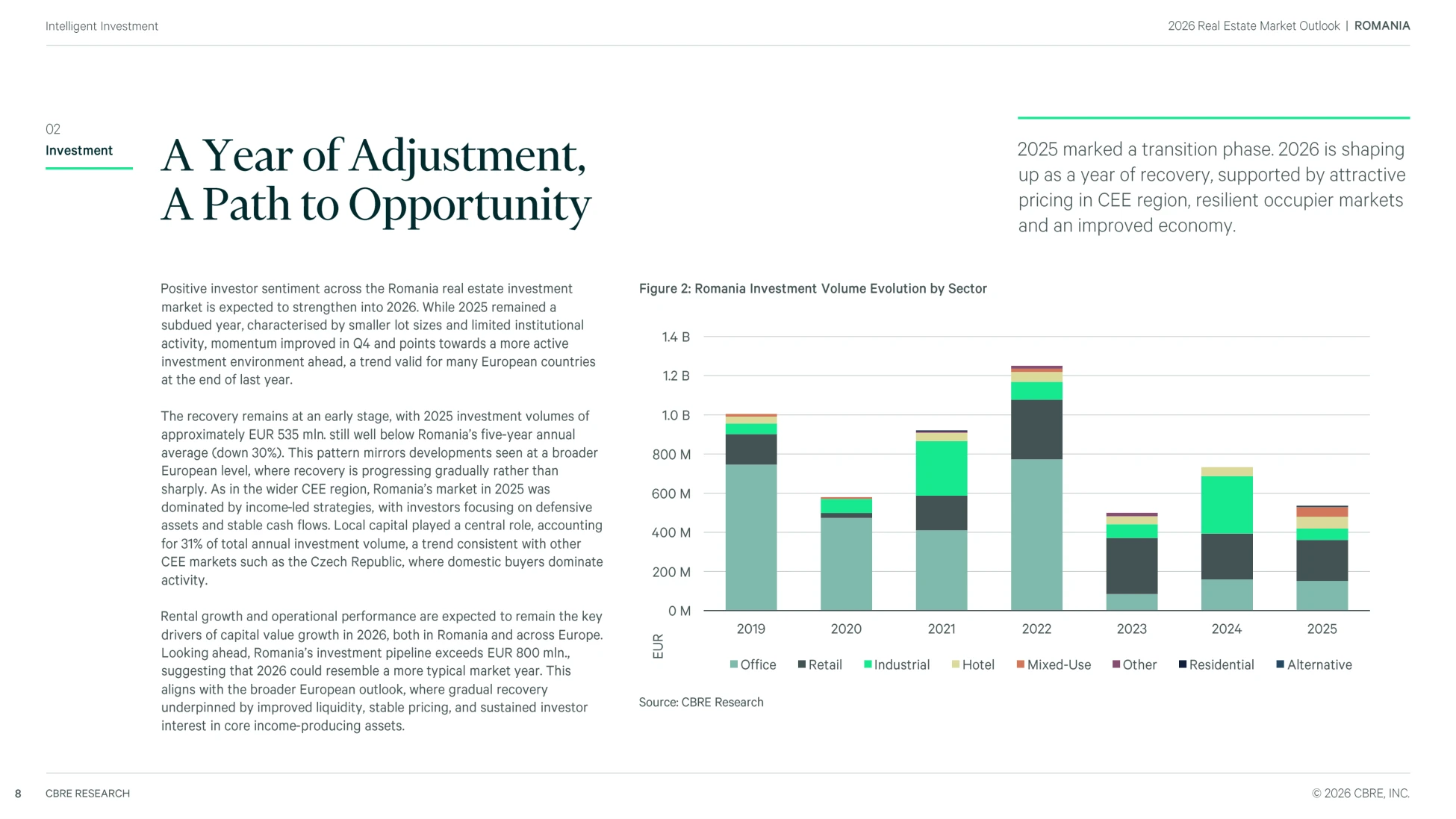

REPORT2026 Romanian Real Estate Market Outlook Resilient Fundamentals, Enduring Demand.CBRE RESEARCHFEBRUARY 2026Executive Summary3ContentsMacroeconomics4Investment7Office10Retail13Industrial & Logistics16Land19Student Housing223CBRE RESEARCH© 2026 CBRE, INC.Intelligent Investment2026 Real Estate Market Outlook | ROMANIA—Romania’s economyheads into 2026 on a cautiously optimistic note, as recent fiscal consolidation measures have started to improve international confidence in the country’s economic outlook. —Real estate capital markets remain locally driven, with a gradual recovery supported by income-focused strategies and stable pricing. Romanian buyers dominated Q4 (c. 35% of volume) and accounted for 31% of 2025 volume, while seller activity is led by portfolio clean-ups and strategic exits, rather than distress.—Logistics leasing remains resilient: 2025 total leasing activity exceeded 1M sq m, with pre-leases at 44% of take-up, reflecting occupiers securing future capacity and upgrading to modern space. Development stayed muted (-49% YoY new supply), keeping vacancy tight (3.8% national; 3.5% Bucharest) and supporting stable prime rents with modest upward pressure.—Infrastructure and cross-border integration will be key themes: improved connectivity is unlocking new logistics nodes around major corridors (including A0/A7), while Romania’s full Schengen accession is expected to support 3PL expansion and multi-country distribution models.—Office demand is expected to stay selective and efficiency-conscious, favouring well-connected, modern buildings, as fit-out costs remain a key decision factor; spillover to non-core submarkets may continue in a context of limited central availability.—Retail development and occupier demand remain resilient, with continued interest in convenience-led formats and retail parks, supported by solid operational performance and a limited pipeline of institutional-grade product.—Land market activity strengthened in 2025, with volumes up country – wise and demand led by retail and residential developers; pricing remained broadly stable, with significant upward pressure for well located plots, as pricing diverging heavily depending on zoning clarity, permitting certainty and infrastructure access.—Student housing demand in Bucharest remains structurally undersupplied, with private stock stagnant at just over 4,000 beds against a student population of 180,000+, driving double-digit rent growth and sustaining strong prospects for well-located PBSA despite a limited development pipeline.ExecutiveSummaryRomania’s real estate market enters 2026 with strong occupier fundamentals yet subdued investor appetite, a trend mirrored in several European markets. Domestic investors continue to provide essential liquidity amid low transaction volumes and disciplined pricing. Investment strategies are firmly income-led, prioritising cash-flow durability, leasing performance and asse...







































