
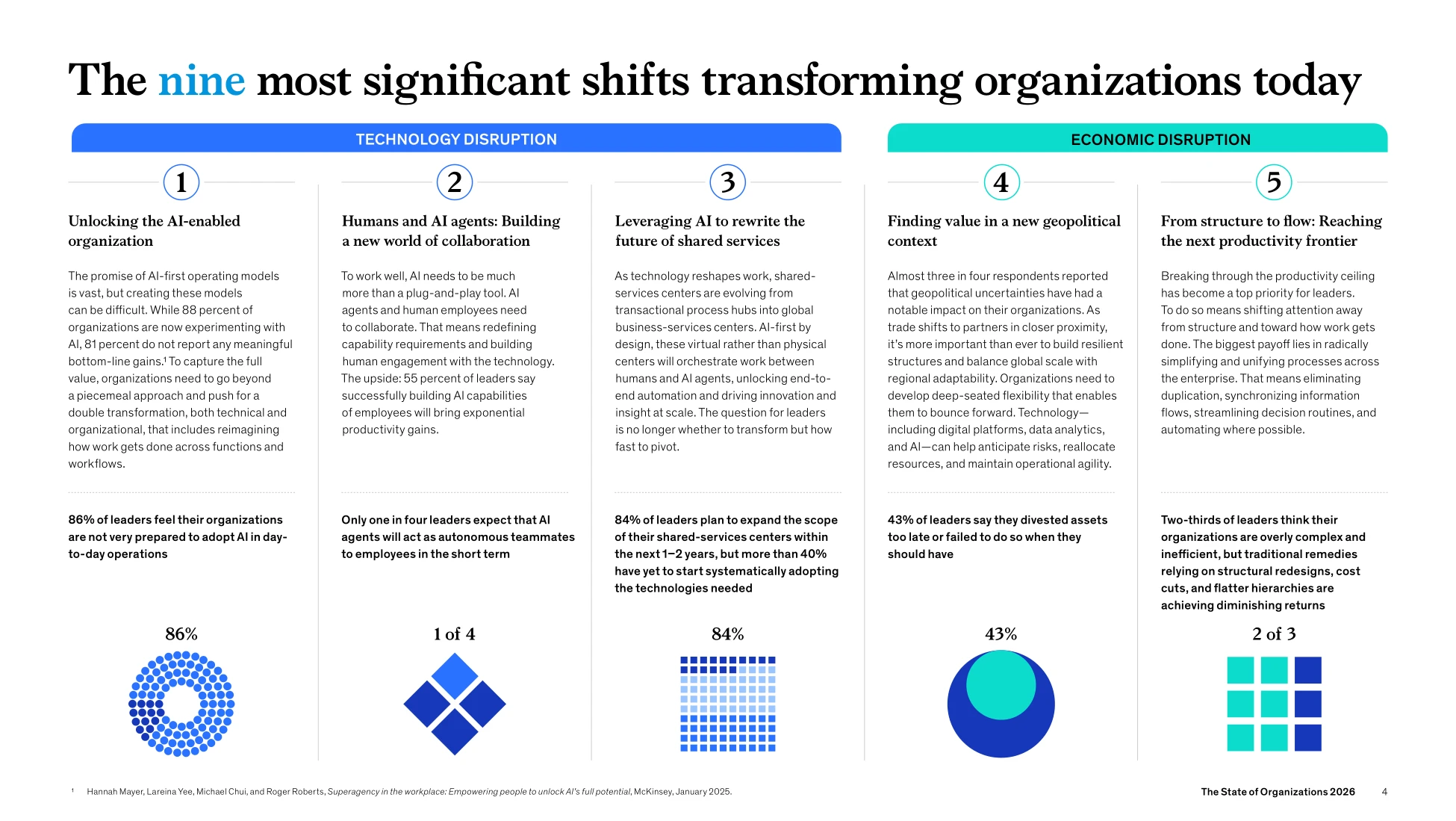
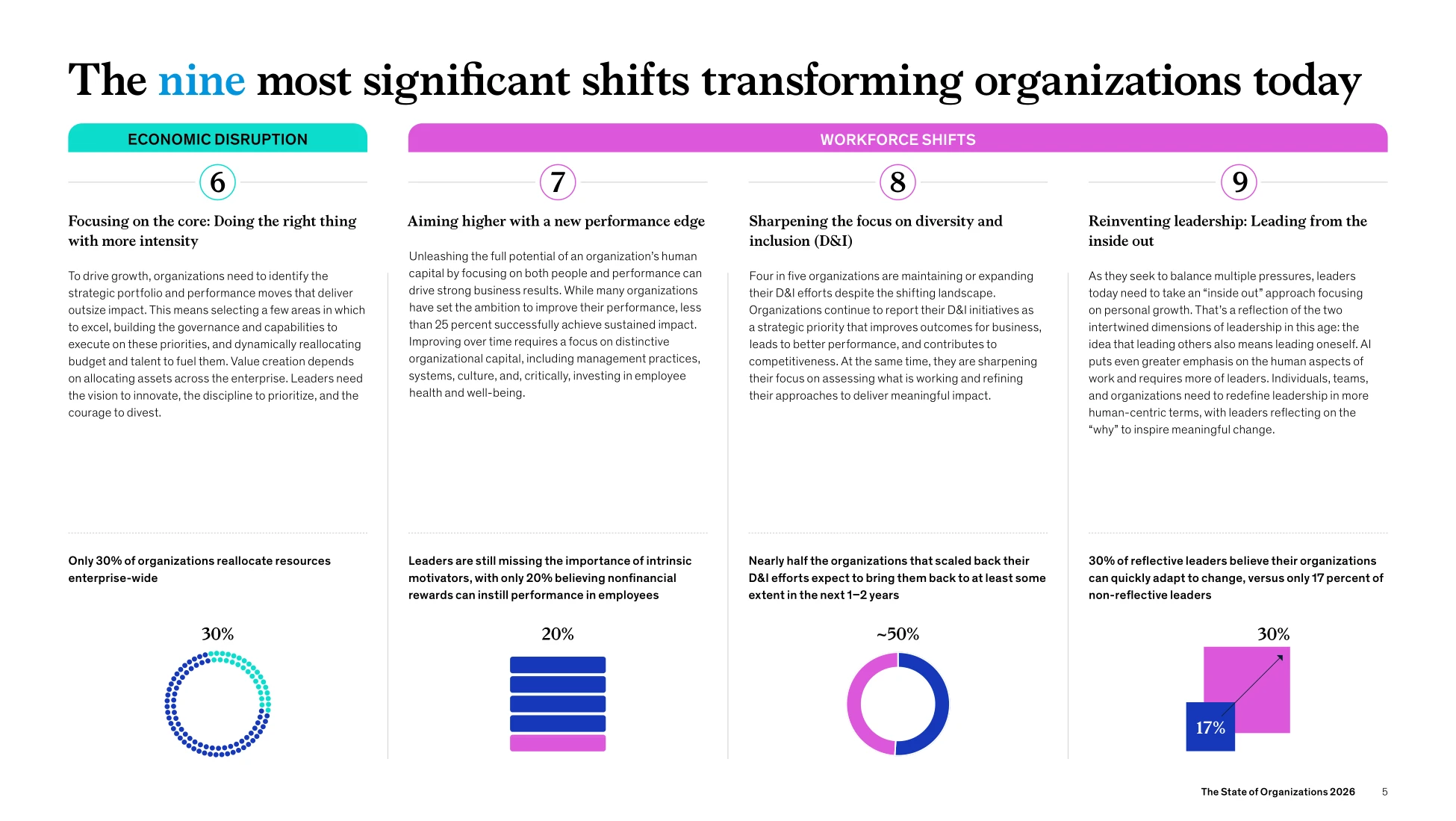
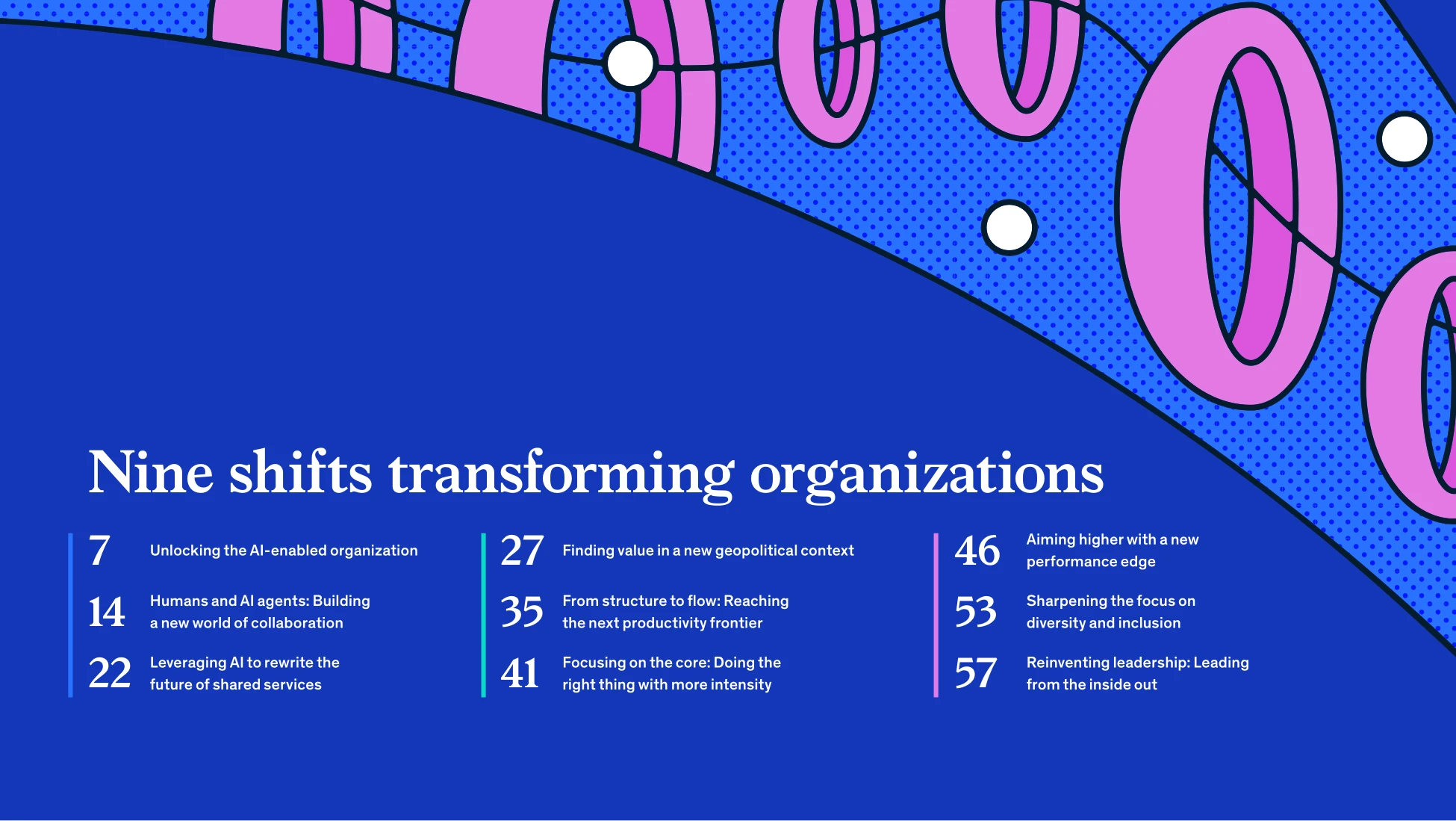
The State of Organizations2026Contents1 Introduction2 Three tectonic forces that are reshaping organizations6 Nine shifts transforming organizations7 Unlocking the AI-enabled organization14 Humans and AI agents: Building a new world of collaboration22 Leveraging AI to rewrite the future of shared services27 Finding value in a new geopolitical context 35 From structure to flow: Reaching the next productivity frontier41 Focusing on the core: Doing the right thing with more intensity46 Aiming higher with a new performance edge53 Sharpening the focus on diversity and inclusion 57 Reinventing leadership: Leading from the inside out 64 Business as change: Managing continuous transformation in the organization69 Appendix71 Authors72 AcknowledgmentsiiThe State of Organizations 2026IntroductionThese are challenging times for organizations everywhere. Continuous disruption is in the air, with forces ranging from artificial intelligence, economic uncertainty, and geopolitical fragmentation to evolving workforce expectations, increasing customer demands, and tougher competitive dynamics redefining how leaders create value and sustain performance. This report, the second edition of McKinsey’s State of Organizations research initiative, seeks to help leaders better understand these dynamics and address them effectively. The first edition, published in 2023, kicked off our exploration of the most significant people and organizational shifts, including leadership, resilience, talent and resource allocation, and diversity and inclusion (D&I) strategies. This second edition updates our findings to reflect the evolving needs and priorities of organizations. Postpandemic questions about balancing in-person and remote work as well as attracting and retaining talent have given way to a sharper focus on reestablishing high performance and aligning talent around a few bold strategic priorities and must-win battles. As with the first edition, this latest research draws on a large-scale survey of leaders around the world. In all, we received responses from more than 10,000 senior executives across 15 countries and 16 industries. While leaders remain focused on driving performance, as in the 2023 report, the emphasis has moved from short-term resilience to sustained productivity and long-term impact, powered by technology and AI at the core of organizational transformation. The survey responses inform our conviction that three tectonic forces are reshaping organizations and will continue to define their success in the years ahead. The first force is the infusion of technology as automation and data analytics are joined by the burgeoning of AI, both the large language models underpinning generative AI and the advent of AI agents that can be inserted into company workflows. Collectively, these technologies amount to a paradigm shift that promises significant benefits, including productivity gains, ...







































