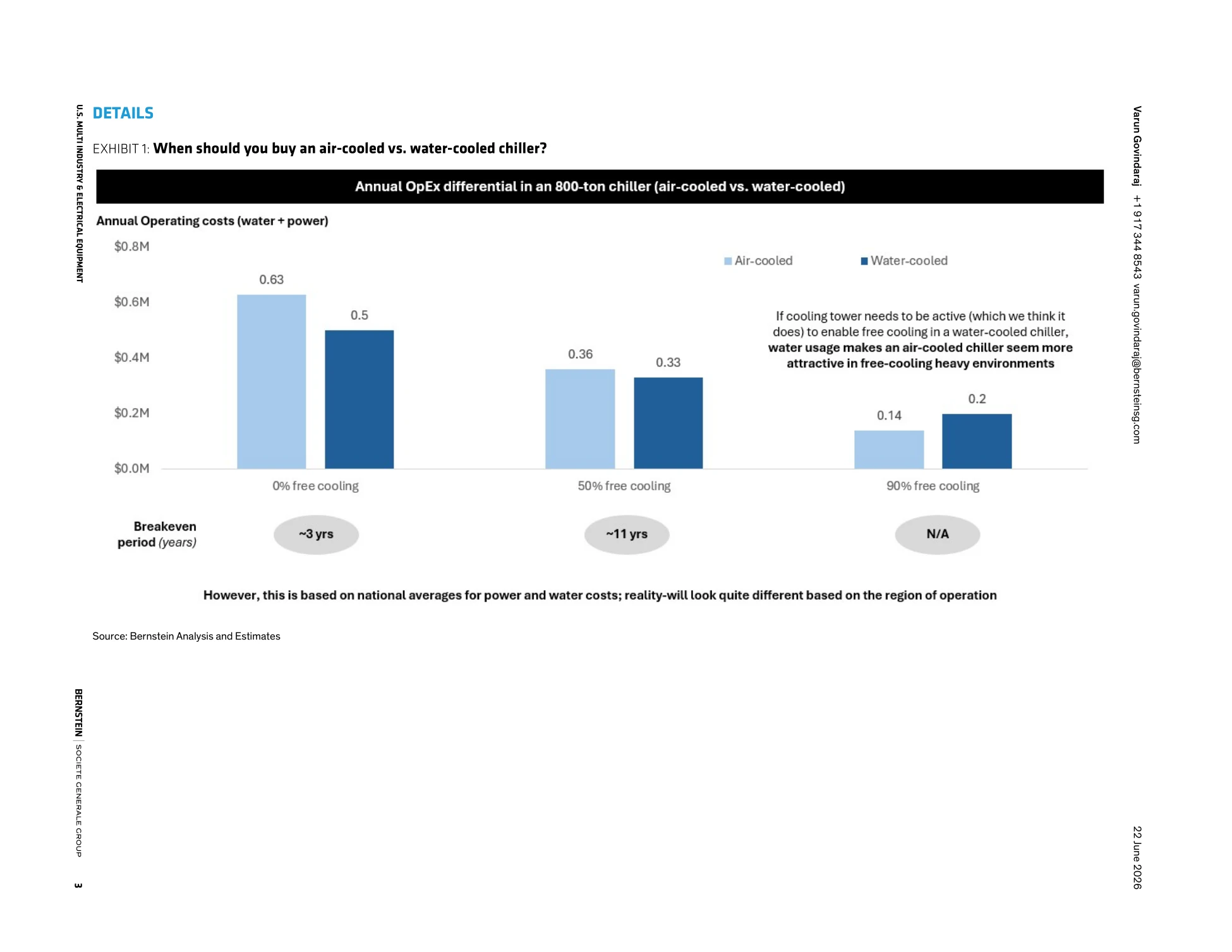
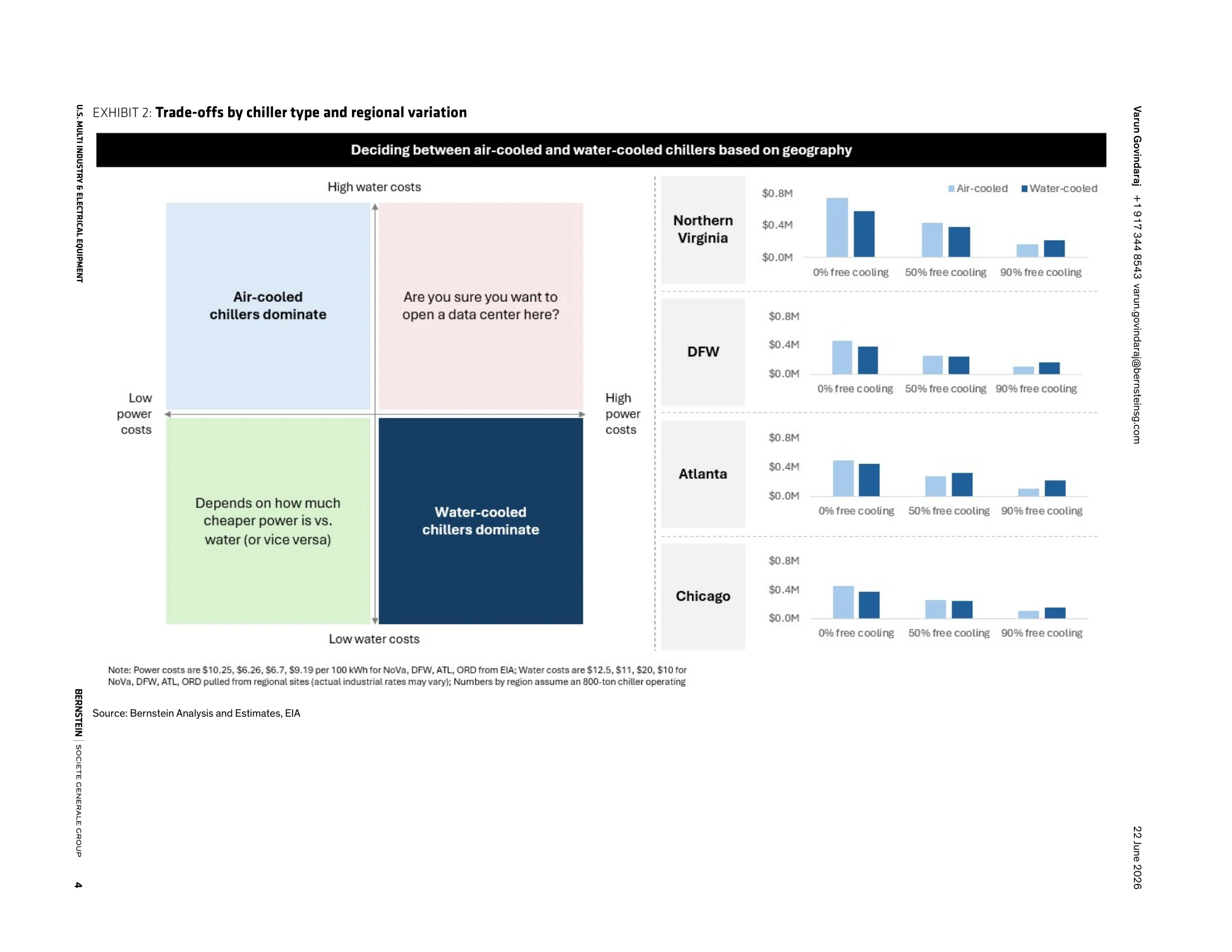
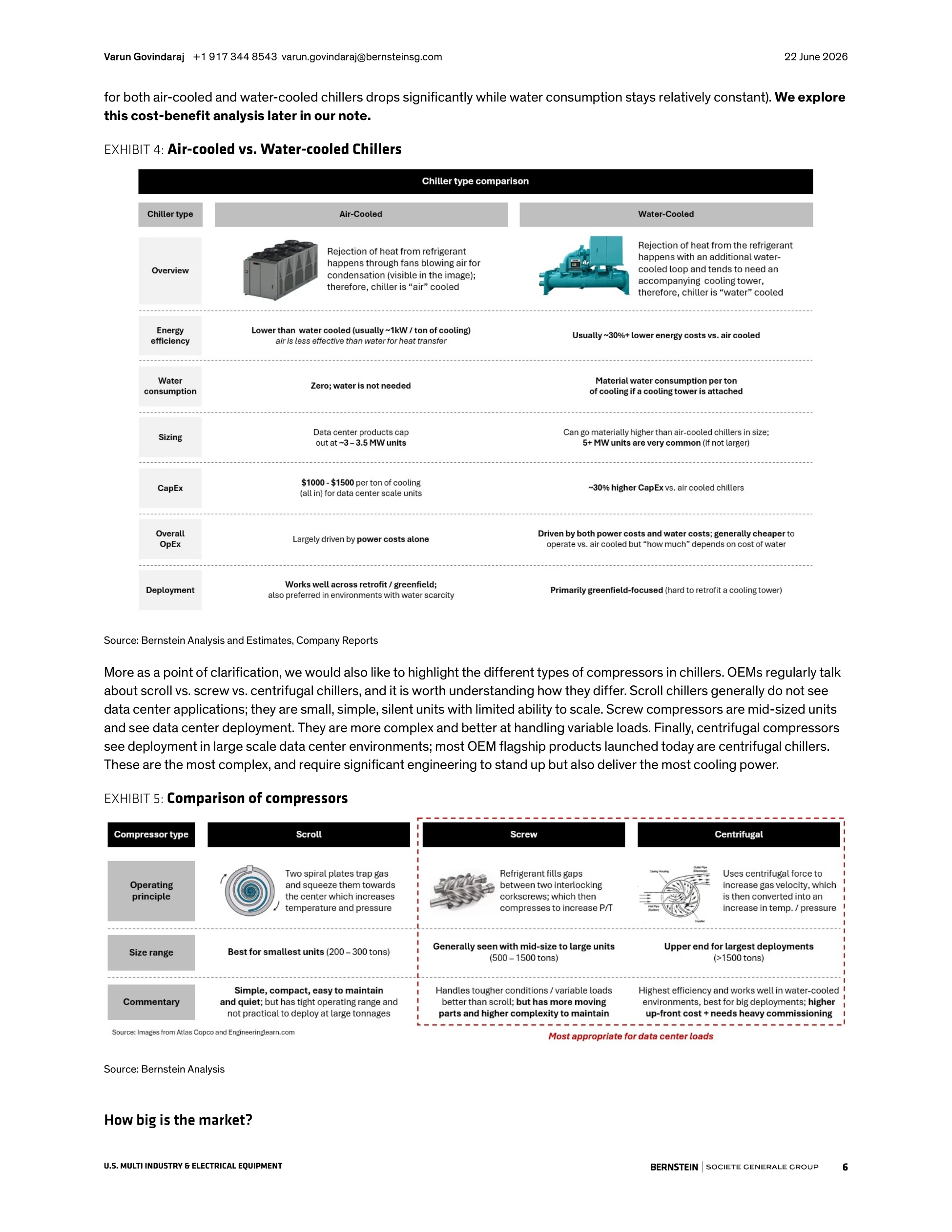
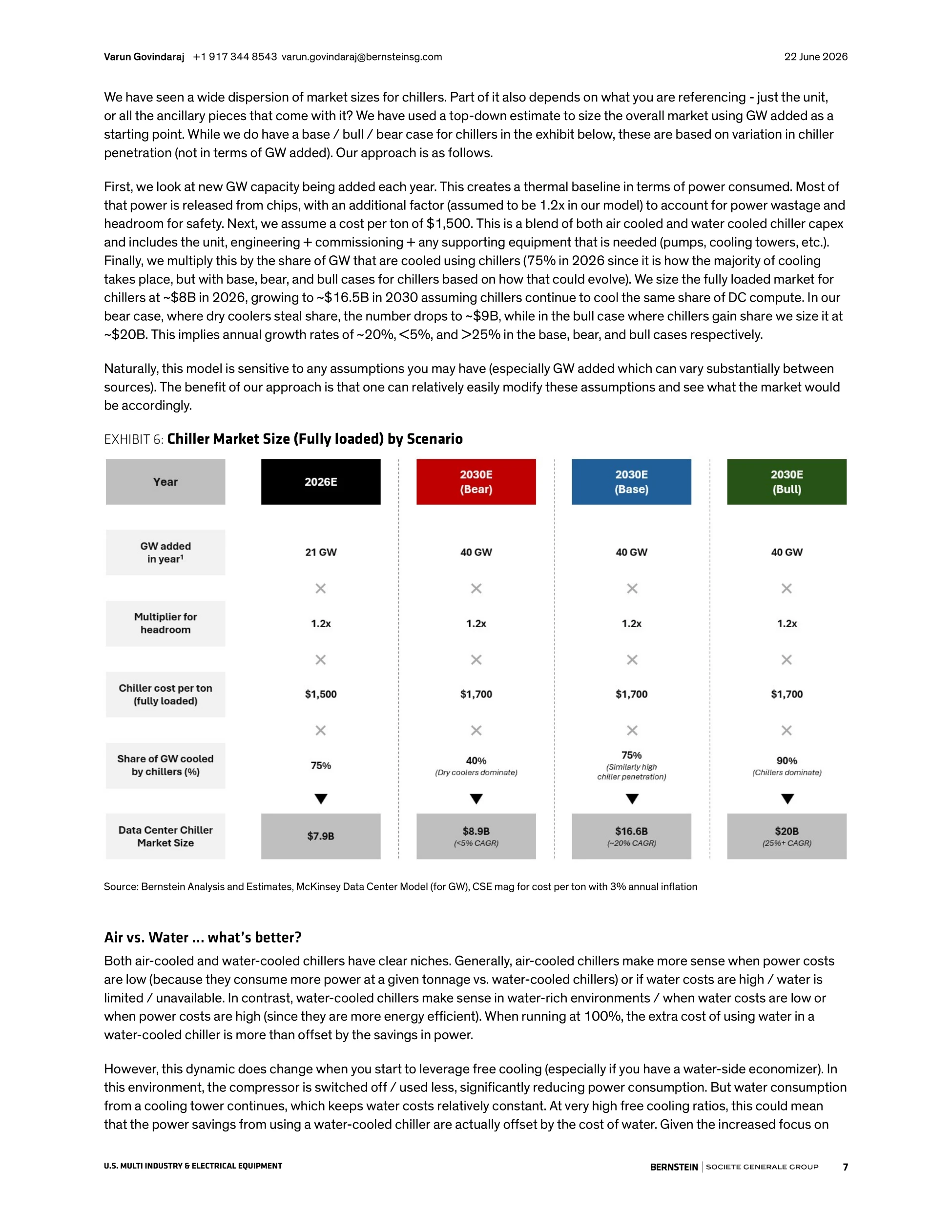
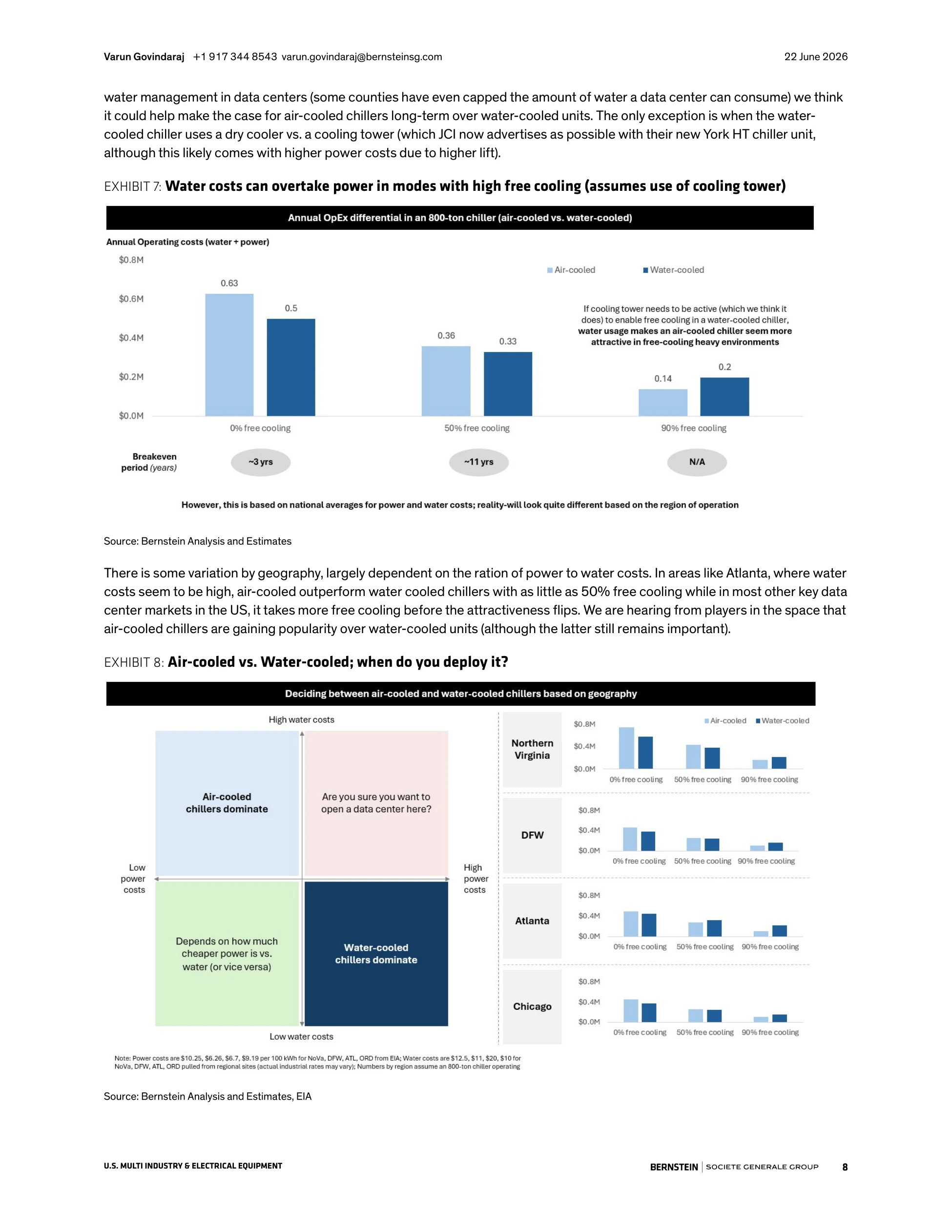
22 June 2026U.S. Multi Industry & Electrical EquipmentData Center Chillers (1/3): Primer and free cooling economicsVarun Govindaraj+1 917 344 8543varun.govindaraj@bernsteinsg.comSpecialist SalesSteve Song+1 917 344 8401steve.song@bernsteinsg.comChillers are a critical part of data center cooling infrastructure both in liquid-cooled andair-cooled environments. They are responsible for creating chilled facility water that thenpumps to CDUs to extract heat from the coolant or to CRAHs to reduce the temperature ofair blowing through the data center. We size this as a ~$8B market in 2026 (fully loadedcost including installation and ancillaries), but the growth outlook can vary significantlybased on how you think chiller penetration changes. Assuming no such changes (our basecase), we project a ~20% CAGR for the market with 2030 estimated at ~$16.5B.We often hear debates of when it makes sense to use air-cooled vs. water cooled units. Asa quick primer, both types of chillers operate using a refrigerant cycle, but air-cooled unitsreject heat from the refrigerant into ambient air, while water-cooled units reject to anotherwater loop (either a cooling tower or a dry cooler). Air-cooled units are lower capex, butmuch less energy efficient. Water-cooled units need more upfront investment and consumelarge quantities of water (if a cooling tower is used), but tend to consume less power for thesame tonnage. So it really is a sensitivity analysis of what you think your operatingconditions and input costs will be when making the decision.To illustrate this, we looked at how much it would cost to run an 800 ton chiller (roughly 2.5MW) - assuming it was air-cooled or water-cooled. When the compressor of the chiller ran24X7, annual operating costs were roughly 25% higher for an air-cooled chiller vs.a water-cooled unit, implying a ~3 year payback on the cost differential. So water-cooled units are always better, right?It is not that simple. This dynamic can change quite drastically when you take free-cooling into account. Free-cooling is a when the ambient temperature drops enough forthe data center operator to tone down (and in some cases switch off) the compressor in thechiller. It’s a bit of a misnomer, the cooling isn’t entirely free (you still need some power) butit’s a fraction of what you’d need with the compressor running at 100%.Energy consumption drops significantly for both air-cooled and water-cooled units.However, water costs stay relatively constant for water-cooled chillers (assuming a coolingtower is used). So as you spend more time in a free cooling environment, you mayrun into a situation where it is actually cheaper to operate an air-cooled chiller vs.a water-cooled chiller. This could be why we are hearing people talk about air-cooledchillers gaining share in the market.We also spent some time benchmarking chiller offerings by key player...







































