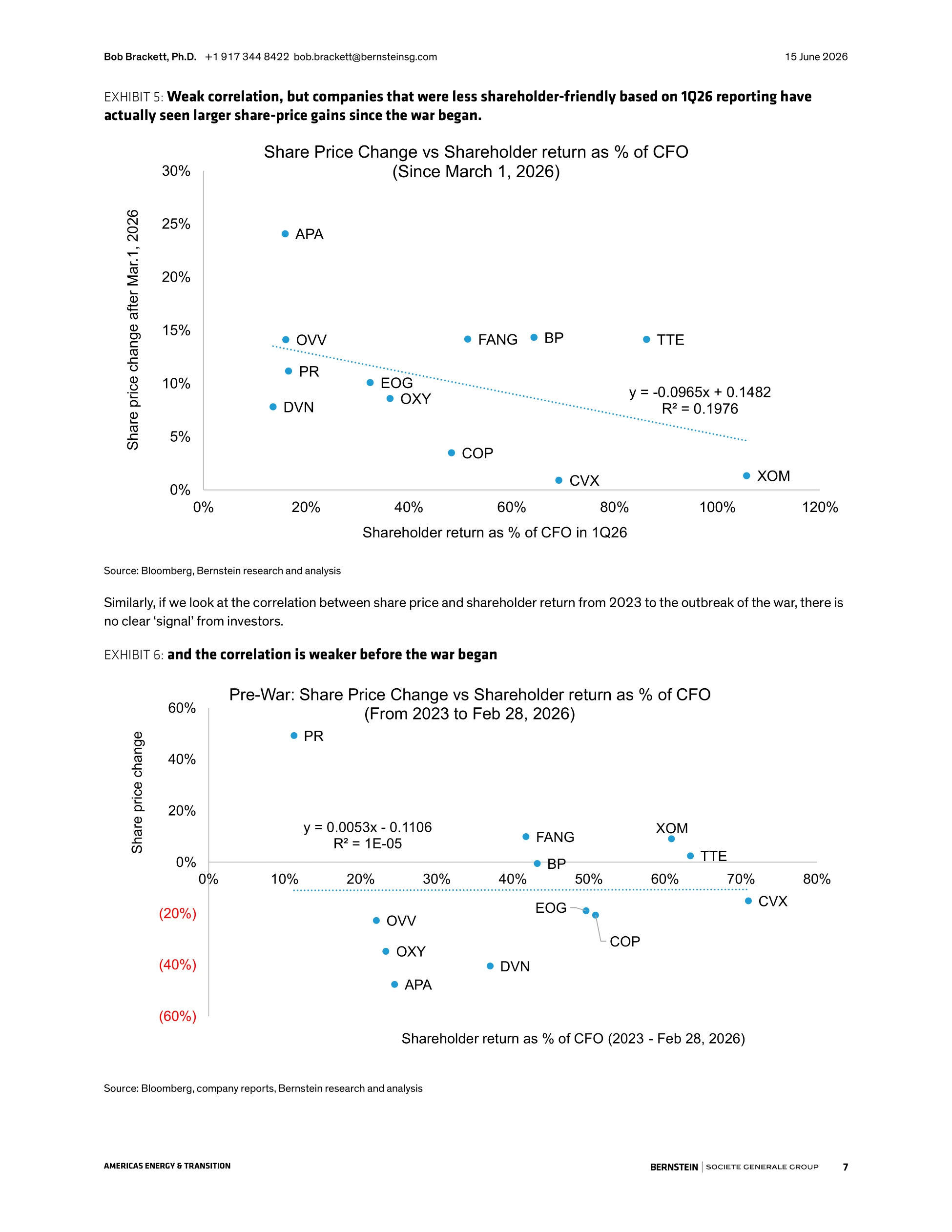
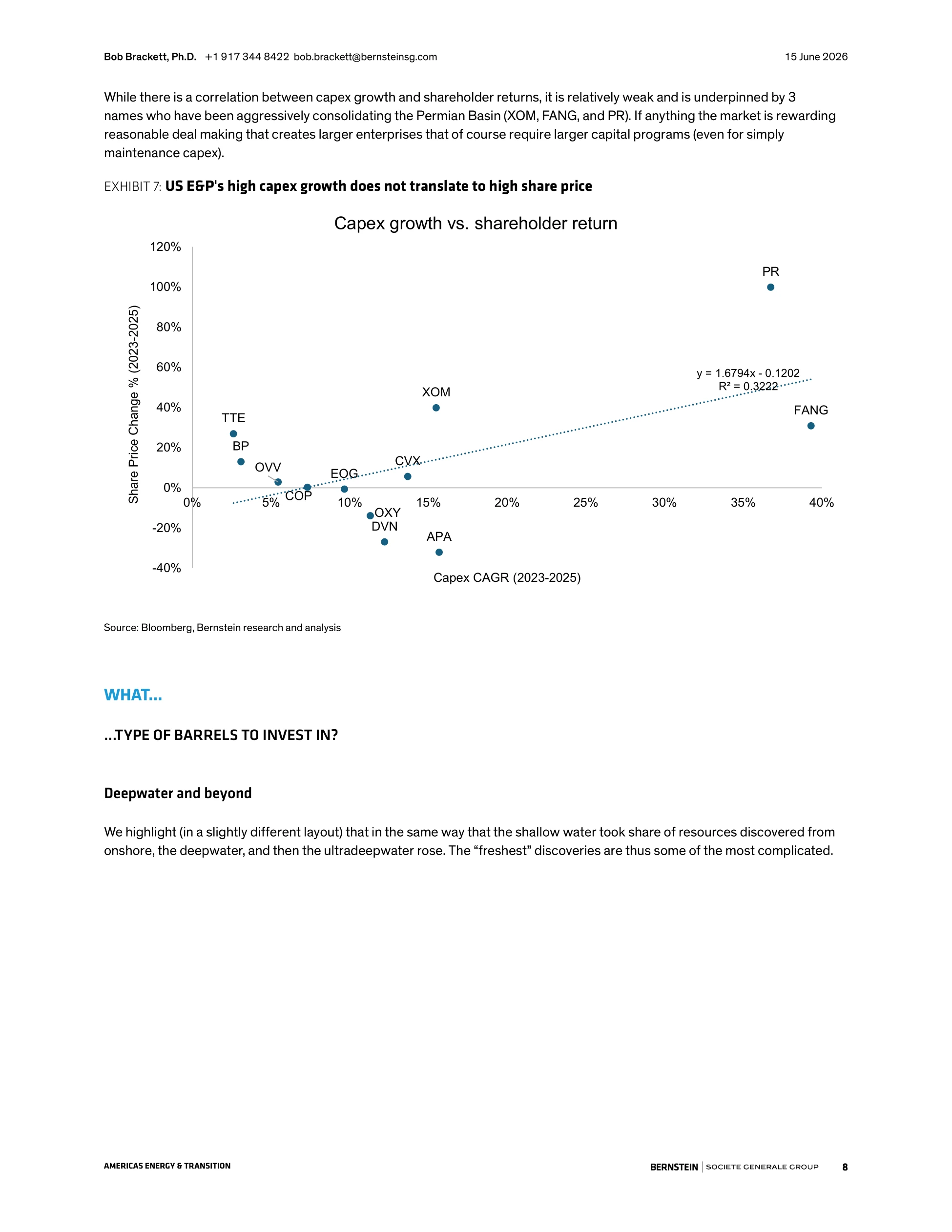
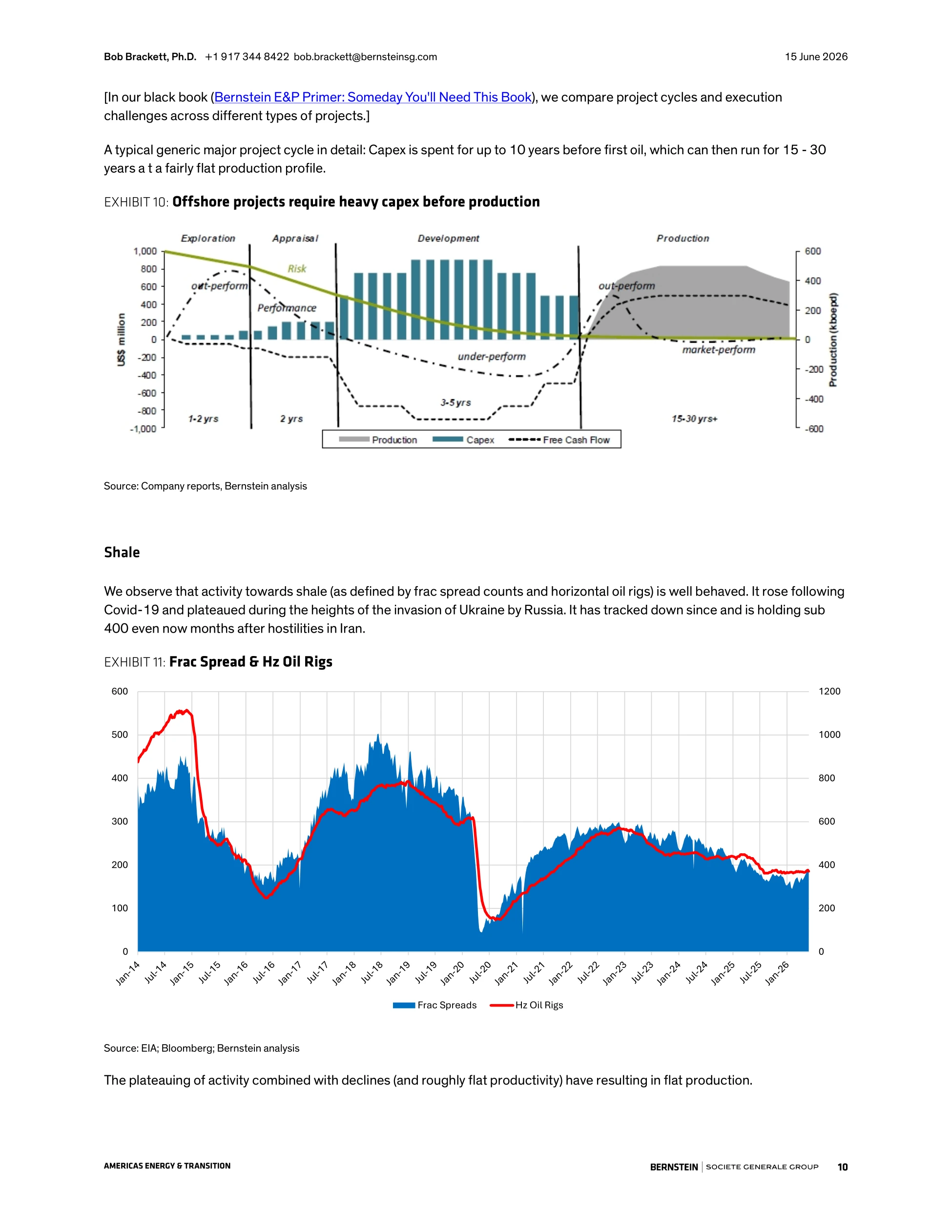
15 June 2026Americas Energy & TransitionBernstein Energy: Applying the 5 "W"s to an upstream capexsupercycle...we are unconvincedBob Brackett, Ph.D.+1 917 344 8422bob.brackett@bernsteinsg.comMinnie Xu+1 917 344 8574minnie.xu@bernsteinsg.comAnshika Bajpai+1 917 344 8306anshika.bajpai@bernsteinsg.comToday, we use our outlook for global upstream oil & gas capital expenditures (BernsteinEnergy: Global Upstream Capex 2026...the quantity of capex falls now...does the quality ofcapex follow?) to consider the current environment. We still see a pullback of ~$40 blnupstream capex in 2026 driven by lagging company conservatism in uncertain oiland geopolitical environment. Public E&Ps remain disciplined, OFS companies are notmaterially resetting FY26 guidance higher, shale productivity gains are harder to achieve, anda large share of discovered resources remains undeveloped because the barrels are long-cycle, politically difficult, or no longer cheap to develop.In a post Strait of Hormuz world, we would expect perhaps ~$560 bln in total upstreamcapex Exhibit 1, ~$50 bln more from our previous forecast in Jan 2026, when Brentaveraged ~$70/bbl. Today, Brent is ~$90/bbl, but we’d expect planning prices haverisen to at most $70/bbl.In this note, we use the five-W framework to assess the likelihood of an upstream capexsupercycle.1. WHY invest? Cash flow is up, but reinvestment appetite is not. Higher Brent hasimproved E&P cash flow, but investors continue to reward capital discipline, buybacksand free cash flow durability over production growth (Exhibit 3 - Exhibit 7.2. WHAT barrels get developed? Roughly 1/3 of the discovered resources over the pastcentury remains undeveloped (Exhibit 8) with deepwater + barrels leading discoveries.The problem is that those deepwater barrels are increasingly harder to convert intosupply (Exhibit 9 and Exhibit 10). Shale barrels are content to plateau (Exhibit 12) whileoil sands barrels (Exhibit 13) need more clarity.3. WHO will invest? NOCs, not public E&Ps, lead the next cycle. The marginal growthbarrel is increasingly controlled by NOCs and state-directed players, not U.S. shaleindependents (Exhibit 14 - Exhibit 16).4. WHERE can capital go? The best geology is often in the worst jurisdictions.Many of the largest undeveloped barrels sit in countries with high fiscal take, politicalinstability, sanctions or weak rule of law (Exhibit 17 -Exhibit 18)5. WHEN to invest? Usually, high oil prices trigger a sharp pickup in rig activity, but thatpattern has broken down this time, and we have not yet seen any raise of guidance fromoil services and equipment companies ( Exhibit 19 - Exhibit 20). Upstream inflation alsomeans companies are spending more simply to hold activity flat.See the Disclosure Appendix of this report for required disclosures, analyst certifications and otherimportant information. Alternatively, visit our Global Research Disclosure W...







































