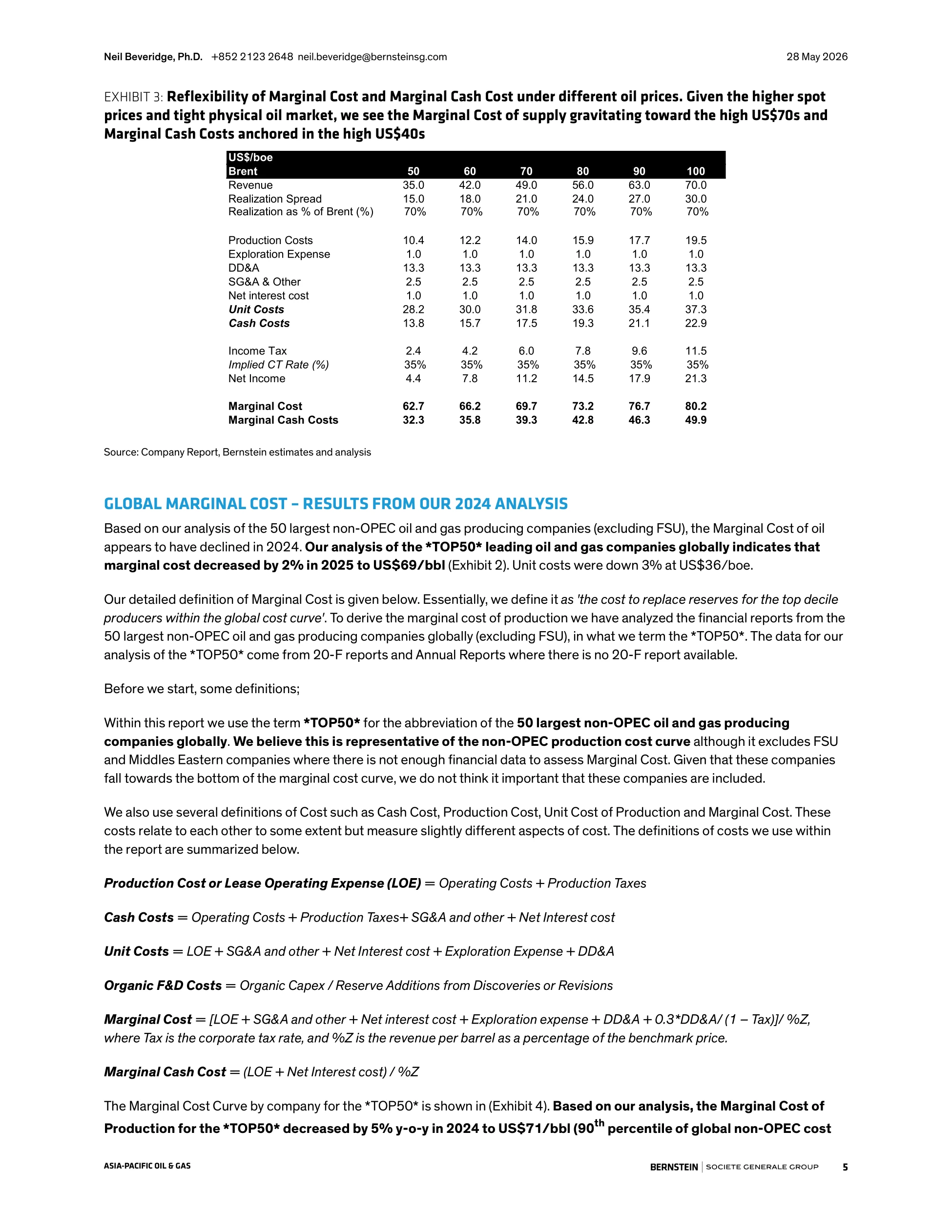
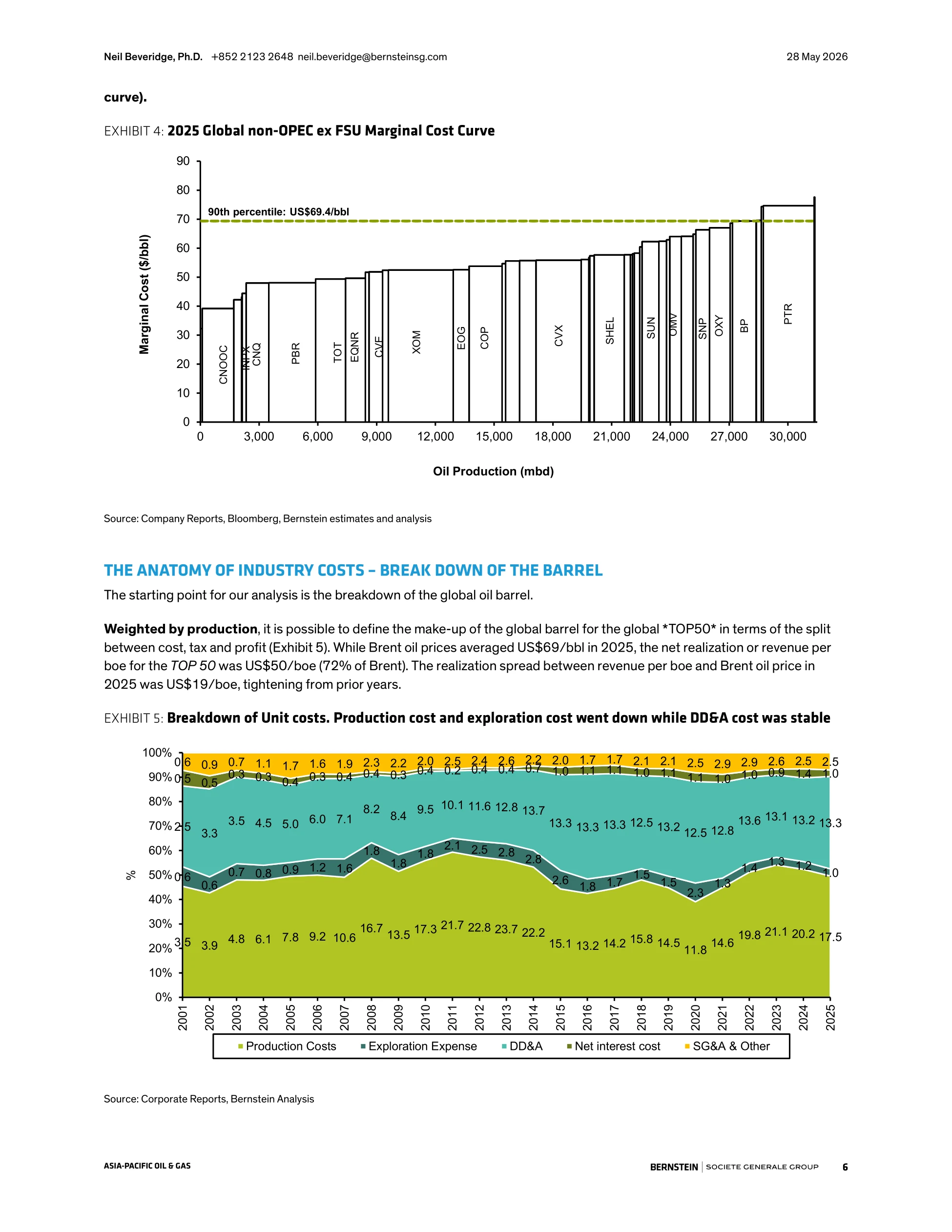
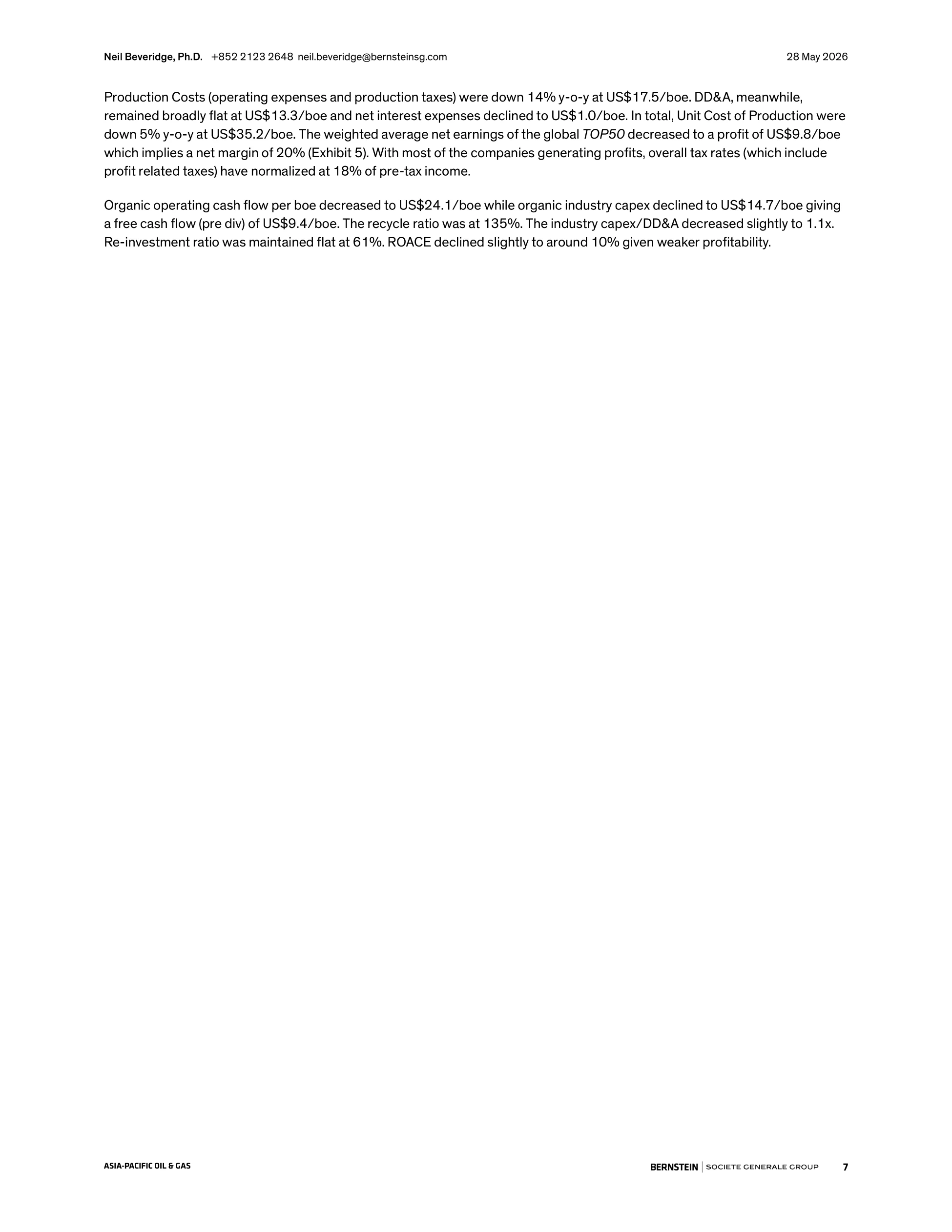
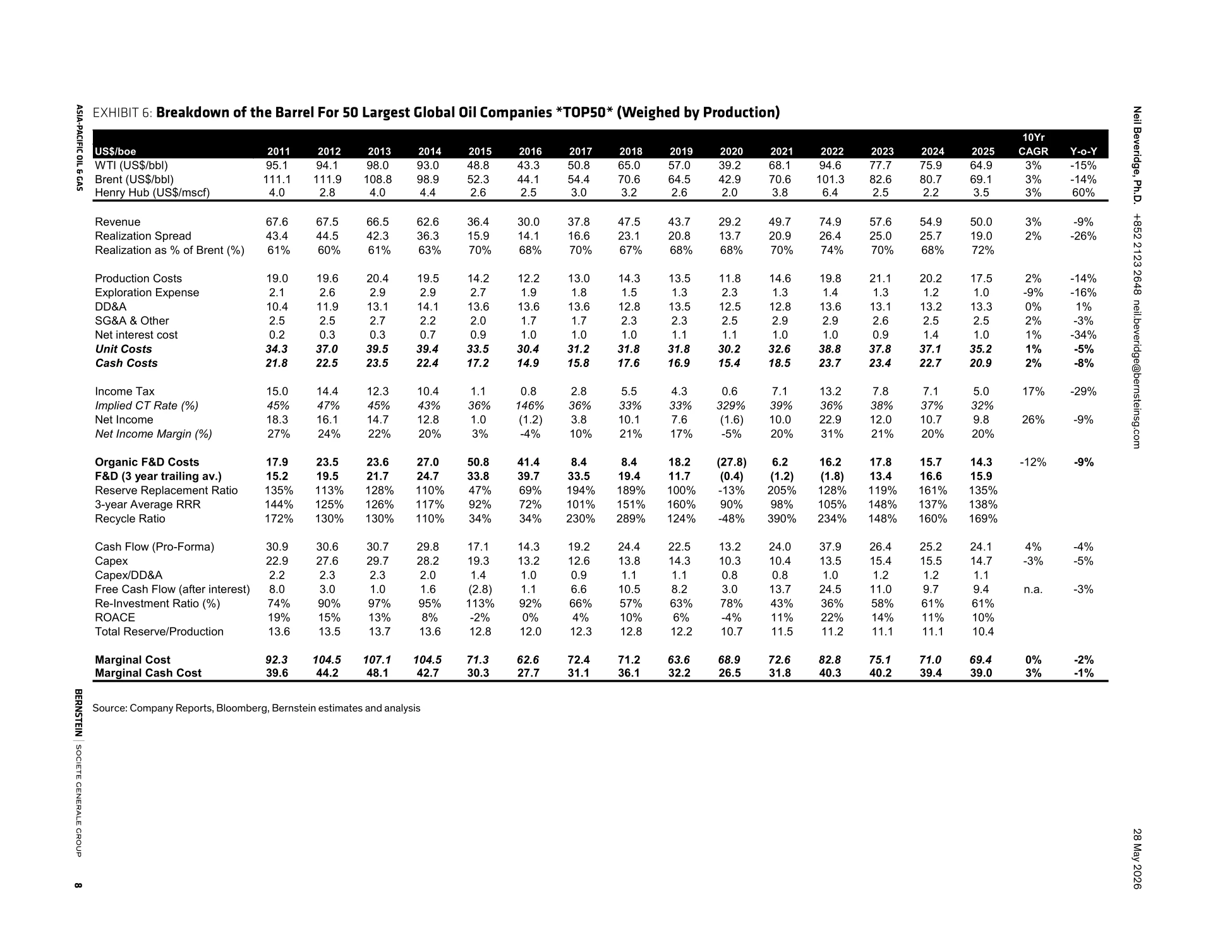
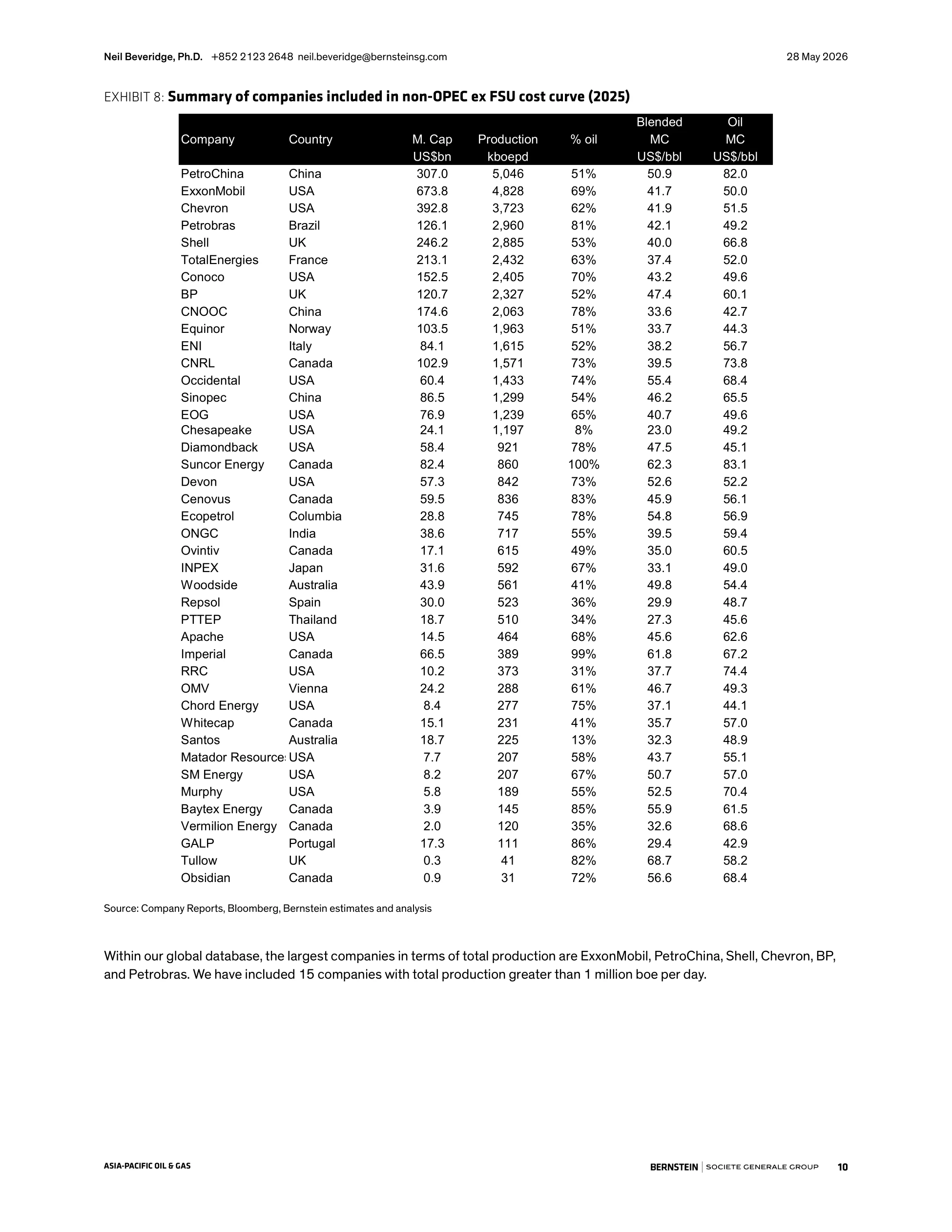
28 May 2026Asia-Pacific Oil & GasBernstein Energy: Global Oil Marginal Cost Survey. What is thelong term price for oil?Neil Beveridge, Ph.D.+852 2123 2648neil.beveridge@bernsteinsg.comBrian Ho, CFA+852 2123 2615brian.ho@bernsteinsg.comKelvin Yuan, Ph.D., CFA+852 2123 2612kelvin.yuan@bernsteinsg.comWe surveyed the 50 largest listed oil and gas companies globally (TOP50), which togetheraccount for roughly two-thirds of non-OPEC oil supply (excluding the FSU). Based on 2025annual reports, we estimate that the global oil marginal cost declined by 2% YoY last yearto US$69/bbl. Adjusting for cost inflation and price reflexivity to oil price we expectmarginal cost will reach US$77/bbl in 2026.Global Marginal Cost of oil for non-OPEC oil producers decreased 2% to US$69/bblin 2025. The decline in marginal cost was broad driven by lower production costs (-14%y-o-y). Meanwhile, DD&A and exploration expenses were largely stable y-o-y at US$13.3/boe and US$1.0/boe respectively. Interest expense declined to US$1.0/boe. The MarginalCost of Oil is below the current spot price and in line with the long-term forward strip (US$70/bbl). Global Marginal Cash Cost of production, which sets a floor for oil price,remained largely stable at US$39/bbl.With a tighter oil market and higher spot prices, we expect 2026 marginal cost tocome in at US$77/bbl. The US$69/bbl level remains a key long-term reference, thoughbackward-looking. Given the reflexivity of costs to oil price, we expect higher spot pricesand a tighter physical market to drive cost inflation across the supply chain, lifting themarginal cost of supply towards US$77/bbl for this year. This is consistent with our US$75/bbl as a reasonable long term oil price assumption for equity valuation, abovethe current 60M forward strip of US$70/bbl.Net income breakeven for the oil industry is US$50/bbl. Global Unit Production Costdeclined by 5% y-o-y to US$35/boe. Given the realization spread between oil price andrevenue per boe of 72%, it implies the industry needs a US$50/bbl oil price to 'break even'on a net income basis. Industry ROACE declined last year to 10% (at an oil price of US$70/bbl) which is in line with the long term industry average and cost of capital of10%. Average net income was US$9.8/boe (-9% y-o-y) with net income margin of 20%.Free cash flow declined to US$9.4/boe (-3%) with lower cash flow alongside a modestdecline in capex (-5%).Industry re-investment rate (capex to cash flow) was stable at 61% in 2025 butremains well below the long-term average. Industry capex per unit of flowing barreldeclined to US$14.7/boe. After troughing at 36% in 2022, the reinvestment ratiorecovered to 61% in 2025, though still below the 80–90% long-term range, reflecting amore cautious outlook on long-term demand.Reserve life remains on a declining trend given lower re-investment in recent yearsand the 1P oil reserves life ...







































