
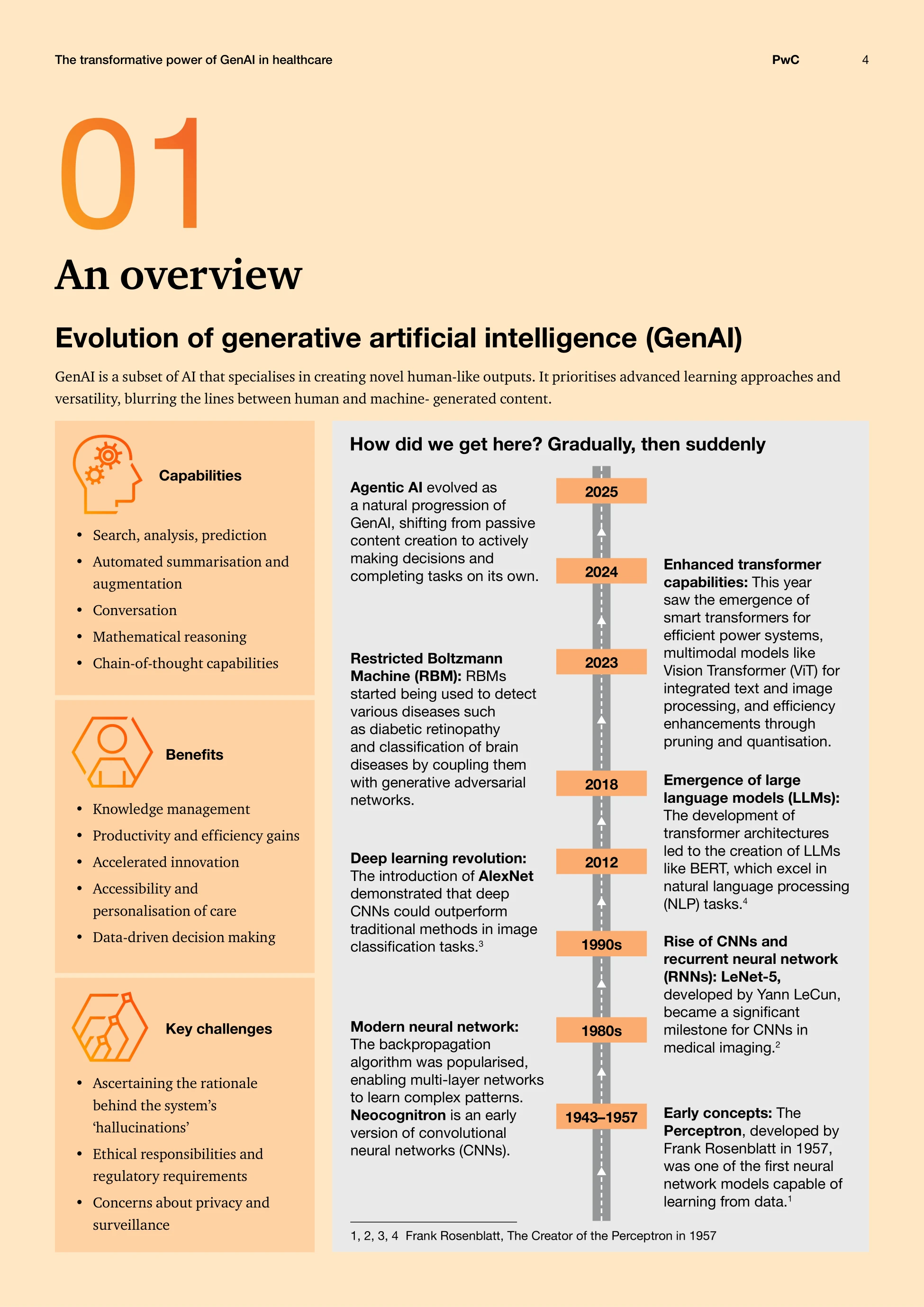
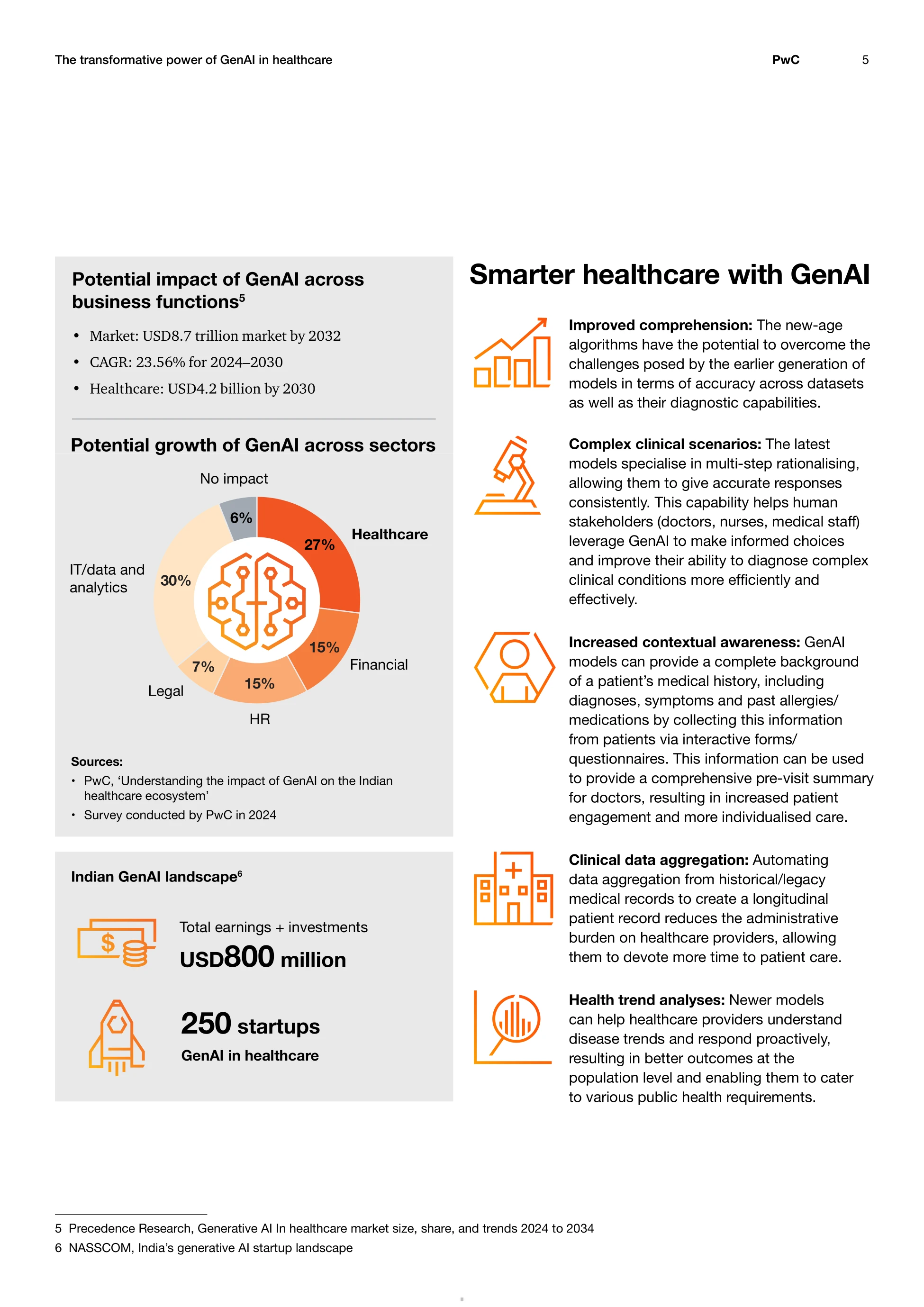
Key budget amendments 2025 | Towards sustainable growth and prosperity1PwCThe transformative power of GenAI in healthcareJanuary 2026The transformative power of GenAI in healthcare2PwCThe transformative power of GenAI in healthcare3PwC01 An overview 0402 Opportunities in the Indian healthcare system 0603 Building a holistic GenAI ecosystem 2604 Regulatory frameworks around GenAI 3205 Navigating risks while deploying GenAI 3406 Way forward: Developing a winning ecosystem in India 40Table of contentsAn overviewGenAI is a subset of AI that specialises in creating novel human-like outputs. It prioritises advanced learning approaches and versatility, blurring the lines between human and machine- generated content.01Evolution of generative artificial intelligence (GenAI)Capabilities• Search, analysis, prediction• Automated summarisation andaugmentation• Conversation• Mathematical reasoning• Chain-of-thought capabilitiesBenefits• Knowledge management• Productivity and efficiency gains• Accelerated innovation• Accessibility andpersonalisation of care• Data-driven decision makingKey challenges• Ascertaining the rationalebehind the system’s‘hallucinations’• Ethical responsibilities andregulatory requirements• Concerns about privacy andsurveillanceEarly concepts: The Perceptron, developed by Frank Rosenblatt in 1957, was one of the first neural network models capable of learning from data.11943–1957Modern neural network: The backpropagation algorithm was popularised, enabling multi-layer networks to learn complex patterns. Neocognitron is an early version of convolutional neural networks (CNNs).1980sDeep learning revolution: The introduction of AlexNet demonstrated that deep CNNs could outperform traditional methods in image classification tasks.32012Restricted Boltzmann Machine (RBM): RBMs started being used to detect various diseases such as diabetic retinopathy and classification of brain diseases by coupling them with generative adversarial networks.2023Agentic AI evolved as a natural progression of GenAI, shifting from passive content creation to actively making decisions and completing tasks on its own.2025Rise of CNNs and recurrent neural network (RNNs): LeNet-5, developed by Yann LeCun, became a significant milestone for CNNs in medical imaging.21990sEmergence of large language models (LLMs): The development of transformer architectures led to the creation of LLMs like BERT, which excel in natural language processing (NLP) tasks.42018Enhanced transformer capabilities: This year saw the emergence of smart transformers for efficient power systems, multimodal models like Vision Transformer (ViT) for integrated text and image processing, and efficiency enhancements through pruning and quantisation.2024The transformative power of GenAI in healthcare4PwCHow did we get here? Gradually, then suddenly1, 2, 3, 4 Frank Rosenblatt, The Creator of the Perceptron in 1957The transformative power of GenAI in healt...