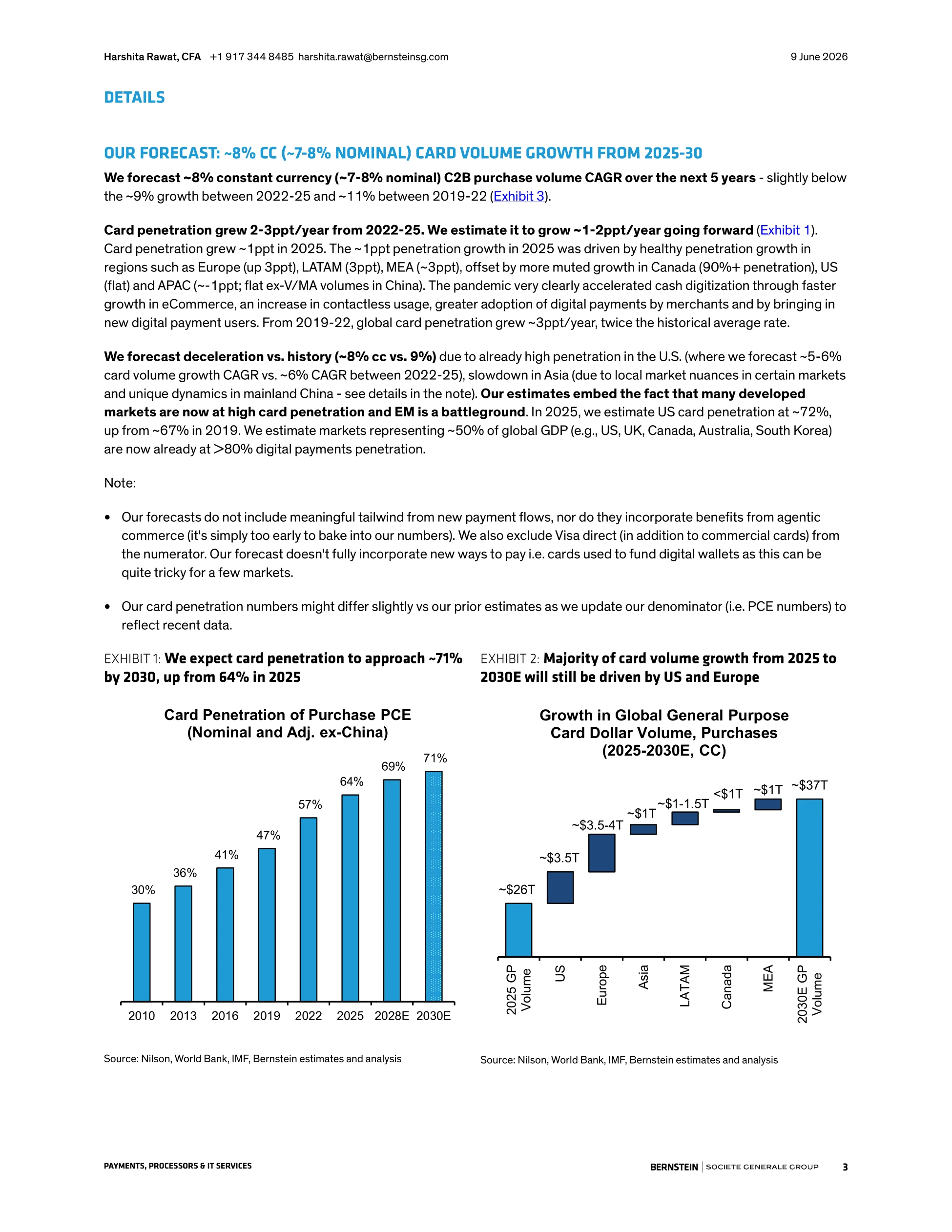
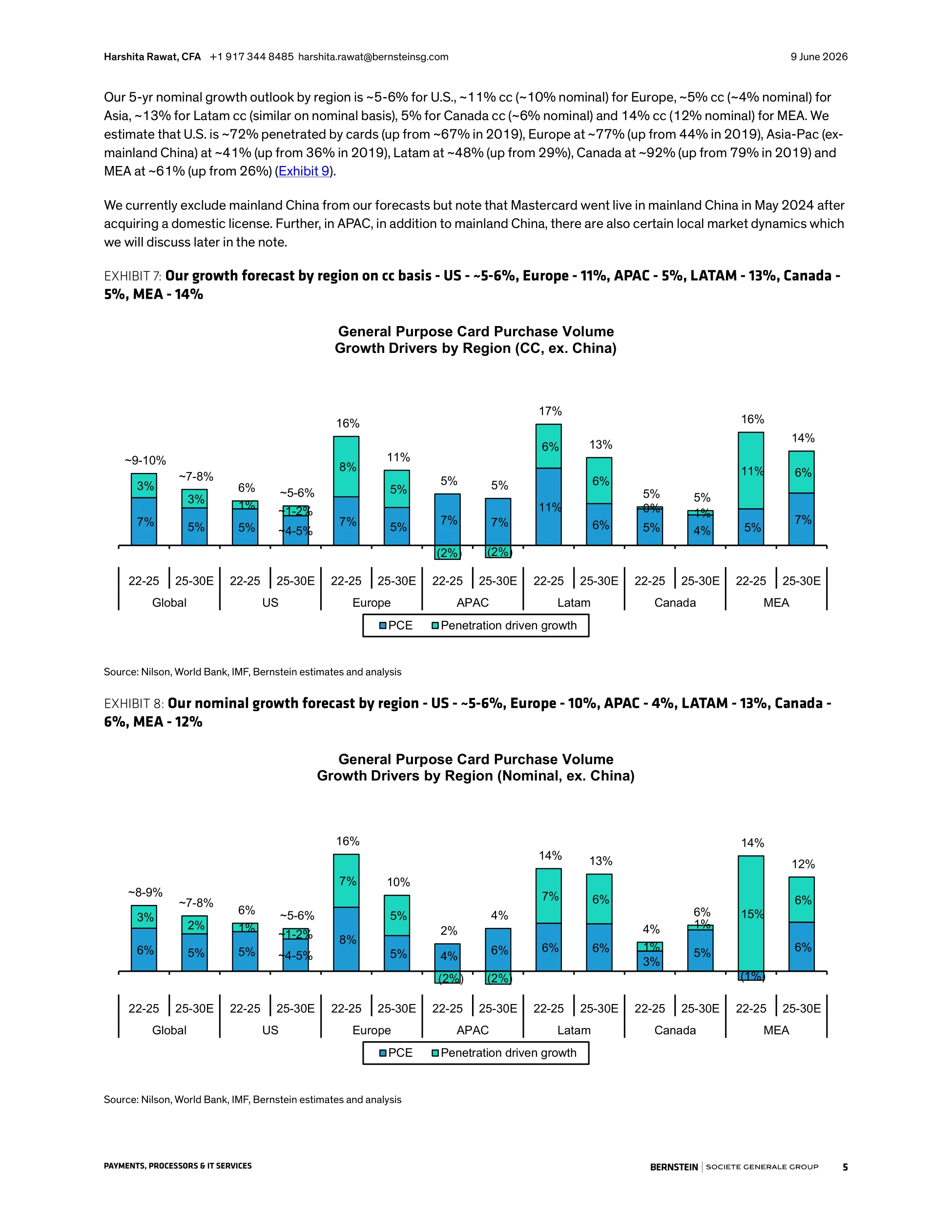
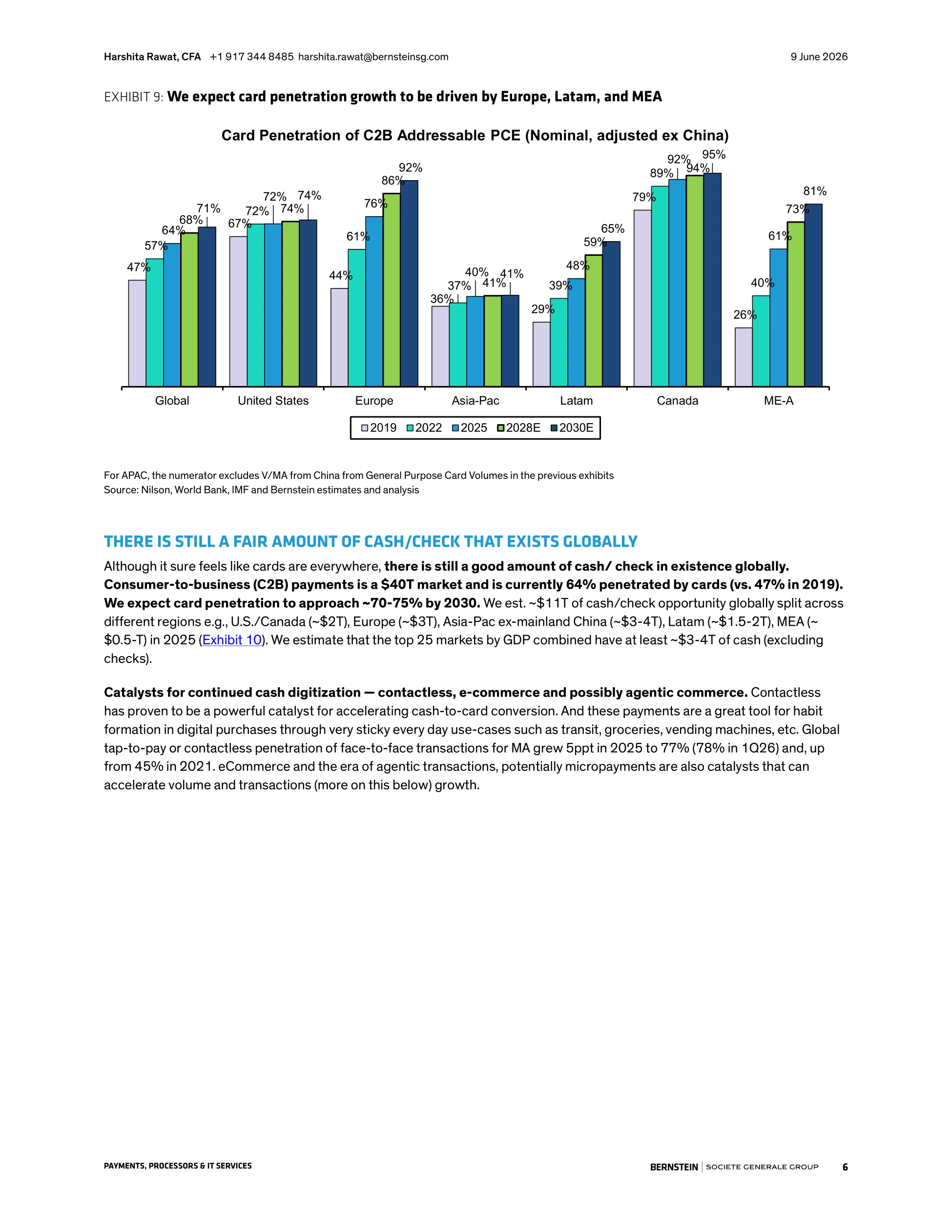
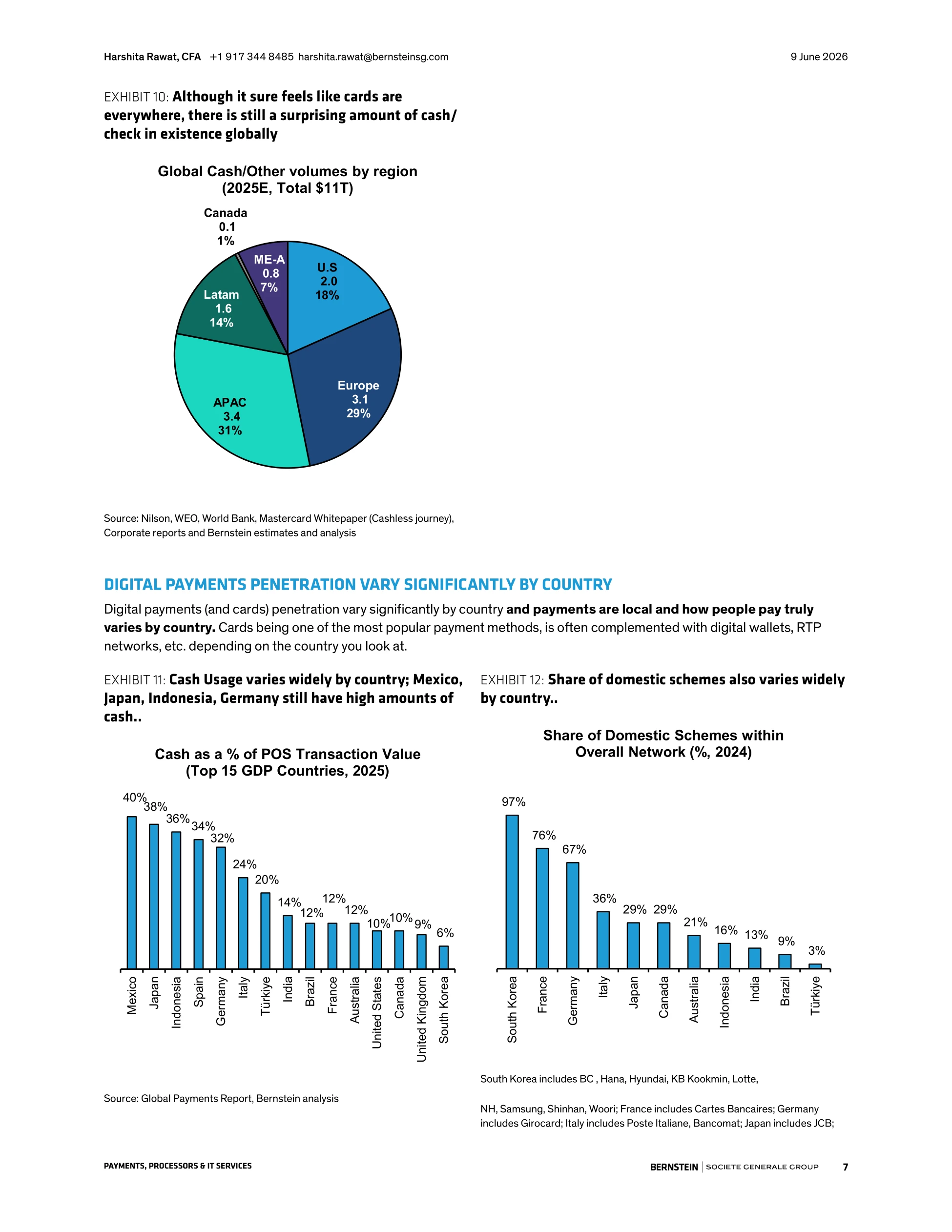
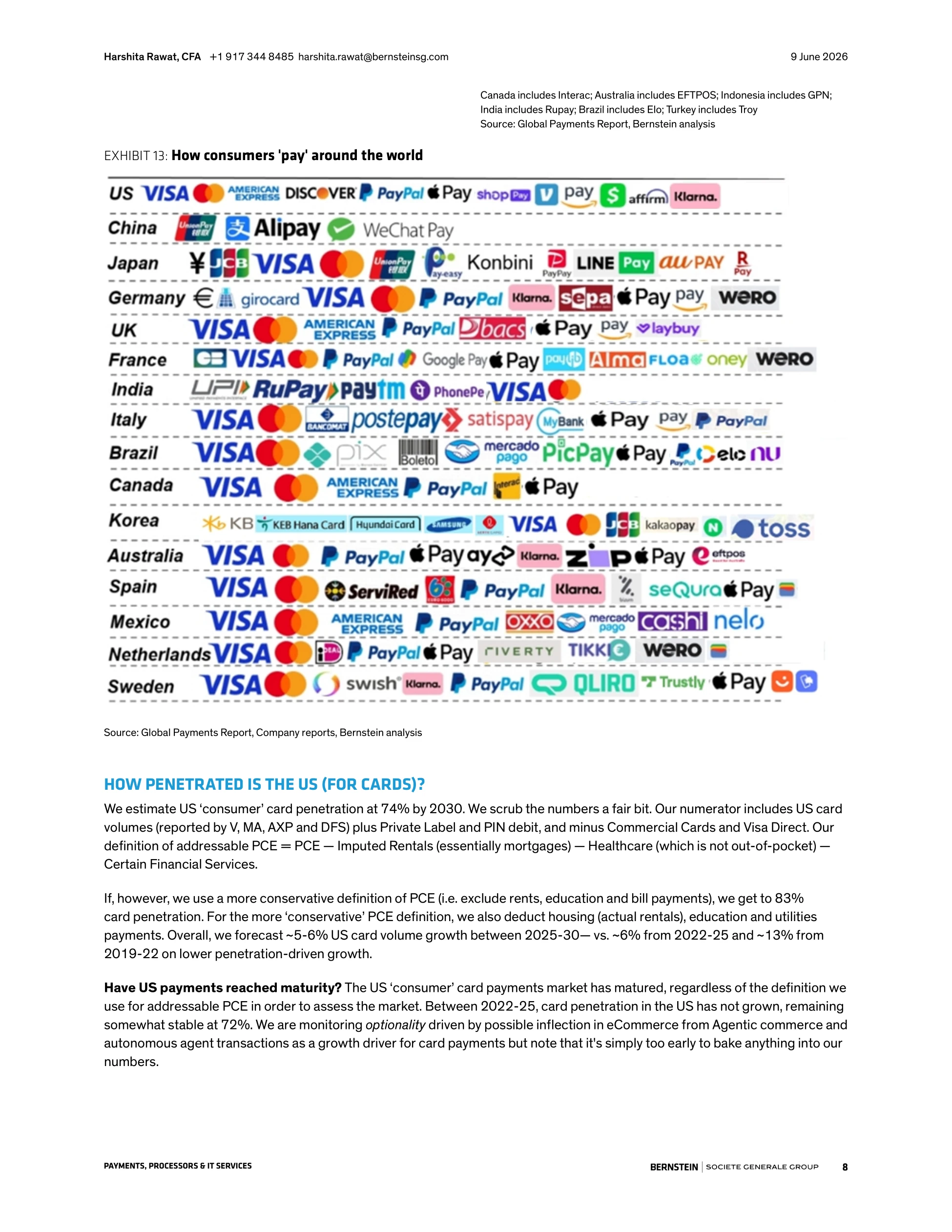
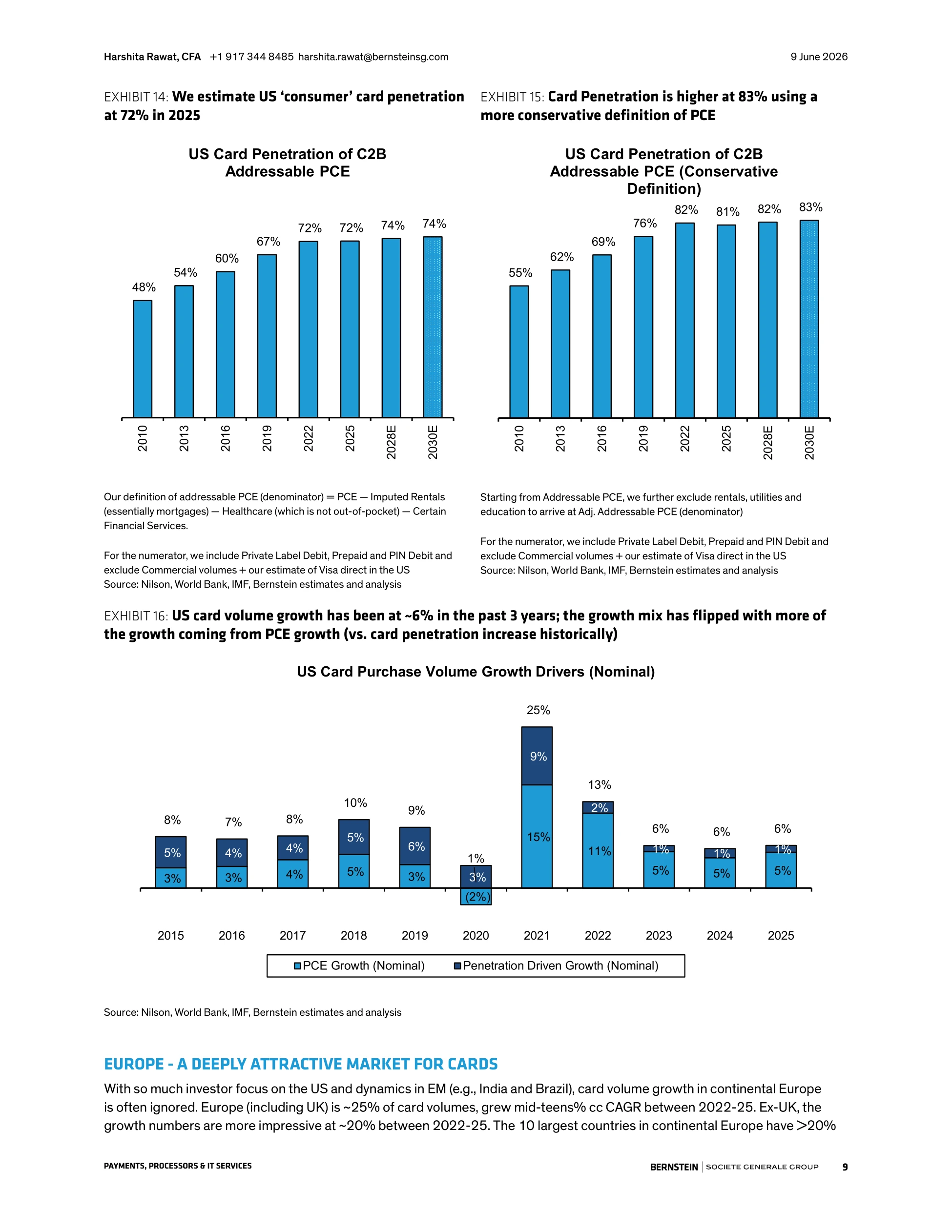
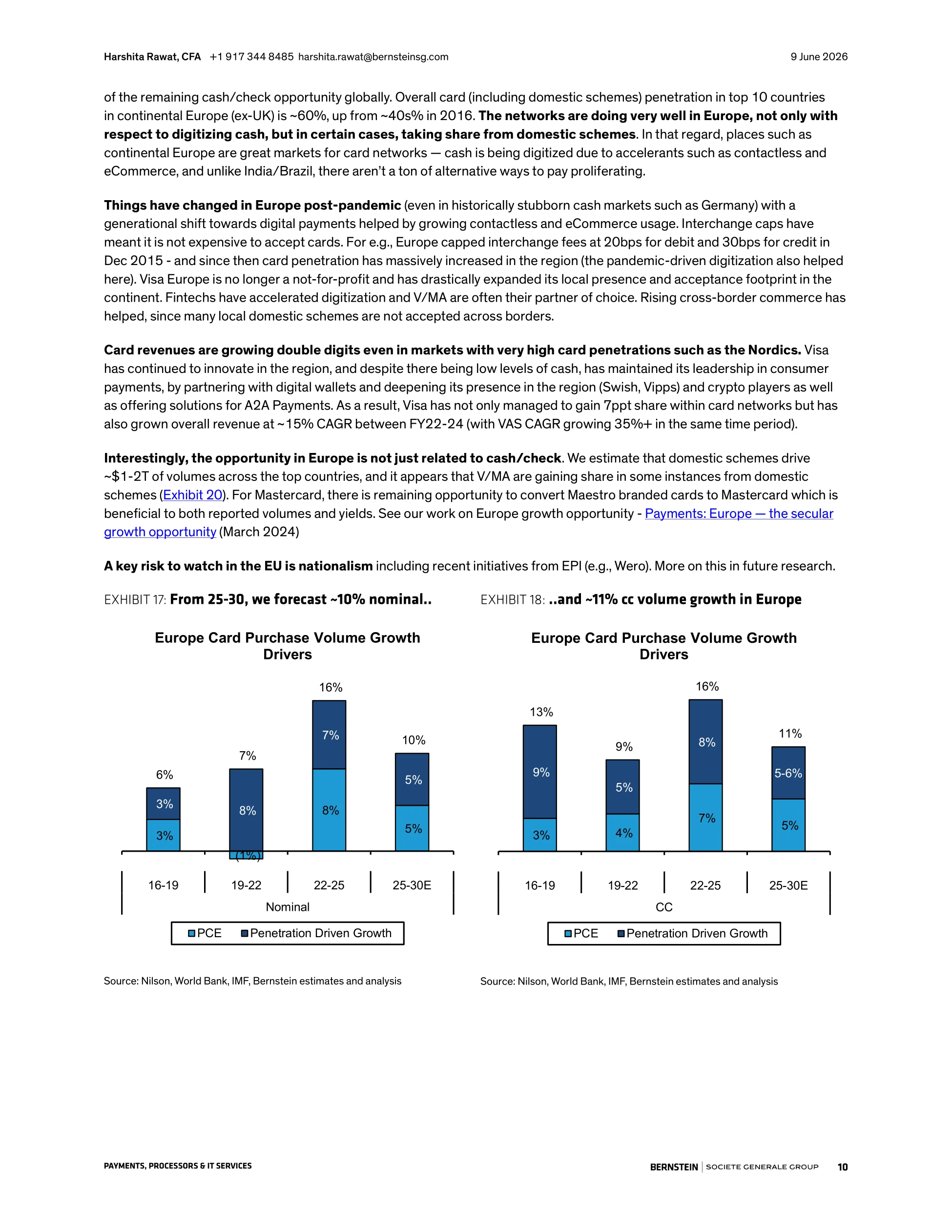
LONG VIEW9 June 2026Payments, Processors & IT ServicesThe Long View: Payments - Does Cash Digitization Runway StillExist?Harshita Rawat, CFA+1 917 344 8485harshita.rawat@bernsteinsg.comSimran Ratani+1 917 344 8329simran.ratani@bernsteinsg.comViola Chen+1 917 344 8614viola.chen@bernsteinsg.comWe publish the 12th annual edition of our global payments forecast model. A lot has changedin the last 10+ years - U.S. is now highly penetrated by cards (72% vs. 58% ten years ago),local payment methods have gained traction (e.g., in Asia where card volume growth hassomewhat stalled), domestic schemes have lost share (e.g., in Europe), other alternative waysto pay (e.g., A2A) have generated noise but have remained contained, and stablecoins arefinding some utility in markets where dollars are desirable. Last year was the first time whenwe brought our forecasts down (see link) - largely because of market maturing in the U.S.and regional dynamics in Asia. Against that dynamic backdrop, our global payments forecastmodel remains the under-pinning of our investment view on the sector and V/MA in particular- even as value-added services capture a growing share of revenue.We forecast 8% cc (~7-8% nominal) card volume growth from 2025-30E (below2022-25 CAGR of 9% cc), driven by 5-6% PCE growth and 2-3% card penetration-driven growth (penetration growing to 71%, up from 64% in 2025). The exit growth ratein 2030 in our model is 7%. We forecast deceleration vs. history (~8% cc vs. 9% cchistorically) due to already high penetration in the U.S. (where we now forecast ~5-6%card volume growth CAGR vs. ~6% CAGR between 2022-25), slowdown in Asia (due tolocal market nuances). Europe remains an attractive market for cards: we forecast 11% ccvolume growth driven by continental Europe (e.g., Germany, Italy, Spain) vs. 16% historically.We are monitoring optionality driven by possible inflection in eCommerce from Agenticcommerce and autonomous agent transactions as a growth driver for card payments butnote that it's simply too early to bake anything into our numbers. We will closely monitor howcards’ commercial models to address historically tougher to address categories such asrent and healthcare.We forecast a stronger growth at 9% in the number of transactions globallybetween 2025-30E (10% 2022-25). Card penetration is lower when assessed as a %of number of transactions (as opposed to transaction value). V/MA derive >1/3rd of theirgross revenue from # of transactions, which tend to grow faster than $ volumes. Cross-border is at an interesting point, and we will address that in a separate note.Card volumes only tell part of the story. We see a runway in tokens, VAS penetration andoptionality in new flows (more details in a separate note), which along with 9% growthin transactions can drive DD% revenue growth despite card volume growth of 8%. Forreference, even in high card ...







































