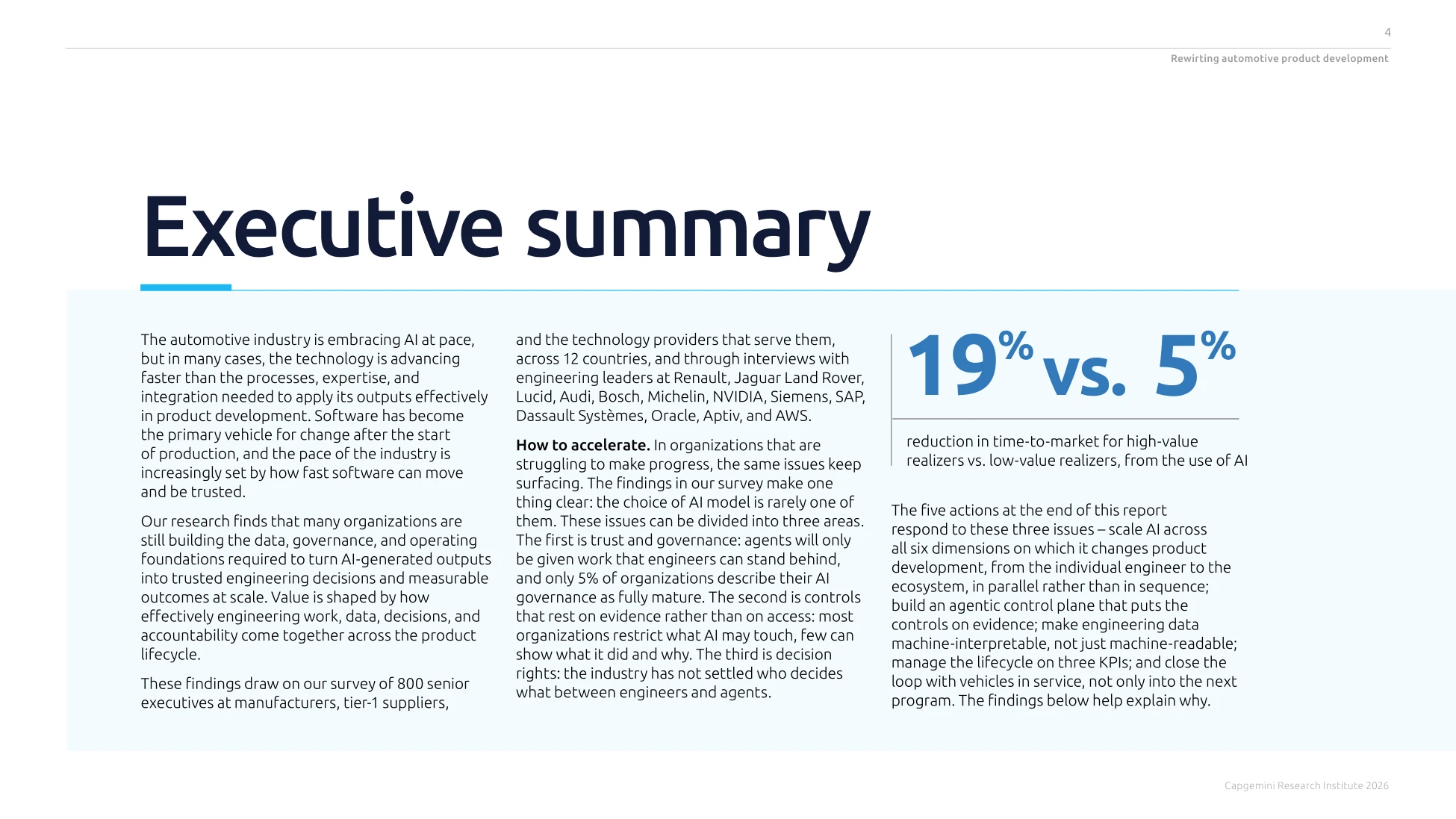
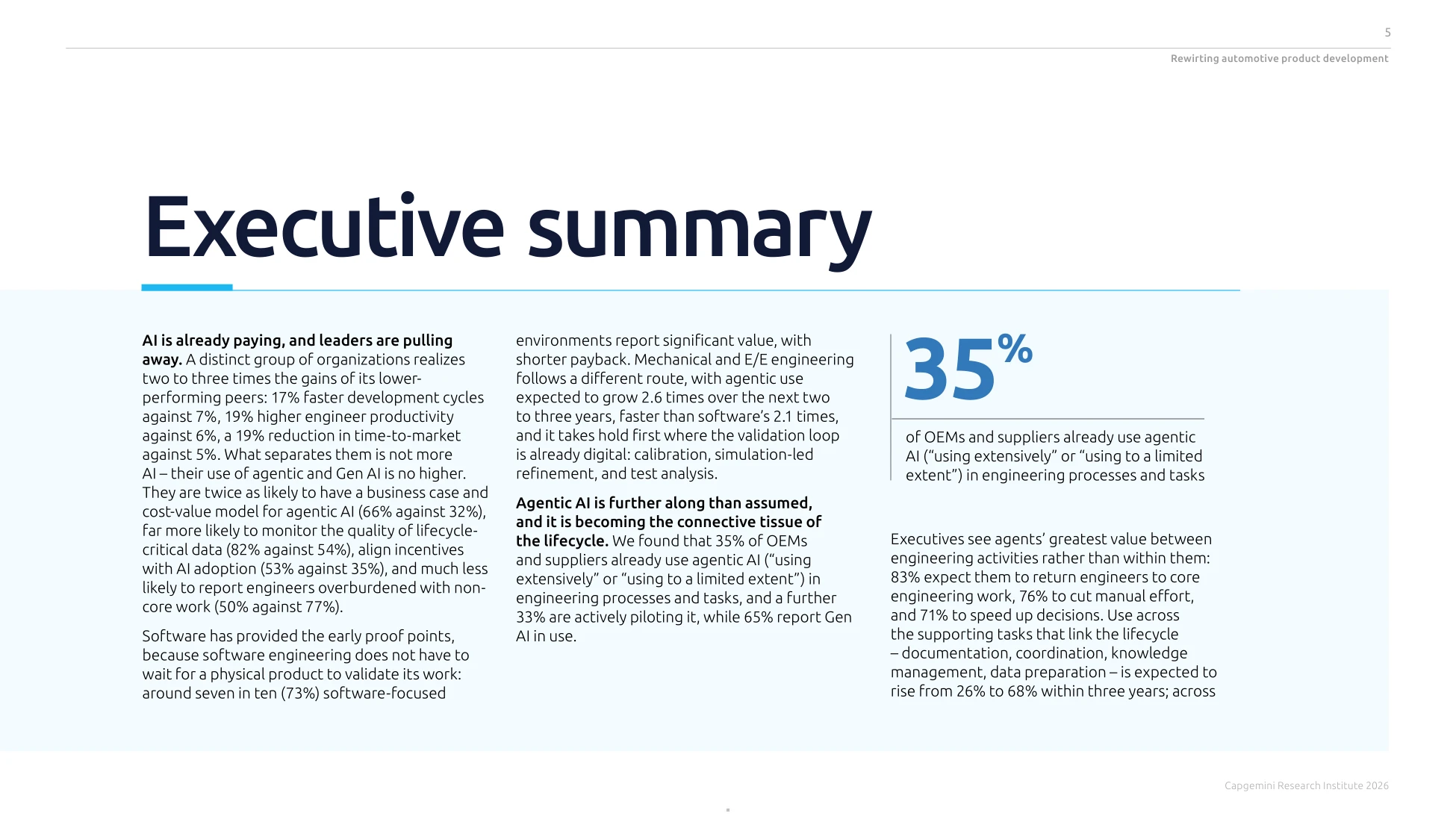
Make it real.Rewiring automotiveproduct developmentHow organizations can pull ahead in the AI raceTable of contents2Capgemini Research Institute 2026Rewirting automotive product developmentWho should read this report and why?0914Organizations are turning agentic AI into engineering advantage32Agentic product development remains an untapped growth opportunity58Scaling agentic AI requires a stronger control planeExecutive summary043Capgemini Research Institute 2026Rewirting automotive product development78Scaling agentic engineering requires a mature approach to AI ecosystem collaborationRewiring automotive product development – at AI speed90Conclusion96Research methodology97Appendix106Executive summary The automotive industry is embracing AI at pace, but in many cases, the technology is advancing faster than the processes, expertise, and integration needed to apply its outputs effectively in product development. Software has become the primary vehicle for change after the start of production, and the pace of the industry is increasingly set by how fast software can move and be trusted. Our research finds that many organizations are still building the data, governance, and operating foundations required to turn AI-generated outputs into trusted engineering decisions and measurable outcomes at scale. Value is shaped by how effectively engineering work, data, decisions, and accountability come together across the product lifecycle. These findings draw on our survey of 800 senior executives at manufacturers, tier-1 suppliers, and the technology providers that serve them, across 12 countries, and through interviews with engineering leaders at Renault, Jaguar Land Rover, Lucid, Audi, Bosch, Michelin, NVIDIA, Siemens, SAP, Dassault Systèmes, Oracle, Aptiv, and AWS.How to accelerate. In organizations that are struggling to make progress, the same issues keep surfacing. The findings in our survey make one thing clear: the choice of AI model is rarely one of them. These issues can be divided into three areas. The first is trust and governance: agents will only be given work that engineers can stand behind, and only 5% of organizations describe their AI governance as fully mature. The second is controls that rest on evidence rather than on access: most organizations restrict what AI may touch, few can show what it did and why. The third is decision rights: the industry has not settled who decides what between engineers and agents. The five actions at the end of this report respond to these three issues – scale AI across all six dimensions on which it changes product development, from the individual engineer to the ecosystem, in parallel rather than in sequence; build an agentic control plane that puts the controls on evidence; make engineering data machine-interpretable, not just machine-readable; manage the lifecycle on three KPIs; and close the loop with vehicles in ...







































