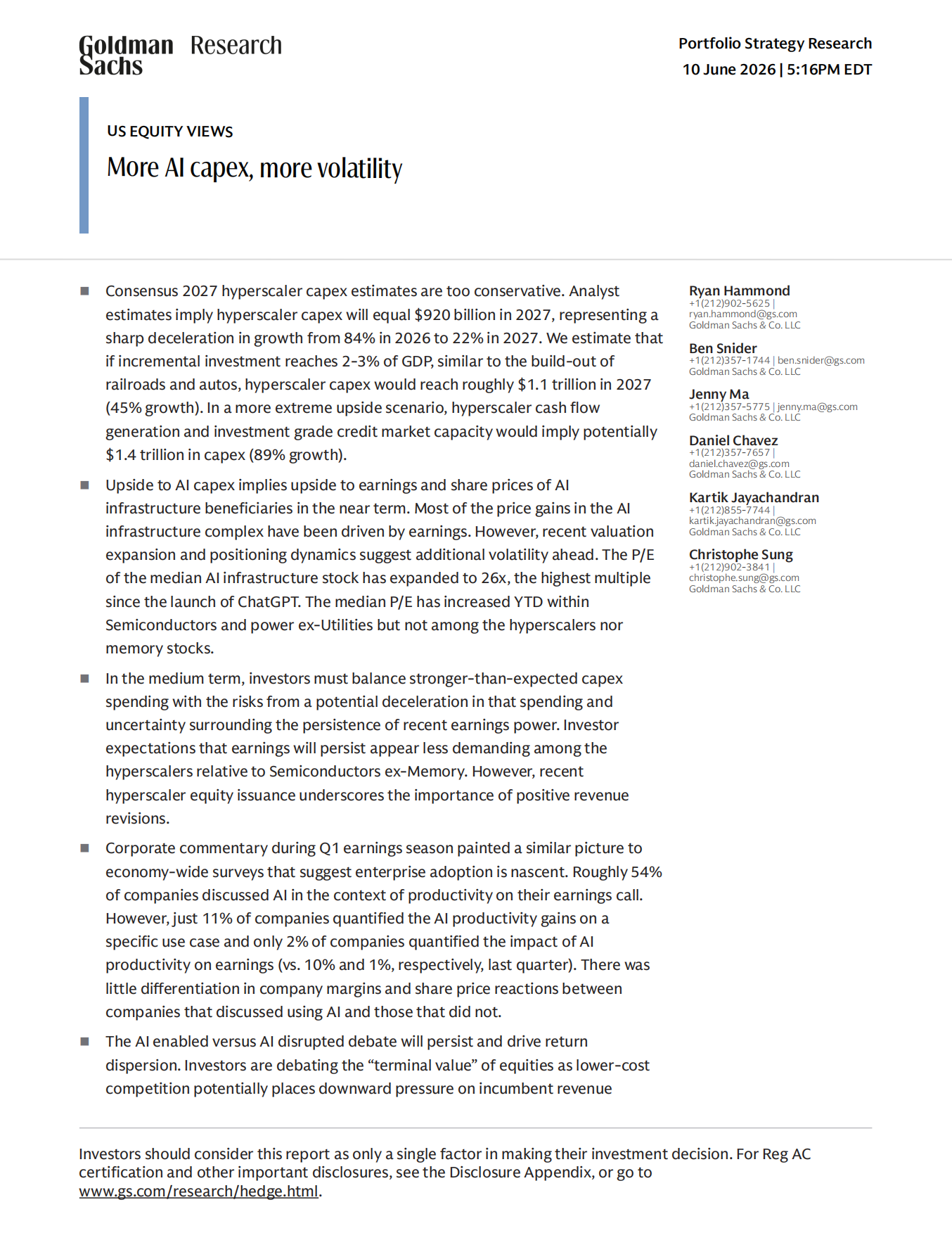
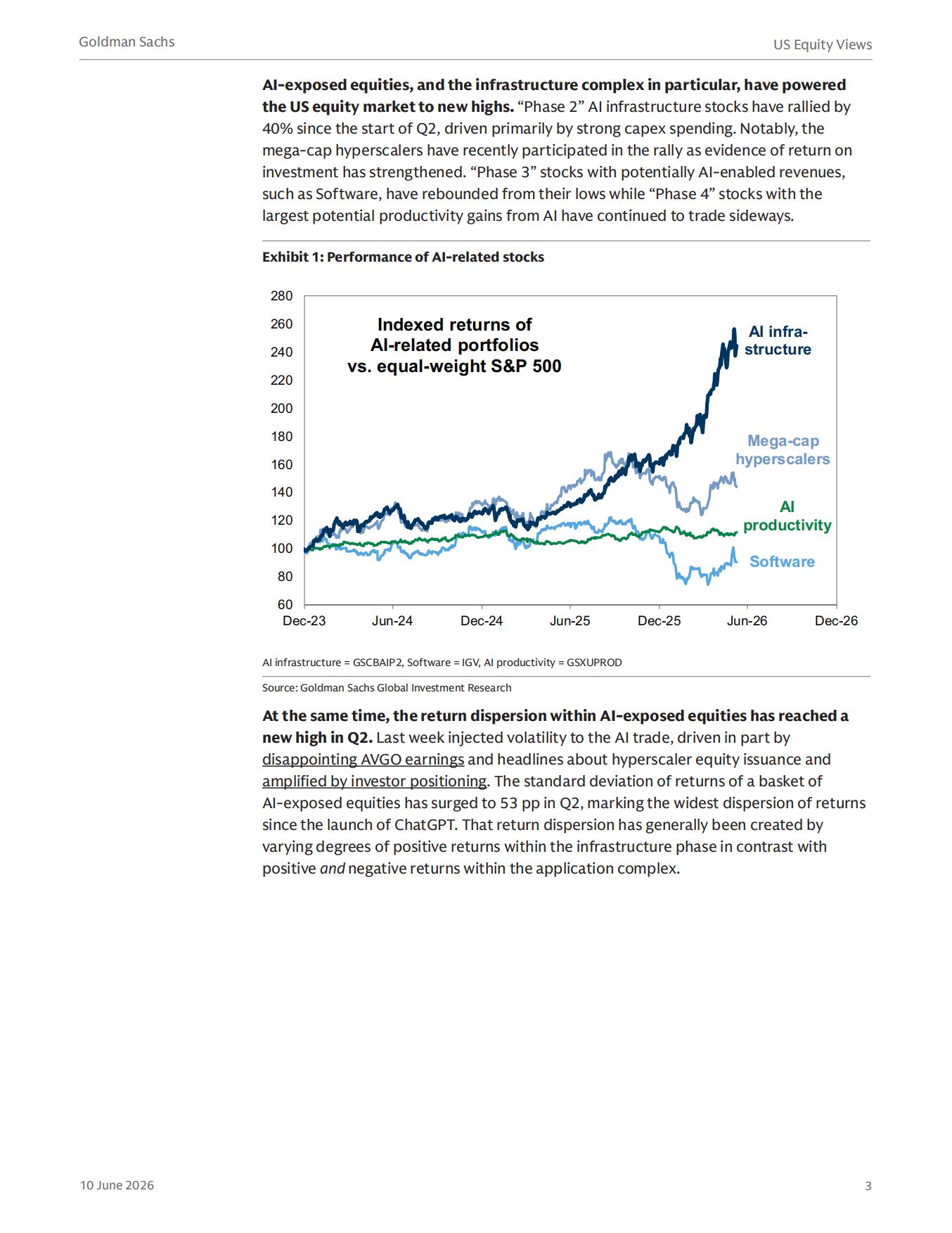
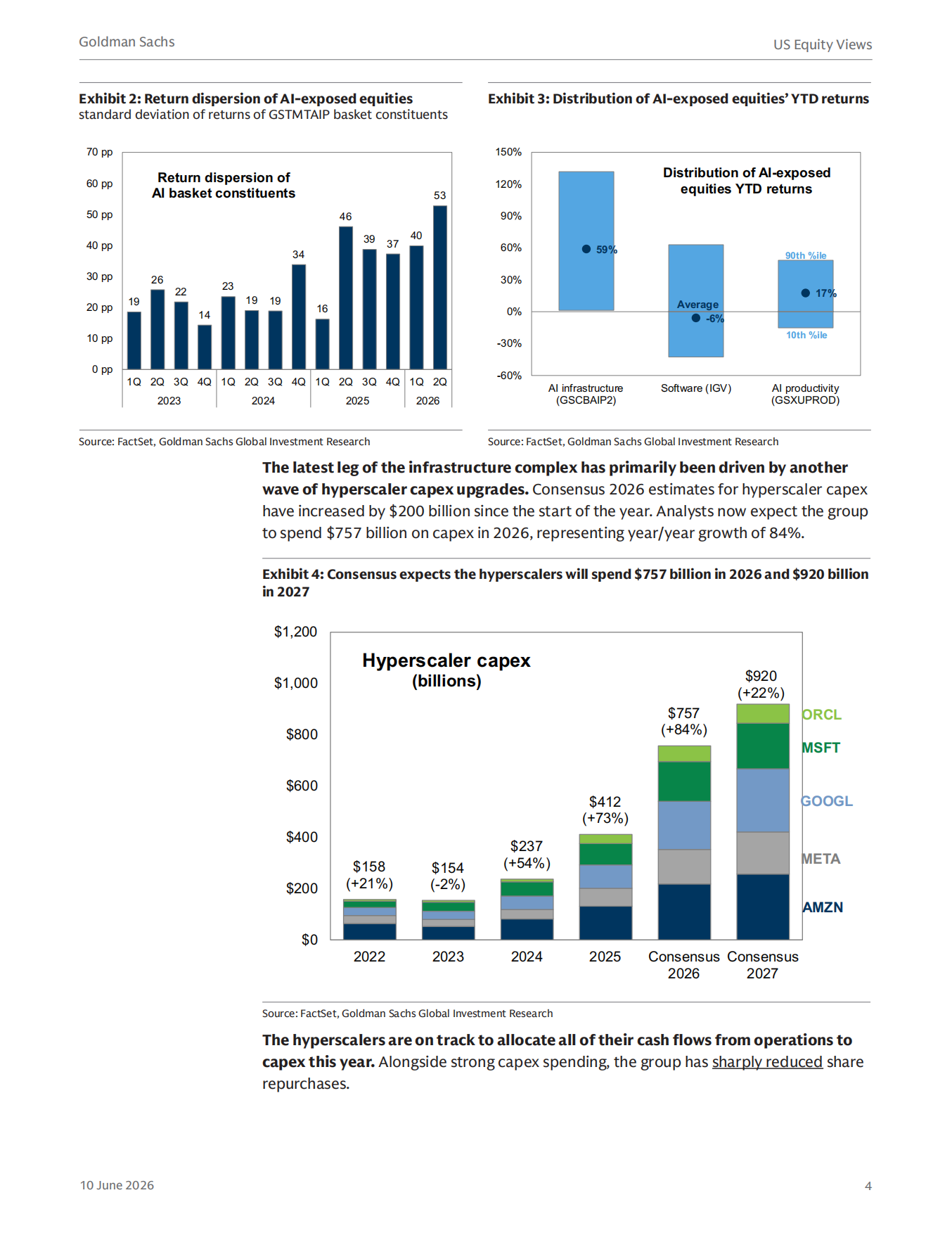
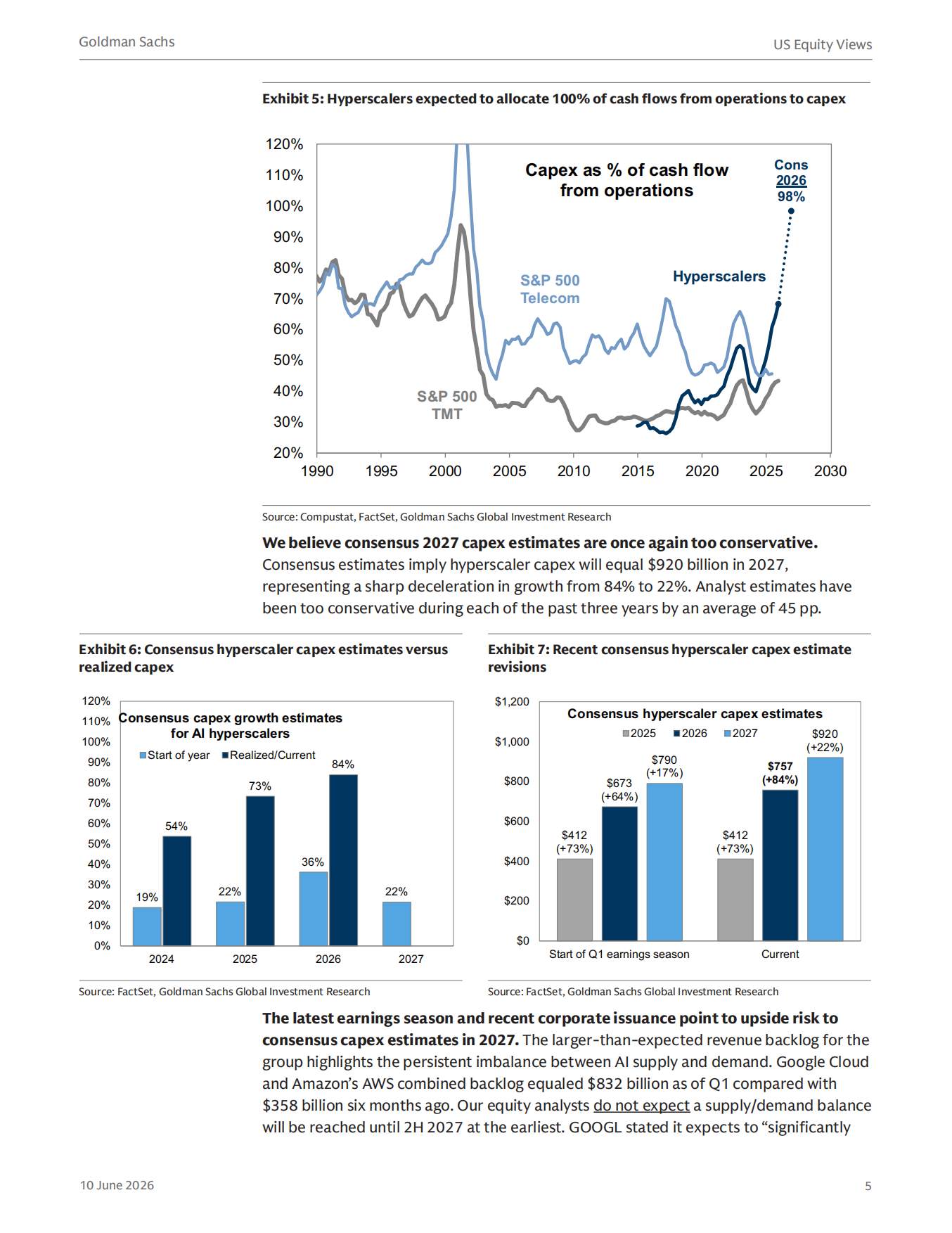
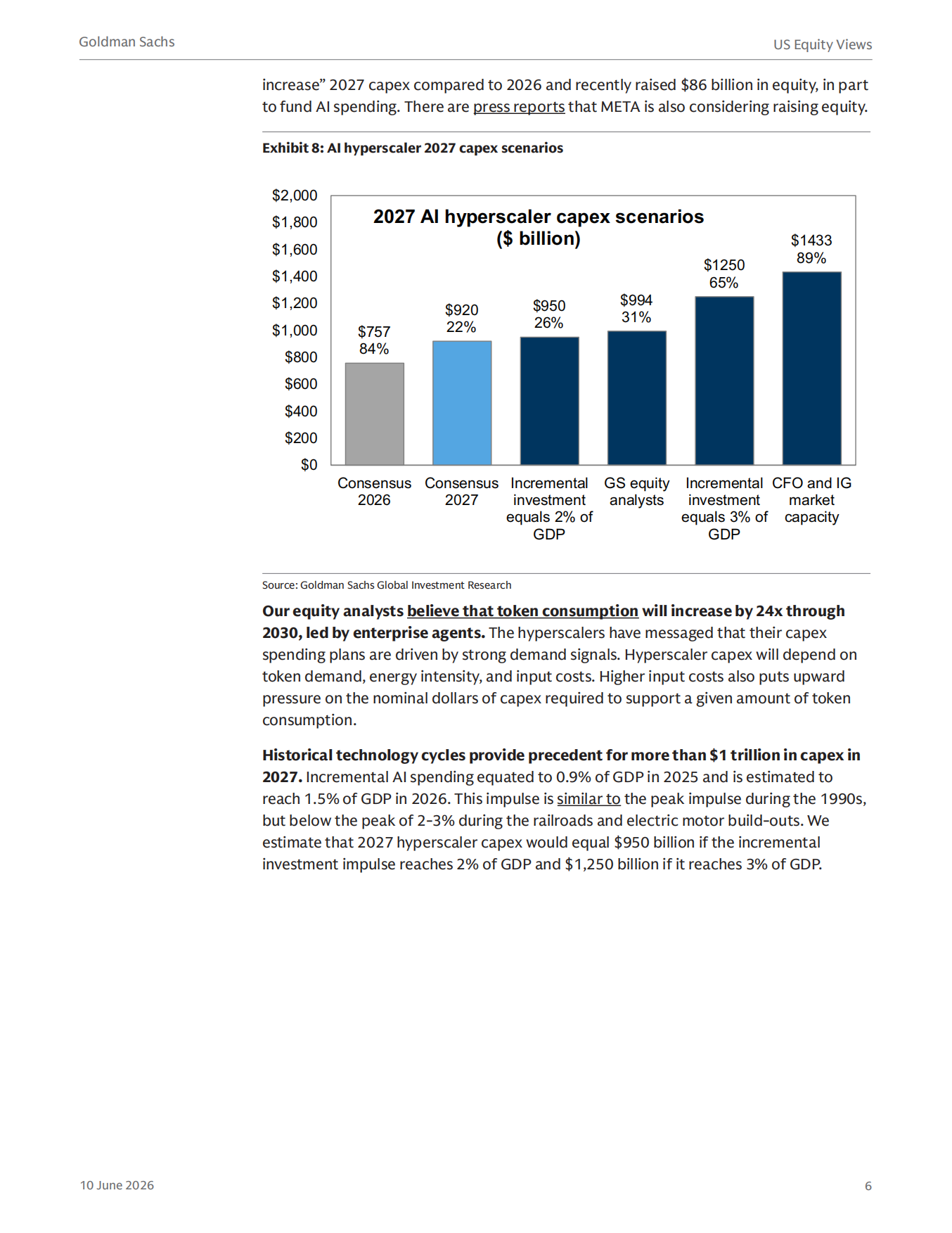
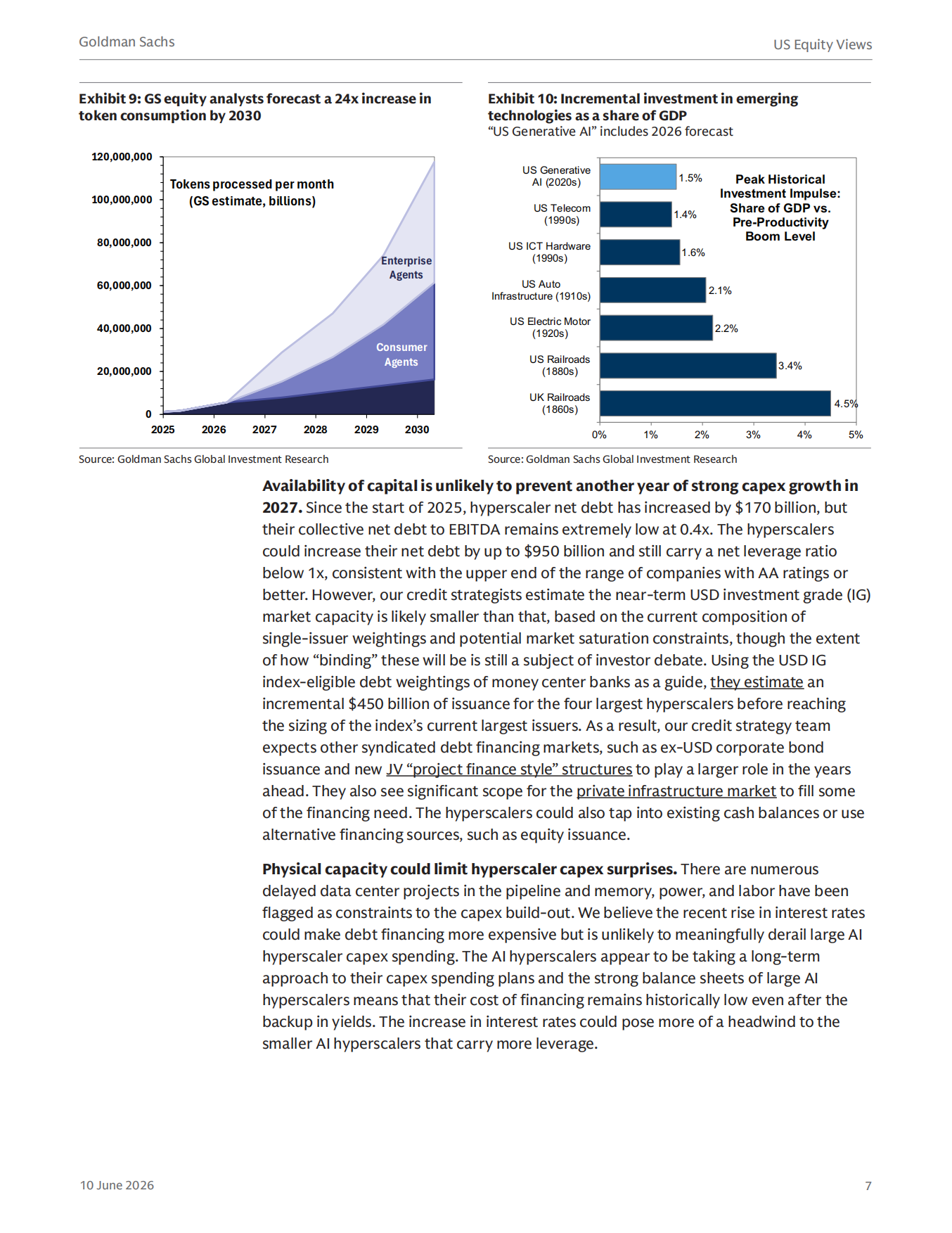
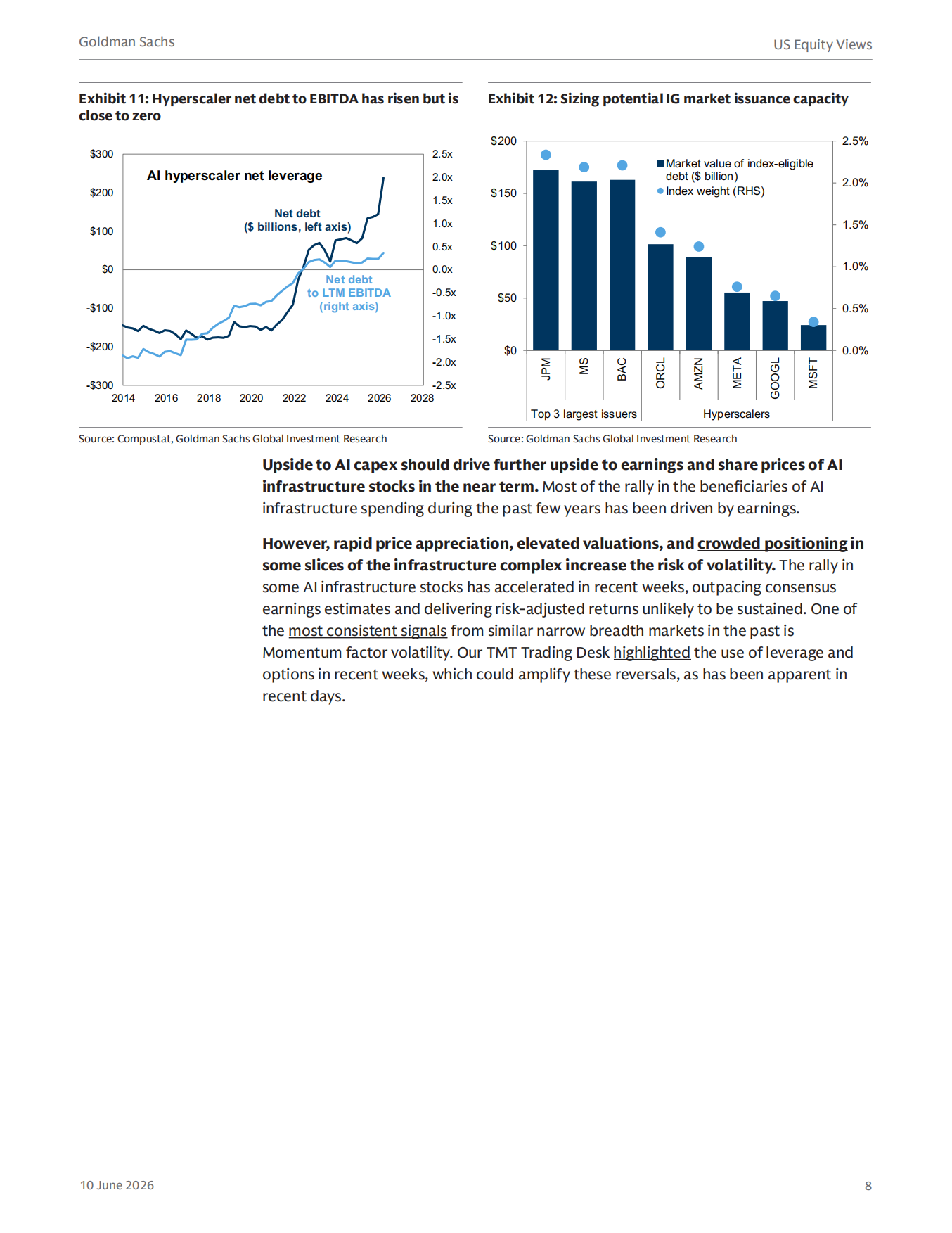
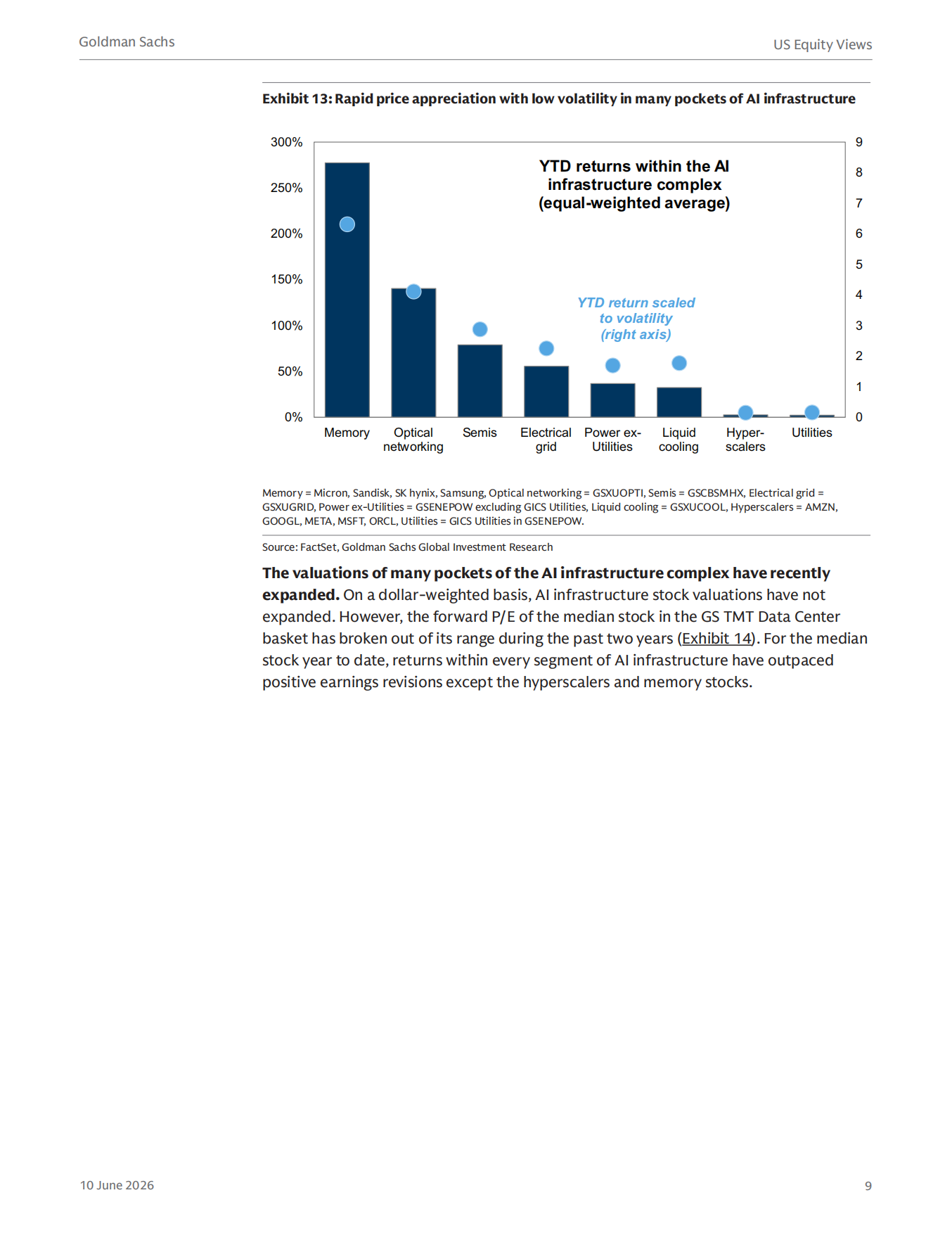
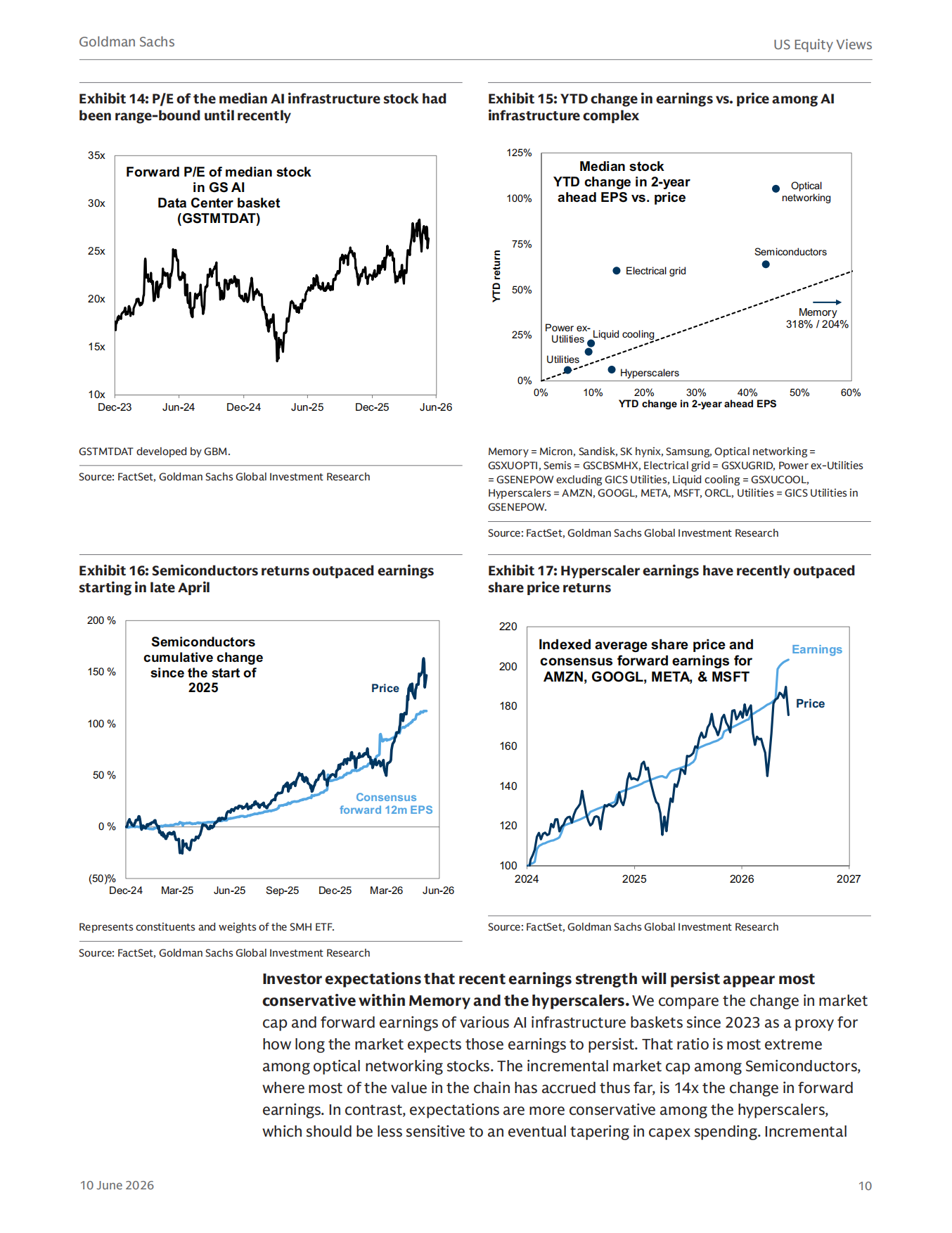
Consensus 2027 hyperscaler capex estimates are too conservative. Analyst nestimates imply hyperscaler capex will equal $920 billion in 2027, representing a sharp deceleration in growth from 84% in 2026 to 22% in 2027. We estimate that if incremental investment reaches 2-3% of GDP, similar to the build-out of railroads and autos, hyperscaler capex would reach roughly $1.1 trillion in 2027 (45% growth). In a more extreme upside scenario, hyperscaler cash flow generation and investment grade credit market capacity would imply potentially $1.4 trillion in capex (89% growth). Upside to AI capex implies upside to earnings and share prices of AI ninfrastructure beneficiaries in the near term. Most of the price gains in the AI infrastructure complex have been driven by earnings. However, recent valuation expansion and positioning dynamics suggest additional volatility ahead. The P/E of the median AI infrastructure stock has expanded to 26x, the highest multiple since the launch of ChatGPT. The median P/E has increased YTD within Semiconductors and power ex-Utilities but not among the hyperscalers nor memory stocks. In the medium term, investors must balance stronger-than-expected capex nspending with the risks from a potential deceleration in that spending and uncertainty surrounding the persistence of recent earnings power. Investor expectations that earnings will persist appear less demanding among the hyperscalers relative to Semiconductors ex-Memory. However, recent hyperscaler equity issuance underscores the importance of positive revenue revisions. Corporate commentary during Q1 earnings season painted a similar picture to neconomy-wide surveys that suggest enterprise adoption is nascent. Roughly 54% of companies discussed AI in the context of productivity on their earnings call. However, just 11% of companies quantified the AI productivity gains on a specific use case and only 2% of companies quantified the impact of AI productivity on earnings (vs. 10% and 1%, respectively, last quarter). There was little differentiation in company margins and share price reactions between companies that discussed using AI and those that did not. The AI enabled versus AI disrupted debate will persist and drive return ndispersion. Investors are debating the “terminal value” of equities as lower-cost competition potentially places downward pressure on incumbent revenue Ryan Hammond +1(212)902-5625 | ryan.hammond@gs.com Goldman Sachs & Co. LLC Ben Snider +1(212)357-1744 | ben.snider@gs.com Goldman Sachs & Co. LLC Jenny Ma +1(212)357-5775 | jenny.ma@gs.com Goldman Sachs & Co. LLC Daniel Chavez +1(212)357-7657 | daniel.chavez@gs.com Goldman Sachs & Co. LLC Kartik Jayachandran +1(212)855-7744 | kartik.jayachandran@gs.com Goldman Sachs & Co. LLC Christophe Sung +1(212)902-3841 | christophe.sung@gs.com Goldman Sachs & Co. LLC10 June 2026 | 5:16PM EDT Investors should consider this ...