Update: DeepSeek AI and the Great Talent CompetitionWhite PaperJune 2026Amy Zegart and Emerson Johnston
2White PaperUpdate: DeepSeek AI and the Great Talent CompetitionAuthors Emerson Johnston is a full-time research assistant at the Hoover Institution’s Technology Policy Accelerator. She is a graduate of Stanford’s Ford Dorsey Master’s in International Policy and received her B.S. and B.A. from Northeastern University. Amy Zegart is the Morris Arnold and Nona Jean Cox Senior Fellow at the Hoover Institution, director of Hoover’s Technology Policy Accelerator, and a senior fellow and associate director at Stanford University’s Institute for Human-Centered AI.How to cite this paper Emerson Johnston and Amy Zegart, “Update: DeepSeek AI and the Great Talent Competition” Technology Policy Accelerator, Hoover Institution and the Stanford Institute for Human-Centered Artificial Intelligence, June 2026. https://doi.org/10.64576/0626
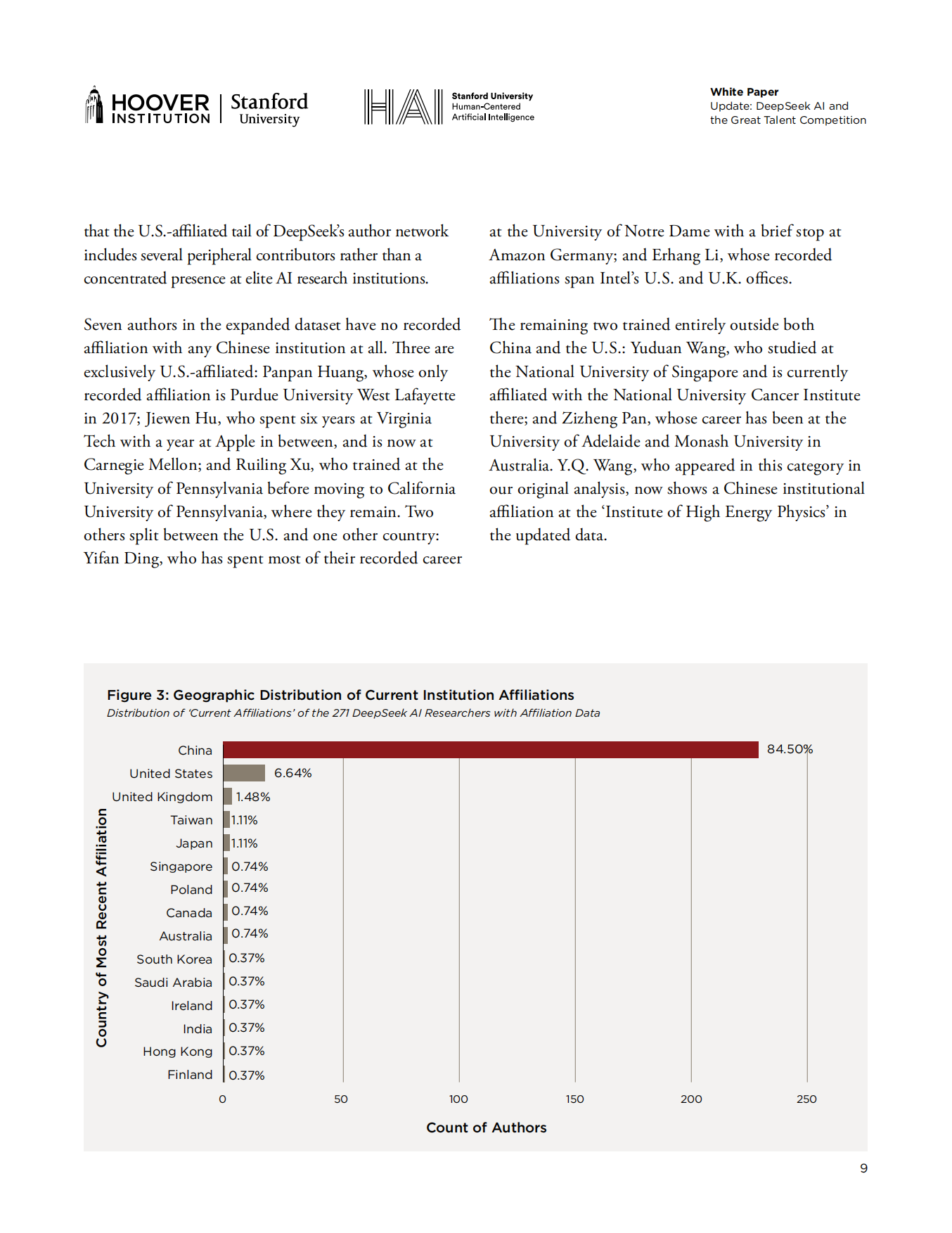
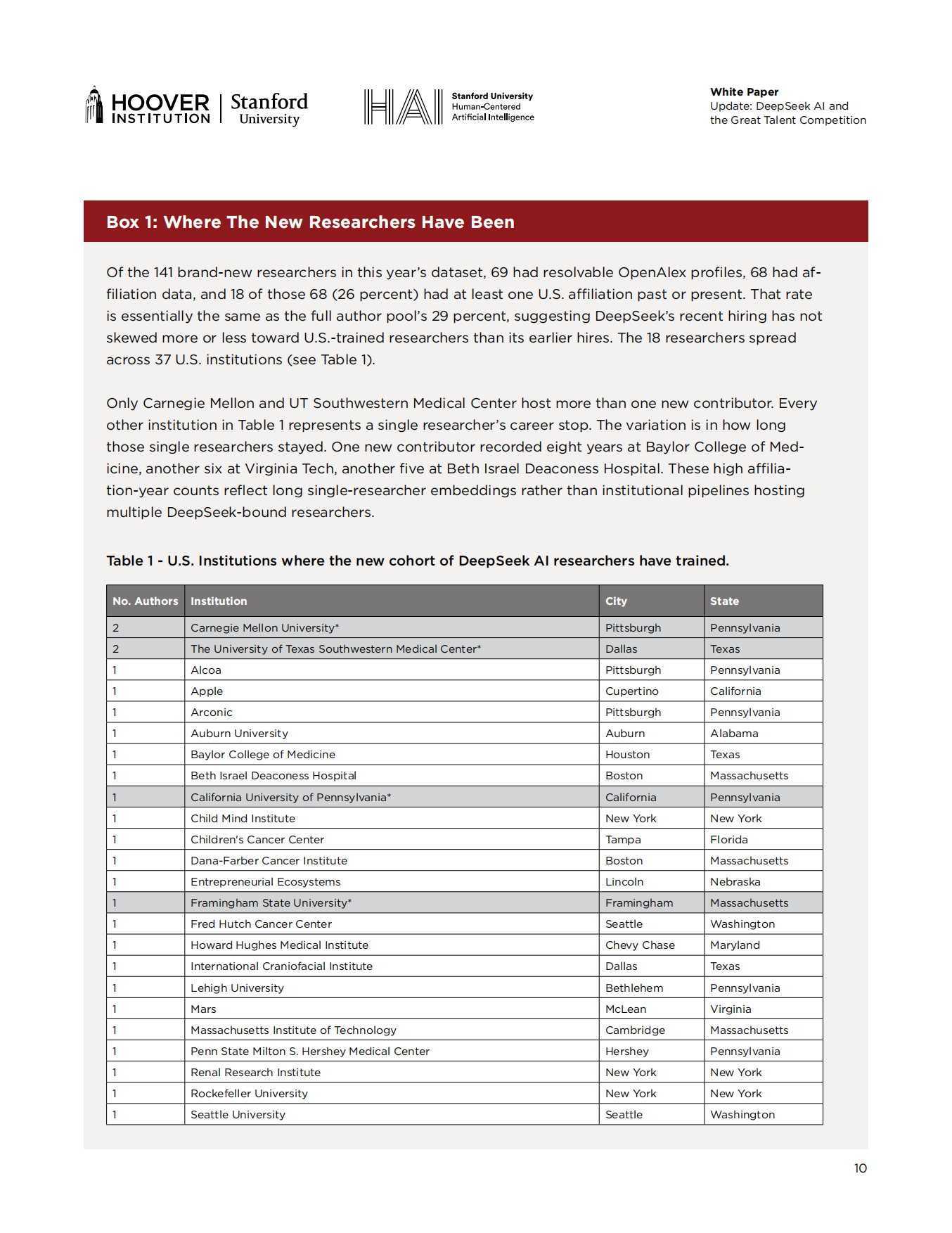
3White PaperUpdate: DeepSeek AI and the Great Talent CompetitionWhen DeepSeek AI released its R1 paper in January 2025 that revealed a model rivaling OpenAI’s o1 for far less compute, media narratives were dominated by two misconceptions. First, that the Chinese company’s breakthroughs were the result of Chinese researchers who could imitate but not innovate; and second, that the research team was young, green, and generally not highly cited in the computer science field. Our 2025 report, “A Deep Peek into DeepSeek AI’s Talent and Implications for US Innovation,” extensively examined the 223 researchers behind the company’s five foundational papers and found a very different picture. We found that DeepSeek did innovate in significant ways, that its research team was far more experienced than most assumed, and that more than half of the team had never left China for school or work. Together, the findings pointed to a domestic AI talent pipeline in China that is larger and more capable than the prevailing narrative allowed. Tey also suggested that any U.S. strategy built on the assumption that China lacks the talent or know-how to surpass the U.S. on its own was already out of step with the evidence.We argued then that the United States needs to compete much more aggressively to attract, welcome, and retain the world’s best and brightest while urgently growing domestic capabilities by improving K–12 and higher education in STEM fields at home.Tis report asks how much has changed in the year since. We extended our analysis from five to seven papers—adding DeepSeek V3.2 (December 2025) and V4 (April 2026) to incorporate the company’s latest research. By expanding our original dataset, we find the author pool has grown from 223 to 356 and we were able to build comprehensive profiles tracking where they studied, lived, and worked for 282 of them.China’s domestic AI talent pipeline is still going strong • ...