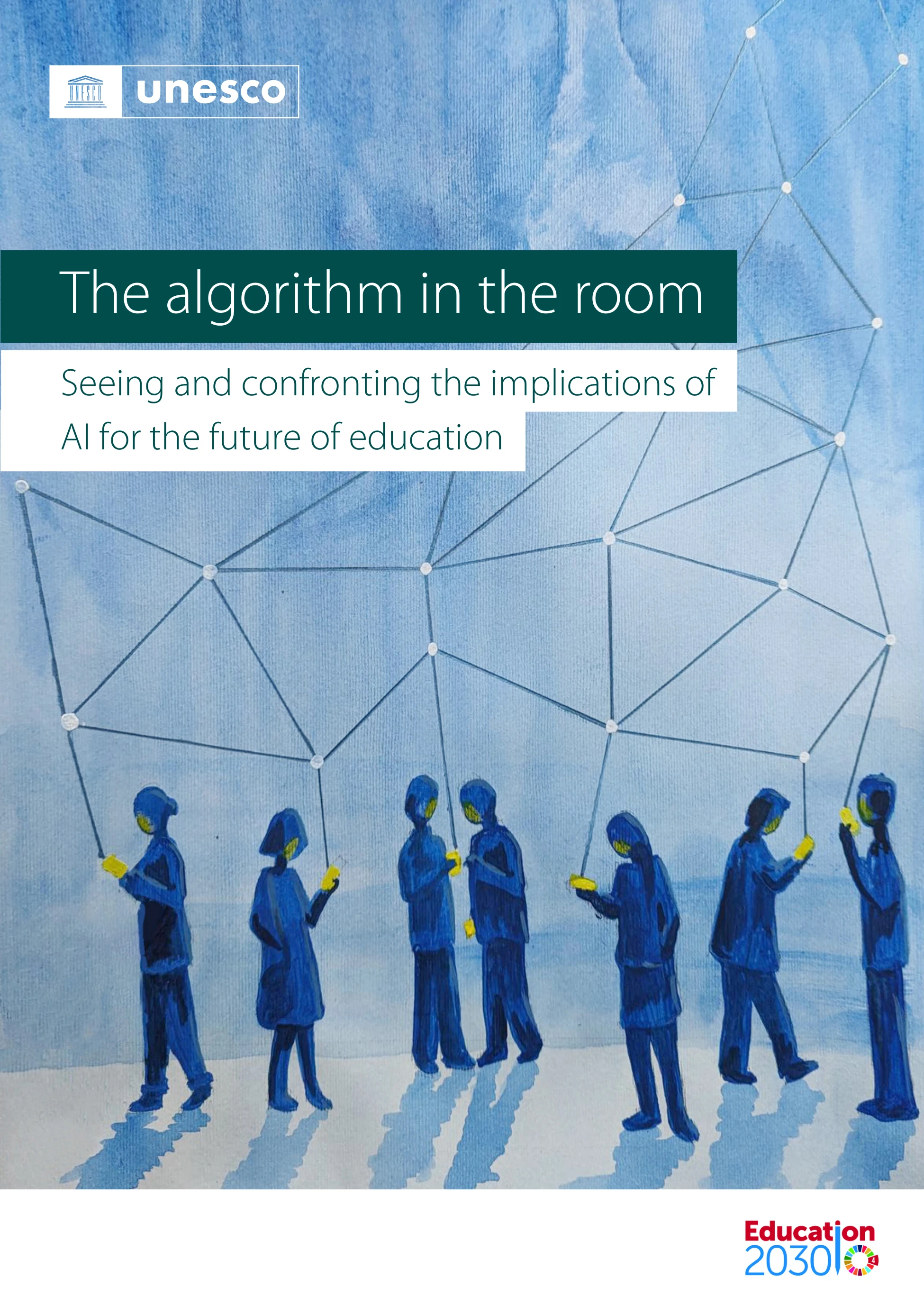
来源:发现报告(www.fxbaogao.com/view?id=5750587)| 引用请注明出处AI for the future of educationThe algorithm in the roomSeeing and confronting the implications of来源:发现报告(www.fxbaogao.com/view?id=5750587)| 引用请注明出处Published in 2026 by the United Nations Educational, Scientific and Cultural Organization,7, place de Fontenoy, 75352 Paris 07 SP, France© UNESCO 2026ISBN: 978-92-3-100897-9DOI: https://doi.org/10.54675/PMRO5023This publication is available in Open Access under the Attribution-ShareAlike 3.0 IGO (CC-BY-SA 3.0 IGO) license (http://creativecommons.org/licenses/by-sa/3.0/igo/). By using the content of this publication, the users accept to be bound by the terms of use of the UNESCO Open Access Repository (https://www.unesco.org/en/open-access/cc-sa).The designations employed and the presentation of material throughout this publication do not imply the expression of any opinion whatsoever on the part of UNESCO concerning the legal status of any country, territory, city or area or of its authorities, or concerning the delimitation of its frontiers or boundaries.The ideas and opinions expressed in this publication are those of the authors; they are not necessarily those of UNESCO and do not commit the Organization.Cover credit: Jamillah Knowles & Reset.Tech Australia / https://betterimagesofai.org. Available under CC BY 4.0Layout: UNESCO/Aida AlhabshiPrinted by UNESCOPrinted in FranceFutures of EducationThe International Commission on the Futures of Education was established by UNESCO in 2019 to reimagine how knowledge and learning can shape the future of humanity and the planet. The initiative incorporates extensive public and expert engage-ment and aims to catalyze a global debate on how education needs to be rethought in a world of increasing complexity, uncertainty, and fragility.UNESCO – a global leader in educationEducation is UNESCO’s top priority because it is a basic human right and the foundation for peace and sustainable development. UNESCO is the United Nations’ specialized agency for education, providing global and regional leadership to drive progress, strengthening the resilience and capacity of national systems to serve all learners. UNESCO also leads eorts to respond to contemporary global challenges through transformative learning, with special focus on gender equality and Africa across all actions.来源:发现报告(www.fxbaogao.com/view?id=5750587)| 引用请注明出处S H O R T S U M M A R YNavigating educational priorities in the age of AIWe live in algorithmic times. Algorithmic systems, content and infrastructures that underpin artificial intelligence (AI) now impact education systems across the world. The title of this volume is a play on the expression ‘the elephant in the room’, which refers to any massive and far-reaching issue that is largely avoided or unaddressed. AI and other algorithmic technologies are among these issues. They are driv...