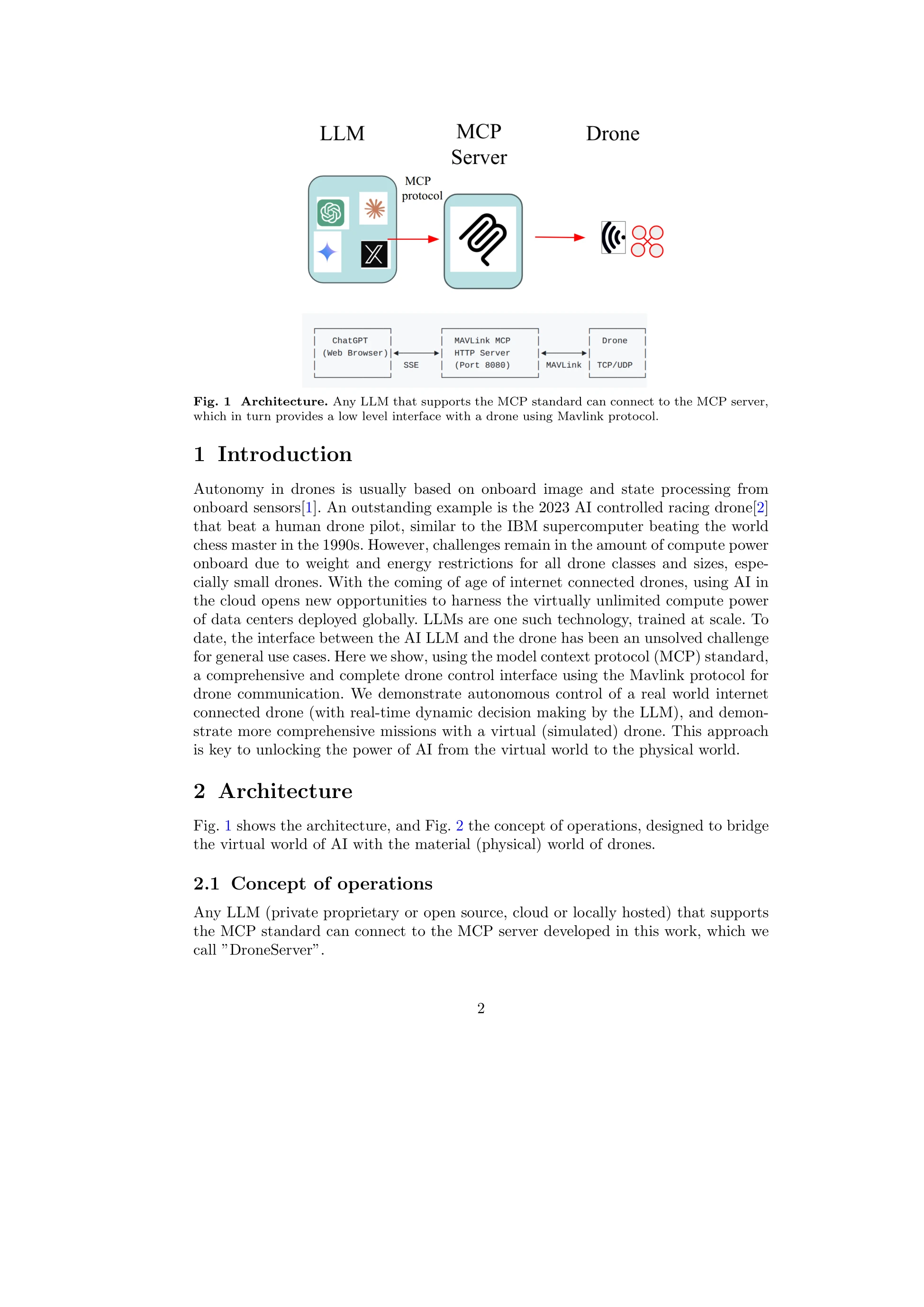
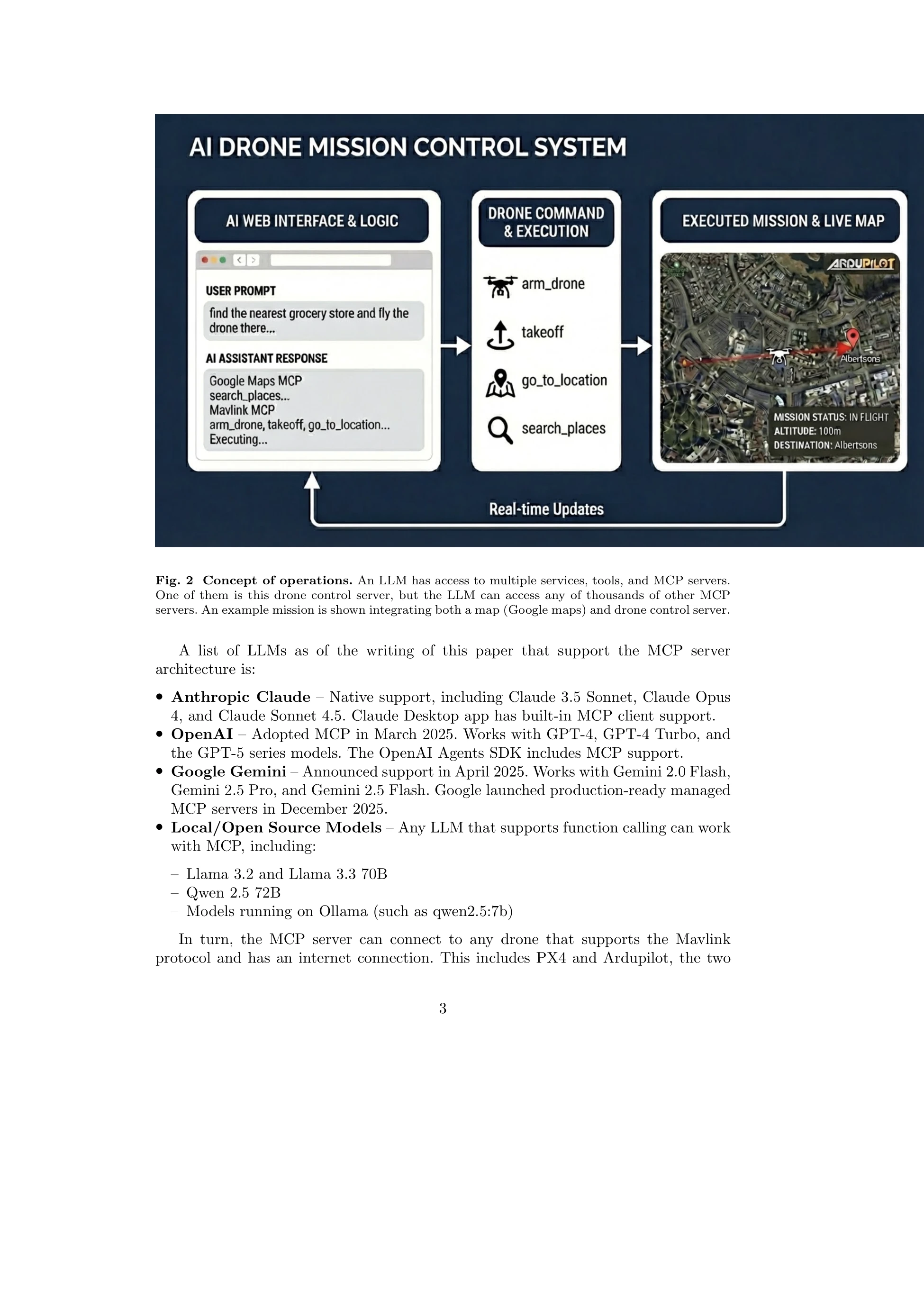
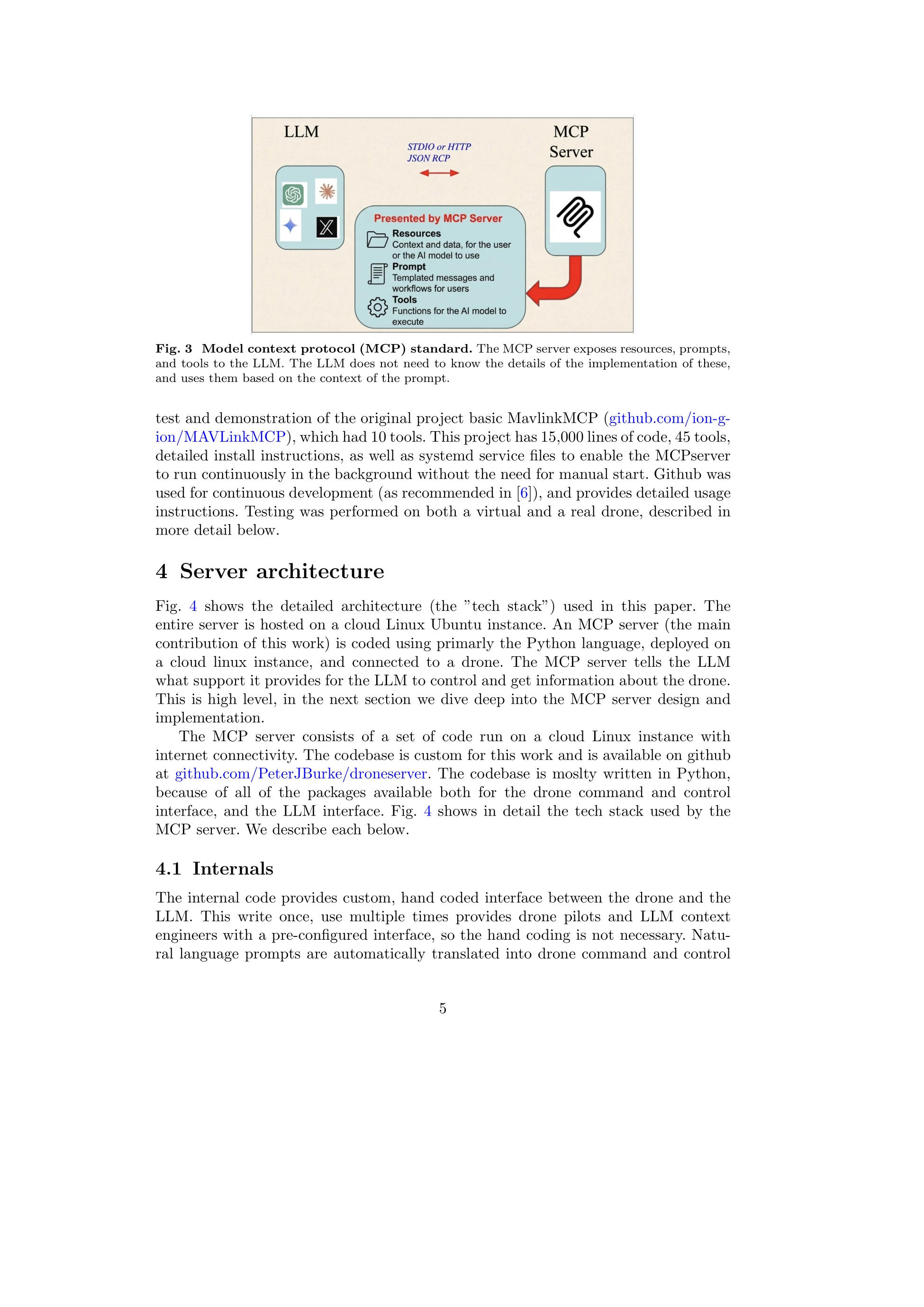
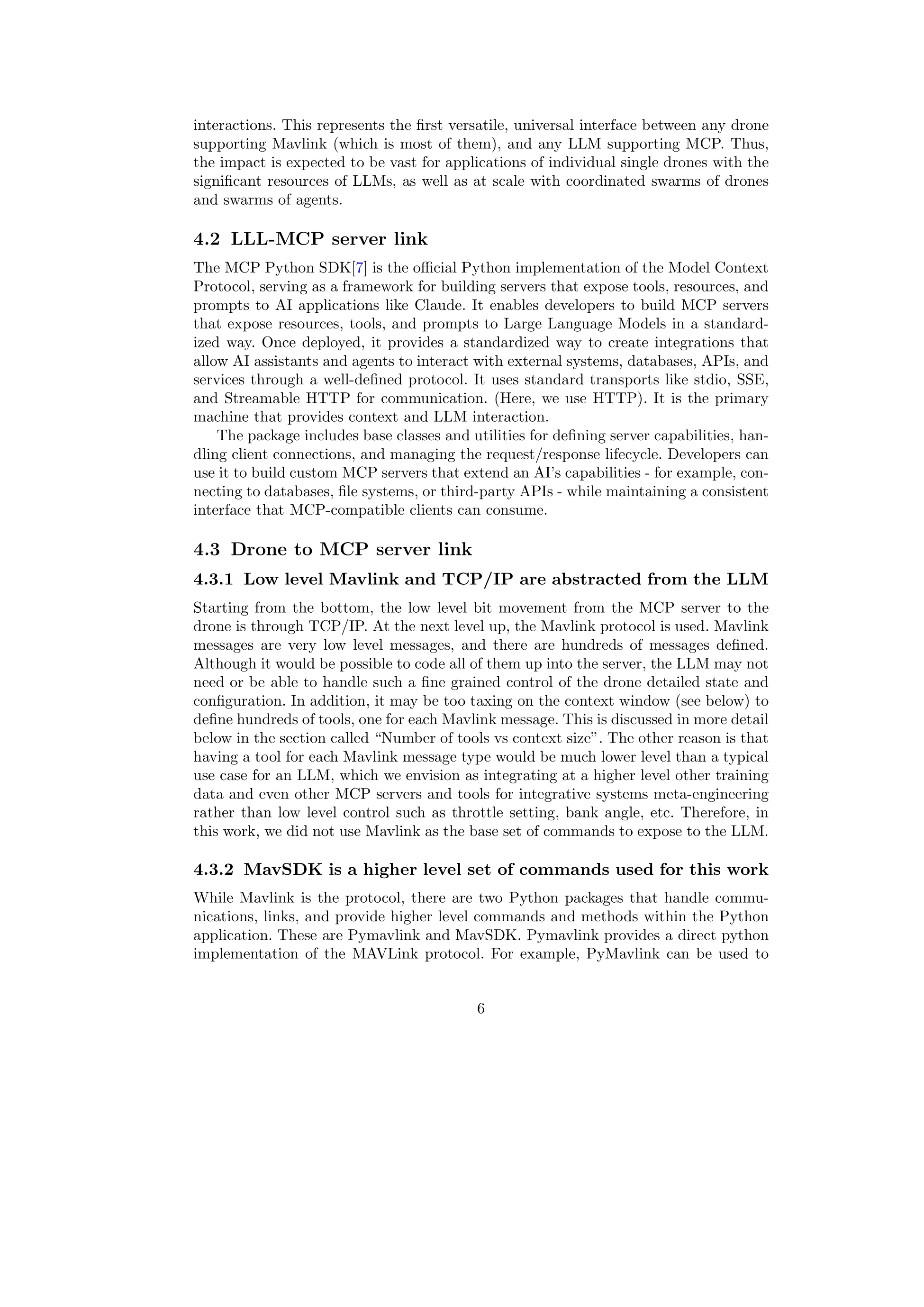
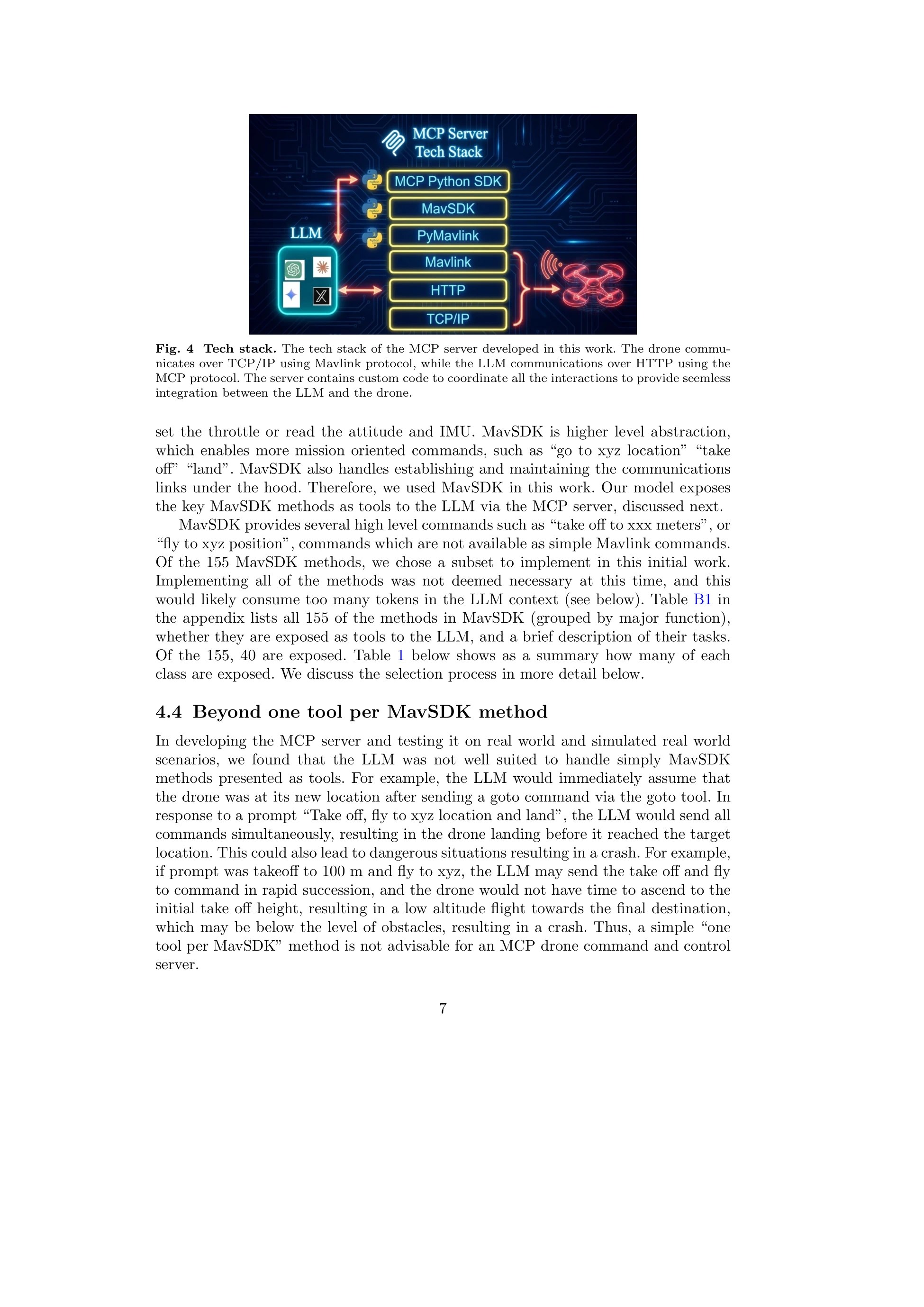
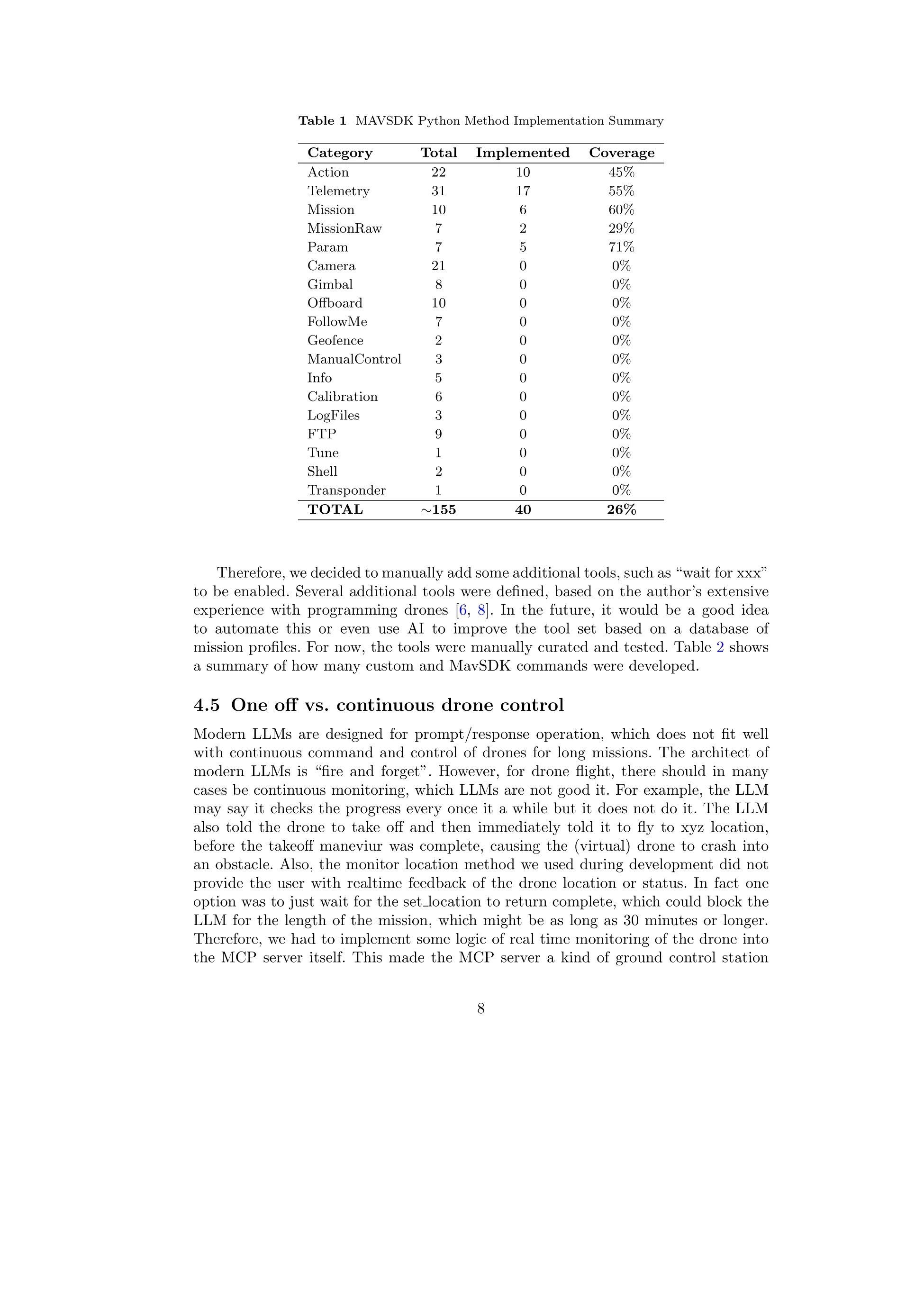
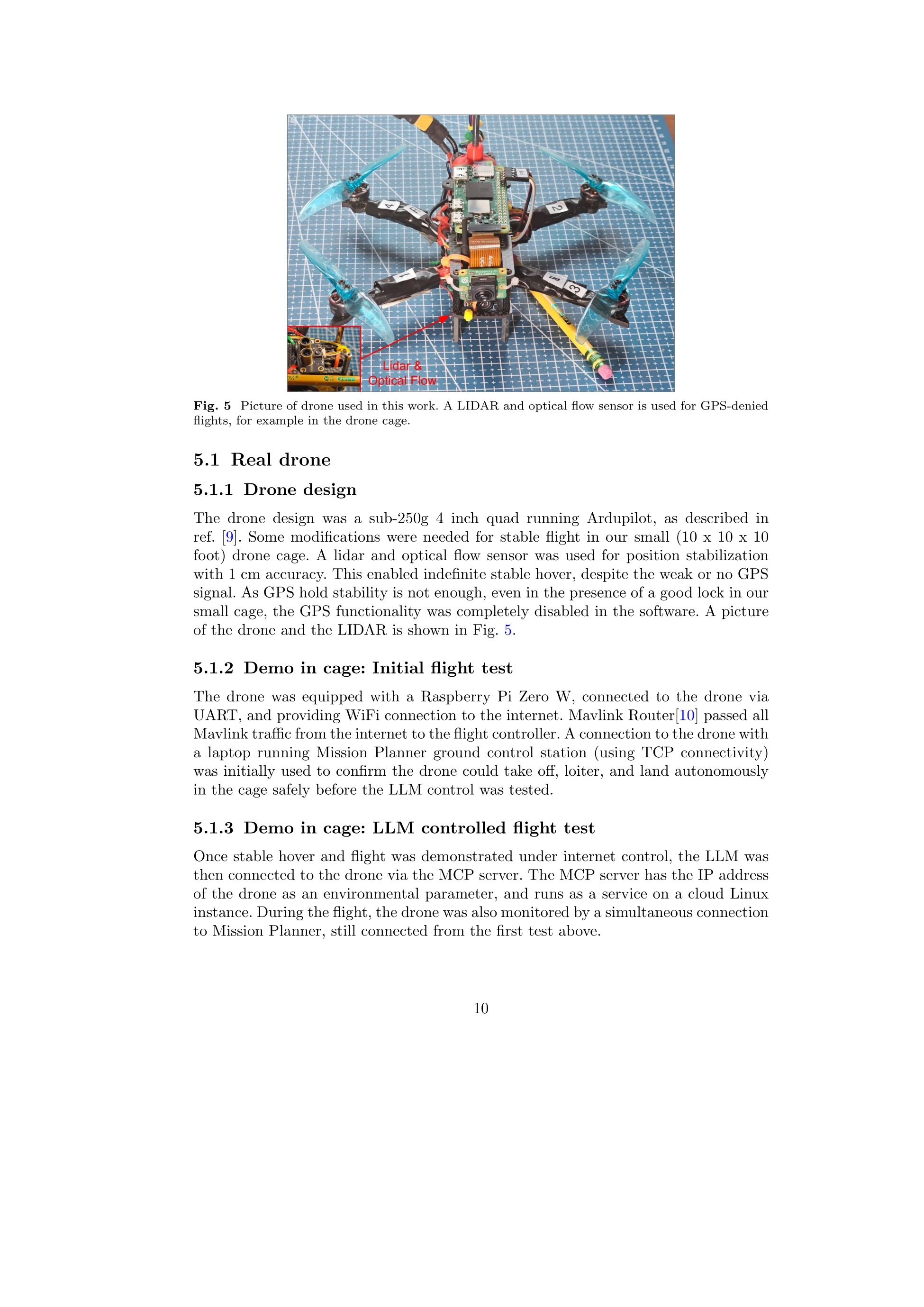
A Universal Large Language Model - DroneCommand and Control InterfaceJavier Ramos-Silva1,2* and Peter Burke2,31*Department of Electrical Engineering and Computer Science,University of California, Irvine, MS 2625, Irvine, 92697, CA, USA.2*BME, MSE, CBEMS, Physics, University of California, Irvine, MS2625, Irvine, 92697, CA, USA.*Corresponding author(s). E-mail(s): pburke@uci.edu;Contributing authors: pburke@uci.edu;AbstractThe use of artificial intelligence (AI) for drone control can have a transforma-tive impact on drone capabilities, especially when integrated with drone sensing,command, and control, part of a growing field of physical AI. Large languagemodels (LLMs) for agentic drone control provide a new opportunity for droneautonomy. However, challenges remain in the interface, with each use case requir-ing a tedious, labor intensive effort to connect the LLM to the drone. Here, usingthe new model context protocol (MCP), we solve that problem, by developingand demonstrating in flight and simulation an LLM agnostic and drone agnos-tic approach, providing the first universal, versatile, comprehensive and easy touse drone control interface. This provides a universal way for AI systems toaccess drone data, tools, and services. Our cloud based MCP server supports theMavlink protocol, an ubiquitous drone control language used almost universallyby millions of drones including Ardupilot and PX4 framework. We demonstrateintegration with multiple commercial including all major frontier models andopen source LLMs. In further testing, we demonstrate extensive flight planningand control capability in a simulated drone, integrated with a Google Maps MCPserver for up to date, real time navigation information. This demonstrates auniversal approach to integration of LLMs with drone command and control, aparadigm that leverages and exploits virtually all of modern AI industry withdrone technology in an easy to use interface that translates natural language todrone control.Keywords: Large language model (LLM), drone, unmanned aerial vehicles (UAVs),unmanned aircraft systems (UAS)1arXiv:2601.15486v2 [cs.RO] 6 May 2026Fig. 1 Architecture. Any LLM that supports the MCP standard can connect to the MCP server,which in turn provides a low level interface with a drone using Mavlink protocol.1 IntroductionAutonomy in drones is usually based on onboard image and state processing fromonboard sensors[1]. An outstanding example is the 2023 AI controlled racing drone[2]that beat a human drone pilot, similar to the IBM supercomputer beating the worldchess master in the 1990s. However, challenges remain in the amount of compute poweronboard due to weight and energy restrictions for all drone classes and sizes, espe-cially small drones. With the coming of age of internet connected drones, using AI inthe cloud opens new opportunities to harness the virtually unlimited compute powerof data centers deployed ...










































