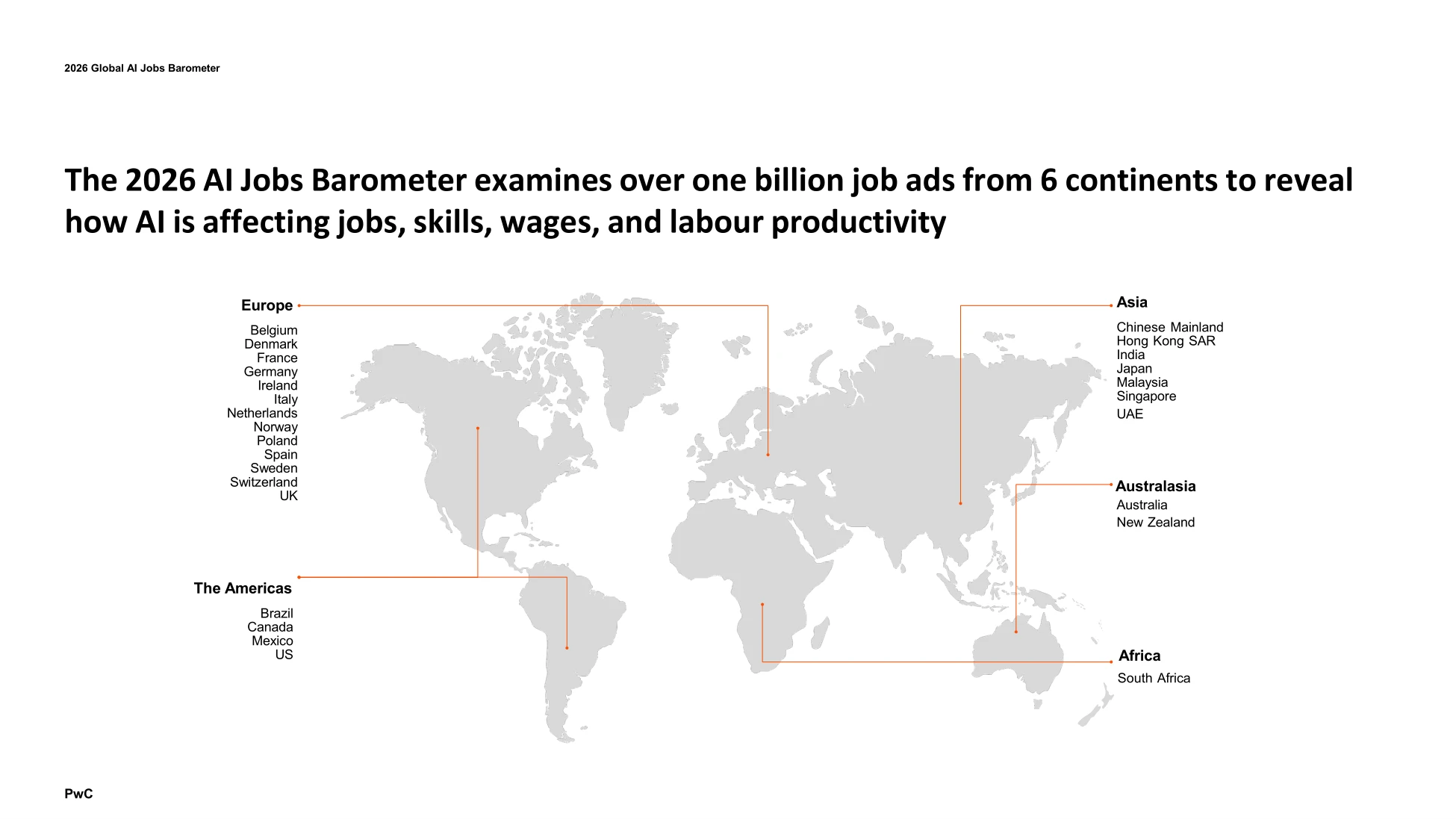
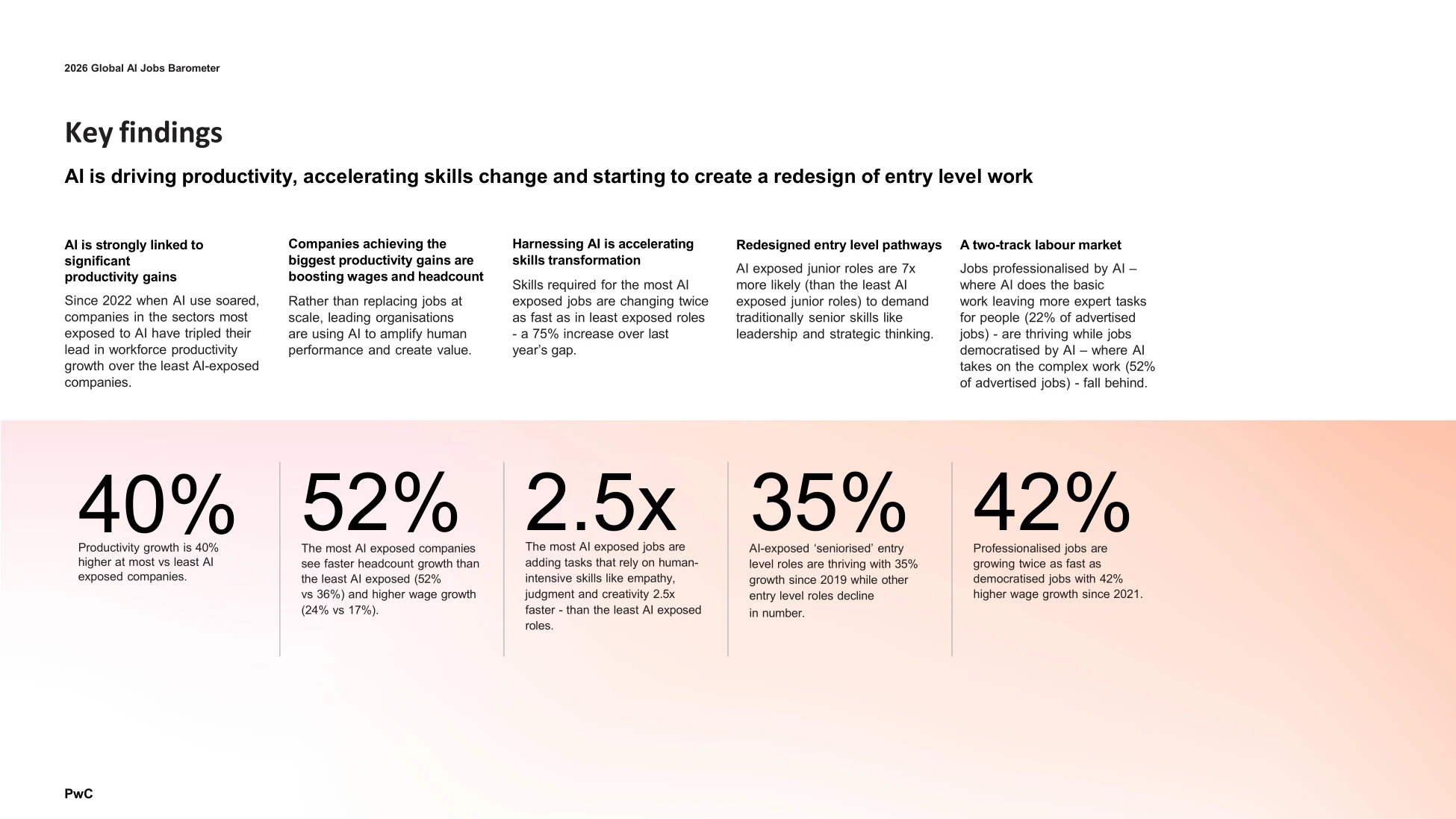
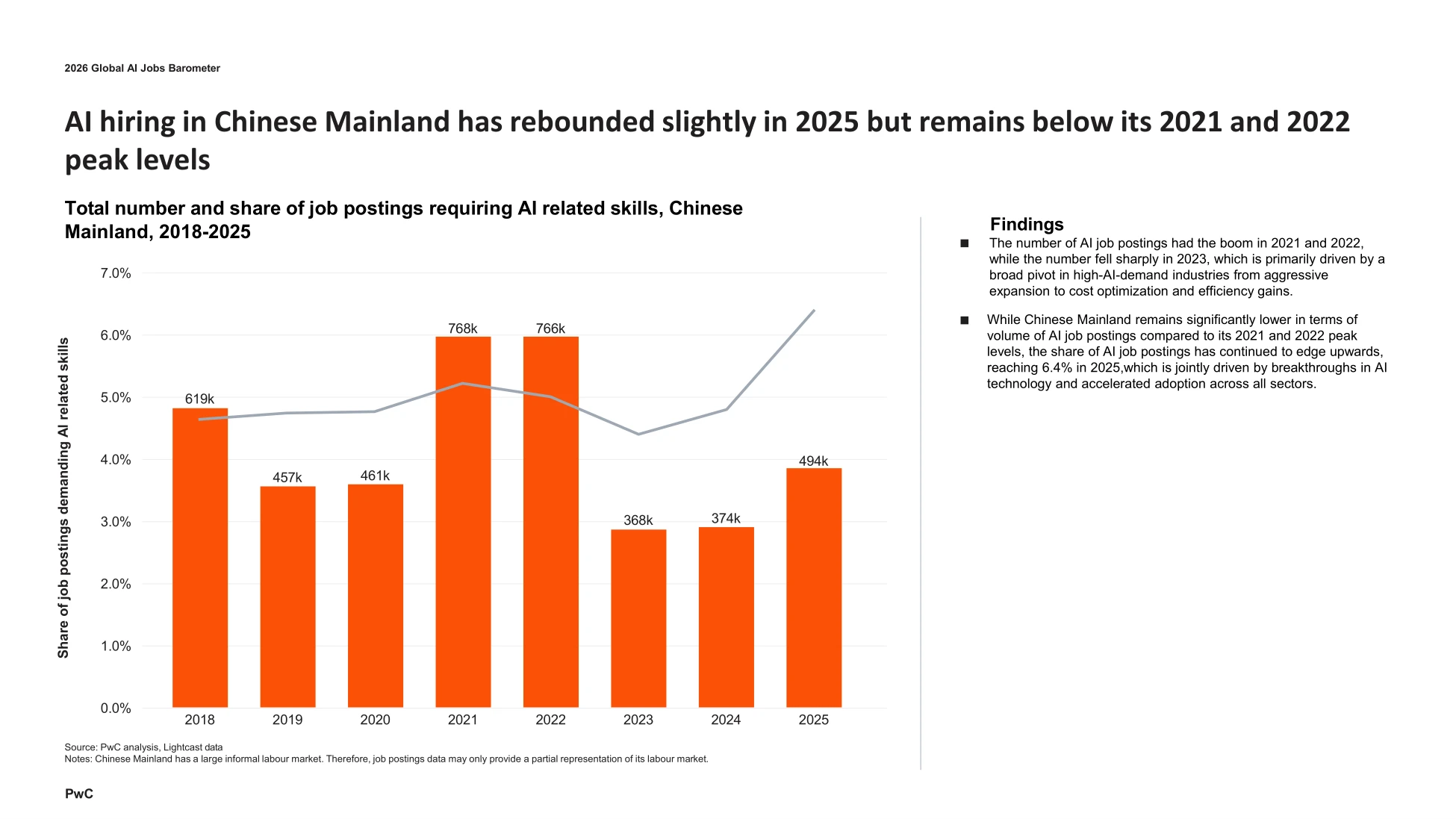
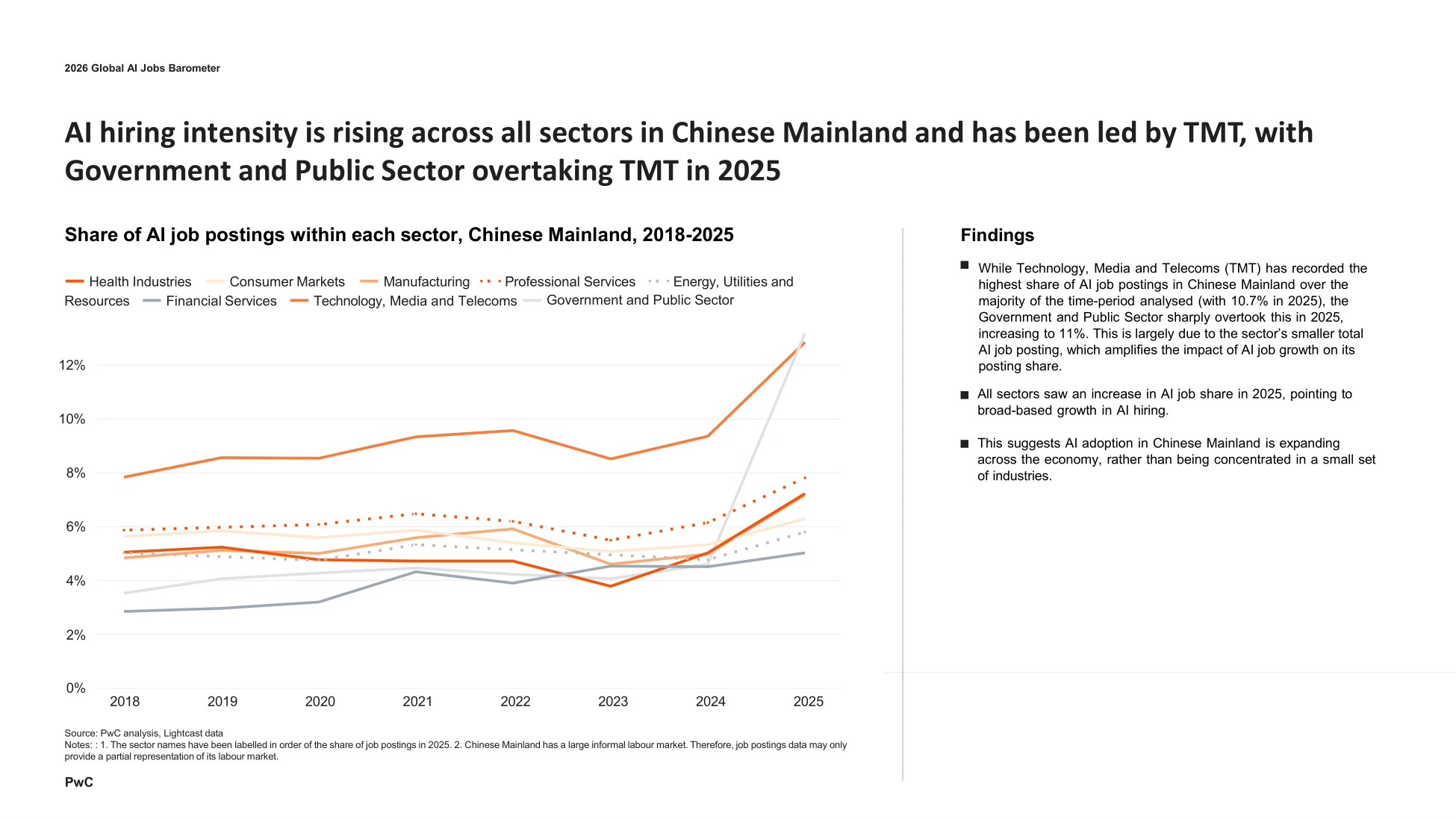
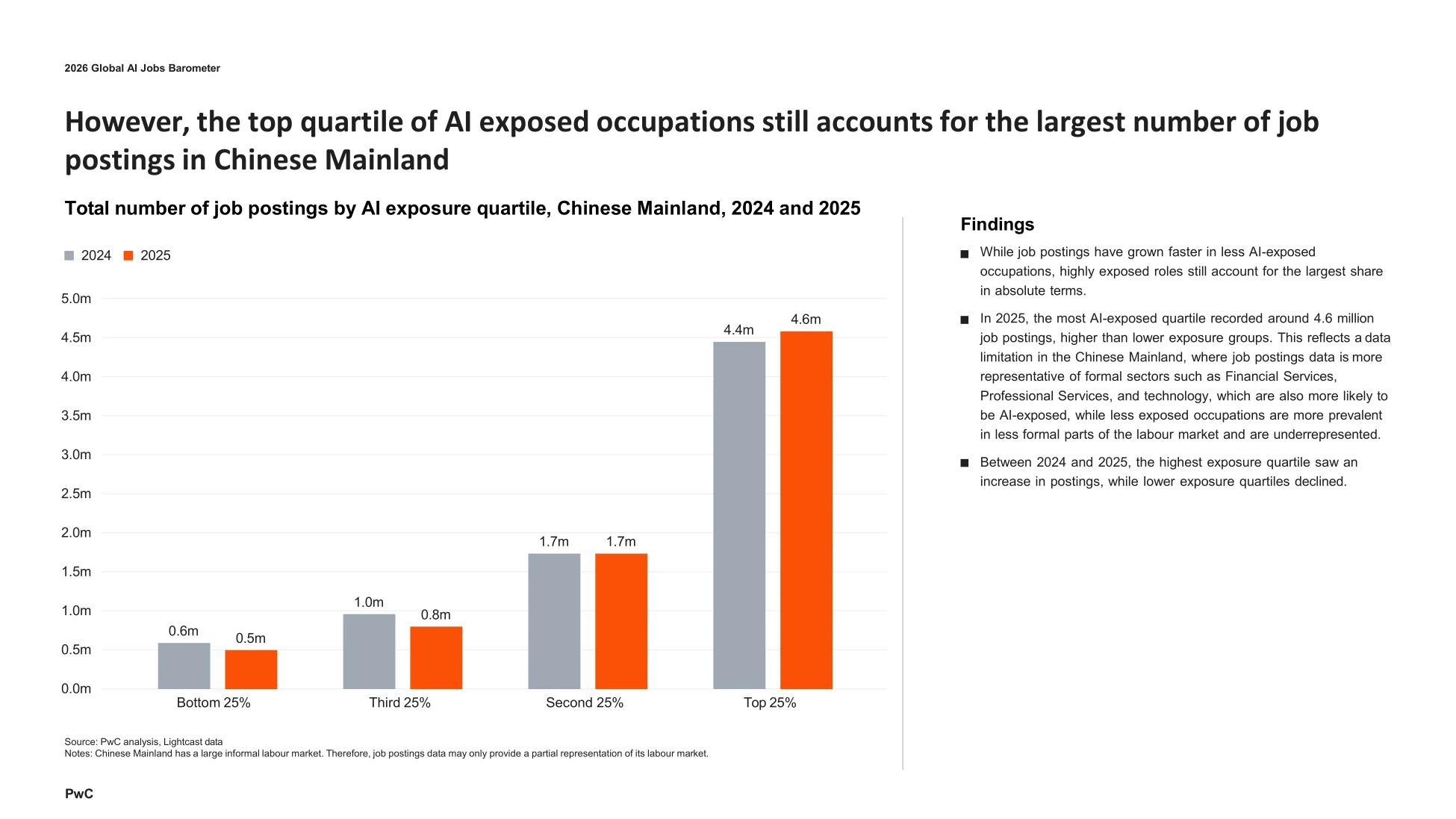
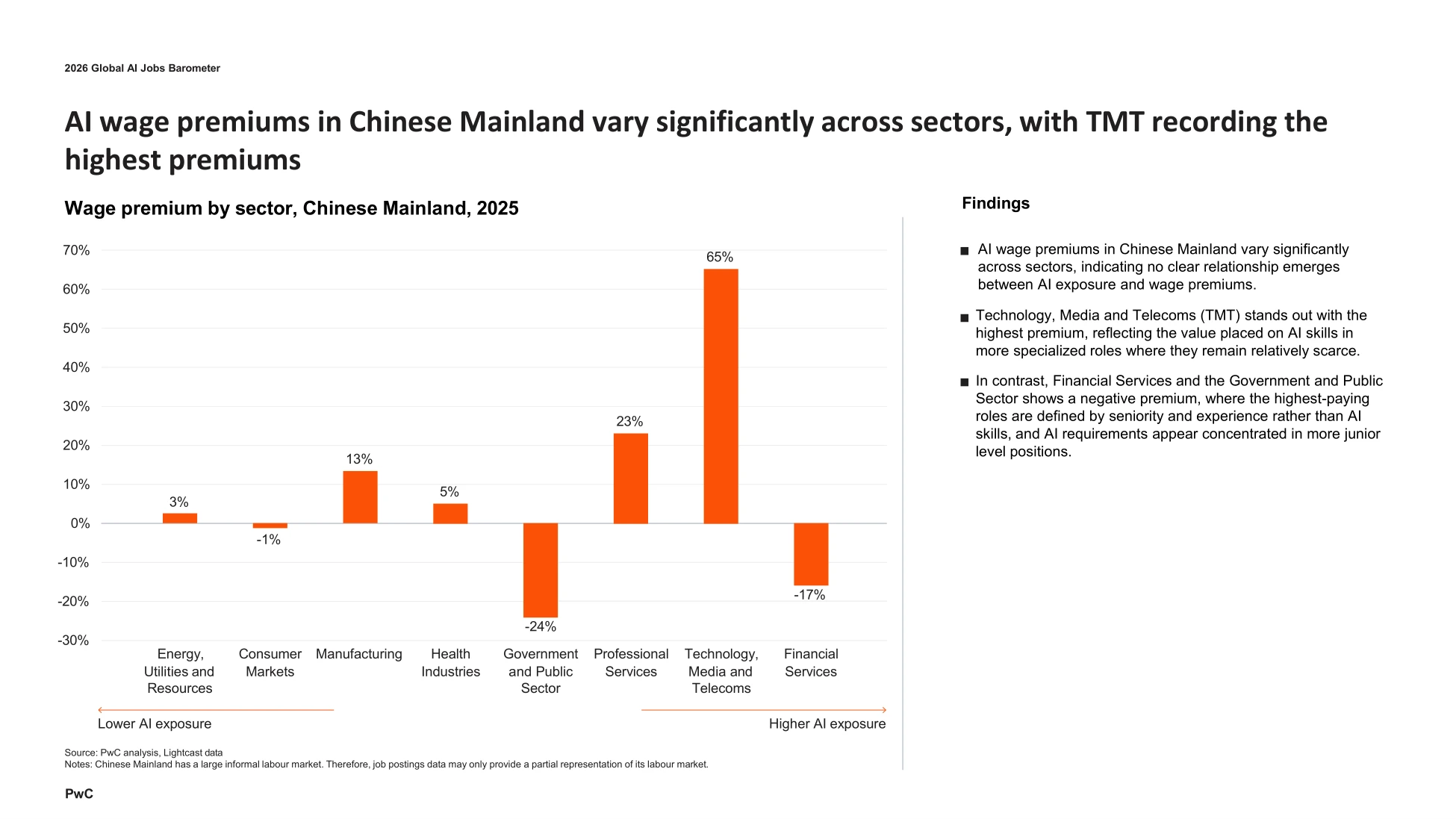
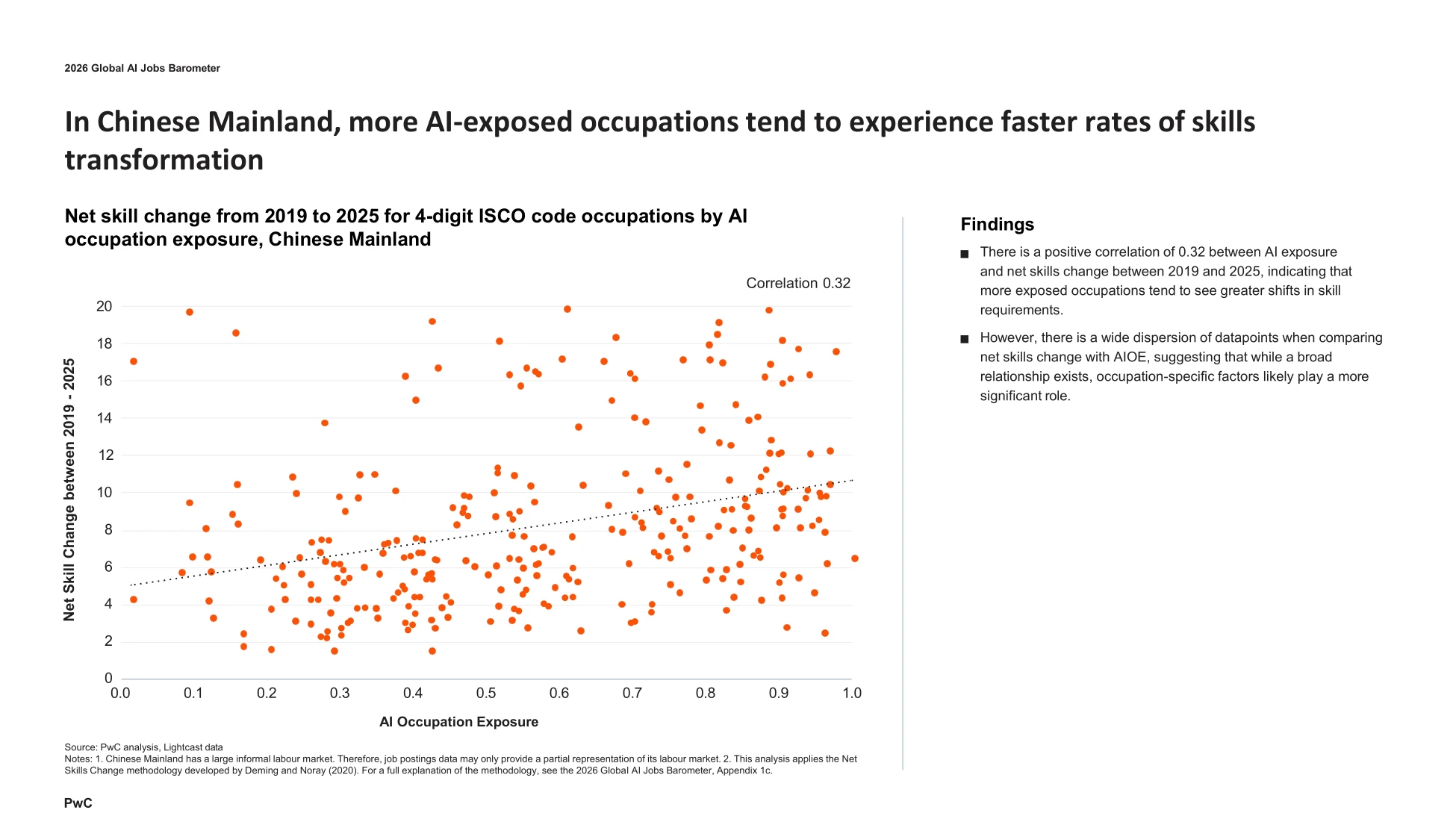
Chinese Mainland AnalysisTwo Futures for Jobs in an AI era2026 Global AI Jobs Barometer2026 Global AI Jobs BarometerEuropeBelgium Denmark France Germany IrelandItaly NetherlandsNorway Poland Spain Sweden SwitzerlandUKAsiaChinese Mainland Hong Kong SAR IndiaJapan Malaysia SingaporeUAEThe AmericasBrazil CanadaMexicoUSThe 2026 AI Jobs Barometer examines over one billion job ads from 6 continents to reveal how AI is affecting jobs, skills, wages, and labour productivityAustralasia Australia New ZealandPwCAfricaSouth Africa2026 Global AI Jobs Barometer40%35% 42%Productivity growth is 40% higher at most vs least AI exposed companies.52% 2.5xThe most AI exposed companies see faster headcount growth than the least AI exposed (52%vs 36%) and higher wage growth (24% vs 17%).The most AI exposed jobs are adding tasks that rely on human-intensive skills like empathy, judgment and creativity 2.5x faster - than the least AI exposed roles.AI-exposed ‘seniorised’ entry level roles are thriving with 35% growth since 2019 while other entry level roles declinein number.Professionalised jobs are growing twice as fast as democratised jobs with 42% higher wage growth since 2021.Key findingsAI is driving productivity, accelerating skills change and starting to create a redesign of entry level workAI is strongly linked to significantproductivity gainsSince 2022 when AI use soared, companies in the sectors most exposed to AI have tripled their lead in workforce productivity growth over the least AI-exposed companies.Companies achieving the biggest productivity gains are boosting wages and headcountRather than replacing jobs at scale, leading organisations are using AI to amplify human performance and create value.Harnessing AI is accelerating skills transformationSkills required for the most AI exposed jobs are changing twice as fast as in least exposed roles- a 75% increase over last year’s gap.Redesigned entry level pathwaysAI exposed junior roles are 7x more likely (than the least AI exposed junior roles) to demand traditionally senior skills like leadership and strategic thinking.A two-track labour marketJobs professionalised by AI – where AI does the basicwork leaving more expert tasks for people (22% of advertised jobs) - are thriving while jobs democratised by AI – where AI takes on the complex work (52% of advertised jobs) - fall behind.PwCChinese Mainland Insights2026 Global AI Jobs Barometer2026 Global AI Jobs BarometerFindingsThe number of AI job postings had the boom in 2021 and 2022, while the number fell sharply in 2023, which is primarily driven by a broad pivot in high-AI-demand industries from aggressive expansion to cost optimization and efficiency gains.AI hiring in Chinese Mainland has rebounded slightly in 2025 but remains below its 2021 and 2022 peak levelsTotal number and share of job postings requiring AI related skills, Chinese Mainland, 2018-20253.0%2.0...










































