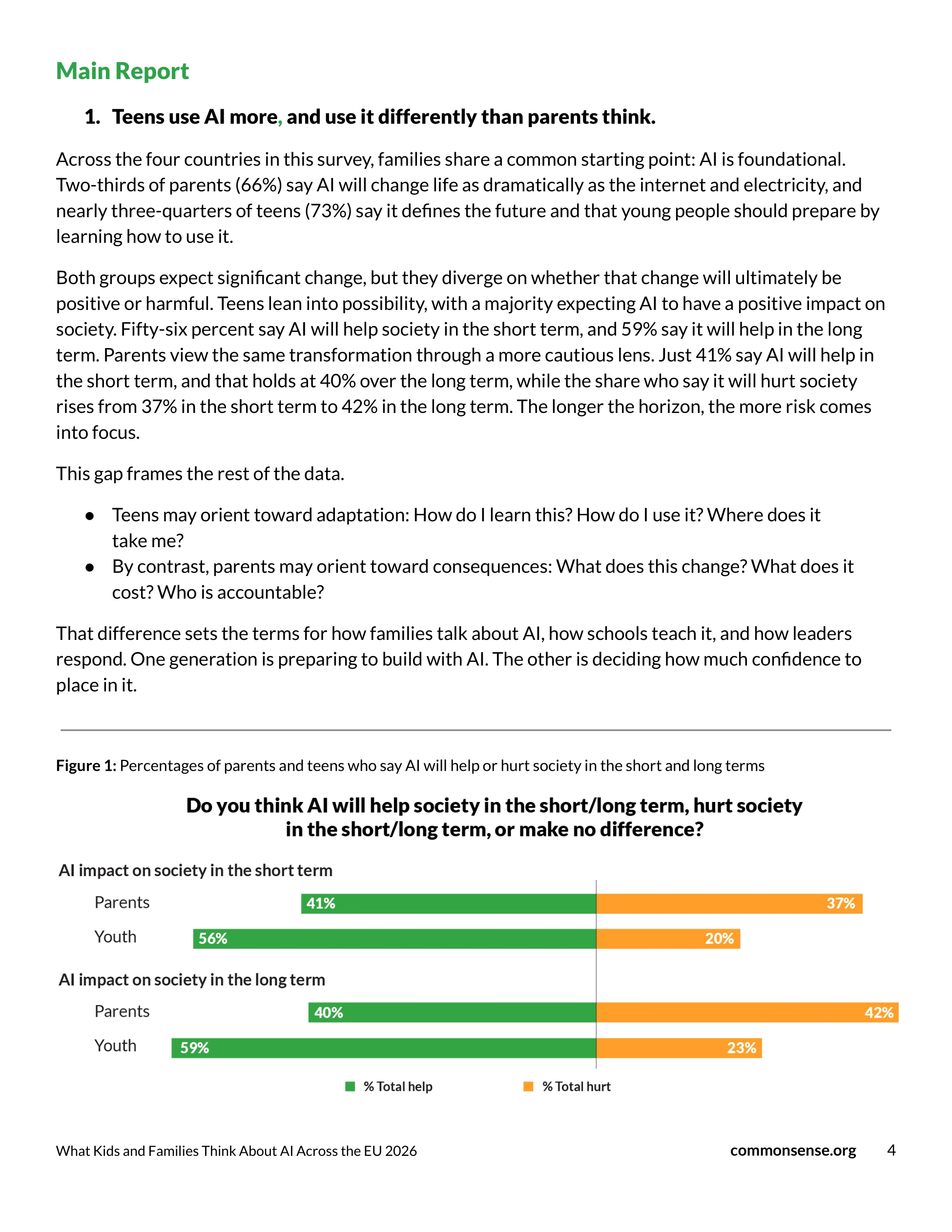
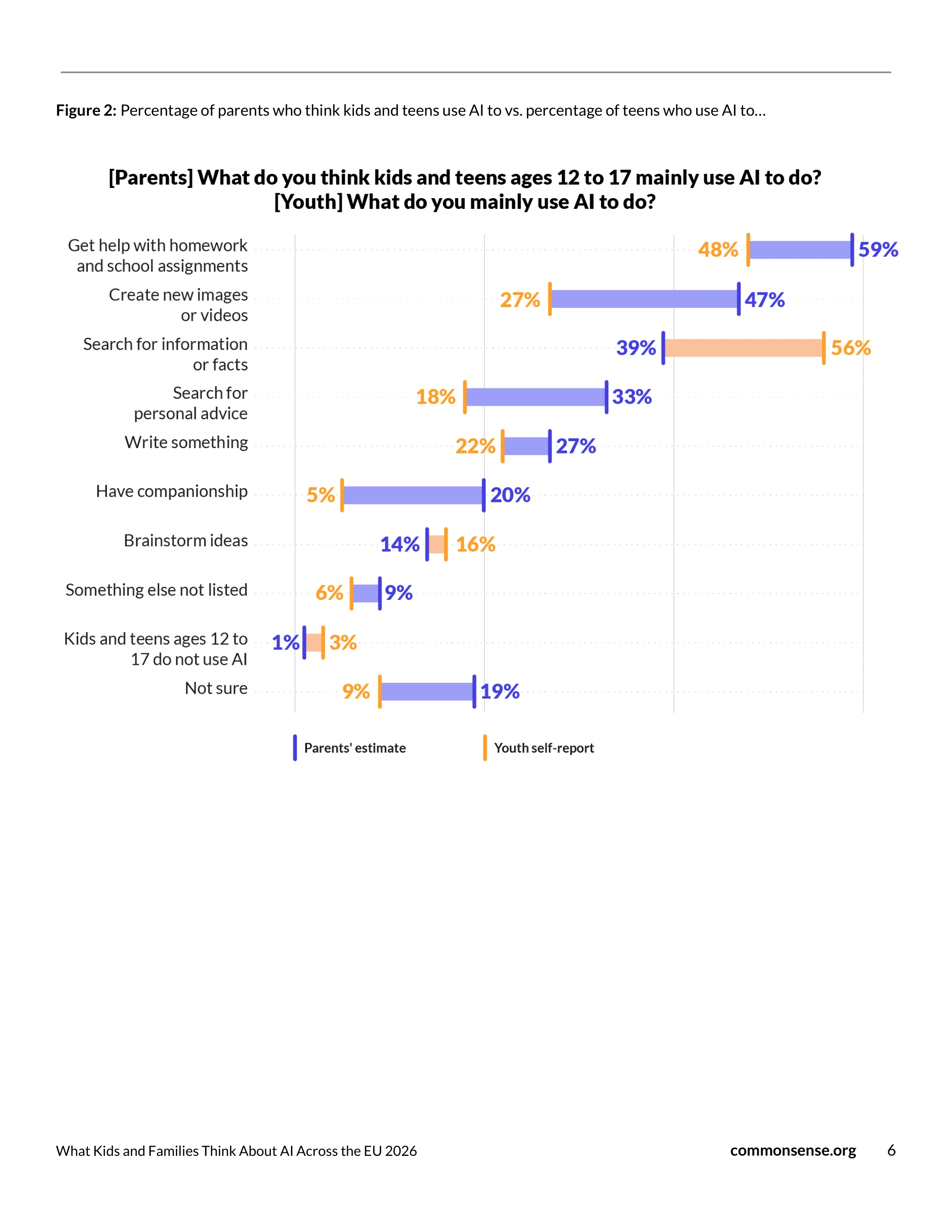
2026 What Kids and Families Think About AI Across the EU Credits Authors: John Della Volpe, Chad Arthur (SocialSphere, Inc.) Michael Robb, Laura Zimmermann, Supreet Mann (Common Sense Media) Designers: Mina Cheong, Chris Arth, Megan Pettley Copy Editor: Christopher Dare Communications and Marketing: Christian Medina Beltz, Kirsten Cahill, Lisa Cohen, Edda Collins Coleman, Erika Radhansson, Brian Ray, and Owen Stidman Suggested citation: Della Volpe, J., Arthur, C., Zimmermann, L., Mann, S., & Robb, M. B. (2026). What kids and families think about AI across the EU. Common Sense Media. Letter from Our Founder AI has gone from novelty to ubiquity in what feels like the blink of an eye. From our kids' classrooms to the phones in their pockets, no technology rivals its reach. Make no mistake: The world our kids grow into will be one built by AI. Families, naturally, have questions about this, and we wanted to hear from them. Earlier this year, we asked American teens and parents how they feel about AI. But AI knows no borders. That's why this time, we brought the same survey across the Atlantic. Families across Spain, the Netherlands, Denmark, and Poland unsurprisingly agree that AI will transform life as we know it, but while they're aligned on the "what," they differ on the "how." Our survey found that in Europe, families' views on AI track more with national context than by shared patterns across the continent. Alongside these national divides are generational divides, with parents less optimistic than their kids about whether AI will improve society. Overall, the research reflects a reality where parents are struggling to make use of a technology they're still learning to understand. It's no surprise, then, that families across nations and generations can find common ground on the need for AI safety. Families are calling out for strong action from policymakers to ensure the technology reshaping our kids' future is safe for them to use. Across the globe, childhood is being transformed by AI. That much is settled. What remains open is whether we can summon the courage to steer that transformation toward something deserving of the trust our children have placed in us. Jim Steyer Founder and CEO Introduction Artificial intelligence is no longer a question of the future for European families. It is already part of daily life, shaping how young people learn, how they complete their work, and how they imagine what comes next. Across Denmark, the Netherlands, Poland, and Spain, parents and teens begin from a shared understanding: This technology is not incremental. Two-thirds of parents say AI will change life as profoundly as the internet, and nearly three-quarters of teens see it as central to their future. But agreement on scale quickly gives way to disagreement on meaning. For teens, AI is something to use. For parent...