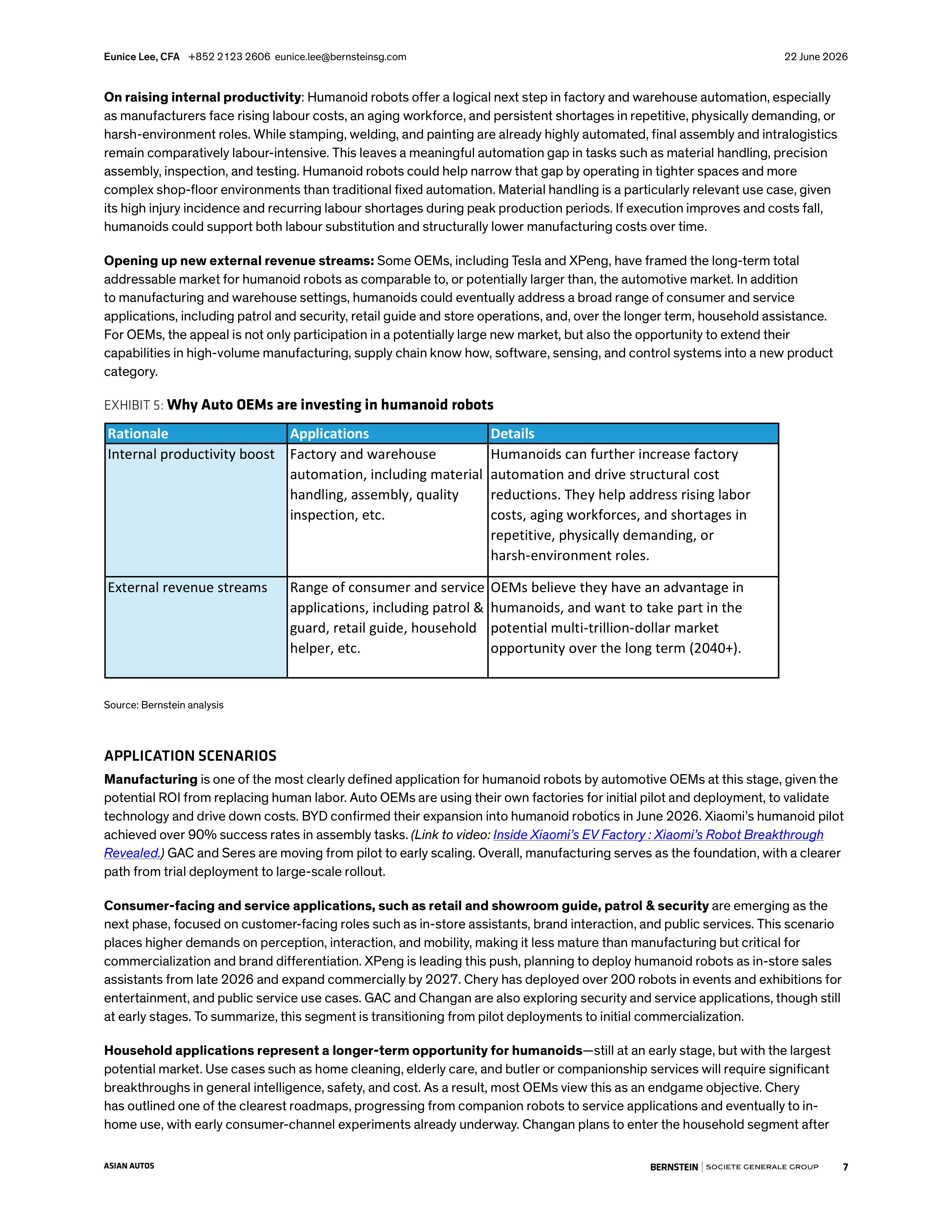
22 June 2026Asian AutosChinese Autos: Why Automakers are entering HumanoidRobotics — and their competitive edgeEunice Lee, CFA+852 2123 2606eunice.lee@bernsteinsg.comJay Huang, Ph.D.+852 2123 2631jay.huang@bernsteinsg.comDien Wang, Ph.D.+852 2123 2622dien.wang@bernsteinsg.comEthan Xu+852 2123 2634ethan.xu@bernsteinsg.comWeibin Liang, Ph.D.+852 2123 2666weibin.liang@bernsteinsg.comFrom Tesla and Hyundai, to XPeng and Xiaomi, an increasing number of automotive OEMsare entering the humanoid robotics space. In this report, we explore the strategic rationale,assess their competitive advantages, and highlight key investment implications.Auto OEMs’ push into humanoid robotics is recent but accelerating. Auto OEMsbegan moving into humanoid robotics from 2020. Hyundai announced its acquisition of80% stake in Boston Dynamics in Dec 2020. Tesla then unveiled its “Tesla Bot” conceptin August 2021. Since then, a growing number of Chinese OEMs have entered the fieldthrough: in-house development (e.g. XPeng and Xiaomi), subsidiary stakes (e.g. BYD’sinvestments in PaXini and Zhiyuan), and strategic partnerships (e.g. Geely with UBTech). Atthe 2026 Beijing Auto Show, multiple OEMs (e.g. XPeng, Chery, BYD, etc.) showcased theirhumanoids, highlighting growing momentum in their broader tech strategies.OEMs are entering humanoid robotics to boost productivity and unlock new revenuestreams. Humanoids can further increase factory automation and drive structural costreductions amid rising labor costs and workforce constraints. Applications may expand toconsumer and service use cases (e.g., security, retail, home assistance), with some OEMs(e.g., Tesla, XPeng) viewing the TAM as comparable to or larger than autos over time.Automakers have several advantages across hardware, software, and scale. There issignificant overlap between vehicle and humanoid components—motors, reducers, sensors—as well as manufacturing. On the software side, there is partial overlap across roboticsand autonomous driving in the development of VLA models and world models. With factoryautomation likely the first deployment wave, OEMs can pilot humanoids in-house, iteraterapidly, and scale deployments, accelerating learning while driving down unit costs. Strongbalance sheets and R&D budgets further support long development cycles and talentattraction, positioning OEMs competitively in humanoid robotics.Investment implications. Investors can gain exposure to humanoids 1) via OEMs orintegrators through dedicated players (e.g. UBTech, Unitree), automakers, or tech firms.Within Chinese autos, XPeng (Market-Perform) and Xiaomi (Outperform) stand out.XPeng’s humanoid features a highly human-like design and explicitly targets consumer andhousehold uses, potentially enabling higher margins if the company successfully addressesemotional companionship. XPeng’s leadership in autonomous driving and broader physicalAI reinforces its credentials in this space. We ma...










































